
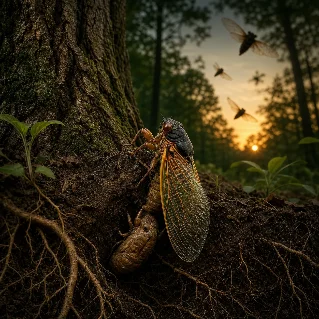
Listening practice: The insects that wait seventeen yearsFirst listen1×2:33Chinese explanation and vocabulary4:37Second listen0:007:120:00hostImagine spending almost your whole life in the dark, beneath a tree, and then appearing with millions of neighbors on almost the same evening. That is the strange rhythm of periodical cicadas in eastern North America. The University of Connecticut explains that the genus Magicicada contains seven species. Four follow a thirteen-year cycle, and three follow a seventeen-year cycle. These numbers describe the years spent underground, not the short life of the flying adult. Today we will follow a cicada from a tiny nymph in the soil to a noisy adult in the trees, and we will ask a question scientists still cannot answer completely: how does it keep track of the seasons for so long?0:39hostAfter cicada eggs hatch in a tree, the young nymphs fall to the ground and dig into the soil. There they pass through five stages of growth. They drink plant fluids from roots, slowly becoming larger while remaining almost invisible above ground. The National Park Service describes this underground period as about seventeen years for Brood X, one of the well-known seventeen-year groups. When the final spring arrives, local conditions matter. The University of Connecticut reports that emergence often begins when the soil seven or eight inches below the surface reaches about sixty-four degrees Fahrenheit, or eighteen degrees Celsius. Warm soil is the signal to leave.1:18hostThe nymphs usually come out after sunset. They climb tree trunks, weeds, or other upright surfaces, and then shed their old skin one last time. Their pale new bodies harden and darken as they become adults. The adults feed on plant fluids, but their main task is reproduction. Males produce species-specific calls that gather into loud choruses. Females choose mates and later cut small openings in living branches to lay eggs. The National Park Service says that the eggs hatch after roughly six weeks. The new nymphs drop to the ground, disappear into the soil, and begin the cycle again.1:54hostThe most interesting part is still uncertain. The University of Connecticut says periodical cicadas can follow seasonal cycles underground, but the exact mechanism is unknown. They may respond to changes in roots, soil, and temperature, yet researchers do not have a complete explanation for how a whole group emerges on schedule. Soil temperature helps set the moment of emergence in a local place. It does not fully explain the long underground calendar. A periodical cicada is therefore both a familiar insect and a scientific question: how can an animal spend thirteen or seventeen years out of sight, then arrive at the surface when the season is right?2:33coach先抓主线:周期蝉的大部分生命在地下度过。北美有些周期蝉会在地下生活十三年,有些生活十七年;成虫只在地面活动大约一个月。第一段介绍它们的生命周期,第二段讲若虫怎样在土里成长以及出土信号,第三段讲蜕皮、鸣叫、交配和产卵,最后一段提醒我们,科学家仍不知道它们怎样准确跟踪这么长的季节周期。3:07coach词汇提示:periodical cicada 是周期蝉;nymph 是若虫,也就是还没有长成成虫的阶段;underground 是地下的;emergence 是出土或出现;root 是根;plant fluids 是植物汁液。听到 thirteen-year cycle 和 seventeen-year cycle 时,要理解为十三年或十七年的生命周期,不是成虫能活那么久。3:35coach这里有一个重要条件:soil temperature reaches about sixty-four degrees Fahrenheit。意思是,地下大约七到八英寸处的土壤温度达到约六十四华氏度,也就是约十八摄氏度时,若虫更可能出土。长句 The new nymphs drop to the ground, disappear into the soil, and begin the cycle again,主干是 nymphs drop, disappear, and begin,意思是新若虫落到地面、钻入土里,再次开始周期。4:12coach最后注意科学上的未知点:周期蝉能够跟踪季节变化,但它们究竟怎样知道第十三年或第十七年到来,机制还没有完全解释。species-specific calls 是每个物种特有的鸣叫;chorus 是许多雄蝉一起鸣叫形成的合唱。带着这些词,再听一遍英文原文。4:37hostImagine spending almost your whole life in the dark, beneath a tree, and then appearing with millions of neighbors on almost the same evening. That is the strange rhythm of periodical cicadas in eastern North America. The University of Connecticut explains that the genus Magicicada contains seven species. Four follow a thirteen-year cycle, and three follow a seventeen-year cycle. These numbers describe the years spent underground, not the short life of the flying adult. Today we will follow a cicada from a tiny nymph in the soil to a noisy adult in the trees, and we will ask a question scientists still cannot answer completely: how does it keep track of the seasons for so long?5:17hostAfter cicada eggs hatch in a tree, the young nymphs fall to the ground and dig into the soil. There they pass through five stages of growth. They drink plant fluids from roots, slowly becoming larger while remaining almost invisible above ground. The National Park Service describes this underground period as about seventeen years for Brood X, one of the well-known seventeen-year groups. When the final spring arrives, local conditions matter. The University of Connecticut reports that emergence often begins when the soil seven or eight inches below the surface reaches about sixty-four degrees Fahrenheit, or eighteen degrees Celsius. Warm soil is the signal to leave.5:55hostThe nymphs usually come out after sunset. They climb tree trunks, weeds, or other upright surfaces, and then shed their old skin one last time. Their pale new bodies harden and darken as they become adults. The adults feed on plant fluids, but their main task is reproduction. Males produce species-specific calls that gather into loud choruses. Females choose mates and later cut small openings in living branches to lay eggs. The National Park Service says that the eggs hatch after roughly six weeks. The new nymphs drop to the ground, disappear into the soil, and begin the cycle again.6:33hostThe most interesting part is still uncertain. The University of Connecticut says periodical cicadas can follow seasonal cycles underground, but the exact mechanism is unknown. They may respond to changes in roots, soil, and temperature, yet researchers do not have a complete explanation for how a whole group emerges on schedule. Soil temperature helps set the moment of emergence in a local place. It does not fully explain the long underground calendar. A periodical cicada is therefore both a familiar insect and a scientific question: how can an animal spend thirteen or seventeen years out of sight, then arrive at the surface when the season is right?