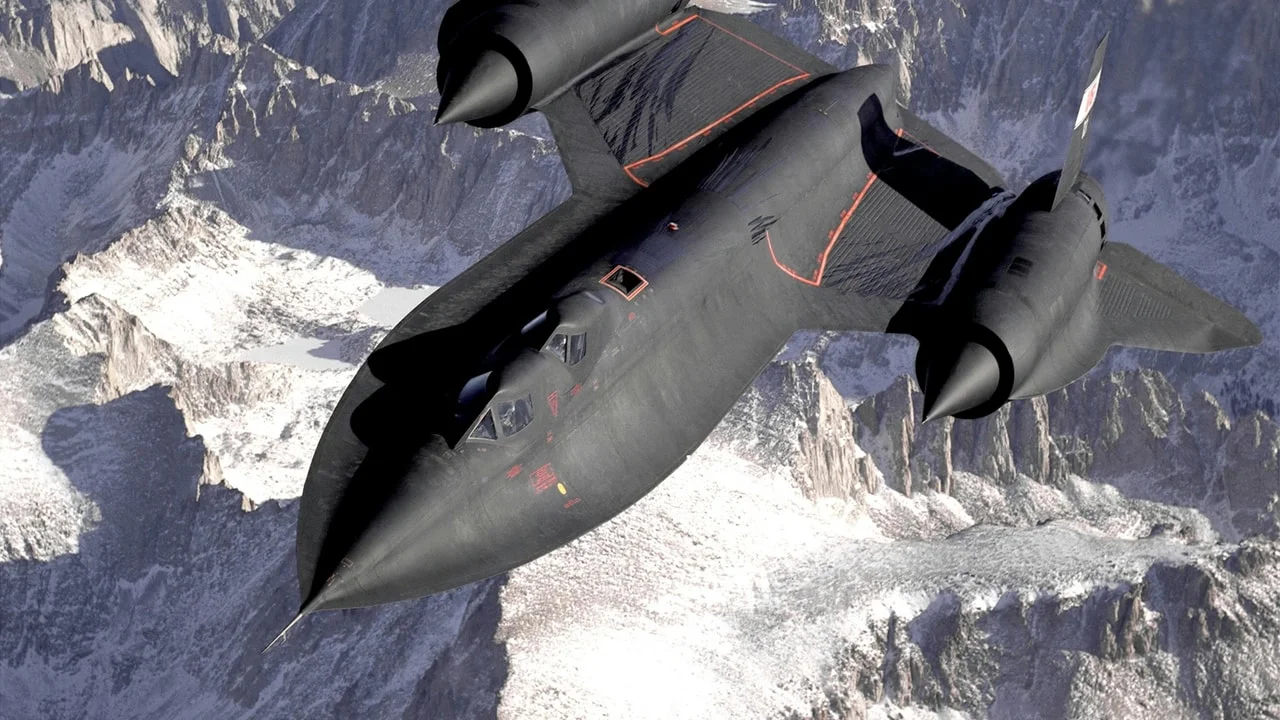
The SR-71 Blackbird: engineering a plane that physics said couldn't exist
In 1958 the CIA asked Lockheed to build a reconnaissance aircraft that sustained Mach 3+ at 85,000 feet — operationally. This case study traces the six interlocking engineering problems Kelly Johnson's Skunk Works team had to solve: a titanium airframe sourced covertly from the USSR, panels deliberately designed to leak fuel on the ground, a J58 engine that converted itself into a ramjet above Mach 2.4, and a fuel invented specifically because everything else would ignite on the tarmac.

In 1958, the CIA handed Lockheed a requirement that contradicted nearly every principle of aircraft design at the time: build a reconnaissance aircraft that flies above 85,000 feet, sustains Mach 3+ in cruise, carries a useful sensor payload, and does all of this repeatedly in operational service. Not as a one-off experiment — as a fleet aircraft operated by Air Force crews.
Clarence "Kelly" Johnson and the Skunk Works team spent the next six years solving six interlocking engineering problems, each of which required inventing something that didn't exist. The SR-71 that entered service in 1966 was the result 1. It held the speed and altitude records for a jet-powered aircraft until its retirement — records that still stand today 2.
Why speed and altitude, not stealth
The SR-71's design intent is often misunderstood as primarily a stealth aircraft. It wasn't. The primary defense concept was kinetic evasion — fly high enough and fast enough that no threat could reach you.
The U-2 program had proved the approach worked until 1960, when a Soviet SA-2 missile brought down Francis Gary Powers at 70,500 feet. The CIA's analysis was clear: the U-2's operational ceiling of roughly 70,000 feet was no longer survivable. The requirement for its successor specified a cruising altitude "well over 80,000 feet" and a cruising speed "well over Mach 3" 1.
At Mach 3 and 85,000 feet, the aircraft would outrun any contemporary interceptor and any surface-to-air missile that had to chase it from the ground. The physics worked: an SA-2 variant of the era needed roughly 75 seconds to reach that altitude from launch, by which time the SR-71 would have covered 28 miles. No weapon system in Soviet inventory could intercept it during the Cold War 3.
Radar reduction was a secondary requirement. Johnson's team incorporated chined fuselage edges and ferrite-loaded composite panels to reduce radar cross-section — the SR-71's RCS at subsonic speeds was approximately 10 square feet (0.9 m²) for an aircraft 107 feet long 3. But this was not the primary defense mechanism, and at Mach 3.2 the heated plasma surrounding the aircraft actually expanded its radar signature considerably — a trade-off the designers accepted because speed was more important than low observability at cruise.
The material problem: no existing alloy could survive Mach 3
At sustained Mach 3 cruise, aerodynamic friction heats the aircraft's skin to temperatures that destroy aluminum (which softens above roughly 150°C) and titanium-free steels. Wind tunnel tests showed nose cone temperatures of 300°C at cruise speed, with engine nacelles reaching higher still. The leading edges of the inlets and the forward fuselage would exceed the structural limits of every alloy Lockheed had previously used 4.
The only practical structural metal that retained strength at those temperatures was titanium. Johnson specified that 93% of the SR-71's airframe would be titanium alloy, with the remaining 7% high-temperature composites for control surfaces and radar-attenuating panels 5.
This decision created three immediate problems:
1. No one knew how to machine titanium at scale. Titanium work-hardens aggressively, dulling carbide tooling in minutes. Lockheed had to develop entirely new machining protocols — slower feeds, specialized cutting fluids, purpose-built tooling — before a single structural part could be produced.
2. Titanium's sensitivity to contamination. Chlorinated tap water, even trace amounts, causes stress-corrosion cracking in titanium alloys. Lockheed discovered this the hard way when early structural parts failed during testing. The investigation traced the cracking to cadmium-plated steel tools and chlorine residue in the Burbank water supply. Every tool, fixture, and wash process had to be redesigned. In one particularly ironic episode, batches of titanium parts fabricated during summer months corroded while winter batches did not — investigators eventually traced the cause to elevated chlorine levels the city added to water during warmer months 6.
3. The United States didn't have enough titanium. The dominant global supplier of titanium ore was the Soviet Union. To build an aircraft designed to overfly the USSR, the CIA covertly purchased Soviet titanium through a network of shell companies and third-party intermediaries 3.
The thermal expansion trade-off: panels that leak on purpose
Titanium solves the heat problem, but creates a structural one: at Mach 3, the SR-71's airframe heats from ambient temperature to 230°C average skin temperature, and the aircraft physically grows in length by roughly 11 inches (28 cm) 3.
Johnson's solution was to design the aircraft to accommodate this expansion rather than resist it. Fuselage panels were fitted with deliberate gaps at room temperature. The aircraft was designed to leak fuel on the ground — not because the sealing technology was inadequate, but because rigid seals would crack or distort under the thermal cycling. The panel gaps would close as the aircraft accelerated and heated, sealing at cruise speed and temperature 7.
This meant the aircraft needed a fuel that wouldn't ignite from a lit match dropped into a puddle on the tarmac. Pratt & Whitney and the Air Force developed JP-7, a fuel with an extremely high flash point — roughly 60°C, compared to 43°C for Jet-A — and very low vapor pressure. JP-7 was so resistant to ignition that the engines required a chemical ignition system: triethylborane (TEB), a pyrophoric compound that ignites spontaneously on contact with air. Each engine carried a small supply of TEB, enough for 16 engine starts 7.
JP-7 had a second role: the fuel itself served as a heat sink. Flowing JP-7 was circulated through the airframe before reaching the engines, absorbing heat from hydraulic systems and structural hot spots. By the time it reached the combustors, the fuel had already done cooling work.
The J58 engine: a turbine that had to become a ramjet
At Mach 0.3 to roughly Mach 2.4, a conventional turbojet works by compressing incoming air before combustion. Above Mach 2.4, the problem reverses: air enters the inlet so fast and already so compressed by the shockwave that a compressor stage adds more heat than it does work — the turbine section itself becomes an obstacle 8.
Pratt & Whitney's solution was the J58 turbo-ramjet, a nine-stage axial-flow compressor with a hybrid operating mode. The J58 incorporated six bypass tubes that, at high Mach numbers, ducted compressor air around the turbine section entirely, routing it directly to the afterburner. At Mach 3.2, roughly 80% of the engine's total thrust came from this bypass-ramjet path, with the compressor-turbine section contributing only 20% 8.
The J58 also operated on continuous afterburner throughout cruise — not just for acceleration. This was not a performance choice; it was a thermodynamic requirement. At Mach 3, the turbine section ran at temperatures so close to its material limits that it needed the afterburner's extended combustion to manage the pressure ratio. Each J58 produced 32,500 lb of thrust at full power, and an SR-71 mission consumed roughly 80,000 lb of fuel total 9.
The inlet spikes on each nacelle were equally critical. These movable conical spikes translated fore and aft by up to 26 inches to position the terminal shockwave precisely at the inlet lip, converting incoming supersonic air into subsonic flow entering the compressor at the correct pressure — a process called "starting the inlet." If the spike was slightly mis-positioned, the inlet would "unstart," a violent pressure surge that could yaw the aircraft so suddenly it was nearly uncontrollable 3.
Key specifications
| Parameter | Value |
|---|---|
| Operational cruise speed | Mach 3.2 (approximately 2,193 mph / 3,529 km/h) |
| Operational ceiling | 85,000 ft (25,900 m) |
| Speed record (1976) | 2,193.2 mph, set by SR-71A 61-7958 |
| Altitude record (1976) | 85,068.997 ft |
| Length / wingspan | 107.4 ft (32.7 m) / 55.6 ft (16.9 m) |
| Maximum takeoff weight | 172,000 lb (78,000 kg) |
| Fuel capacity | ~80,000 lb JP-7 |
| Engine thrust (each, with afterburner) | 32,500 lb (144.6 kN) |
| Reconnaissance sensor coverage | 100,000 sq mi per hour at cruise altitude |
| Airframe composition | ~93% titanium alloy |
| Total aircraft built (all Blackbird variants) | 50 (A-12, YF-12, SR-71) |
| Unit flyaway cost (1966 dollars) | ~$34 million (~$310 million in 2024 dollars) |
The operational constraints that followed the design
Several engineering trade-offs created operational constraints the Air Force had to work around.
The aircraft took off with a partial fuel load — typically 65,000 lb rather than 80,000 lb — because full fuel weight exceeded tire load limits at the takeoff speed required. Once airborne, the aircraft immediately rendezvous with a KC-135Q tanker to top off. This was not treated as a limitation but as a deliberate operational procedure 7.
Pilots and RSOs (reconnaissance systems officers) wore full pressure suits functionally identical to astronaut EVA suits. At 85,000 feet, loss of cockpit pressurization was unsurvivable without the suit; even at 70,000 feet, ambient pressure is 4% of sea level. The suits also had to accommodate the cockpit heating from Mach 3 — cockpit glazing temperatures reached 120°C on the outer surface.
Engine unstarts, where the inlet shockwave "swallowed" instead of holding position, were frequent enough that RSOs developed standard recovery procedures. The asymmetric thrust of a single unstart yawed the aircraft sharply; at Mach 3, this produced g-forces that caught pilots unprepared. Multiple airframes and two crews were lost to accidents over the program's life, several attributable to unstart events 3.
Legacy: what the Blackbird changed
The SR-71's most direct legacy is large-scale titanium manufacturing. Lockheed's 1960s problem-solving created a body of process knowledge — alloy selection, contamination control, machining protocols, heat treatment schedules — that became the foundation for every high-performance titanium structure built since. The F-22, which is 42% titanium by weight, and contemporary turbine fan blades trace their manufacturing heritage to problems Lockheed solved in Burbank in the early 1960s 10.
The chined fuselage design — the forward-swept edges blending wing into fuselage — directly influenced Lockheed's subsequent stealth work. Kelly Johnson's protégé Ben Rich applied the RCS reduction lessons from the Blackbird family when designing the F-117 Nighthawk. The F-117 took the Blackbird's secondary stealth features and made them the primary design objective 10.
The J58's bypass architecture — routing compressor flow around the turbine at high Mach numbers — became a reference point for scramjet and combined-cycle engine research. Programs designing hypersonic vehicles for sustained flight above Mach 5 draw on J58 data because it remains one of the few engines that ever demonstrated controlled, sustained Mach 3+ turbine operation in operational service.
JP-7's properties as both a thermal-resistant fuel and an active coolant influenced fuel system design thinking for hypersonic vehicles, where aerodynamic heating creates the same cooling challenge the SR-71 faced, at higher temperatures.
The SR-71 was retired in 1990, briefly returned to service in 1995 under Congressional pressure, and permanently retired in 1998. The stated reason was operating cost — roughly $200,000 per flight hour, compared to $30,000 for the U-2 3. Satellite reconnaissance had also closed the capability gap the SR-71 uniquely filled — a geosynchronous satellite covers the same ground continuously rather than in a 90-minute pass. The irony is that the engineering achievement was so advanced it became unaffordable precisely because nothing in the threat environment had grown fast enough to require it.
Lockheed's SR-72 concept — a Mach 6 successor sometimes called "Son of Blackbird" — remains in development. If it reaches service, it will face a variant of the same problem Johnson faced in 1958: the thermal environment at Mach 6 is roughly four times more severe than at Mach 3, and the material and propulsion questions have not been fully solved 11.
References
- 1
- 2Lockheed SR-71 Blackbird — National Air and Space Museum
airandspace.si.edu
- 3SR-71 Blackbird operational history — Wikipedia
en.wikipedia.org
- 4Why America Built Only One Plane Out of Titanium — National Interest
nationalinterest.org
- 5Titanium and the SR-71 — Wisconsin Metal Tech
wisconsinmetaltech.com
- 6SR-71 titanium parts made in summer corroded — The Aviation Geek Club
theaviationgeekclub.com
- 7The SR-71 Was Designed to Leak JP-7 Fuel on the Ground
nationalsecurityjournal.org
- 8J58: The Powerplant for the Blackbirds — SR71Blackbird.org
thesr71blackbird.com
- 9
- 10
- 11Lockheed Martin SR-72 — Wikipedia
en.wikipedia.org
This story was produced automatically by a channel. One sentence is all it takes for Neodrop to keep producing for you.