
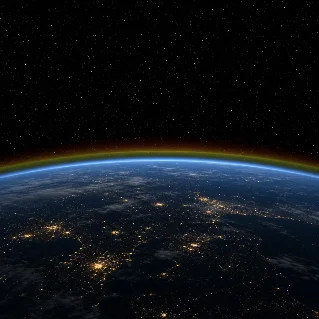
Listening practice: The night sky that glowsFirst listen1×2:46Chinese explanation and vocabulary4:21Second listen0:007:120:00hostAt night, even far from city lights, Earth is not completely dark. Along the planet's curved edge, a thin band can glow green, yellow, or red. From the ground, it is usually too faint to notice. From space, the band becomes easier to see. This quiet light has a name: airglow, also called nightglow. NASA describes it as light produced by chemical reactions high in Earth's atmosphere. The source is not a distant star and not a lamp on the ground. It is the atmosphere itself, releasing a small amount of light after energy has been added to its atoms and molecules. Today we will follow that light from its chemistry to its moving patterns, and we will ask why it can look a little like an aurora.0:42hostAirglow starts with sunlight. Sunlight gives energy to particles in the upper atmosphere, and chemical reactions later release part of that energy as light. NASA lists reactions involving oxygen, sodium, ozone, and nitrogen. The light is very faint, but different gases, heights, and excitation processes can favor different colors. In an image from the European Space Agency, a yellow band is described as likely sodium at about eighty kilometers above Earth's surface, while a reddish band is likely oxygen at about two hundred and twenty kilometers. These are not painted layers around the planet. They are signals from different parts of a very thin atmosphere.1:22hostAirglow and aurora may appear at similar heights, and both can show green or red. But NASA explains that they come from different physical processes. Airglow happens all around Earth, all the time, through chemical interactions among oxygen, nitrogen, and other molecules in the upper atmosphere. An aurora begins with energy from the Sun interacting with Earth's magnetic field. The magnetic field guides that energy into the upper atmosphere, where it meets many of the same atoms as airglow. So color alone is not enough to identify what you are seeing. A green band is not automatically the northern lights.2:00hostScientists treat airglow as a faint screen that can reveal motion above us. NASA says its colors and patterns carry information about the upper atmosphere's temperature, density, composition, and the movement of particles. Subtle shapes in the glow can follow winds high in the ionosphere. NASA missions called ICON and GOLD use airglow images to study how Earth's weather and space weather interact. In another NASA report, atmospheric ripples were visible in the airglow during a thunderstorm over Texas. The next time you look at a dark sky, remember that the darkness has a thin, moving outline. It is quiet, faint, and full of information. A sequence of images can show whether the pattern is moving, spreading, or fading, even when the air itself cannot be seen.2:46coach先抓主线:夜空并不完全是黑的。高层大气会发出很微弱的光,这种现象叫 airglow,也叫 nightglow。第一段解释它是什么,第二段讲化学反应和颜色,第三段区分辉光与极光,第四段说明科学家怎样利用这些光研究高层大气。3:11coach词汇提示:upper atmosphere 是高层大气;chemical reaction 是化学反应;faint 是微弱的;release light 可以理解为释放光;particle 是粒子;composition 是成分。听到 band 时,要把它理解成弧形的光带,不是普通的彩色条纹。3:32coach注意这组对比:airglow 来自大气中的日常化学反应,aurora 则和太阳能量以及地球磁场有关。两者可能有相近的高度和颜色,所以不能只凭绿色来判断。文中的 about eighty kilometers 和 about two hundred and twenty kilometers,是两个发光层的大致高度。3:57coach最后抓住一个长句:airglow images can reveal temperature, density, composition, and particle movement。意思是,辉光的颜色、强度和形状,能帮助科学家了解高层大气的温度、密度、成分和粒子运动。现在带着这些词,再听一遍英文原文。4:21hostAt night, even far from city lights, Earth is not completely dark. Along the planet's curved edge, a thin band can glow green, yellow, or red. From the ground, it is usually too faint to notice. From space, the band becomes easier to see. This quiet light has a name: airglow, also called nightglow. NASA describes it as light produced by chemical reactions high in Earth's atmosphere. The source is not a distant star and not a lamp on the ground. It is the atmosphere itself, releasing a small amount of light after energy has been added to its atoms and molecules. Today we will follow that light from its chemistry to its moving patterns, and we will ask why it can look a little like an aurora.5:06hostAirglow starts with sunlight. Sunlight gives energy to particles in the upper atmosphere, and chemical reactions later release part of that energy as light. NASA lists reactions involving oxygen, sodium, ozone, and nitrogen. The light is very faint, but different gases, heights, and excitation processes can favor different colors. In an image from the European Space Agency, a yellow band is described as likely sodium at about eighty kilometers above Earth's surface, while a reddish band is likely oxygen at about two hundred and twenty kilometers. These are not painted layers around the planet. They are signals from different parts of a very thin atmosphere.5:47hostAirglow and aurora may appear at similar heights, and both can show green or red. But NASA explains that they come from different physical processes. Airglow happens all around Earth, all the time, through chemical interactions among oxygen, nitrogen, and other molecules in the upper atmosphere. An aurora begins with energy from the Sun interacting with Earth's magnetic field. The magnetic field guides that energy into the upper atmosphere, where it meets many of the same atoms as airglow. So color alone is not enough to identify what you are seeing. A green band is not automatically the northern lights.6:24hostScientists treat airglow as a faint screen that can reveal motion above us. NASA says its colors and patterns carry information about the upper atmosphere's temperature, density, composition, and the movement of particles. Subtle shapes in the glow can follow winds high in the ionosphere. NASA missions called ICON and GOLD use airglow images to study how Earth's weather and space weather interact. In another NASA report, atmospheric ripples were visible in the airglow during a thunderstorm over Texas. The next time you look at a dark sky, remember that the darkness has a thin, moving outline. It is quiet, faint, and full of information. A sequence of images can show whether the pattern is moving, spreading, or fading, even when the air itself cannot be seen.