June 23, 2026 · 10:31 AM
The Man Who Stared Back: Velázquez's Portrait of Juan de Pareja
In March 1650, a Spanish court painter sent a man into the Roman Pantheon to deliver his own portrait — and the assembled artists of Europe declared it not art, but truth. That painter was Velázquez. The man was Juan de Pareja, legally his enslaved assistant. The portrait now in Gallery 625 of the Metropolitan Museum of Art traces a 320-year journey from Rome to a Wiltshire country house to a record-breaking Christie's auction in 1970 — the first painting ever sold for more than £1 million. It is also the beginning of a story art history buried for centuries: Pareja went on to become an accomplished painter in his own right.
On the morning of March 19, 1650, a man walked into the Roman Pantheon carrying a painting. He was not a nobleman, not a dealer, not a church official — he was an enslaved Moroccan-Spanish assistant named Juan de Pareja, delivering his master's latest work to the annual exhibition of the Virtuosi del Pantheon, a painters' guild whose members had gathered to hang their offerings in the colonnade beneath the great coffered dome.
The painting he carried was his own face.
What happened next was recorded in Rome, transmitted by word of mouth to Madrid, and committed to paper seventy-four years later by the biographer Antonio Palomino y Velasco: the assembled painters — men from a dozen European nations — stood in front of the portrait and fell silent. When they finally spoke, they said that the other works in the show were art, but this one alone was truth. In the original Spanish, Palomino rendered it with stark precision: las demás pinturas era arte, y ésta sola verdad. 1
The painter was Diego Rodríguez de Silva y Velázquez, court painter to Philip IV of Spain, then fifty years old and at the technical peak of his career. The man in the portrait was his property. In the eyes of seventeenth-century Spanish law, Juan de Pareja — born around 1608 in Antequera, in the province of Málaga, to a Spanish father and an enslaved African-descended mother named Zulema — was a thing that could be bought, sold, bequeathed, or exchanged. 2 That morning in the Pantheon, Velázquez used him as a calling card.
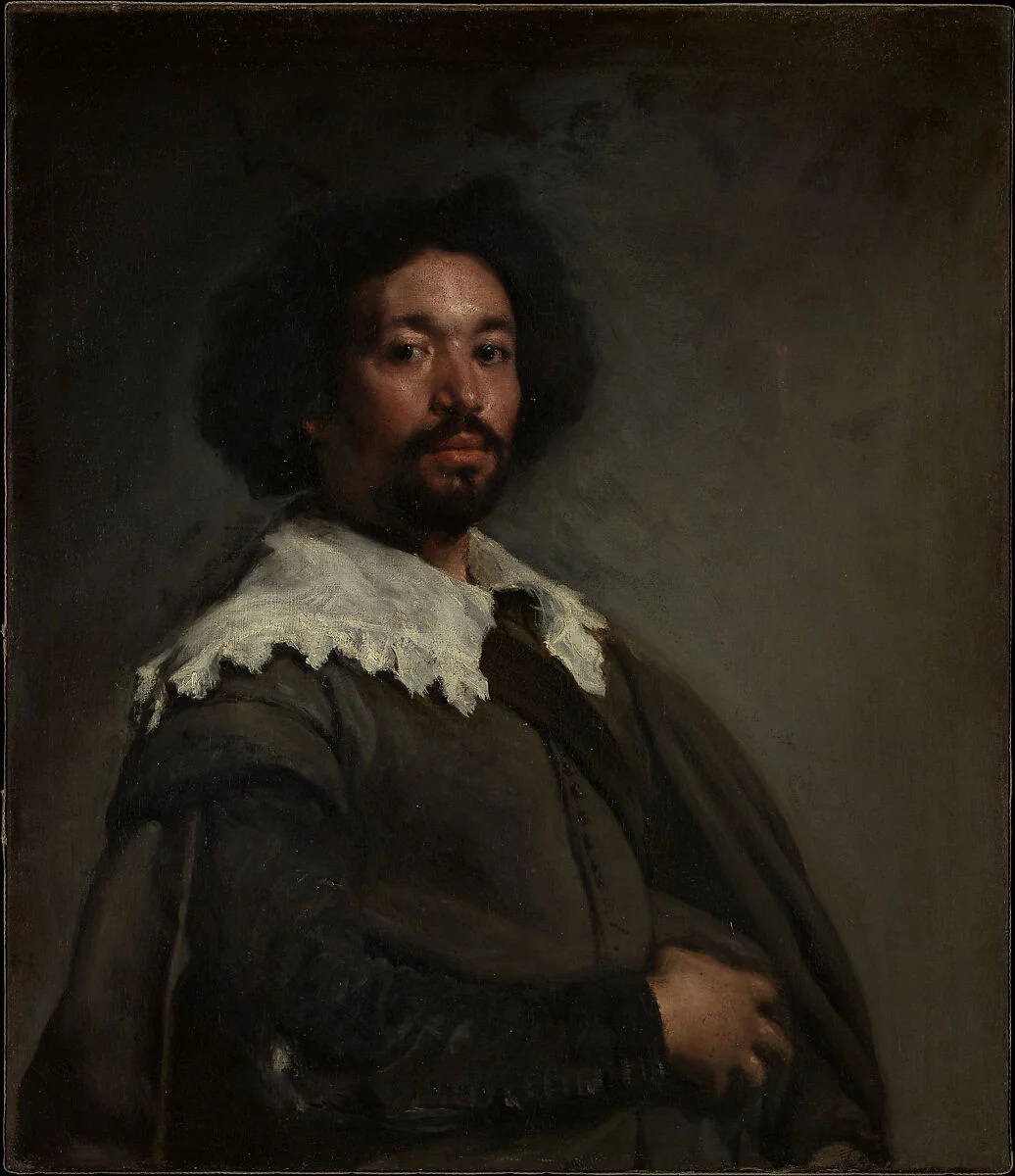
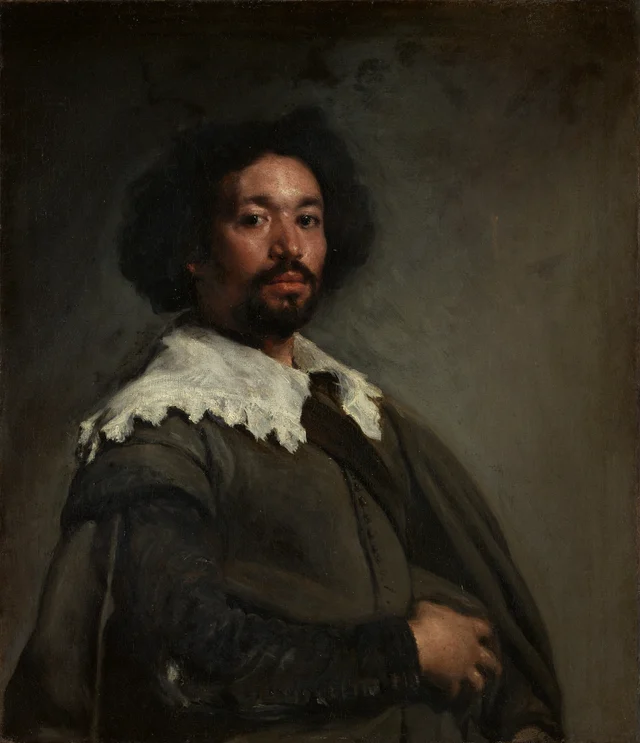
The portrait now hangs in Gallery 625 of the Metropolitan Museum of Art in New York. It has been there since 1971, acquired for a price that broke every record in the history of the art market. To stand in front of it — to meet the gaze coming back from the canvas — is to confront the contradiction directly: a man painted with royal dignity by the man who legally owned him. 3
The second journey to Italy
Velázquez had been to Italy once before, as a young man in 1629. The second journey, beginning in January 1649, was a royal commission of a different kind. Philip IV dispatched his court painter not to study but to shop: to purchase paintings and sculptures for the Alcázar palace in Madrid, a building whose collections were full of Spanish canvases but nearly bare of classical statuary. Velázquez sailed from Málaga, touched Genoa, rode through Milan, visited the Este court at Modena, and lingered in Venice long enough to acquire works by Titian, Tintoretto, and Veronese. He reached Rome in the spring of 1649. 4
Juan de Pareja traveled with him.
Pareja had been part of Velázquez's household since the early 1630s, when he entered the painter's ownership by purchase, inheritance, or gift — the records are silent on the mechanism. For roughly twenty years, he worked in the studio as an assistant: grinding pigments, stretching and priming canvases, preparing varnishes, cleaning brushes. 2 He appears as a witness in Velázquez's legal papers — signing his name to a power of attorney in 1642 and two proxy documents in 1647, the handwriting of a man who could read and write and who inhabited the legal world of contracts and witnesses without being able to claim full standing within it.
In Rome, Velázquez fell into the city's highest artistic circles. He dined and worked alongside Pietro da Cortona, Nicolas Poussin, Claude Lorrain, and Gian Lorenzo Bernini. He was elected to the Accademia di San Luca. He set himself up in the Vatican apartment of Cardinal Camillo Astalli Pamphilj and began angling for the commission he really wanted: the official portrait of Pope Innocent X. 4
But first, he needed practice. Art historian Jennifer Montagu, writing in the Burlington Magazine in 1983, described the Pareja portrait as an exercise in preparation for the papal sitting — a chance to work from a living face under no pressure, to loosen the wrist and calibrate the eye before he confronted a pontiff who would be scrutinizing him across a table. 5 "Italy must have seemed wonderfully lush and colorful," wrote Met curator Everett Fahy in 1971, "after the severe landscape of Castile and the gloomy, etiquette-ridden court of Madrid." 4 The warm light of Rome was loosening something in the painter's hand.
What he painted, and how
The portrait measures 81.3 by 69.9 centimeters — roughly the size of a large bathroom mirror. Pareja stands in three-quarter pose against an atmospheric gray background that lightens toward the upper right, a technique borrowed from Titian, suggesting space without committing to a specific room or landscape. 1
The clothing tells a complicated story. Pareja wears a dark jacket with small buttons at the sleeves, a gray leather vest with hanging sleeves, and a dark cape draped over one shoulder. Across his chest runs a sword belt — an accessory painters did not wear to work. It may have been a studio prop, deliberately added by Velázquez to project an air of military bearing onto a man who held no such rank. The collar is the painting's most technically arresting element: an enormous white lace ruff, several inches deep, rendered in Velázquez's maniera abreviada (abbreviated style) — broad, rapid strokes of lead white over a Venetian gray ground. Up close, the collar is almost abstract, a series of quick calligraphic marks. At a normal viewing distance, it reads as lace. 6
That collar was, in seventeenth-century Spain, technically illegal for someone of Pareja's station. Sumptuary laws prohibited lower-class individuals from wearing such accessories. Whether Velázquez put it on him as a deliberate provocation, as artistic license, or simply because he wanted the compositional contrast of white against dark, is unknowable. But fashion historian Kenna Libes has noted that "aside from the ostentatious collar, his simple clothing and casual hairstyle indicate his position as a working man." 6 The collar, she argues, represents Velázquez's "literal and figurative control over Juan de Pareja and his image" — the painter deciding, in paint, what the enslaved man would look like to the world.
What he cannot have decided is the gaze. The eyes in Velázquez's late portraits are his most technically radical element — rendered, according to X-ray analysis by restorer Hubert von Sonnenburg, in strokes so unified with the background that figure and ground are almost a single field of paint. 4 Each iris was laid in nearly one motion. The double highlight — a bright spot and a dimmer halo around it — gives the eyes their quality of wet presence. Stephanie Archangel, a curator at the Rijksmuseum who contributed to the Met's audio guide for the painting, described the effect in the most direct terms available: "It's a very fierce painting. He's fiercely looking at you. And he has a very piercing look. He's really making his presence be felt." 1
Compare this to the way Velázquez typically depicted Black and African-descended figures in Golden Age Spanish painting — as attendants in the backgrounds of court portraits, their faces turned away or angled toward the center of attention rather than the viewer. The Pareja portrait breaks that convention entirely. He looks forward. He meets you. Met curator David Pullins has put it plainly: "This painting, by contrast, is truly a portrait." 1
The Pantheon and the papal commission
The March 19 exhibition at the Pantheon was an annual event organized by the Virtuosi del Pantheon around the feast of Saint Joseph. Artists hung work in the portico; the event served simultaneously as devotional practice and professional display. Velázquez had recently joined the organization. He sent the portrait — with Pareja as its bearer — ahead of him. 4
According to the Flemish painter Andreas Schmidt, who was present and later told Palomino what he witnessed, the painters who came to look at the Pareja portrait "just stood looking at the portrait in admiration and wonder, not knowing to whom they should speak or who would answer" — unsure, for a disorienting moment, whether the painted face or the living man was the real one. 1
The portrait's success got Velázquez elected a member of the Accademia di San Luca, the prestigious Rome academy whose members included most of the painters he admired. More practically, it landed him the commission he had traveled to Rome to secure: an official portrait of Pope Innocent X. That painting — done in the same year, now in the Doria Pamphilj Gallery in Rome — shows the pope in vivid scarlet, with a searingly penetrating expression that Innocent himself reportedly described as troppo vero (too true), yet hung in his reception rooms nonetheless. Sir Joshua Reynolds called it the finest painting in Rome. Francis Bacon used it as the basis for a celebrated series of screaming pontiffs painted between 1949 and 1971.
The Pareja portrait was the warmup. By the time Velázquez finished it, he was ready for the hardest sitting of his career. 5
Eight months later: the manumission
On November 23, 1650 — eight months after the Pantheon exhibition — Velázquez sat down in a notary's office in Rome and signed a legal document freeing Juan de Pareja.
The document, a Donación de libertad, survived in the Archivio di Stato di Roma for three centuries before historian Jennifer Montagu found it and published it in The Burlington Magazine (vol. 125, 1983). 5 Its language was bluntly commercial even in its generosity: "in view of the good and faithful service the slave has given him and considering that nothing could be more pleasing to the slave than the gift of liberty." Pareja was formally freed — with conditions. He was required to remain in Velázquez's service for four more years, until 1654, and was not permitted to flee or commit crimes in the interim. Full legal freedom came at the end of that contract, not at its signing.
The document demolished the most famous story told about Pareja's emancipation. Antonio Palomino, the same biographer who recorded the Pantheon reaction, had written decades later that Philip IV himself discovered Pareja painting secretly in Velázquez's workshop, was so impressed by the hidden talent of his court painter's enslaved assistant that he commanded Velázquez to free him. Richard Stemp, in a 2024 reassessment, described this story as "manifestly not true." The real document was a notarial act with commercial conditions — dignified, by the standards of the institution of slavery, but far from the royal drama Palomino invented. 5
Pareja himself did not leave Velázquez's orbit after 1654. He stayed on in Madrid, working in the studio. When Velázquez died in 1660, Pareja continued working as an assistant to Juan Bautista del Mazo, Velázquez's son-in-law and artistic heir. Rijksmuseum curator Archangel has offered a pointed counterweight to the easy reading of the portrait as a liberating act: "People always ask this question like, did this painting give him his humanity and therefore did Velázquez free him as a person? And it's almost like, do we think that Velázquez would have only seen his humanity after he painted that painting? He was working with him day and night, he was a talented painter and I bet Velázquez also saw that." 1
Juan de Pareja, painter
What Pareja did in the last decade and a half of his life was effectively erased from art history until the twenty-first century demanded a reckoning.
After gaining his freedom, he built a career as an independent painter in Madrid. His style had nothing in common with Velázquez's cool, abbreviated portraiture. He worked in the mode of the Madrid School — dense, saturated compositions crowded with figures, warm Venetian palette, Baroque dynamism — the most contemporary painting being made in Spain in the 1660s. Met curator David Pullins has noted that "by the time Velázquez dies in 1660, his painting style is super respected, but also really old-fashioned," while Pareja "is really looking at the most contemporary art in Madrid and developing his own language." 7
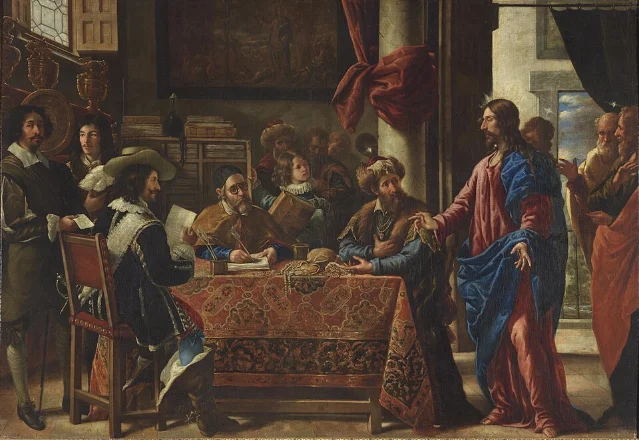
His most important surviving work is The Calling of Saint Matthew, painted in 1661 and now in the Prado, measuring 225 by 325 centimeters — more than ten feet wide. The scene shows Christ calling the tax collector Matthew away from his counting table, surrounded by a dozen contemporary-dressed figures in a richly furnished room. On the far left, standing apart from the Biblical drama, holding a sheet of paper in his right hand and gazing directly at the viewer, is Juan de Pareja himself. This is considered one of the earliest known self-portraits by a Black artist in Western art history. 2 8
In 1667, Pareja completed The Baptism of Christ, now held between the Museo de Huesca and the Prado, at 230 by 356 centimeters. In the rock ledge in the foreground, he carved his signature not in paint but as if in stone — a trompe l'oeil inscription that announced his authorship as a permanent fact of the physical world. 2 Scholars have catalogued approximately fourteen works with secure attribution and eight more as probable — a substantial body for a painter whose documented career spans only about fifteen years of freedom, between 1654 and his death in 1670.
The Harlem Renaissance scholar Arturo Schomburg traveled to Spain in 1926 specifically to look at Pareja's work. He sat in front of The Calling of Saint Matthew in the Prado and wrote afterward that he had journeyed thousands of miles "to look upon the work of this coloured slave who had succeeded by courageous persistence in the face of every discouragement." 9 That pilgrimage was itself nearly erased: Schomburg's notebooks went into an archive; the mainstream art-historical narrative continued to treat Pareja as a footnote in Velázquez's biography rather than an artist with his own story to tell.
320 years adrift: provenance
After the Pantheon exhibition, the portrait passed to Cardinal Troiano Acquaviva d'Aragona, the Spanish-born ecclesiastical diplomat who served as Philip V's representative at the Vatican. The evidence for this is thin — a single reference in a 1765 essay by Francisco Preciado, director of the Spanish Academy in Rome. The Met's 1971 Bulletin noted that Preciado is "the only reference to the portrait's ever being in Acquaviva's collection," and that at least five copies of the painting existed; it is possible the attribution rested on a confusion. Acquaviva died in 1747; what happened to the painting in the intervening century between the Pantheon exhibition and his apparent ownership remains the most significant gap in the provenance record. 4
By the mid-eighteenth century the painting appears in the collection of the Duke of Baranello in Naples, a title associated with the descendants of the Sicilian nobleman Antonio Ruffo — the same collector who had commissioned Rembrandt's Aristotle with a Bust of Homer, now also in the Met. From Naples it moved to Sir William Hamilton, the British ambassador to the Kingdom of Naples from 1764 to 1798, whose Palazzo Sessa inventory described it as "a portrait of a Moorish slave painted by Velázquez." 3 Hamilton was one of the great collector-diplomats of his era, a man who assembled and then sold three successive collections of antiquities; his second collection became the founding gift of the British Museum's Greek and Roman department. When revolutionary France's advances finally forced him out of Naples in 1798, he shipped his paintings — including the Pareja — north aboard HMS Foudroyant, Horatio Nelson's flagship.
In 1801, as Hamilton's finances collapsed under the weight of his extravagances, the portrait appeared at Christie's in London. The lot description read: "Velázquez — Portrait of a Moorish Slave, that was in his service, and became a great Painter." 3 It sold for 39 guineas — roughly the cost of a decent horse — to a buyer whose name the records do not preserve. Then it vanished for a decade.
By 1814, and possibly as early as 1811, it had arrived at Longford Castle in Wiltshire, seat of the Earls of Radnor. The Pleydell-Bouverie family had been methodically building one of the finest private collections in England for three generations. Jacob Pleydell-Bouverie, the 2nd Earl, was the primary architect of the collection; he purchased the Pareja through the London art trade, almost certainly via the dealer William Buchanan, and hung it in his picture gallery alongside Holbein, Poussin, Claude Lorrain, and Van Dyck. There it remained, in the green damask-hung rooms of a Wiltshire country house, for the better part of 156 years. 10
130 seconds in London
In 1968, the 7th Earl of Radnor died. The death duties on his estate were substantial enough that his son and heir, the 8th Earl, had no practical option but to sell the family's greatest painting.
On November 27, 1970, the Portrait of Juan de Pareja came up for sale at Christie's in London. The auctioneer was Patrick Lindsay. The opening bid was £315,000. Art critic Richard Cork, who was in the room, wrote afterward: "The atmosphere was extraordinary. Most observers could not believe that the painting would fetch £1 million. But the bidding, in an auction room that I had never seen so packed and tense, outflew all expectations." 11 The entire competitive portion of the auction lasted 130 seconds. The hammer fell at £2,310,000 — or 2,200,000 guineas, equivalent to approximately $5.54 million at the November 1970 exchange rate. 11
It was the first painting in history to sell at auction for more than £1 million.
The buyer, sitting in the second row, was Alec Wildenstein — thirty years old, vice president of Wildenstein & Company, acting as agent for the Metropolitan Museum of Art in New York. He made no secret of his principals. When the auction ended, he was surrounded by several hundred people for the better part of ten minutes before he could cross the room. He told reporters that the purchase fulfilled a dream of his great-grandfather Nathan Wildenstein, who had considered the Pareja portrait the greatest painting he had ever seen. 11
Wildenstein & Company handled the purchase without charging the museum a fee.
Britain immediately launched a campaign to block the export. The New York Times ran headlines on November 30 ("Britain Mounts Campaign to Save Velazquez Painting") and December 31 ("KEEP VELAZQUEZ, BRITAIN IS URGED; National Gallery Requests a Grant"). The effort failed; no British institution could match the price. 3 The painting left England.
The Observer art critic Nigel Gosling was among those who found the record price not triumphant but obscene. "Never again can this honest, serious record of a friend be looked at simply as a human communication, a work of art," he wrote. "In the future it will bear its price-tag like a scar." 12 The New Yorker took a different view: informed that the Met had paid $5.54 million for a Velázquez, its editorial comment found the news "strangely reassuring" — evidence that no matter what catastrophes beset the city, "the Metropolitan will go right on having the world's costliest works of art." 13
Coming home to the Met — and what the restorers found
Met director Thomas Hoving, who had pushed hard for the purchase, summarized the institutional stakes in the museum's June 1971 Bulletin: "The painting of Juan de Pareja by Velázquez is among the most important acquisitions in the Museum's history. Not a formal portrait but a rare, uncommissioned one, it is a work of genius." 4 The funds came from the Fletcher and Rogers purchase funds, a bequest from Adelaide Milton de Groot, and supplementary gifts from museum donors; accession number 1971.86.
Hubert von Sonnenburg, the Met's chief conservator, undertook the restoration. He found the canvas in a condition unusual for a 320-year-old painting: it had never been relined — never backed with a new layer of canvas to stabilize the original. This is extraordinarily rare for a painting of this age. For Velázquez in particular, whose late technique depended on the coarse texture of the original canvas to register the expressiveness of his brushwork, relining would have been damaging. "The fact that this picture has never been lined is important," von Sonnenburg noted, "since Velázquez, more than any other painter, made full use of a particularly rough-textured canvas as part of his technique, especially in his later works." 4
Von Sonnenburg also discovered that approximately 104 square inches of original canvas — strips along the top (1⅜ inches) and right side (2¼ inches) — had been folded behind the stretcher at some point in the nineteenth century, probably when the painting was reframed at Longford Castle. When unfolded, the recovered strips restored Velázquez's original composition: more space around the figure, a breathing room the cramped version had lacked. He also removed a heavily yellowed natural resin varnish, under which the painting's cool, economical tonal scheme — its grays and near-blacks and warm skin tones — finally reappeared as the painter had left it. 4
The Met's chief curator Theodore Rousseau, who oversaw the acquisition, had no doubt what the museum had obtained: "It is among the most beautiful, most living portraits ever painted. Velázquez's works are extremely rare and stand with those of the greatest painters. This is precisely the kind of object which the Museum has a historic duty to acquire." 4
The reckoning that took three centuries
For decades after the Met acquired it, the painting was discussed almost entirely in terms of Velázquez — his technique, his genius, his masterful execution. The man in the painting was a prop, an occasion, a supporting actor in his master's career. "The Met's purchase of Velázquez's painting in 1971 made headlines at the time," David Pullins noted in 2023, "but scholars and the press said practically nothing about the man depicted." 14
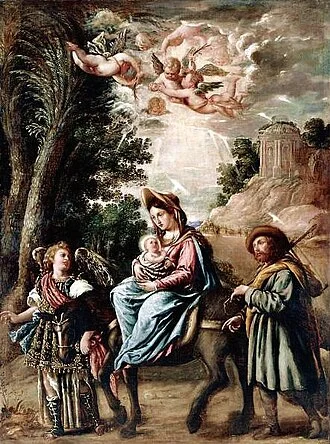
From April 3 to July 16, 2023, the Metropolitan Museum mounted the exhibition Juan de Pareja: Afro-Hispanic Painter — the first exhibition in history dedicated to Pareja as an artist in his own right. Co-curated by David Pullins and Vanessa K. Valdés, a professor at City College of New York, the show brought together about forty objects: five of Pareja's own paintings (including the Saint Matthew on loan from the Prado and the Flight into Egypt from the John and Mable Ringling Museum of Art in Sarasota, Florida), contextual works by Velázquez, Zurbarán, and Murillo, historical documents including the 1650 manumission paper, and archival materials tracing the work of Arturo Schomburg. 14
The exhibition's structure was itself an argument. It opened not with Velázquez but with Schomburg — insisting that the twentieth-century project of recovery was as central to the story as the seventeenth-century act of painting. Max Hollein, the Met's director, framed the purpose directly: "the presentation challenges us to question existing notions about historical art and objects — and introduces a remarkable artist whose name may be familiar to many but whose work had not been explored in depth." 14
Vanessa K. Valdés placed it in its longest arc: "Pareja's artistic legacy reverberates across the canons of Western art and the African diaspora into our time." 14
The following year, Pareja's Calling of Saint Matthew traveled to the Prado for a separate exhibition focused on Isabella Farnese's royal collection, in which it had been held since 1746. 8 In Madrid, the two trajectories of the story finally converged in the same city: the painter's city, the painter's language, the painter's century.
What the gaze carries
Juan de Pareja (1650) hangs in Gallery 625 of the Metropolitan Museum of Art, second floor, European Paintings. It is 81.3 by 69.9 centimeters. The accession number is 1971.86. The credit line reads: "Purchase, Fletcher and Rogers Funds, and Bequest of Miss Adelaide Milton de Groot (1876–1967), by exchange, supplemented by gifts from friends of the Museum, 1971." 1
None of that tells you what it is like to stand in front of it.
Velázquez painted this man with the same gravity, the same technique, the same focused attention he gave to the King of Spain. He made no concession to the legal relationship between them — no hierarchy encoded in the composition, no condescension in the brushwork, no diminishment in the gaze returned. What survives 375 years later is a face that watches back. Rijksmuseum curator Stephanie Archangel has asked the question that sits underneath all the art-historical apparatus: did Velázquez see Pareja's humanity because he painted him, or did he paint him as he did because he already saw it? Working together in the same rooms, over twenty-odd years, day and night — the question answers itself, or refuses to. 1
Juan de Pareja died in Madrid in 1670, twenty years after the portrait and ten years after the man who painted him. He died free, having spent his last sixteen years building a body of work on his own terms, in a style his former enslaver did not use, under a name he signed in paint onto rocks and paper. David Pullins said, at the close of the 2023 exhibition: "Hopefully, the process of filling out his life and biography will have only just begun." 7
The portrait is still in Gallery 625. Pareja is still looking at you.
Cover image: Diego Velázquez, Portrait of Juan de Pareja, 1650, oil on canvas, 81.3 × 69.9 cm. The Metropolitan Museum of Art, New York (acc. 1971.86). Metropolitan Museum Open Access, CC0.
References
- 1Metropolitan Museum of Art — Juan de Pareja collection page
- 2Wikipedia — Juan de Pareja
- 3Wikipedia — Portrait of Juan de Pareja
- 4Metropolitan Museum of Art Bulletin, June 1971 — Everett Fahy on Velázquez's Italian journey
- 5Dr Richard Stemp — Revisiting Velázquez and Juan de Pareja (2024)
- 6Fashion History Timeline — 1650: Diego Velázquez, Juan de Pareja
- 7CNN — This once enslaved 17th-century artist was misunderstood for centuries
- 8Museo Nacional del Prado — The Calling of Saint Matthew
- 9The Art Newspaper — The story of Juan de Pareja: from Diego Velázquez's slave to distinguished artist
- 10National Gallery — Collecting and displaying art: Longford Castle
- 11Art History News — The first painting to make a million quid
- 12The Guardian/Observer — A Velázquez now forever scarred by its £2m price-tag
- 13The New Yorker — Notes and Comment, June 5, 1971
- 14Metropolitan Museum of Art — Press release: Juan de Pareja 2023 exhibition
Add more perspectives or context around this Post.