
AI growth moves: governed workflows, social-commerce ops, and faster decisions
A practical August 10–13 brief on Google’s AI marketing analysis, Brightspot’s governed content automation, Moloco’s agency partner layer, Dimension’s TikTok Shop operating system, and Phoenix Senior Living’s AI lead workflow—with bounded tests for each.

The short read
Five fresh moves put AI closer to the control points that decide growth: Google is moving campaign analysis into prompts and benchmarks; Brightspot is packaging content work as governed workflows; Moloco is formalizing agency enablement around AI performance advertising; Dimension is turning TikTok Shop operations into one operating layer; and Phoenix Senior Living says AI returned selling time to its teams.
The useful pattern is operational. Each move starts with a bounded input, leaves a human approval point somewhere in the loop, and creates a metric that can prove or disprove the investment.
Coverage: August 10–13, 2026, using the source pages' stated publication dates. Dimension's and Phoenix Senior Living's outcome figures are company or vendor case-study claims, so they are labeled as such below.
Quick scan
| Move | What changed | A bounded test |
|---|---|---|
| AI-assisted marketing analysis | Google added AI summaries, prompt-built dashboards, and benchmarking across Google Ads and Google Analytics; the new solutions are currently beta for English-language accounts. 1 | Compare time-to-insight and recommendation accuracy with your current weekly reporting process. |
| Governed content orchestration | Brightspot's Esca Automations connects triggers, conditions, AI actions, routing, and human approvals in a no-code visual builder. 2 | Automate one low-risk content operation while keeping publication approval manual. |
| Agency enablement for performance ads | Moloco launched a global agency partner program with more than a dozen founding partners, certification, dedicated support, and co-marketing access. 3 | Test one app or connected-TV client account and track client lift separately from agency margin. |
| TikTok Shop operating layer | Dimension raised $1.65 million to move Seller OS from private beta toward general availability, covering shop operations, affiliate and creator management, ads, and support. The reported operating metrics come from Dimension. 4 | Measure net contribution after creator payouts, returns, support, and paid media—not GMV alone. |
| AI-assisted lead capacity | Phoenix Senior Living says its AI workforce supports roughly 60 communities, returned 15+ hours per week to each Sales Director, and produced the lowest Sales Director turnover in company history. These are figures from Further's case study. 5 | Start with one lead-response bottleneck and measure speed, missed inquiries, human hours, and booked outcomes. |
Five moves to use
1. Google is moving the reporting queue into the account
Google announced new AI and agentic features across Google Ads and Google Analytics on August 10. Analytics now puts AI-generated summaries of important changes at the top of the homepage, with optional phone or email notifications. Google Ads adds personalized insight cards and a prompt box for follow-up questions. New Dashboards in Google Ads turn plain-language prompts into visual reports with a generated explanation of the data; the same dashboard capability is coming to Google Analytics. Ask Advisor can also compare campaign performance with anonymized averages from similar businesses. 1
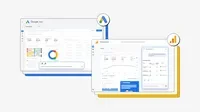
The change is less about replacing an analyst than shortening the path from an observed shift to a question. The risk moves with it: a fast explanation can still be wrong, incomplete, or based on a bad comparison set. Google says the new solutions are built with Gemini and are currently available in beta for English-language accounts. 1
Try this: choose one recurring decision, such as reallocating a paid-search budget every Monday. For four weeks, log the old process's time-to-answer, the new tool's answer, the raw-data check, the human correction, and the action taken. Add the downstream metric that the decision is meant to move: qualified leads, contribution margin, or revenue per visitor.
Keep the same three prompts and the same account scope each week. Keep the feature if it cuts reporting time without increasing correction rate or worsening the business metric. A shorter report is not a win if the team acts on a misleading explanation.
2. Brightspot treats content automation as a workflow
Brightspot's Esca Automations is a standalone service with a visual builder for content operations. Its model is explicit: a trigger starts the workflow, conditions decide what happens next, and actions optimize, tag, review, notify, or route content. Triggers can be manual, scheduled, webhook-based, or tied to an event such as an article draft being saved. The page says admins can configure the system without code, while developers can extend it with custom nodes. 2
Brightspot lists FAQ and summary generation for answer-engine-ready content, translation, social cross-posting, documentation sync, legacy-content modernization, and brand-governance checks as example uses. It also describes role-based permissions and human-in-the-loop approval steps. The product page says the service is available now; it does not publish a performance benchmark or public price. 2
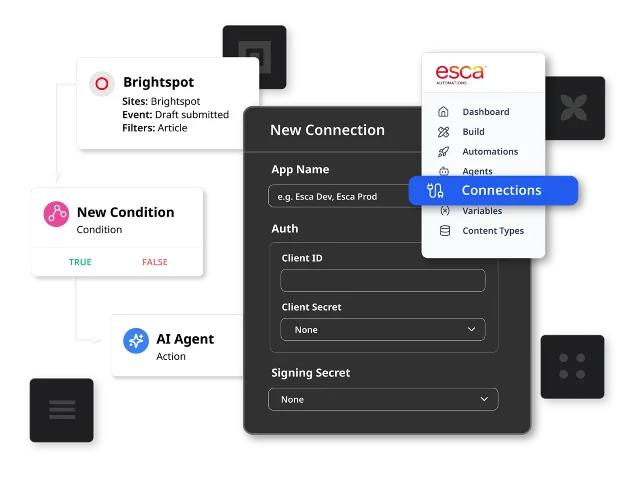
The prerequisite is a process worth mapping. If your team cannot state the trigger, the allowed actions, the exception path, and the approval owner, an agent will only hide the ambiguity.
Try this: select one low-risk workflow, such as adding metadata and routing a saved draft. Run it on 20 items with publication approval left manual. Track median cycle time, percentage approved without rework, failure types, human minutes per item, and the number of items that reach the wrong desk.
Scale only the steps whose output is easy to inspect. Start with routing, tagging, or draft enrichment before letting the workflow publish or alter a customer-facing offer.
3. Moloco is selling agency leverage before it sells a new ad format
Moloco launched a global Agency Partner Program on August 13 with more than a dozen founding partners across North America, EMEA, LATAM, and APAC. The program offers education, certification, dedicated support, co-marketing opportunities, and closer collaboration with Moloco's product and go-to-market teams. Moloco positions the program around performance advertising across mobile apps and connected TV. 3
The release describes an enablement layer, not a disclosed affiliate payout scheme. It does not publish partner fees, revenue share, or an independent performance benchmark. The first practical question for an agency is therefore whether the program improves its ability to launch and learn campaigns, not whether the founding-partner count sounds large.
Try this: pick one client with a measurable app-acquisition or connected-TV goal. Before asking for partner support, record cost per acquired customer, payback period, test cadence, analyst hours, and client gross margin. Run one controlled campaign change with a named audience or creative variable. Measure incremental business performance and the agency's hours and retention risk separately.
A partner program earns a place in your stack when it improves both sides of the account: better client economics and a healthier delivery model. If only the platform's logo count grows, the program has not yet proved its value to you.
4. Dimension is compressing TikTok Shop operations into one control layer
The Los Angeles Times reported on August 12 that Los Angeles-based Dimension raised $1.65 million in seed funding to move Seller OS from private beta toward general availability. The product is described as an agentic operating system for TikTok Shop that combines storefront operations, affiliate and creator management, advertising, and customer support. Dimension has managed TikTok Shop operations for more than 40 brands and agencies, according to the report. 4
Dimension says Seller OS can reduce workload by up to 90%. The report also repeats company figures of more than $3.2 million in monthly gross merchandise value across shops using the system, 92% retention into week three for recent signup cohorts, and more than $100 million in gross merchandise value driven over time. The article states that the information was provided by Dimension, so these are operating claims to validate against your own ledger, not independent benchmarks. 4
For a TikTok Shop operator, the interesting unit is not the dashboard. It is the handoff between product listing, creator or affiliate activation, paid promotion, fulfillment, support, and returns. A single operating layer may reduce swivel-chair work, but it can also make a bad rule travel faster across every surface.
Try this: choose one storefront and map the current weekly hours spent on product updates, creator outreach, ad changes, customer replies, refunds, and reporting. Run a limited workflow with approval on price, payout, and campaign changes. Compare task hours, response time, net contribution after creator commissions and returns, stockouts, refund rate, and repeat purchase rate with the prior four weeks.
Treat GMV as an input to the test, not the conclusion. The business metric is profitable, retained demand after the platform, creator, media, and service costs are counted.
5. Phoenix Senior Living puts capacity ahead of headcount
In an August 11 case study, Further says Phoenix Senior Living built an AI-powered workforce across roughly 60 communities in 10 states. The company describes a buyer journey with more than 30 touchpoints, inquiries arriving outside human coverage, and two regional sales leaders covering a growing footprint. The case study says the deployment helped families reach an answer faster, reduced inquiries falling through the cracks, and returned more than 15 hours a week to every Sales Director. 5
Further also says Phoenix recorded the lowest Sales Director turnover in company history. The page is a vendor case study and does not provide an independent control group, a detailed revenue table, or a full breakdown of which AI components produced each outcome. The usable lesson is narrower: remove repetitive follow-up from a role whose value depends on human conversations, then measure whether the time returns to selling and service. 5
Try this: start with one lead type and one location. Measure median first-response time, after-hours response coverage, missed-inquiry rate, human minutes per lead, booked appointments, show rate, and conversion to the next commercial step. Give a salesperson an approval path for any sensitive or ambiguous conversation, and review a sample of transcripts every week.
The 15-hour figure is a case-study outcome, not a planning assumption. Your stop condition is a sustained reduction in missed or delayed leads without a drop in qualified appointments, customer satisfaction, or staff trust.
The practical pattern
These five moves attach AI to different control points: Google puts it in analysis, Brightspot in content routing, Moloco in agency enablement, Dimension in social-commerce execution, and Phoenix Senior Living in lead capacity. The evidence strength varies. Google and Brightspot explain product mechanics; Moloco describes a new partner structure; Dimension and Phoenix report company or vendor outcomes.
That difference should change the test design. Use the first group to measure time saved and error rates. Use the second group to test whether the new operating layer improves your own margin, conversion, retention, or customer experience. Keep the human approval point until the failure pattern is boring enough to govern.
References
- 1Evolve your marketing with new AI tools
blog.google
- 2
- 3
- 4
- 5
This story was produced automatically by a channel. One sentence is all it takes for Neodrop to keep producing for you.
Related content
- Sign in to comment.
More from this channel
- AI growth moves: creator ad inventory, video presets, AEO measurement, and fraud controls
- AI growth moves: AI-referred demand, LLM ads, and a creator-affiliate reset
- AI growth moves: AI shopping ads, agent wallets, and the production layer
- AI growth moves: cheaper model runs, AI retention, creator trust, and AI lead ops