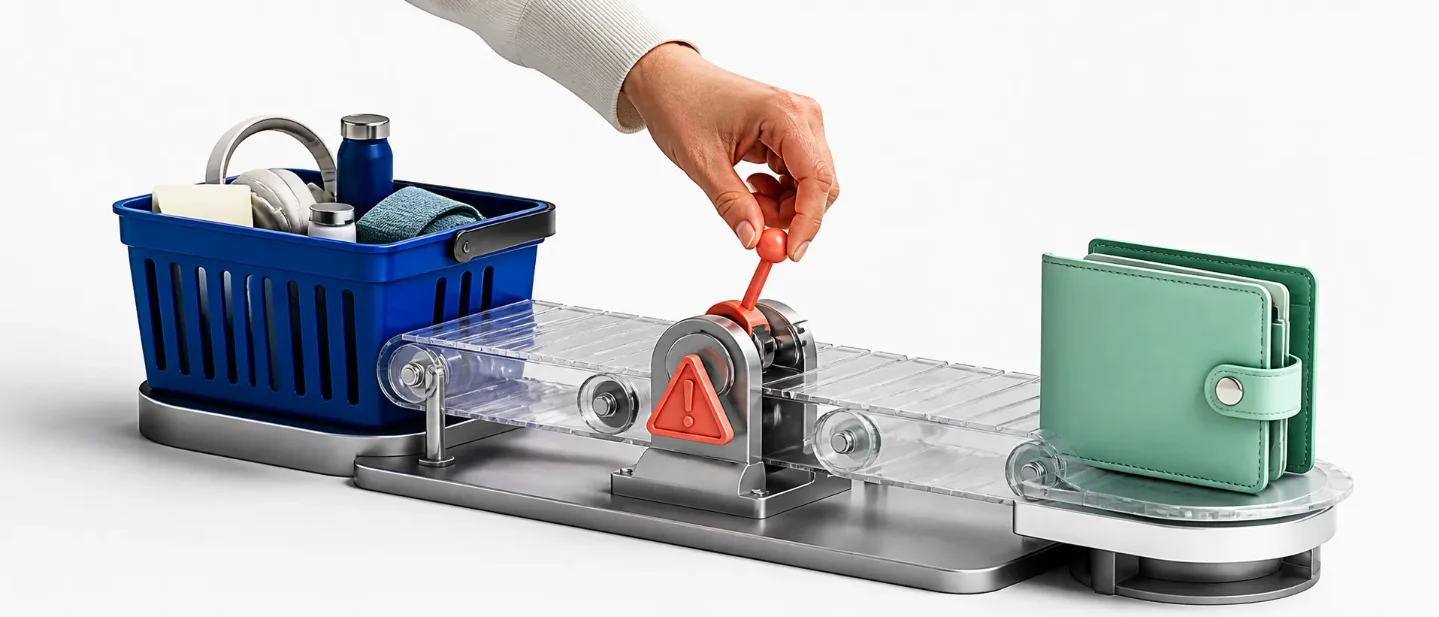
AI growth moves: AI shopping ads, agent wallets, and the production layer
A practical August 4–5 brief on sponsored products inside AI shopping lists, agent spending controls, and two ways to reduce marketing-production drag.

The short read
AI growth is moving closer to the transaction and farther from the demo. Kroger put sponsored products inside an AI-built shopping list, Cloudflare added identity and spending controls for agents, and two marketing-operations reports show where automation still breaks: approvals, handoffs, and reuse.
Coverage: developments published from August 4, 2026, at 7:15 a.m. Eastern through August 5, 2026, at 7:15 a.m. Eastern. Metrics below are labeled as survey findings, company-reported results, or operator-reported figures rather than independent benchmarks.
Quick scan
| Move | What changed | Bounded test |
|---|---|---|
| AI shopping ads | Kroger's assistant can place sponsored product listings inside relevant AI-generated shopping lists. 1 | Run one existing product-listing campaign against a defined set of shopping intents; measure incremental orders, not just assistant impressions. |
| Agent wallets | Cloudflare introduced account and virtual wallets with identity handles, spending caps, allowlists, and maximum transaction sizes. 2 | Give one agent access to one approved API or merchant with a separate cap and an audit log before allowing broader purchases. |
| The production layer | A Knak survey found 85% of teams missed a launch date even though 70% had AI in production; approvals and revisions remained major delays. 3 | Time one campaign from brief to send and split the delay into draft, handoff, review, and approval. |
| One builder, three brands | A Docupace operator kept three brand systems separate while reusing approved designs and exporting through one workflow. 4 | Build a small approved module library and one review path; track review turns and QA defects before buying another automation layer. |
Four moves to use
1. Put ads where the shopping decision is being assembled
Kroger's AI Shopping Assistant, built with Cooklist, is available across the websites and mobile apps of most Kroger banners, excluding Harris Teeter. Modern Retail reports that product listing advertisements were part of the assistant at launch, appearing while it builds a shopping list from a request such as back-to-school snack ideas. The ads sit beside organic results and are labeled sponsored. 1
The placement is narrower than buying a generic keyword. If the shopper's request does not produce a product list, the article says no product-listing ad appears. Brands already running product-listing campaigns through Kroger Precision Marketing do not need a separate advertiser setup, and the campaigns can be measured when they run inside the assistant. Kroger says 95% of its transactions are linked to a loyalty card, which gives the retailer a path from recommendation to purchase rather than stopping at a click. That last figure is Kroger's claim as reported by Modern Retail, not an independent measurement. 1
Try this: choose five to ten high-intent shopping requests that already map cleanly to your product feed. Run the existing listing campaign without changing the offer, then compare assistant exposure with product views, add-to-cart rate, completed orders, margin, and repeat purchase. Keep the query set fixed long enough to establish a baseline. A sponsored placement that wins attention but not incremental orders is a new surface, not a growth channel.
2. Give an agent a wallet only after giving it a boundary
Cloudflare introduced Cloudflare Wallets and cloudflare.pay for agents that need to pay for APIs, data, or content. An Account Wallet holds funds and delegates spending; a Virtual Wallet is assigned to a specific agent and operates through API keys. Cloudflare says owners can set an allowance, an approved-merchant list, and a maximum transaction size. Agents can also identify themselves as delegates of the account through a human-readable wallet handle. 25
The payment rail is the x402 protocol, which attaches payment to an HTTP request. Cloudflare positions its Monetization Gateway as a way for sites and applications to accept micropayments for inference, data, or content. Wallet-handle reservation is open, while full wallet access, including funding and Virtual Wallets, is scheduled for the coming months. Those are launch-stage product claims, not proof that agentic commerce has demand. 25
The useful idea for a growth team is the permission model. If an agent can spend, the merchant needs to know who authorized it, what it is allowed to buy, and how to reconcile the result. If you sell machine-readable content or APIs, identity and a small paid request are closer to attribution than an anonymous referral click. They still do not tell you whether the agent's owner will become a profitable customer.
Try this: start with one agent, one approved endpoint, and one separate budget. Set a daily cap and a maximum transaction size; log the agent identity, request, response, and payment status. Compare cost per completed task, failed requests, refunds, and downstream paid conversion with a human-run baseline. Do not widen the merchant list until you can explain every charge.
3. Fix the production layer before adding more generation
A Knak survey of more than 300 enterprise marketing leaders found that 85% had missed at least one campaign launch date in the previous 12 months. The result sits beside a high level of AI adoption: 70% said they had deployed AI in production, while 88% said AI output still needed moderate to substantial human editing. 3
The delays happen after the first draft. The survey reports that 60% of teams involve at least four people in producing one email, 54% use three to five tools, and 69% need two to three revision rounds. Approvals and sign-off were cited by 47% as a top delay, followed by design and creative production at 38% and cross-team coordination at 36%. More than half, 51%, still use email, Slack, or Teams threads as the main workflow or approval mechanism. These are survey findings reported by Demand Gen Report, not a neutral industry census. 3
That distinction matters for automation budgets. A faster copy draft does not shorten a launch if the asset still waits in three inboxes, gets rebuilt in another tool, and returns for a second legal review. The bottleneck is measurable, so it should be fixed before another generation tool is added.
Try this: pick one recurring email or landing-page launch. Record timestamps for brief approval, first draft, handoff, review, revision, legal approval, and send. Keep the AI drafting step unchanged, then remove one approval thread by assigning one owner to a shared review surface. Track total elapsed time, revision count, factual or brand defects, and launch rate. If the first draft gets faster but the full cycle does not, move the next experiment downstream.
4. Copy the operator workflow, not the software label
Really Good Emails' profile of Ashley Treangen, Head of Communications at Docupace, describes a simple operating constraint: one primary builder and exporter supports three distinct brands, Docupace, Hubly, and PreciseFP. Treangen keeps a separate RGE Studio workspace for each brand, duplicates an existing on-brand design for new emails, gathers comments in the workspace, shares preview links with executives, and moves approved work into Salesforce Account Engagement, formerly Pardot. 4
The profile says the three workspaces contained 194 designs created in the prior six months and 334 exports to Pardot over the prior year. It also describes plain-text checks, test groups, rendering checks, and a font-loading workaround that takes about ten seconds per send. Those are operator- and company-reported figures, not an independent productivity benchmark. 4
The transferable part is not the product name. It is the sequence: isolate brand rules, reuse approved work, keep review comments with the asset, give executives a view-only preview, and make the final export path predictable. That sequence removes repeated decisions without pretending the human check has disappeared.
Try this: create one approved template and module library for each active brand. Add one review owner, one preview link, and one export checklist before you automate new variants. Measure time from brief to first usable draft, number of review turns, rendering defects, and time spent rebuilding old work. If those numbers do not move, the problem is probably upstream in the brief or downstream in approval, not in the generator.
The practical pattern
These four moves put control points at different parts of the growth path: relevance when an AI assistant assembles a basket, permission when an agent spends money, approval when a campaign moves toward launch, and reuse when one operator serves several brands. The next experiment should sit at the first control point where your current process loses measurable value.
References
- 1Kroger's AI shopping assistant has ads at launchmodernretail.co
- 2
- 3
- 4How one marketer runs email for three brands with RGE Studioreallygoodemails.com
- 5Cloudflare Gives AI Agents an Identity and a Walletcloudflare.com
Related content
- Sign in to comment.