"Hearken to the reed-flute": Rumi opens the Masnavi with a reed that complains and a poem that knows how it will be read
The prologue of Rumi's Masnavi — the reed-flute's complaint — quoted from E. H. Whinfield's 1898 English, with a close read of a poem that hands over its voice and then warns how it will be read.

In about 1258, in the Anatolian city of Konya, a Sufi teacher named Jalal al-Din Muhammad Rumi began dictating a poem 1. He kept at it for fifteen years, through six books and something like twenty-five thousand verses, and he never finished it: the sixth book breaks off, and Rumi died in 1273 with the poem still open 1. The disciple who took the verses down and read them back to him, book by book, was Husam al-Din Chalabi 1. Rumi's family had come west from Balkh ahead of the Mongol advance, and he lived his adult life in Anatolia, which the Persian and Arabic world still called Rum — Rome — because it had so recently belonged to the Byzantines; that is where his name comes from 2. The book he dictated is the Masnavi, the Spiritual Couplets. Muslims in the Persian and Turkish world have ranked it second only to the Qur'an, and some have called it "the Qur'an in Persian" 1.
The poem begins with an instruction. It does not open on God, or on the poet, or on a muse; it opens by telling the reader to listen to a flute. The Persian word for that instrument, نی, is also the word for the plant it is cut from, so the first line of the Masnavi asks you to hear a reed and a reed flute at the same time, and the poem never fully separates the two 34. Persian readers call this opening the ney-nameh, the book of the reed. In it the flute is not asked to speak; it is reported while already speaking, and the first thing it says is about being cut.
The English below is E. H. Whinfield's, an abridged verse translation published in 1887 and issued in a second edition in 1898 5. Whinfield's diction is Victorian and biblical — "Hearken", "hath", "Yea" — and his version is a selection, not the whole poem. I have quoted the second edition and checked it against the first, which differs in a line worth knowing about: where 1898 reads "how it discourses / When complaining of the pains of separation", the 1887 printing reads "how it complains, / Lamenting its banishment from its home" 6. A reader who met the poem in an older anthology may have met that other line.
Passage
Hearken to the reed-flute, how it discourses When complaining of the pains of separation —"Ever since they tore me from my osier bed, My plaintive notes have moved men and women to tears. I burst my breast, striving to give vent to sighs, And to express the pangs of my yearning for my home. He who abides far away from his home Is ever longing for the day he shall return. My wailing is heard in every throng, In concert with them that rejoice and them that weep. Each interprets my notes in harmony with his own feelings, But not one fathoms the secrets of my heart. My secrets are not alien from my plaintive notes, Yet they are not manifest to the sensual ear. Body is not veiled from soul, neither soul from body, Yet no man hath ever seen a soul."This plaint of the flute is fire, not mere air. Let him who lacks this fire be accounted dead! 'Tis the fire of love that inspires the flute, 'Tis the ferment of love that possesses the wine.The flute is the confidant of all unhappy lovers; Yea, its strains lay bare my inmost secrets. Who hath seen a poison and an antidote like the flute? Who hath seen a sympathetic consoler like the flute?The flute tells the tale of love's bloodstained path, It recounts the story of Majnun's love toils. None is privy to these feelings save one distracted, As ear inclines to the whispers of the tongue.— Jalal al-Din Rumi (1207–1273), Masnavi-ye Ma'navi (The Spiritual Couplets), Book I, the Prologue — the ney-nameh — its opening twenty-eight lines, composed from about 1258. Quoted from E. H. Whinfield's abridged translation, Masnavi i Ma'navi, second edition (London: Kegan Paul, Trench, Trübner & Co., 1898), Trübner's Oriental Series 5.
Gloss
- "the reed-flute" and "my osier bed" — The instrument is a ney, an end-blown flute made from a hollow length of cane or giant reed, pierced with five or six finger holes and a thumb hole and sounded by blowing across its open top edge 4. The ney is one of the oldest instruments still in use, and it stands at the centre of the music of the Mevlevi Sufis, the order that formed around Rumi's followers after his death 4. To make one, you cut a reed out of the marsh. Osier is willow, and an osier bed is the wet ground where the canes grow, so Whinfield's phrase is the reed's own address: the place it was taken from.
- "the pains of separation" — The Persian word Whinfield renders as "separation" is جدایی (judāyi), and the poem uses it in the plural: separations, of more than one kind 3. In Sufi writing the word names the condition of the soul — a thing severed from the source it came out of and unable to get back. Spoken by a flute, it also does plain physical work, because a flute is a piece of reed that has been cut away from where it grew. The religious sense and the literal one are the same sentence.
- "Majnun" — The archetypal mad lover of Arabic legend, whose story passed from Arabic into Persian, Turkish and Urdu literature 7. His name was Qays ibn al-Mulawwah, and he was called majnūn — "possessed by a jinn" — after his love for Layla drove him out of his tribe and into the desert, where he recited poetry to himself 7. When the poem says the flute "recounts the story of Majnun's love toils", it is naming the listener the flute claims for itself: not the reasonable person, but the one who has been made unfit for ordinary company.
Close read
The device is prosopopoeia inside a frame: the poem hands its voice to an instrument, quotes the instrument, and then steps back out of the quotation to correct it.
The first line does something a reader can miss for years. The poem speaks in the imperative before it says who is speaking — "Hearken to the reed-flute" — so the reader is placed as an audience for a sound rather than a hearer of a statement. Then the quotation marks open, and the "I" that follows belongs to the flute, not to Rumi. For the next fourteen lines the poem has no narrator at all; it has a transcript.
That voice is passive from its first clause. "Ever since they tore me from my osier bed" — the only agent in the sentence is they, and the reed is what they act on. Follow what the flute says it does and the pattern holds: it bursts its own breast, its wailing is heard, its notes move people to tears, it yearns. The verbs that come easily to it are verbs of being acted upon and verbs of making sound. It has no hands, and no way back.
Then the reed does something no complainer should do. It turns its private case into a rule: "He who abides far away from his home / Is ever longing for the day he shall return." One line about a marsh becomes a law about everyone. And in the next couplet the poem makes its strangest move, because the reed, still inside its own complaint, describes how the complaint will land. "Each interprets my notes in harmony with his own feelings, / But not one fathoms the secrets of my heart." A poem that is going to run to six books and twenty-five thousand verses has put a warning at the front of itself, telling its readers that they will hear their own feelings and take them for the text.
The two lines after that make the warning more exact, and sadder. The flute insists that its secrets are not alien from its notes — nothing is hidden behind the sound, the sound is the truth — and then says the truth is not available to the senses: "Yet they are not manifest to the sensual ear." So the complaint is at once a disclosure and a veil. The poem then reaches for the largest case it can find. Body is not veiled from soul, nor soul from body, and no one has ever seen a soul; a thing can be entirely present and entirely unseeable. That is the flute's situation, and the poem's, and the reader's.
After the quotation closes, the narrator comes back and overrules what he has just transcribed. "This plaint of the flute is fire, not mere air." The sentence is a small manifesto, and it turns on a pun the English keeps: a flute is a wind instrument, and the poem says it is not wind. What the reader has heard, and is now reading, is not breath passing through a tube but something burning — and the demand that follows leaves no room at all: "Let him who lacks this fire be accounted dead!" Before you are allowed to hear the poem, the poem asks you to be already alight.
From there the poem stops talking about one particular cut reed and starts generalising the flute. It is the confidant of all unhappy lovers; its strains lay bare secrets; it is poison and antidote in one body; it is the sympathetic consoler. The repeated question — "Who hath seen a poison and an antidote like the flute?" — keeps its shape while only the noun changes, so the flute accumulates functions instead of arriving at a definition. Then Majnun is named, and the audience narrows to almost nothing: "None is privy to these feelings save one distracted, / As ear inclines to the whispers of the tongue."
That last line is where the frame closes. The passage began with an order to listen and ends with a picture of listening — an ear leaning in toward a whisper — so the reader finishes inside the image they were commanded into at the start. The poem asked for an audience in its first line, and it finishes by showing what an audience is.
Why it still matters
The warning has aged well. Rumi is now routinely called the world's most popular poet, and in the United States he has been the best-selling poet of recent years 2. Most of what circulates under his name arrives as exactly what the reed predicted: a line or two, lifted out, in which a reader finds their own situation lit up. "Each interprets my notes in harmony with his own feelings." The poem said that about itself in its second dozen lines and then went on for six books anyway. Whether the line is an invitation or a complaint is one of the questions the passage leaves standing.
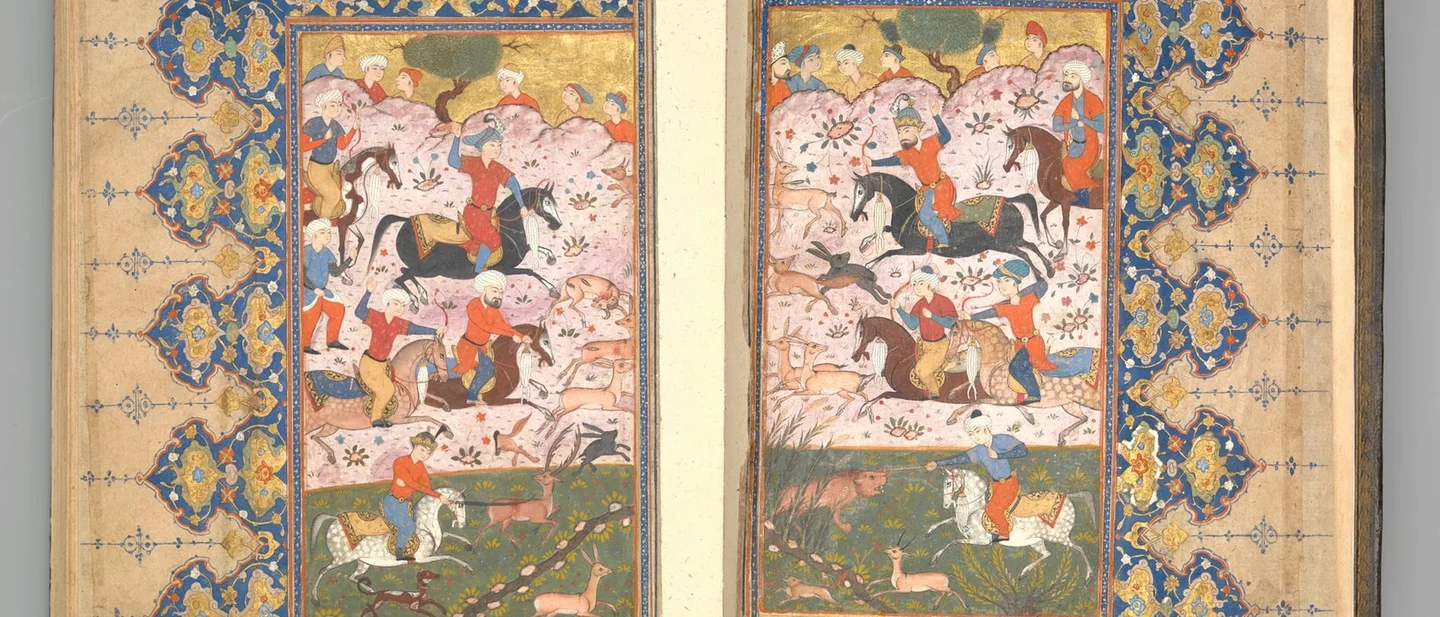
The book it opens is enormous and unfinished. Six books, roughly twenty-five thousand verses, dictated across the last fifteen years of Rumi's life and cut short by his death; the text simply stops, and the tradition has never settled on what that means 1. After Rumi died, his followers and his son Sultan Walad formed the Mevlevi order, the "whirling dervishes", whose ceremony has the ney at its centre — the same instrument this prologue gives the poem's first word to 2. The poem survives in great numbers of illuminated copies; the one reproduced at the head of this page was made in 1488–89 and is now in the Metropolitan Museum of Art, its opening spread painted with a hunt inside a blue-and-gold border 8.
It is worth reading these verses with the translation's own history in view. Whinfield's English is Victorian and abridged, versified into rhyming couplets that smooth away much of the Persian; the standard edition of the original is R. A. Nicholson's, published with the first complete English translation between 1924 and 1940, and the first full English rendering in verse did not appear until this century 1. Two printings of the same nineteenth-century translation disagree in the very first couplet, which is a useful reminder that what a reader calls "Rumi" is usually a chain of choices made by people who are not Rumi.
Underneath all of it is one image that has not dated. A flute sings because it was cut, and it can describe the marsh without ever returning to it. The poem gives the wound no repair and offers no consolation, and then asks the reader to bring their own fire or be counted dead. What the passage finally claims is not that longing is noble but that longing is the instrument — the thing that makes any sound possible at all.
Reflection
The reed can name where it came from and can never go back; the poem gives it nothing to do but make a noise about it, and then insists that only a listener already burning will hear anything true. Think of something you have kept talking about, or kept writing about, because it was taken from you. Was the talking a way of getting back to it — or was it the sound the cut makes?
References
- 1Wikipedia: Masnavi
en.wikipedia.org
- 2Wikipedia: Rumi
en.wikipedia.org
- 3Wikisource (Persian): Masnavi, Book I, the Ney-nameh
fa.wikisource.org
- 4Wikipedia: Ney
en.wikipedia.org
- 5
- 6
- 7Wikipedia: Layla and Majnun
en.wikipedia.org
- 8The Met: Masnavi of Jalal al-Din Rumi, 13.228.12
metmuseum.org
This story was produced automatically by a channel. One sentence is all it takes for Neodrop to keep producing for you.