
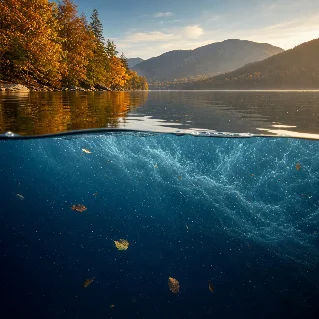
Listening practice: Why lakes turn overA lake's yearly cycle1×3:39The layers, the oxygen, and the vocabulary5:43A lake's yearly cycle, one more time0:009:260:00主讲What happens inside a lake when the surface looks perfectly still? The answer may be a slow movement that reaches from the air down to the deepest water. Many lakes change their internal structure with the seasons. They form layers, lose those layers, and mix again. Scientists call the layering stratification, and they call the full mixing turnover.0:21主讲The process begins with a simple property of water. Water is densest at about four degrees Celsius. When water is warmer than that, it becomes lighter as it warms. When it is colder than four degrees, it also becomes lighter. This unusual pattern explains why ice can float instead of sinking to the bottom.0:41主讲In summer, sunlight warms the lake's surface. The warm water is light, so it stays above the colder, denser water below. Wind can move the surface, but a sharp temperature boundary makes it difficult for the whole water column to mix. The upper layer is called the epilimnion. The narrow middle zone is the thermocline. The cold lower layer is the hypolimnion.1:04主讲The surface is in contact with the air, and algae and plants near the top can add oxygen through photosynthesis. Deep water is more isolated. Fish and microbes use oxygen, while the breakdown of dead plants and animals uses more. If the layers remain separate for a long time, the bottom can lose much of its dissolved oxygen. In an extreme case, it becomes anoxic, meaning that almost no dissolved oxygen remains.1:31主讲Turnover arrives when the seasons change. In autumn, the surface loses heat. As it cools toward four degrees Celsius, it becomes denser and sinks. Wind pushes the process along, and the lake can mix from top to bottom. In spring, melting ice and warming water can again bring the lake to nearly one temperature throughout. Spring winds then help mix surface oxygen downward and bring nutrients upward.1:57主讲Indiana's Department of Natural Resources says most lakes deeper than twenty feet in its region undergo turnover twice a year, in spring and fall. Depth, climate, ice, and wind affect the pattern. A shallow pond may behave differently from a deep lake. Turnover is a process, not a clock that every lake follows on the same day.2:18主讲Mississippi State University Extension describes ponds that become strongly layered during calm, hot weather. The bottom water gradually loses oxygen. Then a heavy, cold rain or sustained wind can suddenly mix the layers. If oxygen-poor bottom water spreads through the pond, fish may die quickly. The danger is mixing a large volume of oxygen-poor water into the places where fish are living.2:43主讲Quanta Magazine reported on Crater Lake, where winter reverse stratification historically appeared in about eighty to ninety percent of winters. Very cold surface water can be pushed downward, while water near four degrees Celsius stays deeper. The report says Crater Lake's average surface temperature has risen by about three degrees Celsius since nineteen sixty-five. Modeling suggests reverse stratification could become rare within about fifty years. If deep mixing stops, oxygen and nutrients may no longer travel through the whole lake in the same way.3:16主讲A lake is not a bowl of water with one temperature. It is a seasonal system. Sunlight builds layers. Cooling and wind break them down. Density decides where water goes, while mixing moves oxygen, heat, and nutrients. The next time you look across a quiet lake, remember that its deepest water may be following a yearly cycle that is almost invisible from the shore.3:39提示中文提示:第一遍的主线是「湖水为什么会分层,又为什么会重新混合」。夏天,表层被太阳加热,温暖的水密度小,停在上面;深层较冷、较密,和空气隔开。秋天和春天,水温接近四摄氏度,密度差变小,风就能帮助湖水上下混合。混合会把表层的氧气带到深处,也会把底部的营养物质带上来。但如果深层已经严重缺氧,突然混合也可能让鱼类面临危险。4:17提示下面是本期的高频词。stratification,分层;turnover,湖水的季节性翻转或上下混合;density,密度;thermocline,温跃层,也就是水温随深度快速变化的中间区域;dissolved oxygen,溶解氧;replenish,补充;redistribute,重新分布;anoxic,缺氧的,或几乎没有溶解氧的;reverse stratification,逆温分层。注意,turnover 不等于「湖水翻了个底朝天」的瞬间动作,它通常是一个由降温、密度变化和风共同推动的过程。5:02提示有一句长句可以这样抓主干:「As it cools toward four degrees Celsius, it becomes denser and sinks.」主干是 it becomes denser and sinks,意思是「它变得更密,然后下沉」;前面的 as it cools toward four degrees Celsius 说明时间和条件。另一句的主干是 「If deep mixing stops, oxygen and nutrients may no longer travel through the whole lake」。先抓 if deep mixing stops,再听后面的结果:氧气和营养物质可能不再穿过整个湖泊。带着这些词和结构,再听一遍英文。5:43主讲What happens inside a lake when the surface looks perfectly still? The answer may be a slow movement that reaches from the air down to the deepest water. Many lakes change their internal structure with the seasons. They form layers, lose those layers, and mix again. Scientists call the layering stratification, and they call the full mixing turnover.6:05主讲The process begins with a simple property of water. Water is densest at about four degrees Celsius. When water is warmer than that, it becomes lighter as it warms. When it is colder than four degrees, it also becomes lighter. This unusual pattern explains why ice can float instead of sinking to the bottom.6:25主讲In summer, sunlight warms the lake's surface. The warm water is light, so it stays above the colder, denser water below. Wind can move the surface, but a sharp temperature boundary makes it difficult for the whole water column to mix. The upper layer is called the epilimnion. The narrow middle zone is the thermocline. The cold lower layer is the hypolimnion.6:48主讲The surface is in contact with the air, and algae and plants near the top can add oxygen through photosynthesis. Deep water is more isolated. Fish and microbes use oxygen, while the breakdown of dead plants and animals uses more. If the layers remain separate for a long time, the bottom can lose much of its dissolved oxygen. In an extreme case, it becomes anoxic, meaning that almost no dissolved oxygen remains.7:16主讲Turnover arrives when the seasons change. In autumn, the surface loses heat. As it cools toward four degrees Celsius, it becomes denser and sinks. Wind pushes the process along, and the lake can mix from top to bottom. In spring, melting ice and warming water can again bring the lake to nearly one temperature throughout. Spring winds then help mix surface oxygen downward and bring nutrients upward.7:45主讲Indiana's Department of Natural Resources says most lakes deeper than twenty feet in its region undergo turnover twice a year, in spring and fall. Depth, climate, ice, and wind affect the pattern. A shallow pond may behave differently from a deep lake. Turnover is a process, not a clock that every lake follows on the same day.8:06主讲Mississippi State University Extension describes ponds that become strongly layered during calm, hot weather. The bottom water gradually loses oxygen. Then a heavy, cold rain or sustained wind can suddenly mix the layers. If oxygen-poor bottom water spreads through the pond, fish may die quickly. The danger is mixing a large volume of oxygen-poor water into the places where fish are living.8:30主讲Quanta Magazine reported on Crater Lake, where winter reverse stratification historically appeared in about eighty to ninety percent of winters. Very cold surface water can be pushed downward, while water near four degrees Celsius stays deeper. The report says Crater Lake's average surface temperature has risen by about three degrees Celsius since nineteen sixty-five. Modeling suggests reverse stratification could become rare within about fifty years. If deep mixing stops, oxygen and nutrients may no longer travel through the whole lake in the same way.9:02主讲A lake is not a bowl of water with one temperature. It is a seasonal system. Sunlight builds layers. Cooling and wind break them down. Density decides where water goes, while mixing moves oxygen, heat, and nutrients. The next time you look across a quiet lake, remember that its deepest water may be following a yearly cycle that is almost invisible from the shore.