The 3pm window: why your strategic snack is the most important fuel decision of your workday
The 3pm energy dip is partly biology and partly blood sugar — and only one of those is fixable with food. This guide explains the two-driver crash model (circasemidian rhythm + glucose decline), introduces the Window 4 Strategic Snack formula (150–200 cal, 7g+ protein, 3g+ fiber, 5g+ healthy fat), gives 4 desk-ready options with macros, names the 3 common 3pm choices that make things worse, and closes with 2 structural micro-habits to automate the whole system.

It's 3pm. Your calendar says you have 90 minutes of work left. Your brain says otherwise.
The screen blurs slightly. A response that would take 30 seconds at 10am is taking three minutes. You're staring at the same sentence for the fourth time. And somewhere in your body, a low-grade pull toward the vending machine — or just... the couch — is quietly winning.
You probably blame your willpower. You shouldn't. This is biology, and it's been documented in circadian science for decades. But here's the part most people don't know: you can't eliminate the 3pm dip, but you can choose how deep it goes. That choice is made at roughly 2:45pm — specifically, what you eat at that moment.
Why 3pm is a biology problem, not a motivation problem 🧠
Your body runs on two overlapping rhythms. The 24-hour circadian rhythm you already know. But there's also a roughly 12-hour circasemidian rhythm — a bi-daily dip in alertness that's hardwired into the brainstem itself. 1
The locus coeruleus — a tiny cluster of neurons in your brainstem that acts as your brain's "gear selector" — naturally dials back its output of noradrenaline (the neurotransmitter responsible for alertness and sharp prefrontal processing) in the early afternoon. This is sometimes called a drop from "second gear" to "first gear" in neuroscience researcher Dr. Mithu Storoni's framework: from focused, clear thinking into sluggish mind-wandering. 1
This dip happens at roughly the same time regardless of whether you've eaten. The food you had at lunch can make it worse — but it's not the root cause. That matters, because it means no snack will fully override it. What a well-designed snack can do is stop the diet-driven amplifier from making an already-difficult window functionally useless.
Two drivers, two levers ⚡
The energy valley between 2:30pm and 4pm is driven by two separate mechanisms that arrive at the same time and compound each other:
Driver 1: The circasemidian dip. Biological. Scheduled. The locus coeruleus pulls back, noradrenaline drops, and your prefrontal cortex gets quieter. Nothing you eat will eliminate this — but it typically lasts only 60–90 minutes and resolves on its own by around 4pm.
Driver 2: Blood glucose decline. Dietary. Controllable. If you ate a carb-heavy lunch at 12:30pm with limited protein and fat (pasta, a bagel, white rice), your blood glucose peaked around 1pm and has been sliding since. By 3pm, it's at or near a trough — exactly when your brain's circadian alertness is also at its lowest. 2 The two drivers stack, and what would have been a manageable biological dip becomes a near-complete cognitive shutdown.
The snack you eat at 3pm can't fix the first driver. But it can directly address the second — and that alone makes the dip survivable instead of devastating.
Loading chart…
The Strategic Snack formula 🥜
The 3-4pm window is Window 4 in the five-window meal framework — the "Strategic Snack." Its job is narrower than the 10am Bridge Snack: rather than bridging a fasting gap, it's resupplying glucose steadily enough to stay in the functional range through the rest of the workday, while keeping the insulin response flat enough to avoid creating a new crash at 4:30pm.
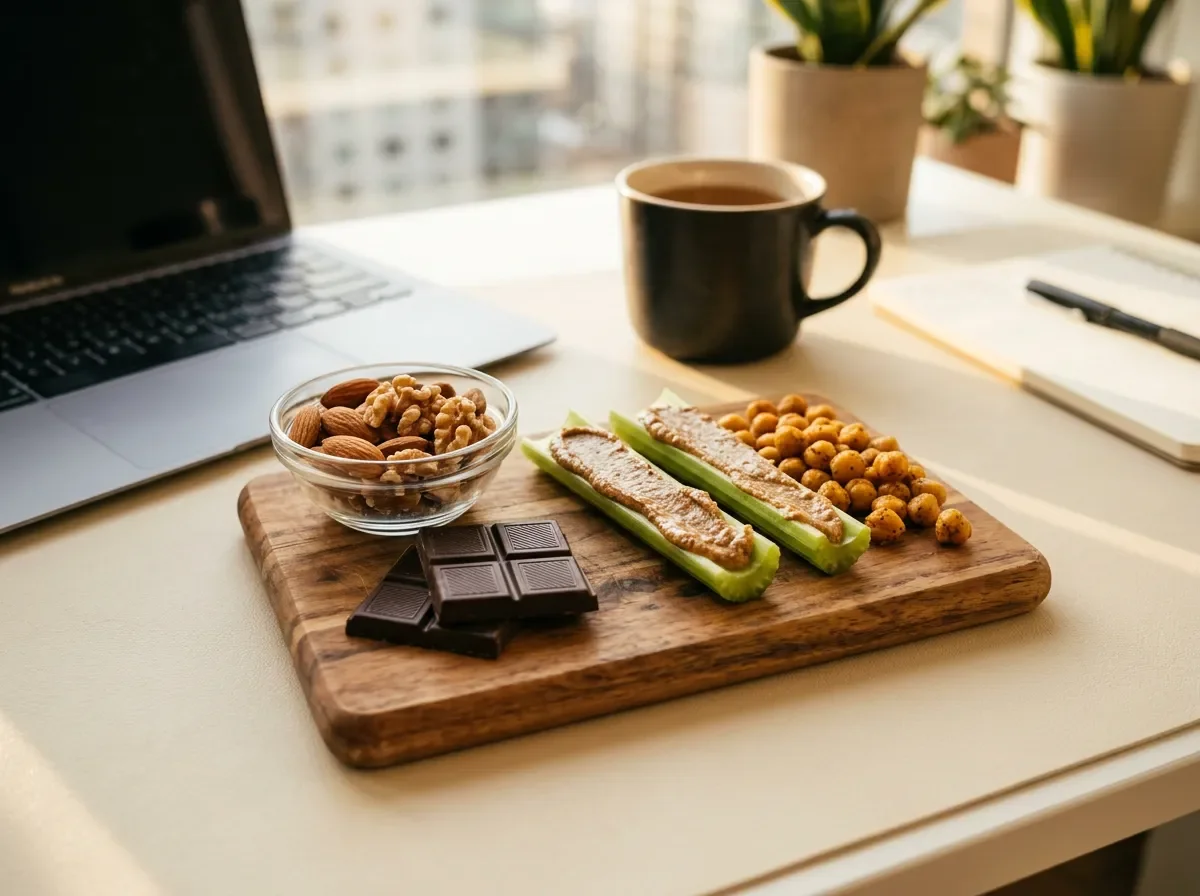
The formula: 150–200 calories, minimum 7g protein, minimum 3g fiber, minimum 5g healthy fat. This trio — protein + fiber + fat — creates what nutritionists call a "blunted glycemic response": glucose enters the bloodstream gradually, peak concentration is lower, and the decline back toward baseline is gentler. 3
A handful of almonds at 3pm, for instance, has been specifically studied: almond snacks lower postprandial blood glucose, reduce hunger, and reduce the "desire to eat" — directly measured outcomes in randomized trials. 3 Greek yogurt works similarly through the high-protein pathway: a high-protein afternoon snack has been shown to delay subsequent eating and improve appetite control compared to lower-protein options. 3
Loading stats card…
4 desk-ready options 💼
These are all shelf-stable, require zero prep, and can live in your desk drawer or bag permanently:
| Option | Calories | Protein | Fiber | Healthy Fat | Notes |
|---|---|---|---|---|---|
| 1 oz mixed almonds + 2 squares dark chocolate (70%+) | ~180 | 7g | 4g | 12g | Magnesium from both sources supports neurotransmitter function |
| 2 tbsp almond butter + apple slices (1 small) | ~190 | 5g | 5g | 9g | Natural sugar from apple, slowed by the fat/protein of almond butter |
| ½ cup roasted chickpeas (packaged) | ~150 | 7g | 5g | 4g | Fully shelf-stable; choose low-sodium versions |
| ¾ cup plain Greek yogurt + 1 tsp chia seeds | ~140 | 13g | 4g | 2g | Highest protein of the four; needs refrigeration unless you use a desk cooler bag |
What to skip — and the specific reason why 🚫
The three options most professionals reach for at 3pm are the exact foods that deepen the dip rather than bridge it:
Granola bar or protein bar. Read the label. Most mainstream granola bars are 60–70% carbohydrates with under 5g protein and minimal fat. The glucose spike peaks in about 20 minutes and drops off within 45. You feel briefly better, then feel worse than before you ate it. If you must use a bar, look for ≥10g protein, ≤20g sugar, and ≥3g fiber.
Third (or fourth) coffee. The caffeine protocol covered in a previous guide is worth referencing here: the hard cutoff is 2pm, because caffeine has a 12-hour quarter-life and late-afternoon dosing directly degrades deep sleep quality — even if you fall asleep fine. Caffeine at 3pm is borrowing energy from 11pm recovery, which means tomorrow's 3pm crash is worse. 5
Nothing. The most common choice. Fasting through the 3pm window might seem disciplined, but it leaves both drivers of the crash fully operational and extends the glucose trough into the early evening, often triggering compensatory overeating at dinner. 2
Two micro-habits to make it automatic ⚙️
Habit 1: Pre-load the option. Sunday evening, put one week's worth of Strategic Snack portions in small zip-lock bags or small jars and put them directly in your desk drawer Monday morning. When 3pm arrives, the decision is already made. You're not choosing between almonds and the vending machine — you're choosing between almonds and the desk where the almonds already are. Proximity wins.
Habit 2: Set a 2:55pm calendar block. Label it "Refuel" and set it to 5 minutes. Not a break, not a walk — just the structural reminder to eat the snack before the dip arrives rather than after you're already in it. Preventive fueling is a different physiological event than reactive refueling: eating before glucose drops stabilizes the decline, eating after it crashes triggers a larger insulin response.
Taken together, these two habits don't require willpower. They require a Sunday evening routine and a recurring calendar reminder.
You now have the complete architecture: the 10am bridge, the noon functional lunch, and the 3pm strategic snack all working in sequence. The next time that 3pm fog rolls in, you'll know it's biology doing its job — and you'll have something ready on your desk to keep it from taking over the final hour of your day.
What's your current 3pm move? Do you have a go-to snack that actually carries you through to 5pm, or does the vending machine usually win? 👇
References
- 1BBC Science Focus: How to beat the afternoon slump
sciencefocus.com
- 2Role of Dietary Carbohydrates in Cognitive Function, PMC 2025
pmc.ncbi.nlm.nih.gov
- 3Ginger Hultin, MS RDN: Fighting the Afternoon Slump
tailonthetrail.org
- 4
- 5Mayo Clinic Press: How to prevent an afternoon crash with diet
mcpress.mayoclinic.org

This story was produced automatically by a channel. One sentence is all it takes for Neodrop to keep producing for you.