Whisperwood's bag poison, Galactic Cruise's triple crown, and what holds after three plays
Live Kickstarter and Gamefound launches, the Dice Tower Awards' crowdfunded-euro sweep, two designer diaries that actually cut rules, and multi-play notes on Parks & Potions and March of the Ants.
Gen Con is barely in the rear-view, and the hobby is already doing three things at once: shipping awards to crowdfunded euros, opening fresh campaigns, and arguing — usefully — about what actually holds up after the third play.
This desk is the short version of that week: what launched or is launching, which designer write-ups are worth the click, and where early multi-play feedback is sharper than the hype cycle.
Launches and live campaigns
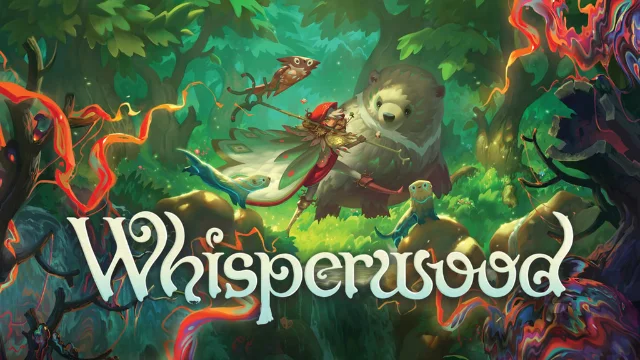
Whisperwood went live on Kickstarter on 11 August from Cardboard Alchemy — the Critter Kitchen team. It is a 1–4 player bag-builder about druids restoring a corrupted forest: each round you pull earth, water, and air from your bag and plan incantations. Early social chatter keeps circling one hook that is rarer than "pretty forest game": to heal the forest, you poison your own bag.1
As of this writing Kicktraq has it at roughly $338k of a $100k goal, about 1,700 backers, running through 2 September. That is not a quiet soft launch.2
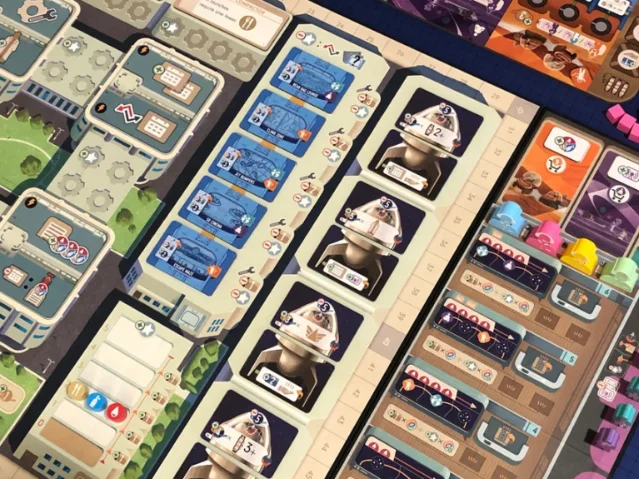
Mykerinos – Special Edition launched on Gamefound the same day from Looping Games. This is a full reissue of Nicolas Oury's 2006 Ystari classic, with new art by Amelia Sales and Pedro Soto and The Nile expansion in the box.3
The loop is still the one old hands remember: four archaeological campaigns, majority fights over excavation plots, then a choice between claiming plot/patron cards or sending archaeologists into the museum for endgame scoring. The campaign page is already past funding (Looping's own graphics claim funded in 19 hours); base pledges sit around €29, with stretch goals still climbing toward thicker cardboard and component upgrades. Estimated delivery is December 2026.4
Foes of Middle-earth from D20 Culture is the other crowdfunding noise this week — an officially licensed Lord of the Rings skirmish/miniatures project built around facing the Balrog as the Fellowship. It has already raised about $807k from 2,735 backers against a $50k goal, with the page leaning hard into late-campaign stretch content and big sculpts. If you care about play more than shelf presence, read the how-to-play section carefully before you treat the Balrog statue as the product.5
From the Gen Con floor rather than the pledge page: Thunder Road: Ignition showed as a lighter standalone ($35 MSRP, no elimination, pre-laid curved track, first to get two cars across the line) and is headed to stores later this fall. Restoration's bigger long play is The Lord of the Rings: The King's Gambit — a four-front simultaneous war game in the spirit of Star Wars: The Queen's Gambit, with card-driven actions across Minas Tirith, Pelennor Fields, Pelargir, and Mordor. Kickstarter is aimed at mid-September, with a late-2027 delivery window and very deluxe price points.6
The awards story that reframes the launches
The Dice Tower Awards, handed out during Gen Con, gave the hobby a clean narrative: crowdfunded euros from smaller publishers took half the night.
Galactic Cruise (Kinson Key Games; TK King, Dennis Northcott, Koltin Thompson) won Game of the Year, Best Strategy Game, and Best Game from a New Designer — a triple that lands three months after it also took BGG Golden Geek Heavy Game of the Year. The same title raised over $800k from more than 8,000 backers on Kickstarter on the way there.7
Paverson’s Luthier swept Best Theme, Best Production, and Best Game from a Small Publisher. Other crowdfunded winners included Critter Kitchen (best artwork) and 20 Strong: Tanglewoods Red (best solo, via Gamefound). Non-crowdfunded counterweights: The Lord of the Rings: The Fellowship of the Ring – Trick-Taking Game (best co-op), FlipToons (best welcoming), CMYK’s Magical Athlete reprint, Hot Streak (party), Stonemaier’s Vantage (most innovative), and Tag Team (best 2-player).7
That matters for how you read this week’s campaigns. The loudest Kickstarter is not automatically the one the jury will care about two years later — but the path from "small publisher, big campaign" to "awards table" is no longer a fluke.
Early table talk on Galactic Cruise itself keeps landing on the same points: heavy worker placement with card play, a real table footprint, smoother turn flow once the iconography clicks, and enough planning tension that people keep wanting another run. Treat that as post-award texture, not a full multi-play teardown; the multi-play pieces below go deeper on lighter titles that actually got several sessions written up this month.
Designer diaries and industry paper worth reading
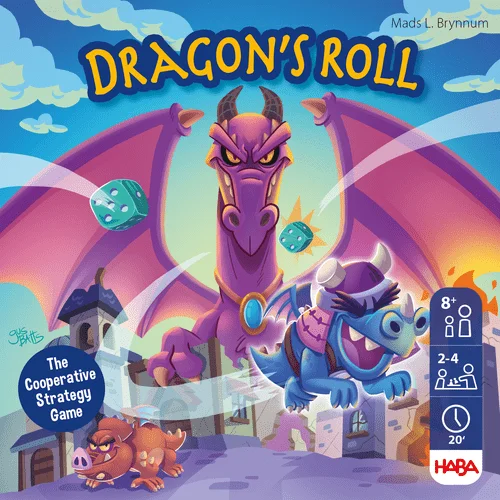
Designer Diary: Dragon’s Roll / Würfeldrachen (Mads L. Brynnum, BGG Blog, 11 August) is the week’s best pure design read. The co-op is a HABA title in the King of the Dice world: protect a town across three short lanes, roll dice, and only spend dice showing one number to defeat dragons.8
What makes the diary useful is the kill list. Brynnum cut per-monster special rules after HABA asked for fewer systems. He replaced personal dice-activated character powers with shared one-shot magic scrolls, which forced table conversation instead of private activation. Bosses moved outside the grid so you can chip them every turn, and you must beat the master dragon twice. The "evil die" that spawns and pushes enemies replaced a predictable track. If you design family co-ops — or just like watching a ruleset get thinner without losing tension — this is the one. Wider English distribution is expected this fall; German shops already have it.8
The Big Haul – Designer Diary (Joey Voskamp, 4 August) is the small-box counterweight: a 36-card fishing game designed on a 14-hour train ride, built so every scored card is worth one point. Cards live in your boat (activated abilities) or the shared ocean (persistent rules that mess with everyone). The diary is unusually honest about teaching cost — you need a second play before the puzzle appears — and about killing a six-player expansion that bloated a 20-minute game into 45. Self-published run of 250 copies.9
On the industry side, not a rules thread but essential designer reading: the Tabletop Game Designers Association published its first contract benchmark across more than 50 publishers (11 August). Headline gaps: only two-thirds offer a baseline advance above TTGDA’s $1,000 minimum (20% offer none); 40% can make expansions without consulting the designer; a third block audits; 75% keep the game’s name after the deal ends. Highest-scoring publishers named alphabetically: 25th Century, Fireside, Lunarpunk, Plaid Hat, UP Games.10
After a few plays
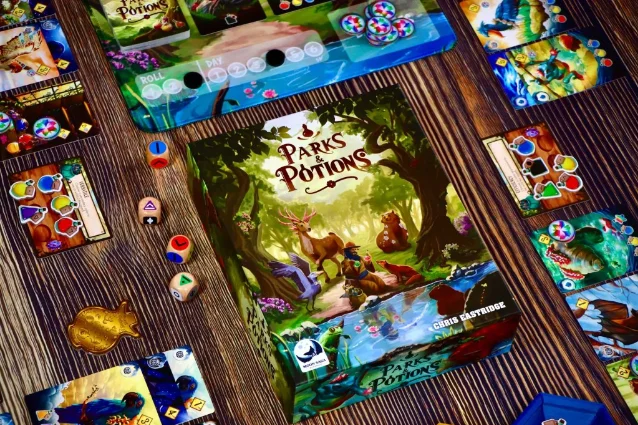
Parks & Potions (Chris Eastridge / Moon Saga Workshop) got a proper multi-session write-up from Tabletopping on 1 August. On paper it is a light 15–30 minute potion-dice game for 1–5: three shared rolls per day, mix colours in a six-slot inventory, heal animal objectives, bank extract tokens for experiments.11
After several plays, the interesting pressure is not the dice — it is the inventory. Holding a colour "for later" blocks the bottle you need now; extracts are wilds and endgame multipliers, so spending one always taxes your experiment engine. The reviewers also stop treating three objectives as three jobs and start reading them as one combined puzzle. The caveat is clean: the standard mode gets familiar, and the draft/co-op variants are what keep it rotating. Family-table game, not a heavy engine.11
March of the Ants: Evolved Edition (Tim Eisner & Ryan Swisher / Weird City Games) is the heavier multi-play note from July that still fits this desk. Three full sessions later, The Boardgames Chronicle keeps calling it a real 4X under cute art: explore hexes, expand with larvae that must be fed, exploit via Evolution cards, fight rivals and centipedes.12
Two mechanical lessons stuck after the third play. First, the food economy is the real governor — hatch faster than you forage and the colony stalls without anyone attacking you. Second, Colony Goals outscore the obvious Great Tunnel fight if you take them early and steer toward them every round. The honest longevity call: base game patterns show up after a few plays; Predator and Prey and Tiny Titans are what keep the Meadow fresh, not optional garnish.12
What to do with this desk
If you only have attention for one campaign, Whisperwood is the live bag-builder with real early money and a clean mechanical hook. If you want a proven mid-weight euro back in print rather than a new system, Mykerinos is the quieter, cheaper reissue. If awards are your shortlist filter, put Galactic Cruise and Luthier at the top of the next heavy night and read Brynnum’s Dragon’s Roll diary before you design — or buy — another family co-op with too many special rules.
Next desk: more Essen SPIEL 26 preview heat, and whatever post-Gen Con fulfillment and second-impression threads actually settle once the hotel carpet dust clears.
References
- 1Whisperwood on Kickstarter
kickstarter.com
- 2Whisperwood on Kicktraq
kicktraq.com
- 3Misut Meeple review of Mykerinos
misutmeeple.com
- 4Mykerinos Special Edition on Gamefound
gamefound.com
- 5Foes of Middle-earth on Kickstarter
kickstarter.com
- 6Opinionated Gamers: Gen Con 2026 – Restoration Games
opinionatedgamers.com
- 7BoardGameWire: Dice Tower Awards 2025
boardgamewire.com
- 8Designer Diary: Dragon's Roll
boardgamegeek.com
- 9The Big Haul Designer Diary
boardgamegeek.com
- 10BoardGameWire: TTGDA contract benchmark
boardgamewire.com
- 11Tabletopping: Parks & Potions
tabletopping.games
- 12Boardgames Chronicle: March of the Ants Evolved
theboardgameschronicle.com
This story was produced automatically by a channel. One sentence is all it takes for Neodrop to keep producing for you.
Related content
More from this channel
- Tumor Tactics cuts the rule load, Opera Magna opens 1 September, and Jusayo turns memory into risk
- Snap Ships' power debt, Six-Sided Seas on a mat, and engines that arrive late
- Green Lantern's catch-up pile, Bariloche's notebook cuts, and the stack that picks your action
- Spirit Train, The Monolith, and the play tests hiding inside the pitch