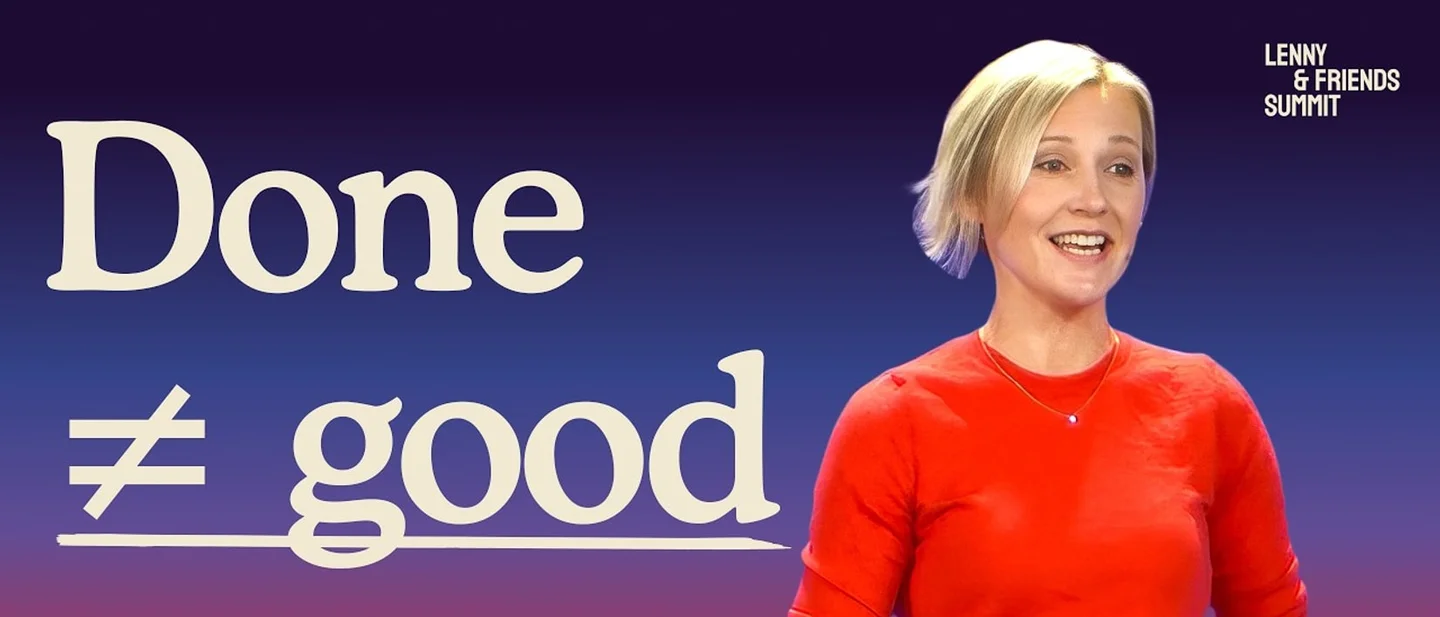
别把「做完」当成「好」:Stripe 设计负责人 Katie Dill 谈 AI 时代的僵尸 UI|Lenny's Podcast
Stripe 设计负责人 Katie Dill 在 Lenny 峰会的 22 分钟演讲:AI 让界面随手就能造出来之后,怎么避免造出一堆僵尸 UI——她给了三个要警惕的迹象与四条做法,最后落在「别把做完当成好」;文末附中英双语逐字稿。

Lenny and Friends Summit 是莱尼·拉奇茨基(Lenny Rachitsky)办的年度线下峰会,面向产品与工程负责人,2026 年这一届在 9 月 10 日于旧金山举行1。峰会现场演讲会陆续发在他的播客频道上,这一条 21 分 48 秒的视频就是其中之一,标题直译过来是《把天花板抬高:怎么用 AI 一起放大意图、质量与手艺》2,2026 年 9 月 25 日上线。
讲话人凯蒂·迪尔(Katie Dill)是 Stripe 的设计负责人。她此前在 Lyft 带设计团队,再往前在 Airbnb 做体验设计总监,更早是 Frog Design 的创意总监,2017 年入选《快公司》的「商业最具创意人物」3。她此前也上过莱尼的播客,谈的是「怎么把产品做美」4。这个履历决定了她这场演讲的形态:她不讲工具怎么用,讲的是当「把界面做出来」几乎不要钱了,设计这件事还剩下什么。
这期视频在做什么:它是一场单人口播的观点演讲,没有访谈者,也没有提问环节。迪尔要回答的是一个具体的焦虑——AI 让所有人都能造东西之后,怎么避免造出一堆看起来完成、其实没人在意过的界面。她先讲了三个需要警惕的迹象,再给出四条做法,最后落回一个判断:这一轮建造热潮里,攒下来的时间可以花在「把东西做特别」上。想决定要不要看这 22 分钟,读完下面这份摘要就够了;想核对原话,文末附了完整的中英双语逐字稿。
她先说了一段建筑史
演讲从一个类比开始。二战后美国有一次史上最大的建造热潮,新技术和新工法让房子起得飞快,那一批建造者沿用了 1920 年代现代主义的语汇:简单几何、裸露表面、单一色调、没有装饰2。
她承认现代主义的创始人有明确的意图——萨沃伊别墅(Villa Savoye)背后有观点,包豪斯(Bauhaus)背后有原则。问题出在二战后:建造的紧迫性加上新工法,让这套风格被一遍遍照抄,意图一层层变薄,最后剩下的只是「不适合当地语境的通用模式」。她的证据是对比:过去银行的门面长什么样,后来银行的门面长什么样。她说这叫僵尸建筑(zombie buildings)——彼此没有区别,看不出任何「这是有意为之、这是合乎用途」的痕迹,对使用者和周边环境都谈不上关心。
她把这段话直接接到今天:所有人都在建造,三个人的团队能干过去三十个人的活,这就是又一轮建造热潮,而它和二战后的那一轮有相似的迹象。
三个需要警惕的迹象
迹象一:大模型擅长给最可能的答案。 她说得很直接:LLM 很会告诉你什么曾经流行、什么现在流行、什么行得通;它不擅长告诉你什么是原创的、什么是属于你的品牌和你用户的具体语境的。她举的例子是一张分不出行业的主页——你猜这家卖什么?软件?其实卖韩式烤肉。这张网页本身没有错,问题在于它没有性格,也没有为用户的使用场景留下任何痕迹。
迹象二:「完成」的诱惑。 她用了自己一个不太体面的例子:冰箱里拿出来的微波炉卷饼,硬得像石头,九十秒就成了一顿饭。她对速度的迷恋让她容忍了很严重的缺陷。AI 给的是同一种感觉——你敲一句话,界面就出来了,圆角挺好看,还有点投影,「做完了」的满足感立刻到位,于是没人再问它到底解决了问题没有、到底哪里不一样。她在这里点了一句:这正是前面那一位讲者克莱尔·沃(Claire Vo)提的问题。
迹象三:工作太容易,就被当成一次性的。 她的说法是,做起来太快,人就容易把决策的责任一起放开,不去想长期的事——比如这东西以后是谁在维护。三条迹象叠在一起,最后就会出现她所说的僵尸 UI(zombie UI):单调、空洞、没有被人照料过。
什么算「被人照料过」
她列了三个日常例子,都不是宏大设计。一个是 Grok 机器人那个小的动画和动感;一个是日历标签页里真的写着日期——你大概每天都从它面前划过,但它说明做的人替你想过;一个是 Link 的智能体钱包,它把智能体网购时可能遇到的问题提前想到,把排查步骤做进去,连使用者是一个 agent 都考虑到了。
这三个例子的共同点是,做的人把「用户会怎么用」带进了工作里,于是这些东西带上了品牌的性格。她由此转到正题:AI 有时候正是那个把界面做平庸的元凶,但它也能被用来做有照料感的东西,她有四条建议。
建议一:你得先有自己的观点
她说,如果你没有观点,AI 会替你给一个,而那个观点大概率是通用的、朝后看的。所以第一件事是把自己的品牌定义清楚:它是为了什么、为了哪些用户、你想在他们眼里是什么、他们在意什么。这套定义就是你的标准。
她把这一条放到今天的组织结构里解释:当建造被分散出去,所有权也就模糊了——公司里比过去多得多的人在以各种方式参与产品,而把事情推给 AI 又太容易。她在 Stripe 举的例子是他们很在意「乐观」这件事,于是把它做进所有的细节里:选什么颜色、怎么写、写什么、给创业者交付什么样的产品。
为了让这条建议落地,她讲了一次设计评审(design crit)。当时评审的是一张广告,画面上有 Stripe 的品牌图形 parallelogram 和用户素材,大家觉得大致对,但有些地方不对。一位跨部门伙伴想快点推进,问了一个她觉得很有意思的问题:用 AI 做出来的东西,质量标准是什么?
她的回答是:用户不关心它是怎么做出来的,只关心它好不好;标准应该建立在最终产出上。这场讨论最后的产物是 17 条修改意见——毛边再柔和一点、边角再圆一点、气泡再小一点。Stripe 内部后来把这种细致的打磨当动词用,叫 Pepsi bubbling。她补了一句自己的尺度:目标不是完美,是比客户能看到的再深一层。
建议二:把标准写进机器
她的第二条建议来自一个现实:人不会参与接下来的每一个决策。明天就会出现没有设计师在场的界面,会有智能体在我们睡觉时找到问题并修掉,也会有实时生成的界面交给用户。所以她主张重新看重设计系统(design system),并且强调今天的系统跟昨天的系统不是一回事。
过去不必把所有东西都写下来,因为总有个设计师在房间里填空;现在要让分散的建造和智能体参与建造,决策必须更容易被定义。她的原话是:设计的对象不再是屏幕,而是系统本身。
她用古腾堡做类比。大家知道古腾堡造了第一台印刷机,不太被知道的是他围着这台机器建的那套系统:他不只做了 26 个小写字母和 26 个大写字母,而是做了 290 个不同的字符、不同宽度、缩写和连字,目的是让排版两端对齐时不出现难看的白河与白湖。她要的正是这个效果——系统既足够可扩展、又足够有主见,让机器做出来的东西看起来像手工做的。
Stripe 在这件事上踩过坑。他们最早做了一个理解设计文档的 MCP,效果不好:不够具体,结果也不对,三个人输入同一句提示会得到三个不同结果。后来他们改成基于设计系统做的命令行工具(CLI),相当于给 AI 加了一个 harness(约束层),让它听话得多;它跑在开发者真正干活的地方,在合适的时机读文档,避免上下文腐坏。她强调这一版和旧版设计系统最大的差别是:它不只是组件和原子部件,还包括完整的模板与流程,知道产品该有什么行为、各部分怎么拼起来。
她还引了建筑师克里斯托弗·亚历山大(Christopher Alexander)的一句话给这一段收尾:一个系统可以满足每一条规则,仍然是死的。
建议三:拒绝把「完成」当成「好」
她的观察是过滤器消失了。过去质量过滤嵌在产品开发的每个阶段:一开始有二十个想法只能给一个配人,然后是反复的推敲与修剪,产品就这样有条理地长出来。现在二十个想法一周就能造完,好处是终于可以跳过那些讨论假想产品的会,直接拿真东西在手里看;代价是过滤的位置从流程中段挪到了造完之后,而那时候说不比以前难得多。
她把接住这件事的角色叫编辑(editor),并说这个角色在今天格外重要。问题很直接:你公司里谁在看端到端,判断我们造出来的是不是一个整体?她说这里要改掉一个习惯——把「造完」当成「做完」、把「做完」当成「好」。练编辑能力最关键的一步,是自己像用户那样去体验:它真的解决了问题吗?它跟用户想事情的方式一致吗?它整体连贯吗?很多东西单看都挺好,合起来放到用户旅程里就有点脱节。而编辑做的也不只是判断好或不好,还要判断它有没有成形、怎么推它到完整。
她引了 Nabeel Qureshi 一篇谈艺术为什么好的文章:好作品在于那些意料之外的细节,那种「居然连这都想到了」的瞬间,以及表面之下的意义和把一切串成一个整体的持续主题;这些恰恰是 AI 不擅长的5。她也引了这篇文章里最狠的一句:AI 废品之所以让人反感,是因为它给人一种「细节无所谓」的感觉——杯子是绿的,但换成蓝的也没什么关系。她的结论落在编辑的责任上:编辑要为每一个决定负责,而在很多时候,每一个决定就是每一个像素。
她给的例子就来自这场峰会。活动视觉是她的团队做的,同事 Stefan 负责开场动画:先用三维场景打底,再交给 AI 做各种动画版本。她说第一版看着挺有意思,但逐像素看就不对了——动作有点跳,也不像该有的样子。改到第 56 版才到那个真正好看的结果:更真实,有一点生气,差异很微妙,但能感觉到用心。她特别点出这件事的另一面:如果没有 AI,他可能不会去搭那么复杂的场景,也不会试那么多视角。成果不是一次成型,靠的是判断力和反复推敲,但 AI 把可能性空间撑开了。
建议四:把创造力放出来
她最喜欢的是第四条。她的原话是:AI 可以帮我们量产单调,但它也是我们有过的最强的创造力催化剂。
理由和竞争的加剧绑在一起:当所有人都能造东西,做出区别会变得更难也更重要。她对当下的界面形态不满意——聊天框、图表、命令行,「这些绝不是现代交互的顶点」。她认为还有太多东西可以做:让界面有生成感、活的、能回应的、动态的;我们甚至可以直接跟电脑说话。所以她喊的是:去发明新的界面,去发明新的美学,最佳实践还没有被写下来。
她举的类比是多点触控让全新交互成为可能、合成器让人造出全新的声音。她也看见这股创造力已经在外面发生:有人做出了比过去有趣的得多的数据可视化,餐厅网站开始有性格,普通人用 AI 画画、做艺术。
Stripe 自己的做法是用 AI 放大创意团队的能力。她讲的例子是最新一本书《Built to Grow》的封面:底稿是一位做大理石纹(marbling)的艺术家做的,人在这些版本上反复打磨,再用 AI 把细节调得更细,确保颜色和线条都在该在的位置6。她的说法是,这等于把人的好判断规模化,做出真正漂亮的东西。
要跟 AI 做成更好的创作伙伴,她给的建议是两条:改善输入,把提示词写得更有针对性,说清你的品牌、你的独特兴趣、你认为什么是好,把你用来建立标准的一手材料一起放进去,让它用不同的方式想事情;压测输出,别掉进卷饼那个陷阱,永远往前再推一步,也可以用对抗性的智能体来批评和敲打它,但最终得自己要求更好。
这一场值不值得看
如果只看一段,看「建议二」那几分钟(大约第 9 到 12 分钟):把设计系统当成给 AI 的约束层来重新设计,从 MCP 换成 CLI 的那段弯路很具体,也是这场演讲里最接近可操作经验的部分。
需要说明的是,这场和同一天台上的另外几场是同一场讨论的不同侧面。克莱尔·沃讲的是判断从哪来,马蒂·卡根(Marty Cagan)讲的是产品团队被什么拖住,迪尔讲的是当产出变得便宜之后,什么值得被留下。三场连起来看,才是这次峰会给出的完整答案。
需要提醒的是,她列举的产品细节都是她在台上的说法:哪些出自某个内部小组、哪些改动带来了什么效果,本期的用处是理解她的判断,不是核实那几条产品线本身。
人物背景与外部对照
凯蒂·迪尔:Stripe 设计负责人。更完整的路径是 Lyft 设计副总裁、Airbnb 体验设计总监、Greenstart Ventures 合伙人、Frog Design 创意总监,也在加州艺术学院的研究生设计项目任教;本科是艺术中心设计学院的工业设计,另有科尔盖特大学的历史学学位3。她 2023 年上过莱尼的播客,聊的是「美为什么能建立信任」4。
Stripe Press 与《Built to Grow》:Stripe 旗下的出版品牌,出过《Working in Public》《Scaling People》一类偏工程与组织的书;《Built to Grow》讲的是创业公司怎么把早期销售做成可重复的收入引擎6。她讲的那个封面就来自这本书。
约翰·拉斯金与哥特建筑:她结尾用拉斯金做对照,说他在 1850 年前后写了很多关于质量与手艺的文字,并把哥特建筑当作典范——没有两座哥特建筑是一样的,甚至一根柱子和另一根都不一样,每个细节都带着制作者的手和心思。拉斯金那段论述出自《威尼斯之石》(The Stones of Venice,1851 至 1853 年出版)中「哥特的本质」一章7。
克里斯托弗·亚历山大:她引的「一个系统可以满足每一条规则,仍然是死的」来自这位建筑学家的论述。亚历山大是《建筑模式语言》的作者,后半生都在写四卷本的《秩序的本质》,讨论什么样的结构才是活的。
这一场的形态:与这次峰会的其他几场一样,是现场演讲的录像,没有访谈与提问环节;视频里能听到的掌声来自现场观众。
完整中英双语逐字转录稿
逐字稿说明:本稿取自本期官方视频的英文原始字幕轨(YouTube 的 en-orig 轨),措辞未作改动,仅对少量专名做了订正(如 Villa Savoye、Bauhaus、Grok bot、Three.js、Nabeel Qureshi、Claire Vo),时间码来自官方字幕;中文译文由机器翻译生成,只对专名做了统一。这是一场单人口播演讲,全篇讲话人均为 Katie Dill,时间轴每 10 分钟标注一次;字幕轨本身只在结尾标出一处 [applause],现场的掌声与观众反应未逐条收入。
00:00 - 10:00
Katie Dill:
Good morning. Right after World War II, there was a massive building boom, the largest in history. In the US, people were coming home from war. There were new technologies, new construction methods, and buildings were going up like gang busters. The builders of that day drew on the style of modernism from the 1920s. That's really simple geometries, clean, bare surfaces, monochromatic color palettes, and no adornment. Now, say what you will about modernism, but the founders behind the movement had intentionality.中文:早上好。二战结束后,出现了一次史上最大的建筑热潮。在美国,人们从战场归来。新的技术、新的建造方法层出不穷,建筑如雨后春笋般迅速竖起。那时的建筑师借鉴了 1920 年代的现代主义风格。那是一种非常简单的几何形态、干净、光秃的表面、单色调的色彩搭配,并且没有任何装饰。现在,不管你对现代主义怎么说,但运动的创始人们是有明确意图的。
Katie Dill:
There was a point of view behind the Villa Savoye. There were principles behind the Bauhaus. But after World War II, with urgency to build and new construction methods, the style was essentially copied again and again without intentionality. The thinking got thinner and thinner, and all that was left were generic patterns ills suited to the context at hand. For example, we used to have banks that looked like this, signaling trust, reliability, and security. And then we got this.中文:在萨沃伊别墅背后有一种观点。在包豪斯背后有一些原则。但二战之后,随着建设的紧迫性和新的建造方法,这种风格实际上被一遍又一遍地复制,而没有任何意图。思考变得越来越薄弱,留下的只是与具体环境不太匹配的通用模式。例如,我们过去有看起来像这样的银行,传递信任、可靠和安全的信息。然后,我们就有了这个。
Katie Dill:
You're all too familiar with this reality because it carried on for decades until this day. Zombie buildings all over the place. Nothing differentiates them. Nothing says this is intentional. This is fit to purpose. They essentially show no care for the user and the habitants around it. No care for context or the brand. I think about this a lot. One, we're surrounded by them. And two, we're in another building boom now. The AI building boom.中文:你们对这种现实太熟悉了,因为它延续了几十年,直到今天。到处都是僵尸建筑。没有什么让它们与众不同。没有什么表明这是故意为之。这是适合用途的。它们基本上不关心用户和周围的居民。不关心环境或品牌。我经常想到这个问题。一是,我们被它们包围。二是,我们现在正处于另一个建筑热潮中。人工智能建筑热潮。
Katie Dill:
Everybody and their mother can build now. Teams of three can do what teams of 30 used to be needed for. But there's echoes of the post-war building boom. Similarities that are actually watch points for us. I want to tell you about these watch points and then we'll talk about how we can navigate them together. First, LLMs are really good at telling you the most probable answer, which essentially means that they're able to tell you what has been or is popular now, what has worked, what was in style.中文:现在每个人甚至他们的母亲都可以建造。三人团队可以完成以前需要 30 人团队才能完成的工作。但这让人想起战后建筑热潮。这些相似之处实际上是我们需要关注的点。我想告诉你这些关注点,然后我们再讨论如何一起应对它们。首先,大型语言模型在告诉你最可能的答案方面非常擅长,这本质上意味着它们能够告诉你现在流行什么,什么有效,什么是时尚的。
Katie Dill:
They're less good at telling you what's original or specific to you, your brand, and your users context. I'll give you an example. Can you guess what this brand sells? Software? No. Korean barbecue. Now this is I'm sure a very fine website but it has no character no context for the user or the context of the use which brings me to my second point than temptation of done. AI makes things feel finished really really fast all too often prematurely.中文:他们在告诉你什么是原创的,或者什么是特定于你、你的品牌以及你的用户上下文的方面不太擅长。我给你举个例子。你能猜出这个品牌卖什么吗?软件?不是。韩国烧烤。我相信这是一个非常好的网站,但它没有个性,没有为用户提供上下文,也没有使用的背景。这带我到第二点,即完成的诱惑。人工智能让事情感觉很快就完成了,但往往过早地就显得完成了。
Katie Dill:
I'll give you an example that I probably shouldn't admit. I have a microwave burrito for lunch all too often. I take the cold, hard rock out of the freezer, plop it on the plate, put it in the microwave. In 90 seconds, I go from hungry to lunch. I'm willing to overlook some pretty serious flaws. It's nearly inedible, but I'm so enamored by the speed of execution. The same happens with AI. You type in a sentence and boom, you have an interface.中文:我给你举一个我可能不该承认的例子。我午餐经常吃微波炉冷冻卷饼。我把冰冷、坚硬的卷饼从冰箱里拿出来,啪地放在盘子上,然后放进微波炉。90 秒后,我从饥饿变成有午餐可吃。我愿意忽略一些相当严重的缺陷。它几乎不能下咽,但我对执行速度如此着迷。同样的情况也出现在人工智能上。你输入一句话,砰,你就有了一个界面。
Katie Dill:
There's some nice little corners and maybe some drop shadows and it's good to be done, but an apparently polished state can often be misleading. Does it really solve the problem? Does it really differentiate? All the questions Claire Vo brought up earlier apply here. And the third watch point, this work is so easy to do, so quick that it often feels disposable and worst is treated that way. We sometimes let the responsibility of our decisions fall by the wayside and don't really think about the long term, like who's maintaining this.中文:这里有一些不错的小角落,也许还有一些投影,看起来完成得不错,但表面上光鲜亮丽的状态往往具有误导性。它真的解决了问题吗?它真的有差异吗?Claire Vu 之前提出的所有问题在这里同样适用。第三个需要注意的地方是,这项工作非常容易完成,非常快速,以至于常常感觉可以丢弃,而最糟糕的是,它真的被这样对待。我们有时会让自己决策的责任被忽视,而不真正考虑长期影响,比如谁来维护它。
Katie Dill:
Anyways, all three of these watch points can come together to a world that looks a little like this, an actual place in Turkey. If we're not careful, our building boom could end up a little too much like the post-war building boom. The proliferation of patterns ills suited to the context at hand. essentially zombie UI. Zombie UI that's monotonous, vacant, or uncared for. We spend half our waking lives looking at screens. We want software that feels actually cared for.中文:无论如何,这三个观察点都可以汇聚成一个看起来有点像这样的世界,一个位于土耳其的真实地方。如果我们不小心,我们的建筑热潮可能会变得有点像战后建筑热潮。模式的泛滥不适合当前的环境。本质上是僵尸界面。僵尸界面显得单调、空洞或无人关心。我们一生中有一半的清醒时间都在看屏幕。我们希望软件看起来实际上是被用心对待的。
Katie Dill:
And that means has a little personality as something as simple as the Grok bot and the little animation and life that it brings. Or even these tiny details like actually having the date in the tab on the calendar. You probably clicked by this all day long, but that shows the builder cared about you. Or the understanding of context like the link agent wallet. It anticipates the issues that the agent could have while buying online and has the troubleshooting built in because they anticipate the context of the user even when it's an agent.中文:这意味着像 Grokbot 这样简单的东西也有一点个性,以及它带来的小动画和生命力。甚至像在日历标签中实际显示日期这样的小细节也是如此。你可能整天都会点击它,但这表明开发者关心你。或者理解上下文,例如链接代理钱包。它预见到代理在网上购物时可能遇到的问题,并内置了故障排除功能,因为它预测了用户的上下文,即使用户是代理。
Katie Dill:
These examples show builders that are care about their users and bring that care into the work. It shows the character of the brand and it has soul. We can do this with AI even though it can sometimes be the culprit. And I have four recommendations on how we can use AI to build products with care and soul. First one, you have to have a point of view. If you don't, AI will give it for you.中文:这些例子展示了那些关心用户的开发者,并将这种关心融入到他们的工作中。这展示了品牌的个性,并且它有灵魂。即使有时人工智能可能是问题所在,我们也可以通过人工智能做到这一点。我有四个建议,关于我们如何使用人工智能来打造充满关怀和灵魂的产品。第一个,你必须有一个观点。如果没有,人工智能会替你提供。
Katie Dill:
And as we've already talked about, that's very likely to be generic and looking at the past. You need to define your brand. What is it for you? What is it for your users? Who do you want to be to them? And what do they care about? This forms the basis of your standards. And I'd say this in any era, but it's all the more important right now. When building is distributed, ownership is diffuse. We're all contributing to the products in more ways than we've been in the past.中文:正如我们已经讨论过的,这很可能是通用的,并且是回顾过去。你需要定义你的品牌。它对你意味着什么?它对你的用户意味着什么?你希望在他们眼中成为什么样的人?他们关心什么?这构成了你的标准的基础。我会说这一点在任何时代都是如此,但现在尤其重要。当构建是分布式的时候,所有权是分散的。我们都以比过去更多的方式为产品做出贡献。
Katie Dill:
It's too easy to abdicate to AI. So, for example, at Stripe, we care a lot about optimism. So we put that into all the details big and small. The colors we choose, the way we write, what we write about, and the products that we ship to try to support entrepreneurs. Now, these details are so important to be aligned on because everybody is contributing and so much is changing. And I'll give you an example of where that friction can show up if there isn't alignment.中文:将责任完全交给人工智能太容易了。例如,在 Stripe,我们非常重视乐观精神。所以我们把这种精神融入到所有大大小小的细节中。无论是我们选择的颜色、我们的写作方式、我们写作的内容,还是我们推出的产品,都是为了支持创业者。现在,这些细节非常重要,需要保持一致,因为每个人都在做出贡献,而且变化非常多。我给你一个例子,说明如果没有一致性,这种摩擦可能会出现在哪里。
Katie Dill:
We were recently in a design crit looking at an advertisement. So, this is an ad we were working on that shows our brand, the parallelogram, with our users visuals. And as we were looking at this, we're like, "All right, cool. You kind of get what's happening, but some things are off. " And in the room was a cross functional partner that was looking to move fast and get something shipped. Sure, you can't relate. And we had a discussion because they brought up a really interesting question.中文:我们最近在一次设计评审中审视了一则广告。这是我们正在制作的广告,展示了我们的品牌——平行四边形,以及我们用户的视觉内容。当我们观看时,我们心里想,“好吧,很酷,你大致明白发生了什么,但有些地方不太对。”在场的是一位希望快速行动并发布产品的跨职能合作伙伴。当然,你可能很难感同身受。我们进行了讨论,因为他们提出了一个非常有趣的问题。
Katie Dill:
What's the quality standard for something made with AI? What a curious question. Why should that matter how it was made? It doesn't matter to the users how it was made. It matters to them if it's good or not. And so that is the basis of our standards. It's the output at the end of the day that matters and they care if it's good and so should we. So through that discussion, we've got alignment on what really matters here and what we're striving for and then walked away with 17 bullet points of improvements to be made.中文:用人工智能制作的东西的质量标准是什么?真是个好奇的问题。为什么制作方式会重要呢?对于用户来说,它是如何制作的并不重要。对他们来说重要的是它是否好用。因此,这就是我们制定标准的基础。最终重要的是产出,如果它好用,他们会关心,我们也应该关心。因此,通过这次讨论,我们对真正重要的事情以及我们追求的目标达成了一致,然后列出了 17 条需要改进的要点。
Katie Dill:
the frost a little bit here and there, softer edges, a bit smaller bubblers. And now we use this term as a verb to mean meticulous craft around the office called Pepsi bubbling. Now, we're not shooting for perfection. We're shooting to go one level deeper than what your customer could see. That meticulous craft will show up for them. And this point of view really drives the standards and drives the work, especially when there's agents involved.中文:这里那里有一点霜,边缘更柔和,气泡器稍微小一点。现在,我们把这个术语用作动词,意思是在办公室里进行被称为百事气泡的精细工艺。现在,我们不是追求完美。我们追求的是比客户能看到的更深入一层。这种精细的工艺会在他们面前显现。而这种观点真正推动了标准并推动了工作,尤其是在涉及代理的时候。
Katie Dill:
And so much more is happening on a daily basis. So how do you develop it? Frankly, it's all about getting really good at noticing. Notice what your users need and what they want, not just what they say. Notice what about the world around you signals good and great and meh. really take note of these things in the products that you use, but also in analogous situations so you can be inspired by art, science, and a broader point of view in the work that you create.中文:每天都有很多事情在发生。那么,你该如何开发它呢?坦白说,这完全是关于变得非常善于观察。注意你的用户需要什么和想要什么,而不仅仅是他们说什么。注意你周围世界中哪些是好的、很棒的或者一般般的信号。真正注意你使用的产品中的这些东西,同时也注意类似的情况,这样你就可以在你创造的作品中从艺术、科学以及更广泛的视角中获得灵感。
Katie Dill:
Building your sense of taste and your understanding of the world around you and what's good and great can really improve your own standards that you will then need to scale. Which brings me to my second recommendation, which is encode your standards into the machine. It would be a wonderful world if every human had the shared understandings and could make the same decision. But the reality is is humans are not going to be a part of all of these decisions going forward.中文:培养你的品味以及对周围世界和什么是好的、伟大的事物的理解,确实可以提升你自己的标准,而这些标准随后你需要去实现。这就引出我的第二个建议,那就是将你的标准编码到机器中。如果每个人类都有共同的理解并且能够做出相同的决定,那么世界将会是美好的。但现实是,未来人类不会参与所有这些决策。
Katie Dill:
We are seeing interfaces built without a designer in the room. We're seeing agents finding problems and fixing them while we sleep. And we're certainly seeing generative UI built in real time for users. This is why design systems are having a moment again. And the system of yesterday is different than the system of today. In the past, you didn't have to write everything down because there was always a designer in the room to fill in the blanks.中文:我们看到界面是在没有设计师在场的情况下构建的。我们看到代理在我们睡觉时发现问题并修复它们。我们当然也看到为用户实时生成的生成式界面。这就是为什么设计系统再次受到关注的原因。而昨天的系统与今天的系统不同。在过去,你不必把所有东西都写下来,因为总有设计师在场来填补空白。
Katie Dill:
Now, we must enable distributed building and agentic construction and the decisions need to be easier to define. So, the object of design is no longer the screen. It is the system itself. Now, everybody knows Gutenberg created the first printing press. The lesserk known part of the story is the system he built around it. He didn't create just 26 lowercase and 26 uppercase letters. He created 290 unique characters, different widths, abbreviations, liatures.中文:现在,我们必须启用分布式构建和自主构建,并且决策需要更容易定义。因此,设计的对象不再是屏幕,而是系统本身。现在,每个人都知道古腾堡发明了第一台印刷机。但故事中不太为人知的部分是他围绕它建立的系统。他不仅仅创造了 26 个小写字母和 26 个大写字母。他创造了 290 个独特的字符,不同的宽度、缩写、连字。
10:00 - 20:00
Katie Dill:
And the reason that he did this is because when he type set it and wanted it to be fully justified, he wanted to make sure that there wouldn't be the weird rivers and lakes of whites space that erode the beauty of the final product. Essentially, he was making it both extensible and opinionated enough that it could feel as good as handmade, although it was machine-made. This is what we should be aiming for as well.中文:他之所以这样做,是因为当他排版并希望完全对齐时,他想确保不会出现奇怪的白色空白的‘河流和湖泊’,破坏最终作品的美感。本质上,他让它既具可扩展性,又有足够的设计理念,使其感觉像手工制作一样好,尽管它是机器制作的。这也是我们应该追求的目标。
Katie Dill:
Now, the old system scaled consistency, but the new system needs to scale intent. We've been working on this at Stripe and, you know, have hit a few snags along the way. And so, we're we're figuring it out. But one of the things we want to do is we want to empower builders to go from prompt to production nearly instantaneously. Like many, we started with an MCP that understood our design documentation, but the results were not great.中文:现在,旧系统提高了一致性,而新系统需要提高意图的扩展性。我们一直在 Stripe 研究这个问题,过程中遇到了一些障碍。所以,我们正在解决它。但我们想做的一件事是,我们希望让开发者能够几乎瞬间从提示到生产。像许多人一样,我们从一个理解我们设计文档的 MCP 开始,但结果并不理想。
Katie Dill:
it wasn't specific enough and it wasn't driving the right outcomes. Three different people could put in the same prompt and get three different results. So since then we've evolved and now we have created a CLI built on our design system. It makes a harness that makes the AI far more obedient. Now it's where the builders are building and it consumes the documentation at the right time and place to avoid context rot. Now, importantly, the big difference between this version and a previous design system is it's not just components and atomic parts, but it's actually full templates and flows.中文:它不够具体,也没有产生正确的结果。三个不同的人输入相同的提示可能会得到三个不同的结果。因此,从那时起,我们进行了改进,现在我们创建了一个基于我们设计系统的命令行工具(CLI)。它制作了一个使人工智能更加服从的工具。现在,构建者正在使用它,它在恰当的时间和地点使用文档,以避免上下文腐败。更重要的是,这个版本与之前的设计系统的主要区别在于,它不仅仅是组件和原子部件,而是完整的模板和流程。
Katie Dill:
So, the system actually knows what our product is supposed to behave like and how it all comes together. Essentially, it's far more opinionated than it's been in the past. We embed these standards into the means of production, which enables a more coherent product. But this is just the baseline. Christopher Alexander said, "A system can satisfy every rule and still be dead. " This brings me to my third recommendation. Refuse to confuse done with good. The filter is gone.中文:所以,系统实际上知道我们的产品应该如何运作,以及它是如何组合在一起的。本质上,它比过去更加有主见。我们将这些标准嵌入生产手段中,这使得产品更加一致。但这只是基础。克里斯托弗·亚历山大曾说过:“一个系统可以满足每一条规则,但仍然是死的。”这就引出了我的第三个建议:拒绝将完成与优秀混淆。过滤器已经消失。
Katie Dill:
It used to be. Quality filter was essentially built into every stage of the product development process, even before a project started. We've got 20 ideas and we can only staff one. And then we poked and we prodded and we pruned along the way and products grew somewhat methodically. Well, now we can build 20 ideas in a week. This is awesome in many ways and we can finally skip theoretical meetings talking about hypothetical products and react to the real thing in our hands.中文:曾经是这样的。质量筛选基本上内置在产品开发过程的每一个阶段,甚至在项目开始之前就已经存在。我们有 20 个想法,但只能安排一个。然后我们一路上不断地探讨、推动和修剪,产品以某种方式逐步成长。现在,我们可以在一周内实现 20 个想法。这在很多方面都很棒,我们终于可以跳过讨论假设产品的理论会议,直接对手中的真实产品作出反应。
Katie Dill:
But the filtering that used to be throughout the process now needs to happen post build when it is a lot harder to say no. This is where the role of an editor comes in and it is ultra important in this day and age. Who is doing this in your organization? Who's looking at the end to end and understanding whether or not we're actually building a whole? It's a new behavior. We have to unlearn that built means done and that done means good.中文:但是,过去贯穿整个过程的过滤现在需要在构建之后进行,而那时很难说“不”。这就是编辑的角色所在,而且在当今时代尤为重要。在你的组织中,谁在做这件事?谁在审视从头到尾的全过程,并理解我们是否真的在构建一个整体?这是一种新行为。我们必须摒弃“构建完成就算完成”和“完成就意味着好”的观念。
Katie Dill:
The most important thing I can say to anybody working on their editing skills is you have to experience it like a user would. Does it actually solve the problem? Is it actually attuned to the way the user thinks about things? Is it actually coherent? A lot of things look good in isolation, but then when you pull it to all together into the user journey, it feels a little disconnected and it's not just about saying yes or no, this is good or it shouldn't go.中文:我能对任何在提升编辑技能的人说的最重要的一点是,你必须像用户一样去体验它。它真的解决了问题吗?它真的符合用户思考事物的方式吗?它真的连贯吗?很多东西单独看起来不错,但当你把它们整合到用户体验流程中时,就会感觉有些脱节,而且这不仅仅是关于说‘好’还是‘不好’,是否应该出现的问题。
Katie Dill:
It's actually about is it even fully formed? How can we push this to completion? We don't want done to be the enemy of good. A very insightful article by Nabeel Qureshi talks about what makes art great. And he says it's about the unexpected details, those little surprising things you're like, "Wow, I can't believe they thought of that. " And then the deeper meaning that sits behind the surface or the continuous themes that tie it all together to a whole.中文:其实问题在于它是否已经完全成型?我们如何才能将其推进到完成?我们不希望“完成”成为“好的”的敌人。Nabil Koreshi 的一篇非常有见地的文章谈到了是什么让艺术变得伟大。他说,这关乎那些出乎意料的细节,那些让你惊讶的小东西,让你想,“哇,我真不敢相信他们想到了这个。”然后,还有隐藏在表面背后的更深意涵,或者是将一切连结成整体的持续主题。
Katie Dill:
These are the things that AI is not great at. But knowing what the gaps are in AI help us better navigate that and fill these gaps in. As Nabeel says, one of the things that so offends us about AI slop is the sense that the details don't matter. The cup is green but may as well have been blue. An editor takes accountability for every decision, which is in many ways every pixel. I'll give you an example from this event.中文:这些是人工智能不擅长的事情。但了解人工智能的缺口可以帮助我们更好地应对这些问题并弥补这些缺口。正如尼比尔所说,让我们对人工智能粗糙感到反感的原因之一,就是那种细节无关紧要的感觉。杯子是绿色的,但也可能是蓝色的。编辑对每一个决策负责,在很多方面,这意味着对每一个像素负责。我给你举这个活动中的一个例子。
Katie Dill:
So my team had the pleasure of designing the event. Stefan worked on this fabulous opening animation. He and the team started with a 3D model of the scene and then they brought it into AI to help with the different animations. Now here's the first version. It's cool. It's, you know, fun to see the different little parts of it and it's nice the way it moves. But if you scrutinate, scrutinize it pixel by pixel, something feels off, right?中文:所以我的团队有幸设计了这次活动。斯特凡负责这个精彩的开场动画。他和团队首先制作了场景的 3D 模型,然后将其导入 AI 以帮助制作不同的动画。现在这是第一个版本。很酷,你知道的,看到它的不同小部分很有趣,而且它的运动方式也很棒。但是如果你逐像素仔细审视,会感觉有些不对,对吧?
Katie Dill:
That's not quite the way it should move. It's a little jilted. You kind of want to get more of the scene, right? So he did it again and again and again. 56 times, 56 iterations later, he got to something truly beautiful. Now, it's got more realism. It's got a little bit of life and it's subtle differences, but you can sense the care. Now, what one of the things that so uh impresses me about this is that if he didn't use AI, he may not have built such a complex scene or he may not have tried so many different viewpoints.中文:那种移动方式不太对。它有点僵硬。你希望捕捉到更多的场景,对吧?所以他一次又一次地尝试。重复了 56 次,经过 56 次迭代,他终于得到了真正美丽的结果。现在,它更有真实感,有一点生命力和细微的差别,但你能感受到其中的用心。我觉得令人印象深刻的一点是,如果他没有使用人工智能,他可能不会创建如此复杂的场景,也可能不会尝试这么多不同的视角。
Katie Dill:
And while it wasn't one and done and certainly took a lot of wherewithal and scrutiny, AI opened the possibility space. Now, this brings me to my last and definitely my favorite fourth recommendation. Unleash creativity and artistry. Yes, AI can help us manufacture monotony, but it is also the greatest creative catalyst we've ever had. This matters more now because when everybody in their mother is building something, it is going to be harder and more important to differentiate.中文:虽然这并不是一次完成的事情,也确实需要大量的勇气和审慎,但人工智能打开了可能性的空间。现在,这把我带到了我的最后一个,也是我最喜欢的第四个建议。释放创造力和艺术性。是的,人工智能可以帮助我们制造单调,但它也是我们有史以来最伟大的创意催化剂。这现在更为重要,因为当每个人都在构建某些东西时,差异化将变得更加困难也更加重要。
Katie Dill:
and the interfaces of today, chats, charts, CLIs. No way is that the epitome of great interactions in the modern era. There is so much more we can do and so much more we should do to make things feel generative, alive, responsive, dynamic. We can literally talk to the computers. So, let's branch out. It is time to invent new interfaces. It is time to invent new aesthetics. The best practices have not been written yet. We get to do that and now we have the tools to do it.中文:以及今天的界面,聊天、图表、命令行界面。那绝不是现代时代伟大交互的典范。我们可以做的远不止这些,我们也应该做更多,让事物感觉具有生成性、生命力、响应性和动态性。我们真的可以与计算机对话。所以,让我们拓展思路。是时候发明新的界面了。是时候发明新的美学了。最佳实践尚未被书写。我们可以去做,而现在我们有了实现它们的工具。
Katie Dill:
It's just like when multi-touch made it possible to do wholly new interactions or the synthesizer allowed us to create totally new sounds. AI is allowing all sorts of new creativity. And we're seeing so much of this online. We're even seeing folks showing up the Stripe design team with way more interesting data viz. And we're seeing websites for restaurants with character and personality and people using AI to paint and create art themselves. It is a really interesting time.中文:这就像多点触控让我们可以进行全新的交互,或者合成器让我们可以创造全新的声音一样。人工智能正在带来各种新的创造力。我们在网上看到了许多这样的例子。甚至有人在数据可视化方面展示得比 Stripe 设计团队更有趣。我们看到餐厅的网站充满了个性和特色,人们也在使用人工智能自己绘画和创作艺术。这真是一个非常有趣的时代。
Katie Dill:
And at Stripe, we're using AI to essentially amplify the abilities of the creative team. Our more most recent cover for Built to Grow, it was created by a human marbler who worked on these stunning iterations. And then we used AI to fine-tune the details ever further to ensure we had the colors and the lines in all the right places. It was basically taking the good judgment of the humans and helping us scale it to make something truly stunning.中文:在 Stripe,我们正在使用人工智能来实质上增强创意团队的能力。我们最近为《Built to Grow》制作的封面,是由一位人类大理石艺术家创作的,他在这些惊艳的版本上进行了工作。然后我们使用人工智能进一步微调细节,以确保颜色和线条都在正确的位置。基本上,这是将人类的良好判断力放大,帮助我们扩展它,从而创造出真正惊艳的作品。
Katie Dill:
Now, to make AI a stronger creative partner, there's a couple of things I recommend. One, improve your inputs. You want more specity going in the direction of your brand, your unique interests. So, put specific prompts. Don't just say, "Hey, I need a website for my Korean barbecue, but this is what I believe in. This is what good is. This is what we care about. " Add your source material that you're using to build your own standards with.中文:现在,为了让人工智能成为一个更强大的创意伙伴,我建议几件事情。第一,改进你的输入。你希望更多地朝着你的品牌方向,你独特的兴趣方向增加具体性。所以,提供具体的提示。不要只是说,“嘿,我需要一个韩国烧烤的网站,但这是我的信念。这是优质的标准。这是我们关心的。” 添加你用来建立自己标准的源材料。
Katie Dill:
Help make it think in different ways. And then stress your outputs. Don't get tempted by the burrito dilemma. always push a step further and then of course use adversarial agents to help you critique it and bang it up a little bit, but you yourself should always be pushing for better. Now, these are just tactics. The much harder thing is definitely cultural. It is easy to follow cookie cutter patterns. It's safe and cozy, but it is much more impressive and much harder to find something unique that improves the status quo.中文:帮助它以不同的方式思考。然后强调你的输出。不要被玉米卷困境诱惑。始终推进一步,然后当然使用对抗代理来帮你批评它,并稍微强化一下,但你自己应该始终追求更好。现在,这些只是策略。更难的事情绝对是文化方面的。遵循标准化模式很容易。这很安全舒适,但找到一些独特的、能改善现状的东西要难得多,也更令人印象深刻。
Katie Dill:
So, if you're leading a team, don't just tell them to use AI, but give them room to explore. Protect the strange. AI lowers the cost to create. Let's spend some of that savings on making something truly special. If we only use AI to make the things that we already make just faster, then we are definitely missing out on the most interesting part. AI can help us raise the ceiling, not just the floor. The most important thing is to be very intentional.中文:所以,如果你正在领导一个团队,不要只是告诉他们使用 AI,而是要给他们探索的空间。保护那些奇怪的想法。AI 降低了创作的成本。我们可以将部分节省下来的成本用于创造一些真正特别的东西。如果我们只用 AI 来加快已有作品的制作,那么我们无疑会错过最有趣的部分。AI 可以帮助我们提高上限,而不仅仅是改善底线。最重要的是要非常有意图地去做每一件事。
20:00 - 30:00
Katie Dill:
It's your point of view. It's your system. It's your quality bar and your ambition that you will want to bring to life with AI. In total contrast to the post-war building boom and modernism design was Gothic architecture. In 1850, John Ruskin wrote a lot about quality and craft and highlighted Gothic architecture as the epitome of great. He noticed that no Gothic building was alike. Frankly, not even one column was alike the other. Each detail was uniquely crafted and showed the unique hand and mind of the maker behind it.中文:这是你的观点。这是你的体系。这是你的质量标准和你希望通过人工智能实现的雄心。与战后建筑热潮和现代主义设计完全相反的是哥特式建筑。1850 年,约翰·罗斯金写了大量关于质量和工艺的作品,并将哥特式建筑作为卓越的典范。他注意到,没有两座哥特式建筑是相同的。坦白说,甚至没有一根柱子是完全相同的。每一个细节都是独特制作的,展示了背后制作者独特的手艺和思想。
Katie Dill:
It felt truly cared for. This is what our users want. They're not impressed if we animated something with Three.js and Blender in 30 minutes. They are impressed by us solving their problems and clever touches in the details that show we anticipated their needs and that our brand has some character behind it. We have the choice in this building boom to not make the digital equivalent of zombie buildings. We can make this a creative renaissance.中文:感觉真的得到了关心。这就是我们的用户想要的。如果我们用 Three.js 和 Blender 在 30 分钟内制作了动画,他们不会感到印象深刻。他们会对我们解决他们的问题以及在细节上的巧妙处理感到印象深刻,这些细节显示我们预见了他们的需求,并且我们的品牌有一些背后的个性。在这次建设热潮中,我们有选择不去制造数字版的僵尸建筑。我们可以让这成为一个创意复兴。
Katie Dill:
So, let's make some products that are more powerful and show the hand and care of the maker. Thanks everybody. [applause]中文:所以,让我们制造一些更强大的产品,并展示制造者的手工和关怀。谢谢大家。[掌声]
References
- 1The Lenny and Friends Summit is back!|Lenny's Newsletter
lennysnewsletter.com
- 2
- 3Katie Dill|San Francisco Design Week 讲者页
sfdesignweek.org
- 4Building beautiful products with Stripe's Head of Design|Lenny's Newsletter
lennysnewsletter.com
- 5What Makes Art Great?|Nabeel S. Qureshi
nabeelqu.co
- 6Built to Grow|Stripe Press
press.stripe.com
- 7Surface, Depth and Form: John Ruskin's 'The Nature of Gothic'|Paul Mellon Centre
paul-mellon-centre.ac.uk
This story was produced automatically by a channel. One sentence is all it takes for Neodrop to keep producing for you.