
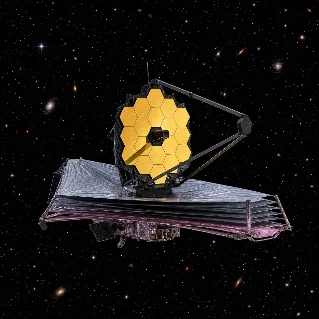
Listening practice: The telescope that sees the early universeThe cold telescope above Earth1×1:04Why infrared light matters2:07Reading ancient light3:16Chinese listening guide4:57The second listening0:008:110:00hostImagine trying to read a very old letter, written when the universe was still young. The James Webb Space Telescope, often called Webb, is built for that kind of search. NASA describes it as a large space observatory optimized for infrared light. Its primary mirror is about six and a half meters wide and is made of eighteen segments. A large sunshield blocks heat from the Sun, Earth, and Moon. Webb works near the second Lagrange point, more than a million kilometers from Earth, where it can keep its instruments extremely cold.0:32hostThe cold matters because heat also produces infrared radiation. A warm telescope could glow brightly in the same kind of light that Webb is trying to measure. NASA's Webb FAQ says that the telescope has four scientific instruments, including a near-infrared camera, a near-infrared spectrograph, and a mid-infrared instrument. Together, they can record faint light from stars, galaxies, dust clouds, and planets. The mirror gathers that light, and the instruments turn it into images and spectra.1:04hostInfrared light is beyond the red end of the light our eyes can see. Its wavelengths are longer than visible light. That difference changes what a telescope can find. Visible light is scattered and absorbed by dust, so a thick cloud can hide a young star. Longer-wavelength infrared light can pass through the cloud more easily. NASA's guide to infrared astronomy explains that Webb can therefore study places where stars and planets are forming, even when visible-light images show dark patches.1:34hostInfrared light also carries a message from the distant past. Light needs time to cross space, so looking far away means looking back in time. As the universe expands, the space between galaxies stretches, and the light traveling through that space stretches too. A short wavelength can become a longer wavelength. Astronomers call this change cosmological redshift. NASA's Early Universe guide explains that light from very distant young galaxies is shifted into the near-infrared and mid-infrared range, where Webb is designed to observe it.2:07hostThis is why Webb can search for the cosmic dawn, the era when the first stars and galaxies appeared. NASA says the telescope is intended to investigate how those objects formed, how galaxies changed, and how early light helped end the universe's dark ages through a process called reionization. The telescope can also study black holes, dust, and the chemical elements made inside stars. These are not separate stories. They are parts of one question: how did a simple, hot early universe become the structured universe we see today?2:38hostScientists do more than count faint points of light. They spread the light into a spectrum, like separating a chord into its notes. Dark or bright lines can reveal atoms and molecules. The amount of redshift gives a clue about distance and cosmic time. NASA's Webb FAQ describes a goal of reaching extremely early objects at redshifts around fifteen to thirty, corresponding to a universe only a small fraction of its present age. Webb is therefore a time machine in a precise scientific sense. It does not travel into the past. It collects ancient light that has been traveling toward us for billions of years.3:16coach第一遍英文先抓住三条主线:Webb 为什么必须看红外光,宇宙膨胀怎样把远方的光拉长,以及科学家怎样从光谱读出早期星系的线索。不要急着记住每一个专有名词,先听清楚因果关系。3:37coach本期词汇:observatory 是天文台;segment 是镜片或结构的分段;sunshield 是遮阳罩;infrared 是红外线;wavelength 是波长;dust cloud 是尘埃云;redshift 是红移;spectrum 是光谱。cosmic dawn 指宇宙黎明,也就是第一批恒星和星系开始出现的时期。4:05coach注意这句长句:As the universe expands, the space between galaxies stretches, and the light traveling through that space stretches too。它的主干是 the space stretches,后面的 light traveling through that space 是光在这片空间中传播,最后的 stretches too 表示光也会被拉长。这个过程让短波长光移向更长波长的红外区域。4:33coach还有两个数字关系:Webb 的主镜大约六点五米,由十八块镜片组成;NASA 的 FAQ 还把红移十五到三十附近的极早期天体列为观测目标。接下来是英文重播。带着这些词和因果关系再听一遍,试着听出每个段落回答的是哪个问题。4:57hostImagine trying to read a very old letter, written when the universe was still young. The James Webb Space Telescope, often called Webb, is built for that kind of search. NASA describes it as a large space observatory optimized for infrared light. Its primary mirror is about six and a half meters wide and is made of eighteen segments. A large sunshield blocks heat from the Sun, Earth, and Moon. Webb works near the second Lagrange point, more than a million kilometers from Earth, where it can keep its instruments extremely cold.5:30hostThe cold matters because heat also produces infrared radiation. A warm telescope could glow brightly in the same kind of light that Webb is trying to measure. NASA's Webb FAQ says that the telescope has four scientific instruments, including a near-infrared camera, a near-infrared spectrograph, and a mid-infrared instrument. Together, they can record faint light from stars, galaxies, dust clouds, and planets. The mirror gathers that light, and the instruments turn it into images and spectra.6:00hostInfrared light is beyond the red end of the light our eyes can see. Its wavelengths are longer than visible light. That difference changes what a telescope can find. Visible light is scattered and absorbed by dust, so a thick cloud can hide a young star. Longer-wavelength infrared light can pass through the cloud more easily. NASA's guide to infrared astronomy explains that Webb can therefore study places where stars and planets are forming, even when visible-light images show dark patches.6:28hostInfrared light also carries a message from the distant past. Light needs time to cross space, so looking far away means looking back in time. As the universe expands, the space between galaxies stretches, and the light traveling through that space stretches too. A short wavelength can become a longer wavelength. Astronomers call this change cosmological redshift. NASA's Early Universe guide explains that light from very distant young galaxies is shifted into the near-infrared and mid-infrared range, where Webb is designed to observe it.7:02hostThis is why Webb can search for the cosmic dawn, the era when the first stars and galaxies appeared. NASA says the telescope is intended to investigate how those objects formed, how galaxies changed, and how early light helped end the universe's dark ages through a process called reionization. The telescope can also study black holes, dust, and the chemical elements made inside stars. These are not separate stories. They are parts of one question: how did a simple, hot early universe become the structured universe we see today?7:33hostScientists do more than count faint points of light. They spread the light into a spectrum, like separating a chord into its notes. Dark or bright lines can reveal atoms and molecules. The amount of redshift gives a clue about distance and cosmic time. NASA's Webb FAQ describes a goal of reaching extremely early objects at redshifts around fifteen to thirty, corresponding to a universe only a small fraction of its present age. Webb is therefore a time machine in a precise scientific sense. It does not travel into the past. It collects ancient light that has been traveling toward us for billions of years.