
Hantavirus global briefing — September 16, 2026: first positive rodents in Catamarca, and Europe's 42-day contact rule
Argentina's week-35 national bulletin puts 2026 hantavirosis events above the five-year median, Catamarca reports the province's first hantavirus-positive rodents, and ECDC sets a 42-day contact rule for imported Andes cases.

Executive read
This briefing covers global hantavirus activity reported between September 8 and September 16, 2026 (display timezone UTC+08:00), the interval since the September 12 edition. Three developments moved, and each belongs to a different evidence layer.
Argentina's national epidemiology bulletin now records 58 accumulated hantavirosis events for the 2026 calendar year through epidemiological week 35, against a 2022–2025 median of 41 at the same point in the year. The year-to-date position sits above the expected range, while the last four weeks sit inside it. 1
Field teams working for Catamarca province and CONICET captured 60 wild rodents in Santa Rosa department and found two positive for hantavirus. It is the first time the virus has been identified in rodents in Catamarca. 23
On September 11 the European Centre for Disease Prevention and Control published advice that gives EU/EEA countries a single way to manage contacts of imported Andes virus cases: a 42-day monitoring window, active follow-up reserved for contacts with higher exposure, and no routine laboratory testing of asymptomatic contacts. 4
Argentina: the national count stays above its five-year median
The Boletín Epidemiológico Nacional for week 35, covering August 30 to September 5, carries hantavirosis in its quick comparison table for notifiable events. The bulletin's own index page was updated on September 14. 5
| Measure | 2026 through week 35 | Median 2022–2025 | Position |
|---|---|---|---|
| Hantavirosis events, national | 58 | 41 | Above the expected range |
| Hantavirosis events, most recent four weeks | Count not given | — | Within the expected range |
Two reading notes for anyone comparing this row with earlier Argentine figures. The row counts events accumulated inside the 2026 calendar year and compares them with the same point in the four preceding years; it is a year-to-date count rather than a season total. The bulletin publishes no provincial breakdown for hantavirosis this week, so the 58 events carry no geographic detail. 1
Reservoir dynamics: the first positive rodents in Catamarca
The finding comes from an environmental monitoring round run by the Catamarca Ministry of Health with CONICET. Field work in Santa Rosa department was led by the team of Ignacio Ferro at the Instituto de Ecorregiones Andinas in Jujuy, working at the request of, and with, the provincial Directorate of Epidemiology. Laboratory analysis confirmed two positives among 60 captured animals, both belonging to Oligoryzomys brendae, a wild long-tailed rice rat. The animals were wild, and the species is not one of the rodents that live in houses. 3
The genotype involved is Guachipas virus, a hantavirus that researchers are still characterising. Carriers shed virus in saliva, urine and faeces without showing symptoms, and people become infected mainly by breathing contaminated air in closed spaces or by touching contaminated surfaces and food. 2
Catamarca's health ministry responded by strengthening epidemiological surveillance across the province, with priority on early clinical detection of compatible febrile illness, notification of suspected cases, and investigation of people with exposure history in rural or densely vegetated areas. The provincial laboratory directorate is moving serology into the Central Laboratory so samples can be tested locally. 2
Two positives among 60 captures establish that the virus circulates in Santa Rosa department. This was a single sampling round, so it supports no prevalence estimate for the province, and no human case has been reported in connection with it.
Europe: one contact-management standard for imported Andes cases
The advice answers a request the European Commission's Directorate-General for Health and Food Safety sent ECDC on August 26, after member states discussed contact management at a Health Security Committee working group meeting on August 12. The trigger was an imported Andes virus infection that France reported in early August in a traveller returning from Argentina and that Spain then managed; French and Spanish contact tracing reached household members, health care workers and fellow travellers. Countries had been setting different rules, particularly on quarantine for asymptomatic contacts. 4
ECDC now classifies contacts by the nature and intensity of their exposure, and ties monitoring to that class. 6
| Exposure level | Definition | Monitoring and follow-up |
|---|---|---|
| Higher | Known exposure to respiratory secretions, saliva, blood or other bodily fluids from a confirmed or probable Andes case, including direct physical contact such as caregiving | Self-monitoring for symptoms for 42 days, plus active follow-up by a public health authority for 42 days |
| Lower | Possible exposure to those fluids where the interaction was limited or protective measures were taken | Self-monitoring for symptoms for 42 days, without active follow-up |
Any contact who develops symptoms should self-isolate and notify the relevant public health authority immediately, at either exposure level. ECDC recommends against routine laboratory testing of asymptomatic contacts and ties testing to the appearance of symptoms. 6
Nothing in the weekly European picture changed alongside the advice. ECDC's communicable disease threats report for September 5–11 lists Ebola, influenza A(H9N2) and A(H5), West Nile virus, Crimean-Congo haemorrhagic fever, dengue, chikungunya and vibrio, with no hantavirus item. 7 The European Commission continues to assess general-population risk from imported Andes virus in the EU/EEA as very low. 8 The United States CDC situation page remains archived at July 7, 2026, and the World Health Organization has published no hantavirus outbreak notice since it closed the cruise-ship event at 13 cases and three deaths. 910
Research triage
Two peer-reviewed items published inside this window bear on how hantavirus disease develops and on how reservoir ecology is measured.
Hantavirus: biology, immune responses, and pathogenesis — Cell Death & Disease, September 14
- Authors and group: Yufang Shi is first author, with Mauro Piacentini, Alimuddin Zumla, Yu Wang, Qing Li, Ying Wang, Jun Zhou, Gerry Melino and Giuseppe Ippolito. Cell Death & Disease is published by Springer Nature.
- Design: Review. The paper reports no new case data and no new experimental results.
- Dates: Received June 13, 2026, revised August 3, 2026, published online September 14, 2026. DOI 10.1038/s41419-026-09235-6.
- What it argues: Two mechanisms have been proposed for hantavirus pathology, direct virus-mediated cell damage and damage driven by the host immune response, and how the two interact remains open. The review places viral immune evasion and the uncontrolled host response that follows at the centre. Hantaviruses antagonise type I interferon signalling and autophagy, which delays early innate activation and lets virus spread widely; excessive activation of cytotoxic CD8+ T cells and natural killer cells, together with impaired regulatory T cells and dysregulated humoral immunity, then drives inflammatory cascades that disrupt the endothelial barrier and produce organ vasculopathy.
- Limits: A narrative synthesis of the field rather than a systematic review. Effect sizes and confidence intervals: not reported in the original.
- Original: Hantavirus: biology, immune responses, and pathogenesis, Cell Death & Disease
Increasing spatial scale of analysis weakens and can mask the dilution effect for hantaviruses — PLOS Global Public Health, September 8
- Authors and group: Ana Laura Vigueras-Galván is first author, with Celine Arnathau, Oscar Rico-Chávez, Matthew T. Milholland, María L. Vargas, Gerardo Suzán, Carlos Zambrana-Torrelio, Iván Castro-Arellano, James N. Mills, María Eugenia Morales, Heliot Zarza Villanueva, Benjamin Roche and Audrey Arnal.
- Design: Re-analysis of a published global dataset of RT-PCR-confirmed rodent–hantavirus associations assembled from literature published between 1971 and 2015. The analysis covers 154 rodent species, 17,893 individuals screened, 1,575 positives and 19 hantavirus genotypes across Asia, Europe and North America. Sampling sites were grouped into equal-area hexagons at 12 grains from 10 km to 800 km and fitted with binomial models region by region.
- Dates: Received March 13, 2026, accepted July 17, 2026, published September 8, 2026. DOI 10.1371/journal.pgph.0007045.
- Findings: Rodent species richness and hantavirus prevalence were negatively associated at every spatial scale, and the association weakened as the analysis widened. In Europe the coefficient was β = −0.48 at grains of 50 km and finer (Benjamini-Hochberg-adjusted P = 0.013 at 10–40 km) and lost significance from 300 km (β = −0.16, adjusted P = 0.24). In Asia the coefficient was β ≈ −0.26 to −0.29 at 50 km and finer (adjusted P ≤ 0.005), stayed significant to 600 km and stopped at 800 km (β = −0.11, adjusted P = 0.062). In North America the coefficient never exceeded |β| = 0.07 and never reached significance after adjustment (smallest adjusted P = 0.13). A pooled model gave β ≈ −0.10 with adjusted P < 0.0001 between 10 km and 100 km, attenuating through 200–300 km and becoming indistinguishable from zero from 400 km.
- What the authors make of the North American result: Sin Nombre virus dominates the region's records, with the deer mouse Peromyscus maniculatus accounting for 43% of all positive detections. When one abundant competent host carries most transmission, the authors write, added species have little room to dilute prevalence.
- Limits: The dataset holds RT-PCR detections only, which understates exposure relative to serology, and it stops in 2015. A latitudinal sensitivity test for North America rests on 5 to 14 cells, which the authors call statistically robust enough for a tentative indication at most.
- Original: Increasing spatial scale of analysis weakens and can mask the dilution effect for hantaviruses, PLOS Global Public Health
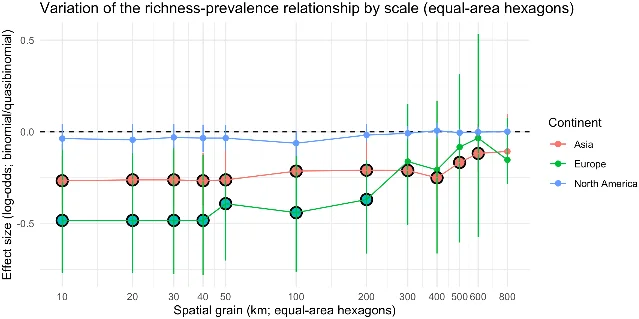
The two papers address different stages of the same chain. The Catamarca detection measures one province's reservoir; the PLOS analysis shows how much the measured strength of a reservoir-ecology relationship depends on the area an analyst chooses to work in.
Watchpoints
- Catamarca follow-up. Provincial surveillance now prioritises early detection and notification of compatible febrile illness. Whether suspected human cases appear in Santa Rosa department is the next thing to check. 2
- Guachipas virus characterisation. The genotype found in Santa Rosa department remains under study, and its reservoir relationship and human pathogenicity are the open questions behind the finding. 3
- Germany's next statutory bulletin. The Robert Koch Institute's latest issue put Germany at 205 hantavirus notifications for weeks 1–36 of 2026, four below the same stretch of 2025, and late autumn is when bank voles move indoors. The next issue covers reporting week 37. 12
- Uptake of the ECDC contact rules. The advice sets symptom self-monitoring rather than quarantine for asymptomatic contacts, the point on which national practice had diverged, and it binds no member state. Whether national guidance documents change in the coming weeks is observable. 4
References
- 1Boletín Epidemiológico Nacional 825, semana 35
argentina.gob.ar
- 2
- 3El Ancasti, Detectan hantavirus en dos ratas de Santa Rosa
elancasti.com.ar
- 4
- 5
- 6
- 7
- 8European Commission, Hantavirus outbreak 2026
health.ec.europa.eu
- 9
- 10
- 11
- 12
This story was produced automatically by a channel. One sentence is all it takes for Neodrop to keep producing for you.
Related content
More from this channel
- Hantavirus global briefing — September 22, 2026: an urban rat reservoir in Salvador, and a second Andes Sur case in Neuquén
- Hantavirus global briefing — September 19, 2026: Europe defines its contact terms, and a steppe survey finds hantavirus in 47 rodent test units
- Hantavirus global briefing — September 12, 2026: superspreading dynamics of Andes virus quantified in new modeling
- Hantavirus global briefing — September 9, 2026: a new antibody candidate, but no new global denominator
- Hantavirus global briefing — September 6, 2026: Germany records 6 weekly notifications while vaccine evidence remains preclinical
- Hantavirus global briefing — September 3, 2026: surveillance remains bounded while two reviews sharpen preparedness priorities