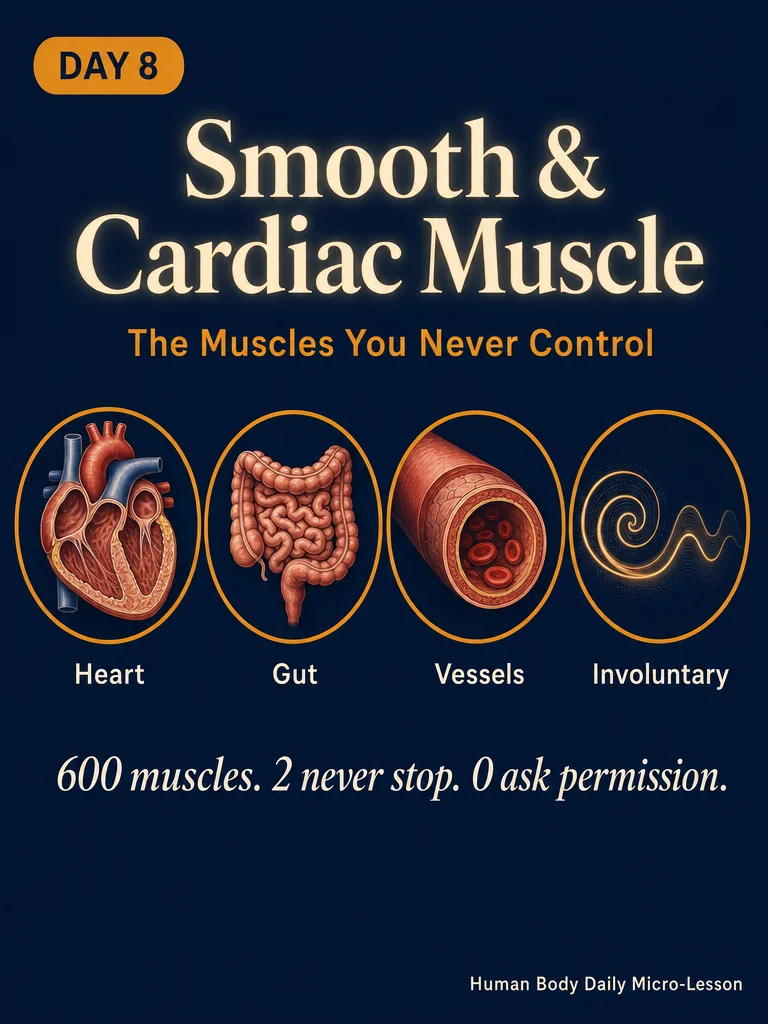

You've been contracting your biceps on purpose all week. Today meet the muscles that have been running without you the entire time.
Card 1 — The Hook
600 muscles in your body. Two of them have never once waited for instructions. Smooth muscle and cardiac muscle operate on their own logic — no nerve command required to start, no fatigue to stop them. Day 8 closes out the muscular system by introducing the involuntary half.
Card 2 — The Three Muscle Types, Compared
Day 5 gave you skeletal muscle: striated, voluntary, built to fatigue. Today's two are different in almost every way.
- Skeletal — long striped fibers, multiple nuclei at the edges, needs a motor neuron signal to contract, tires after sustained effort.
- Smooth — spindle-shaped cells, single central nucleus, no visible banding, lines the walls of your gut, blood vessels, bladder, and uterus. Contracts slowly and sustainably. Entirely involuntary.
- Cardiac — striated like skeletal but branched and interconnected through intercalated discs — specialized junctions that let electrical signals pass instantly from cell to cell. Lives only in the heart. Never fatigues. Self-pacing.
The key structural feature of cardiac muscle: intercalated discs allow the whole heart to contract as one synchronized unit rather than fiber-by-fiber.
Card 3 — Why It Matters
Your heart doesn't wait for your brain. The sinoatrial (SA) node — a cluster of specialized cardiac cells in the right atrium — spontaneously depolarizes about 70 times per minute. That's myogenic rhythm: the heartbeat originates in the muscle itself. A transplanted heart keeps beating even after all nerve connections are severed, because the SA node runs autonomously.
Meanwhile, smooth muscle in your intestines is squeezing food forward right now in rhythmic waves called peristalsis — circular muscle layers contracting sequentially, pushing 3–5 cm per minute. That post-meal stomach rumble is your smooth muscle at work, no thought required.
Card 4 — Today's Exercise: Feel Your Cardiac Muscle
Place your index and middle fingers on the inside of your wrist, just below the base of your thumb (radial pulse). Count the beats you feel for 15 seconds, then multiply by 4. That number is your resting heart rate in BPM.
Normal range: 60–100 BPM. Trained endurance athletes often sit at 40–60 BPM — not because their hearts beat slower out of laziness, but because a stronger heart ejects more blood per beat, so it needs fewer beats to deliver the same output. Every pulse you count is a cardiac muscle cell firing on its own schedule, every second of your entire life.
Day 8 of 30 · Human Body Daily Micro-Lesson
Tomorrow — Day 9: The Heart — Your Body's Pump
Comments