

Six bids, 18 months: Oracle takes PeopleSoft
2026. 6. 14. · 08:25

Six bids, 18 months: Oracle takes PeopleSoft

In June 2003, Larry Ellison launched an unsolicited $5.1 billion bid for PeopleSoft — four days after PeopleSoft announced a deal that would have leapfrogged Oracle in the ERP market. What followed was the second-longest hostile takeover in modern M&A history: six escalating bids, a federal antitrust trial, a Delaware Chancery proceeding over an unprecedented contractual poison pill, and a CEO firing timed to the minute of a court ruling. The deal closed in December 2004 at $26.50 per share ($10.3 billion) — and Harvard Law later calculated Oracle overpaid by $1.4 billion because it never asked what would happen if it triggered the target's own defective poison pill.

리서치 브리프

On June 2, 2003, PeopleSoft announced it would acquire J.D. Edwards for $1.7 billion in an all-stock transaction. 1 The move was logical: PeopleSoft would leapfrog Oracle to become the world's second-largest enterprise applications vendor, behind only SAP. Four days later, Larry Ellison made it the most expensive deal trigger in software history.
On June 6, Oracle launched an unsolicited all-cash bid at $16 per share, totaling $5.1 billion — targeted directly at PeopleSoft's shareholders, bypassing its board entirely. 2 What followed was the second-longest hostile takeover bid in modern M&A history — 18 months from announcement to resolution, surpassed only by U.S. Surgical's bid for Circon. 3 It involved a federal antitrust trial, a Delaware Chancery hearing, a contractual innovation that had no precedent in corporate law, and a CEO firing timed so precisely to an appellate decision that it reads, in retrospect, like choreography.
The final price was $26.50 per share$10.3 billion in total, a 66% premium over Oracle's opening bid. 4 Harvard Law professor Guhan Subramanian later argued Oracle overpaid by $1.4 billion because of a negotiation error it never recognized it had made. 3
This case is about how three legal battles — antitrust, Delaware corporate law, and a novel contractual poison pill — created three independent blocking mechanisms, and how each one dissolved at a different rate.

The parties: objectives, leverage, and what each side would never say aloud

PartyStated objectiveBATNAHidden preferenceKey leverage
Oracle (Ellison)Acquire PeopleSoft's 12,000-customer ERP install base; block it from surpassing Oracle in market rankWalk away; watch PeopleSoft/JDE become a stronger rivalAcquire at the lowest possible price; damage PeopleSoft's sales in the interim even if the deal never closedAntitrust uncertainty as a permanent cloud; cash bid visible to shareholders
PeopleSoft (Conway)Reject the bid and close the JDE merger; protect employees and customersRemain independent; extract the highest possible price if forced to sellAvoid any deal at any price; Conway's career survival depended on independence 5CAP's $2B contingent liability; antitrust regulatory uncertainty as a shield
DOJ Antitrust DivisionPrevent a two-to-one consolidation in "high function" enterprise softwareLitigate through trialEstablish a precedent for unilateral effects theory in differentiated-product marketsPreliminary injunction authority under Clayton Act §7
Delaware Chancery (Strine)Determine whether PeopleSoft's poison pill and CAP were legally enforceable defensive measuresDefer to transaction outcomeAvoid setting an irreversible precedent on contractual poison pillsPower to redeem or invalidate the defensive mechanisms blocking the deal
PeopleSoft shareholdersMaximize per-share valueReject the Oracle tender offerAccept Oracle's offer if the price exceeded what independence could deliverTender or withhold shares; vote out the board

Act I: The opening gambit and the trigger it created

Ellison's stated motive for the initial bid was transparent to the point of being tactically reckless. He announced publicly that Oracle wanted PeopleSoft's customer list — not its products, not its employees. PeopleSoft CEO Craig Conway, a former Oracle sales executive who had left under adversarial circumstances, described Oracle's behavior as "atrociously bad behavior from a company with a history of atrociously bad behavior." 6 Ellison's own assessment of Conway was equally unsparing: "If Craig and the dog were standing next to each other, trust me — I have one bullet — it wouldn't be for the dog." 7
The personal animus was a strategic liability for Oracle. It made Conway a credible public defender — he had insider knowledge of Ellison and could attack with specificity — while simultaneously making him impossible to negotiate with. Wharton professor Harbir Singh observed that Oracle's motivation "might be positive — to enhance its competitive position — or it might be negative — Ellison's personal drama, and a desire to disrupt two competitors." 1
The $16 opening bid immediately handed PeopleSoft a PR gift. Conway ran a full-page Wall Street Journal advertisement addressed directly to PeopleSoft customers, warning that Oracle intended to "discontinue all PeopleSoft products, ultimately forcing customers to convert to Oracle's applications and database" — at a cost of "millions to tens of millions of dollars" per organization. 6 SAP, watching from the sidelines, immediately launched its own advertising campaign. Global operations head Leo Apotheker told the Financial Times that SAP stood ready to offer PeopleSoft and JDE customers "an alternative," capitalizing on the "enormous uncertainty." 1
On June 18, Oracle raised its bid to $19.50 per share — a 22% increase in 12 days, totaling $6.3 billion. 8 PeopleSoft rejected it. The JDE deal closed. And PeopleSoft's legal team prepared something that had never been done before.

Act II: The Customer Assurance Program — a poison pill that was also a business strategy

PeopleSoft's Customer Assurance Program (CAP) was embedded directly into new software license agreements. The mechanism: if PeopleSoft was acquired and the acquirer subsequently reduced product support, upgrades, or new releases within a specified window, affected customers would receive a cash refund of two to five times their original license fees. 9 The refund window extended to roughly four years post-acquisition.
The structure had no corporate law precedent. A traditional poison pill operates as a governance mechanism — the board can redeem it at any time. The CAP was a contractual obligation to third parties. Once a customer signed a license agreement containing CAP language, PeopleSoft could not unilaterally revoke that customer's rights. Harvard Law professor Lucian Bebchuk called it "an especially worrisome takeover defense, because a poison pill is reversible in a way that this plan was not designed to be." 10
The program's financial scale escalated rapidly. PeopleSoft initially disclosed a potential liability of approximately $800 million; by mid-2004 the total contingent obligation had reached nearly $2 billion. 11 Oracle's own Delaware court filings acknowledged the problem directly: "If the PeopleSoft board is permitted to continue to issue self-serving, entrenchment-motivated contracts under the revised money-back offer, Oracle may be forced to abandon its bid as it will no longer be economically viable." 2
Oracle EVP Chuck Phillips framed the shareholder angle: "It helps the customer but makes any potential acquirer have a huge liability. It's making [PeopleSoft] worthless and taking control from the shareholders." 9 PeopleSoft countered that the program was "very positive for customers and very positive for shareholders" — the customer confidence it preserved translated directly into continued sales. 9 Jennifer Arlen of NYU Law School later confirmed this was legitimate value preservation, not just managerial entrenchment: the CAP "induced Oracle to increase its bid by more than 60 percent." 12
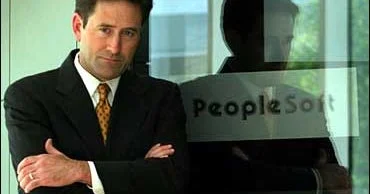
Craig Conway at PeopleSoft headquarters, October 2004
Craig Conway at PeopleSoft's Pleasanton, CA offices. His firing on September 30, 2004 — timed to the same day Oracle won its antitrust trial — became the clearest signal that PeopleSoft's board was opening the door to a deal. 13

Act III: The DOJ antitrust trial — the defense that collapsed first

On February 26, 2004, the Justice Department, joined by ten states, filed suit in the Northern District of California to block the merger. 14 Case number 3:04-cv-00807 — United States v. Oracle Corporation — was the DOJ's first major antitrust challenge to a merger in differentiated-product markets relying primarily on unilateral effects theory. 15 The government's market definition: "high function HRM software" and "high function FMS software" — a two-to-one consolidation that would leave only SAP as a remaining competitor.
The trial ran from June 7 to July 1, 2004, with closing arguments on July 20. While the trial proceeded, Oracle briefly lowered its bid — on May 14, 2004, Oracle CFO Jeffrey Henley announced a cut from $26 to $21 per share (from $9.4 billion to $7.7 billion), a $1.7 billion reduction that had no precedent in major hostile takeover history. 8 Henley's stated rationale — "Our revised offer reflects changes in market conditions and in PeopleSoft's market valuation" — was technically accurate; PeopleSoft's stock had fallen to $17.30. 8 Piper Jaffray analyst Tad Piper read it more directly: the cut "represents in some ways a diminished interest on Oracle's part." 8
On September 9, 2004, Chief Judge Vaughn R. Walker issued his decision — 331 F. Supp. 2d 1098 — denying the preliminary injunction. The ruling rejected the government's market definition on its face: "'High function software,' as defined by plaintiffs, has no recognized meaning in the industry." 15 Walker found that market participants used the terms "enterprise software," "up-market software," and "Tier One software" — and that within those markets, Oracle and PeopleSoft competed against Lawson, Microsoft, and customers' own legacy systems, not only against each other. 15 The DOJ announced on October 1, 2004 that it would not appeal. 14 The EU Commission followed, granting unconditional approval (COMP/M.3216) later that month. 16
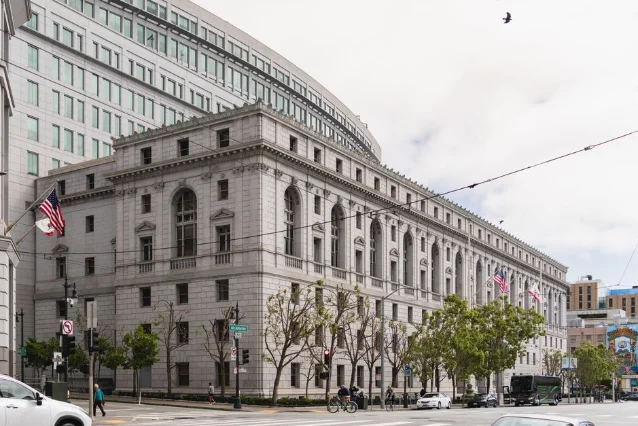
Federal courthouse in San Francisco, Northern District of California
The Northern District of California courthouse in San Francisco — where Chief Judge Vaughn R. Walker issued United States v. Oracle Corp., 331 F. Supp. 2d 1098, on September 9, 2004.
The ZOPA — the zone where a deal was economically possible — had been invisible for 15 months because of antitrust uncertainty. The Walker ruling did not change Oracle's willingness to pay or PeopleSoft's willingness to sell. It changed the probability that a deal, if reached, could actually close.

Act IV: Conway fired — the negotiation signal no one officially sent

The timing was not coincidental. On the evening of September 30, 2004 — three weeks after the Walker ruling and the day before DOJ announced it would not appeal — PeopleSoft's board convened without Conway present and voted unanimously to remove him as president and CEO. 13 The public announcement came Friday morning, October 1.
Board director George "Skip" Battle issued the official statement: "The decision regarding Mr. Conway resulted from a loss of confidence in his ability to continue to lead the company." 5 When an analyst pressed Battle on whether the firing had anything to do with Oracle, he replied: "Your speculation that this has something to do with positioning ourselves in some direction with regard to Oracle is just not right." 5
The market's interpretation diverged sharply from Battle's. PeopleSoft shares jumped $2.98 to $22.83 on the day of the announcement — past Oracle's standing $21 bid — implying the market had immediately priced in a higher deal. 5 Wedbush Morgan analyst Nathan Schneiderman put it plainly: "PeopleSoft is definitely heading toward negotiations with Oracle. They see the writing on the wall. Now it's just a matter of price." 17 Yankee Group analyst Sherryl Kingstone, noting the board's denial, said: "Even if they say it has nothing to do with Oracle, that's the only reason I can think of." 17
Conway received a $4 million severance — twice his annual salary and bonus — with stock options worth potentially $60 million if the Oracle deal closed. 5 Founder Dave Duffield, 63, returned as CEO immediately. Analyst David Hilal of Friedman, Billings & Ramsey summarized what the succession signal meant for negotiations: "He's a warm, fuzzy teddy bear, but he's also a shrewd businessman. There's no doubt that Ellison and Conway didn't like each other. If they were both trying to squeeze the last drop of blood out of each other, it would be very difficult to negotiate. Dave would be easier to deal with, and that's better for both sides." 5
링크 미리보기를 불러오는 중…

Act V: Delaware and the CAP's uncertain fate

While the antitrust track was resolving, a parallel battle ran in Wilmington. Vice Chancellor Leo E. Strine Jr. of the Delaware Court of Chancery presided over a two-week trial beginning October 4, 2004, in which Oracle asked the court to invalidate both PeopleSoft's traditional shareholder rights plan and the CAP. 11
The CAP had been revised six times by the time of trial. Strine characterized customers who had signed early CAP versions as "innocent purchasers" — their contractual rights could not be retroactively stripped. 18 His remark that the hearing was "as much a business deal as a legal action" captured something real: 18 both Ellison and co-president Safra Catz took the stand, and PeopleSoft's board members were required to explain under oath why they had fired their CEO three days before the trial began.
Strine never ruled. On December 13, 2004, Oracle and PeopleSoft reached a merger agreement at $26.50 per share. 19 The Delaware litigation was immediately suspended; Strine held a brief meeting with counsel that day in which the CAP received "only scant mention." 10 Bebchuk, reflecting on the outcome, expressed a bleak form of hope: "Right now, the validity of this defense is left in doubt…. I hope the uncertainty would chill and discourage its actual use in the future." 10 Lawrence Hamermesh of Widener Law School was less diplomatic: "Does a settlement deprive the world of the benefit of his thinking? Absolutely." 10

Act VI: The final bid — $26.50 and how it got there

Oracle raised its bid from $21 to $24 per share on November 1, 2004, calling it a "best and final offer" and setting a November 19 deadline. 20 Ellison noted the deal would "accelerate our growth all over the world." 20 PeopleSoft told shareholders to wait.
The decisive meeting came on the weekend of December 12–13, 2004. PeopleSoft's board — now led by Duffield — reached out to Oracle directly, inviting Ellison to examine non-public financial information he had not previously seen. After reviewing the data, Oracle agreed to move from $24 to $26.50 per share. The $2.50 increment, modest as a percentage, was the difference between a rejected board recommendation and an endorsed one. 7
"Skip" Battle, who chaired the board's transaction committee, called it "a long, emotional struggle" in which PeopleSoft employees had "consistently performed well under the most challenging of circumstances." 21 Ellison, on the same day Oracle announced a strong quarterly result, said: "Today we announced both a great quarter and the agreement to acquire PeopleSoft. This merger gives Oracle even more scale and momentum." 4
By December 10, approximately 120.6 million shares had been tendered and not withdrawn. 22 The deal closed in January 2005. The combined entity had roughly 54,000 employees, more than 23,000 customers, and annual revenue exceeding $2 billion — holding 25% of the ERP market against SAP's 39%. 7 Ellison committed to developing PeopleSoft 9 and JD Edwards 6 and providing at least ten years of continued product support. 4
Duffield left the CEO role on December 29, 2004 — 16 days after signing. In 2005, he co-founded Workday with former PeopleSoft executive Aneel Bhusri, building a cloud-based HR and finance platform that would compete directly with Oracle for the next two decades.
Oracle PeopleSoft combined brand mark, 2004
The Oracle-PeopleSoft brand following deal close — the combined entity held 25% of the global ERP market. 11

The bid escalation in full

Oracle's offer moved six times across 18 months:
DatePer shareTotal valueContext
June 6, 2003$16.00$5.1BInitial hostile bid, 5 days after JDE announcement
June 18, 2003$19.50$6.3B+22%; PeopleSoft closes JDE deal, CAP created
February 2004$26.00$9.4B+33%; DOJ files antitrust suit same month
May 14, 2004$21.00$7.7B−19%; antitrust trial pending; PeopleSoft stock at $17
November 1, 2004$24.00$8.8B+14%; DOJ cleared, EU cleared, Conway fired
December 13, 2004$26.50$10.3B+10%; PeopleSoft board opens data room; deal signed
링크 미리보기를 불러오는 중…

Frameworks you can use

Hostile-bid escalation as information extraction

Each Oracle bid served two functions: an offer to PeopleSoft's shareholders and a probe of PeopleSoft's board. The $16 opening established a baseline that PeopleSoft immediately weaponized in its public messaging — Subramanian later identified this as Oracle's first negotiation error, providing PeopleSoft with "Exhibit A" in its PR campaign. 3 Oracle's second error was raising to $26 while the DOJ investigation was underway — at that price, PeopleSoft's board could not have accepted even if it wanted to; antitrust clearance was a precondition to any deal closing. 3
The practical takeaway: in a hostile bid under regulatory review, the bidder should not anchor high until the regulator has cleared the transaction. High anchors made before a precondition is satisfied are information gifts to the target — they reveal the bidder's ceiling without creating any obligation on the target to respond.

The defective poison pill and the "last look" problem

PeopleSoft's standard poison pill had a design flaw that inverted its intended function. Installed in 1995 when PeopleSoft's share price was $33–34, the pill's dilution factor had ballooned to 24x by 2004 as the stock declined — nearly double the software industry average of 13x. 3 If triggered, the pill would have required issuing 6.0 billion new shares worth an estimated $58.8 billion — larger than the total global common stock issuance of $170 billion in all of 2004. 3
The potency was the problem. The pill also contained a ten-day redemption window after a trigger event — what Subramanian calls the "last look" provision. Any board confronting a $58.8 billion dilution would have redeemed the pill rather than let it fire. This made the pill, in game-theoretic terms, a non-credible threat — PeopleSoft could not commit to financial Armageddon. As Subramanian wrote: "By giving PeopleSoft a last look to avoid disaster, the pill in fact weakens PeopleSoft's bargaining hand." 3
Subramanian calculated that deliberately triggering the pill — or even credibly threatening to — would have allowed Oracle to acquire PeopleSoft for approximately $22.75 per share: $3.75 less than the $26.50 paid, saving $1.4 billion in total acquisition cost. 3 Oracle never contemplated this path.
For practitioners designing poison pills: calibrate dilution to be severe enough to deter, but not so extreme that no board would actually allow it to fire. The credibility of the deterrent depends on the acquirer believing the target will not blink.

The CAP as post-bid BATNA enhancement

The Customer Assurance Program demonstrates a category of defensive tactic that sits outside traditional corporate law entirely: obligations to third parties (customers, suppliers, partners) that create contingent liabilities large enough to make a hostile acquisition economically marginal.
Three effects made the CAP work as a BATNA enhancer. First, it stabilized PeopleSoft's revenue base immediately after Oracle's announcement — customers who received a money-back guarantee had less reason to delay purchases or switch to SAP. 12 Second, the $2 billion contingent liability added directly to Oracle's effective acquisition cost, shrinking its return on the transaction unless it could neutralize the liability through continued product support. Third — and unlike a traditional poison pill — the CAP could not simply be cancelled by the PeopleSoft board after a successful tender offer; Oracle would have had to negotiate separately with each affected customer or honor the support commitments outright.
Arlen's broader finding: strict shareholder choice — requiring board approval for any post-bid defensive measure — would have prevented PeopleSoft from adopting the CAP quickly enough to protect Q3 2003 revenue. The CAP was not entrenchment; it was value preservation made possible by a governance structure that gave the board discretion. 12

Regulatory preemption as a defensive weapon — and the day it runs out

The antitrust track gave PeopleSoft 15 months of cover. As long as the DOJ suit was pending, Oracle's bid could not close regardless of shareholder support or board position. This rendered the normal mechanics of hostile takeover pressure — shareholder accumulation, proxy fights, board seat challenges — irrelevant. Conway's strategy of aggressive public resistance was rational precisely because closing was impossible.
The Walker ruling changed the calculus in a single day. Once the antitrust defense dissolved, Conway's combative posture — which had been a coherent strategy for blocking — became an obstacle to extracting maximum value. The board's dilemma: the CEO whose confrontational style was essential during the blocking phase was now impeding the negotiation phase. The three-week gap between the Walker ruling (September 9) and Conway's removal (September 30) was the board resolving this dilemma in the only way available to it.
The lesson transfers directly to any deal involving regulatory review as a de facto defense: model the scenario in which the regulator clears the deal, and decide in advance whether your current negotiating team and posture remain optimal under that scenario. If the answer is no, the leadership transition should be planned — not improvised in the three weeks after the ruling.

What to remember

  • Antitrust uncertainty is a structural blocking mechanism, not just a tactic. PeopleSoft's board did not need to outmaneuver Oracle on price for 15 months — the DOJ did it for them. The deal's ZOPA was undefined until the Walker ruling resolved the probability that a transaction could close. Mapping which regulatory clearances are preconditions to completion — and sequencing offers accordingly — is underweighted in most hostile bid playbooks.
  • The CAP raised Oracle's effective acquisition cost by $2 billion without Delaware ever ruling on its validity. The legal uncertainty was the point. An irreversible contractual obligation to third parties is a fundamentally different defensive instrument than a redeemable shareholder rights plan — the board cannot simply cancel it to enable a deal, and the acquirer cannot ignore it. Bebchuk's hope that unresolved legal status would "chill and discourage" future use of similar programs has not been definitively tested; the Oracle-PeopleSoft settlement left the question open. 19
  • Firing the CEO can be the most legible negotiation signal a board can send — because it is simultaneously deniable. Conway's removal was coordinated with the DOJ's non-appeal announcement on the same day. The board denied any Oracle connection. The stock market responded as if the deal had become a question of price, not possibility. Boards planning leadership transitions in the context of hostile bids should treat the timing of CEO changes as a signaling decision with immediate market consequences.
  • Oracle's $1.4 billion overpayment resulted from never asking "what happens if we trigger the pill?" Subramanian's game-theoretic analysis showed that the correct move — deliberately triggering the defective pill — was never on Oracle's option list. The "looking forward and reasoning back" prescription applies in any negotiation where the other side has an apparently powerful commitment device: before conceding that the device is credible, model what would actually happen if it were activated. The answer is often not what the device's designer intended. 3

Cover image: AI-generated scene. The Stanford Graduate School of Business published the landmark teaching case "Oracle's Hostile Takeover of PeopleSoft" (CG4A, 2006), authored by Robert Daines, Vinay Nair, and Davina Drabkin; it was a Case Centre bestseller in 2012 and 2013. 23

관련 콘텐츠

이 콘텐츠를 둘러싼 관점이나 맥락을 계속 보강해 보세요.

  • 로그인하면 댓글을 작성할 수 있습니다.