Five papers: June 21, 2026
2026. 6. 21. · 09:17

Five papers: June 21, 2026

Five papers from the June 21, 2026 window — a Sunday weekend drought that left the major journals without new primary research, with Nature Communications filling the gap. Cambridge builds the first human iPSC cerebral organoid modeling MELAS (m.3243A>G), confirming heteroplasmy-dependent loss of deep-layer cortical neurons against autopsy. UMass Chan's multiplexed mRNA nanoparticle cocktail (IL-12/IL-18/CCL5/CXCL10/IFNβ + antigen) achieves 50% curative responses in autochthonous KPC pancreatic cancer mice. Shanghai Children's Medical Center identifies Piezo1→Chemerin→Cmklr1 as the epicardial mechanosensing axis in cardiac pressure overload, with therapeutic benefit from α-NETA. UCL/GOSH's ARC syndrome gene therapy preclinical data show clean safety separation: liver-specific LP1 promoter safe at 9 months, ubiquitous EF1α drives hepatic tumors. Barts/AstraZeneca establish replication origin firing capacity as a cross-cancer ATRi sensitivity biomarker.

리서치 브리프

Five papers indexed June 21, 2026, ranked by journal IF tier and translational signal. All five come from Nature Communications — NEJM, JAMA, BMJ, Lancet main, Nature Medicine, and Nature Cancer published zero new primary research articles in this window, a weekend drought that has persisted for four to six days across most of those journals. Rankings weight journal tier, study design rigor, human-tissue validation, and directness of therapeutic implication.

Ranking basis

Papers are ordered by (1) journal IF tier within the Nature Comms cohort, then (2) study design (human organoid + autopsy validation > autochthonous preclinical curative > mechanistic + human sample validation > gene therapy safety discrimination > multi-omics biomarker), then (3) proximity to a clinical decision point. Today's top-2 are tied on journal and are separated by the depth of translational signal: the MELAS organoid provides a disease-modeling breakthrough in a mutation space where no animal model exists; the PDAC mRNA cocktail puts a 50% curative rate in an autochthonous model on record and has already spun out a company.
통계 카드를 불러오는 중…

1. iPSC cerebral organoids model m.3243A>G MELAS, implicating heteroplasmy-dependent deep-layer cortical neuron loss

Journal: Nature Communications — IF ~16 (Tier 2) 1
Study design: iPSC-derived cerebral organoid model (slice cultures) from patients carrying the m.3243A>G mtDNA mutation; single-cell RNA sequencing; human autopsy validation in a MELAS patient brain specimen.
Key findings: High-heteroplasmy organoids showed preferential loss of deep-layer cortical neurons (long-range projection neurons), driven by mitochondrial-stress-triggered axonal degeneration and apoptosis — a cell-type-specific vulnerability that low-heteroplasmy organoids did not display. The transcriptional signature mapped directly to the human autopsy specimen: the pattern in the organoid matched the one found in the post-mortem MELAS cortex. 1 No animal model for this mutation exists; this organoid system is the first tractable human preclinical platform for m.3243A>G.
"Our findings provide insights into the vulnerability of long-range projection neurons in mitochondrial diseases, advancing our understanding of disease mechanisms with a view to potential therapeutic strategies."
— Hathazi et al.
Clinical/research implications: The m.3243A>G mutation causes the majority of MELAS (mitochondrial encephalomyopathy, lactic acidosis, and stroke-like episodes) cases and a significant share of maternally inherited diabetes with deafness. The absence of a viable animal model has stalled mechanistic understanding and drug testing for decades. The heteroplasmy-threshold effect — where neuronal vulnerability only manifests above a certain mutant-to-wild-type mtDNA ratio — is now directly addressable: the organoid system can be used to titrate heteroplasmy levels and screen compounds that shift the threshold or protect projection neurons. The autopsy concordance substantially raises confidence that the model reflects actual human pathology rather than an in vitro artifact.
Authors/institution: Hathazi D, Lyons G, Horvath R et al.; University of Cambridge (lead). Published June 21, 2026.

2. Multiplexed cytokine + antigen mRNA cocktail achieves 50% curative responses in autochthonous PDAC

Journal: Nature Communications — IF ~16 (Tier 2) 2
Study design: Autochthonous (KPC) pancreatic ductal adenocarcinoma (PDAC) mouse model; intratumoral and systemic nanoparticle-formulated mRNA delivery; NK and CD8+ T cell profiling; antigen-reactive T cell persistence assays. PMID 42321218. 3
Key findings: A cocktail encoding IL-12, IL-18, CCL5, CXCL10, and IFNβ mRNAs, administered intratumorally, activated NK and CD8+ T cells and reduced tumor growth and fibrosis in KPC mice. Combining the cytokine mRNAs with tumor antigen mRNAs enhanced dendritic cell antigen presentation and CD8+ T cell priming; a single dose extended survival. When the cytokine/antigen mRNA cocktail was encapsulated in lipid nanoparticles for systemic delivery to autochthonous PDAC tumors, 50% of animals achieved curative responses with persistent antigen-reactive T cells. 2
"Nanoparticle encapsulation of the cytokine/antigen mRNA cocktail allows systemic administration and local delivery to autochthonous PDAC tumors in mice, culminating in curative responses in 50% of animals and antigen-reactive T cell persistence."
— Parikh et al.
Clinical/research implications: PDAC's immunosuppressive tumor microenvironment — depleted of pro-inflammatory cytokines and resistant to T cell infiltration — has frustrated checkpoint inhibitor trials. The multiplexed mRNA strategy circumvents this by directly delivering what the TME lacks. The autochthonous model result is material: KPC tumors are widely regarded as the most clinically predictive PDAC preclinical model, substantially harder to treat than transplant models. Systemic delivery of the nanoparticle formulation is a practical advance over intratumoral injection for a dispersed, often inaccessible tumor type. The research team has filed two PCT patent applications (PCT/US2025/031926 and PCT/US2026/030619) and co-founded ImmunoScript, Inc. — the translational pathway is active. Disclosed competing interests include Boehringer Ingelheim consulting.
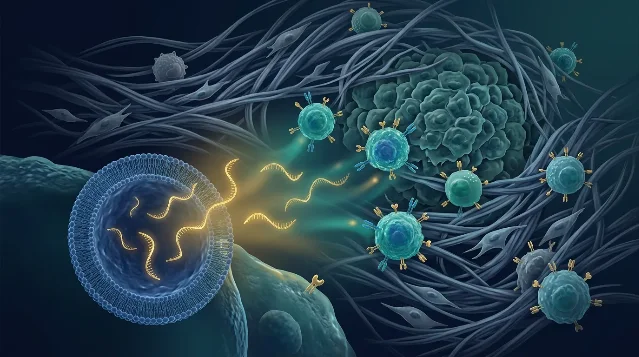
Lipid nanoparticle releasing mRNA strands to activate immune cells against a pancreatic tumor mass surrounded by desmoplastic stroma
Conceptual illustration of the multiplexed mRNA delivery mechanism: lipid nanoparticle (left) releasing cytokine/antigen mRNA strands that activate teal-colored immune effector cells converging on the tumor. AI-generated illustration.
Authors/institution: Parikh N, Ruscetti M et al.; UMass Chan Medical School. Published June 19, 2026.
Links: DOI 10.1038/s41467-026-74574-z · PMID 42321218

3. Piezo1–Chemerin–Cmklr1 paracrine axis drives cardiac fibrosis; Cmklr1 inhibitor α-NETA shows therapeutic activity

Journal: Nature Communications — IF ~16 (Tier 2) 4
Study design: Single-cell spatial transcriptomic atlas of mechanosensitive ion channels in transverse aortic constriction (TAC) mice; epicardial-specific Piezo1 knockout; in vitro Chemerin-Cmklr1 paracrine assays; α-NETA pharmacological intervention; human cardiac sample validation. PMID 42321193. 5
Key findings: Piezo1 was the most highly expressed mechanosensitive ion channel in epicardial cells. Epicardial-specific Piezo1 knockout reduced fibrosis and preserved cardiac function in TAC mice. 4 The mechanism: pressure-overloaded epicardial cells secrete Chemerin, which binds Cmklr1 on ventricular fibroblasts, activating the Pi3k-Akt1-Pou3f1 downstream pathway and driving fibroblast-to-myofibroblast transition. α-NETA, a Cmklr1 inhibitor, effectively mitigated myocardial fibrosis and dysfunction in the TAC model. The pathway was validated in human cardiac tissue.
Clinical/research implications: Cardiac fibrosis is a downstream effector of nearly every chronic cardiac pathology — hypertension, aortic stenosis, heart failure with preserved ejection fraction — and has no approved direct antifibrotic therapy. The Piezo1-Chemerin-Cmklr1 axis is a cell-type-specific paracrine circuit that operates upstream of conventional fibrogenic cascades. The human-sample validation moves this beyond a mouse-only phenomenon. α-NETA already exists as a pharmacological tool compound; a selectivity profile against related chemerin receptors (CCRL2, GPR1) will be the next gatekeeping experiment before any IND-enabling work. The epicardial origin of the signal also opens a potential epicardial-targeted delivery strategy to minimize systemic Cmklr1 inhibition effects.
Authors/institution: Zeng Y, Zheng X, He Q et al.; Shanghai Children's Medical Center, Shanghai Jiao Tong University School of Medicine. Published June 19, 2026.
Links: DOI 10.1038/s41467-026-74703-8 · PMID 42321193

4. Liver-specific lentiviral gene therapy rescues ARC syndrome; ubiquitous vector triggers hepatic tumors in 3/5 mice
Journal: Nature Communications — IF ~16 (Tier 2) 6
Study design: Vps33b-knockout mouse model of ARC syndrome (arthrogryposis, renal dysfunction, and cholestasis); two lentiviral vector designs — LP1 (liver-specific promoter) and EF1α (ubiquitous promoter); 9-month safety observation; survival, liver function, fibrosis, and canalicular structure endpoints. PMID 42321174. 7
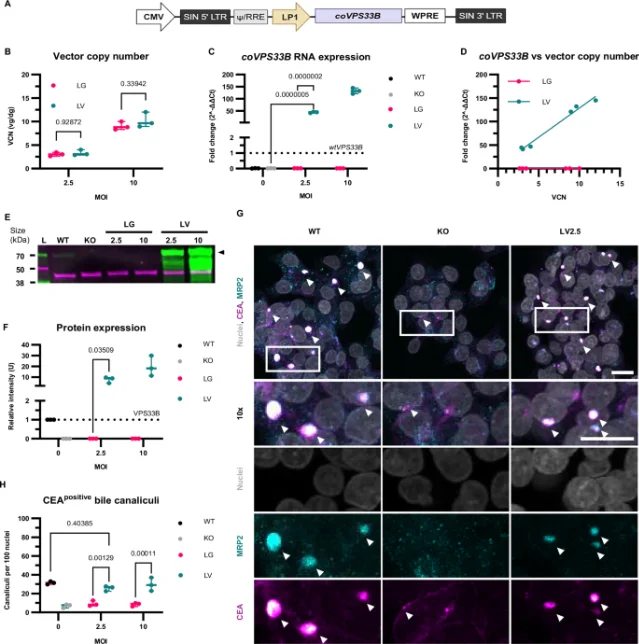
Key findings: LP1-VPS (liver-specific) treatment improved survival, normalized growth, restored hepatic function, and reduced fibrosis and bile canalicular defects. No hepatic tumors were observed in LP1-VPS-treated mice over 9 months. In contrast, EF1-VPS caused hepatic adenomas and hepatocellular carcinoma in 3/5 mice; EF1-GFP caused tumors in 2/5 mice — insertional oncogenesis at the EF1α promoter level. 6 Transient clodronate liposome-mediated hepatic macrophage depletion before vector administration enhanced hepatic transduction efficiency.
Lentiviral gene therapy vector comparison across ARC syndrome mouse model endpoints
LP1-VPS vs. EF1 vector efficacy comparison in Vps33b-knockout ARC mice — survival, liver histology, and canalicular structure. 6
Clinical/research implications: ARC syndrome, caused by loss-of-function VPS33B mutations, is a rare and usually fatal early-onset multisystem disorder with no disease-modifying treatment. This is the most complete preclinical safety and efficacy package yet reported for any lentiviral approach to a congenital hepatobiliary disorder. The promoter-choice tumor-risk split is the central finding for regulatory purposes: EF1α-driven vectors remain a safety concern in this setting, while LP1 appears clean at 9 months — the standard minimum for pre-IND LV safety data. Separately, Genespire's GENE202 (a related LV gene therapy for methylmalonic acidemia) has received both FDA and EMA orphan drug designation and is expected to enter the clinic in 2026, suggesting a development-ready manufacturing platform that ARC could potentially access. The macrophage depletion transduction-enhancement protocol is a practical optimization detail that matters for clinical translation, where vector dose is a cost and safety variable.
Authors/institution: Cozmescu A-C, Gissen P et al.; UCL Great Ormond Street Institute of Child Health, London. Published June 19, 2026.
Links: DOI 10.1038/s41467-026-73631-x · PMID 42321174

5. Replication origin firing capacity predicts ATR inhibitor sensitivity across cancer types and AML patient samples

Journal: Nature Communications — IF ~16 (Tier 2) 8
Study design: Multi-omics (proteomics, transcriptomics) and functional analysis across cancer cell lines; CDC7/CDK2 inhibitor and CDC45 overexpression perturbation experiments; validation in breast cancer, colorectal cancer cell lines, and acute myeloid leukemia (AML) patient samples. PMID 42321192. 9
Key findings: ATRi-sensitive cancer cell lines showed high expression of DNA replication initiation factors (including CDC45) and a correspondingly elevated origin firing rate. The relationship is causal: CDC7 inhibition or CDK2 inhibition decreased ATRi sensitivity; CDC45 overexpression increased it. 8 High replication initiation factor expression predicted ATRi sensitivity in breast cancer, colorectal cancer, and AML patient samples — an across-cancer validation of the biomarker. ATR inhibitors (iniparib, ceralasertib, elimusertib, camonsertib) are in multiple ongoing clinical trials; no clinically validated patient stratification biomarker currently exists.
Clinical/research implications: ATR (ataxia telangiectasia and Rad3-related) is a master kinase coordinating the replication stress response. Cancers with high replication origin firing are dependent on ATR to prevent catastrophic fork collapse, making them selectively vulnerable to ATRi. The problem has been that ATRi trials have enrolled unselected patients, diluting efficacy signals. A multi-omics biomarker that is causal — not merely correlated — and validated across tumor types with mechanistic perturbation experiments is exactly what ATRi drug development needs for enriched Phase 2 design. AstraZeneca, which markets ceralasertib and co-authored this study, has direct commercial motivation to apply this stratification. Independent validation in archival trial samples before prospective use is the standard next step; the CDC45 expression assay will need to be ported to a clinically deployable IHC or NanoString platform.
Authors/institution: Lumeau A, McClelland S et al.; Barts Cancer Institute, Queen Mary University of London / AstraZeneca. Published June 19, 2026.
Links: DOI 10.1038/s41467-026-74588-7 · PMID 42321192

Notable mentions

Two papers from this window outside the top 5:
mCRPC 34-metastasis multi-omics — functional evolutionary convergence (Nature Communications, PMID 42321191) 10: Weng, Trigos, Sandhu et al. (Peter MacCallum / UCSF / UCL) profiled 34 metastases from 9 mCRPC patients by rapid autopsy using single-cell multi-omics and whole-genome sequencing. Recurrent intratumoral subpopulations appeared convergently across diverse clonal backgrounds and microenvironments — suggesting systemic selection pressure independent of local context. Microenvironmental co-adaptation signals were present despite minimal transcriptional heterogeneity driven by the TME. The functional convergence concept has direct implications for which subpopulation to target therapeutically in a tumor that will inevitably evolve.
First atomic-resolution sevoflurane binding site in a voltage-gated sodium channel (Nature Communications, PMID 42321197) 11: Hollingworth, Hemmings, Wallace et al. (Birkbeck / Weill Cornell) solved the X-ray crystal structure of sevoflurane bound to NavMs (a prokaryotic VGSC homolog), identifying a membrane-embedded hydrophobic pocket where the anesthetic displaces a lipid molecule. Alanine substitution at a conserved tyrosine abolishes sevoflurane binding. Sevoflurane modulated fast and slow inactivation of human Nav1.1, consistent with a membrane-assisted gating pathway. This is the first atomic-level description of a volatile anesthetic binding site in a VGSC — mechanistically relevant for understanding anesthetic depth, drug interactions at the channel level, and the structural basis for developing more selective neuronal sodium channel modulators.
Cover image: Pexels / Tima Miroshnichenko

관련 콘텐츠

이 콘텐츠를 둘러싼 관점이나 맥락을 계속 보강해 보세요.

  • 로그인하면 댓글을 작성할 수 있습니다.