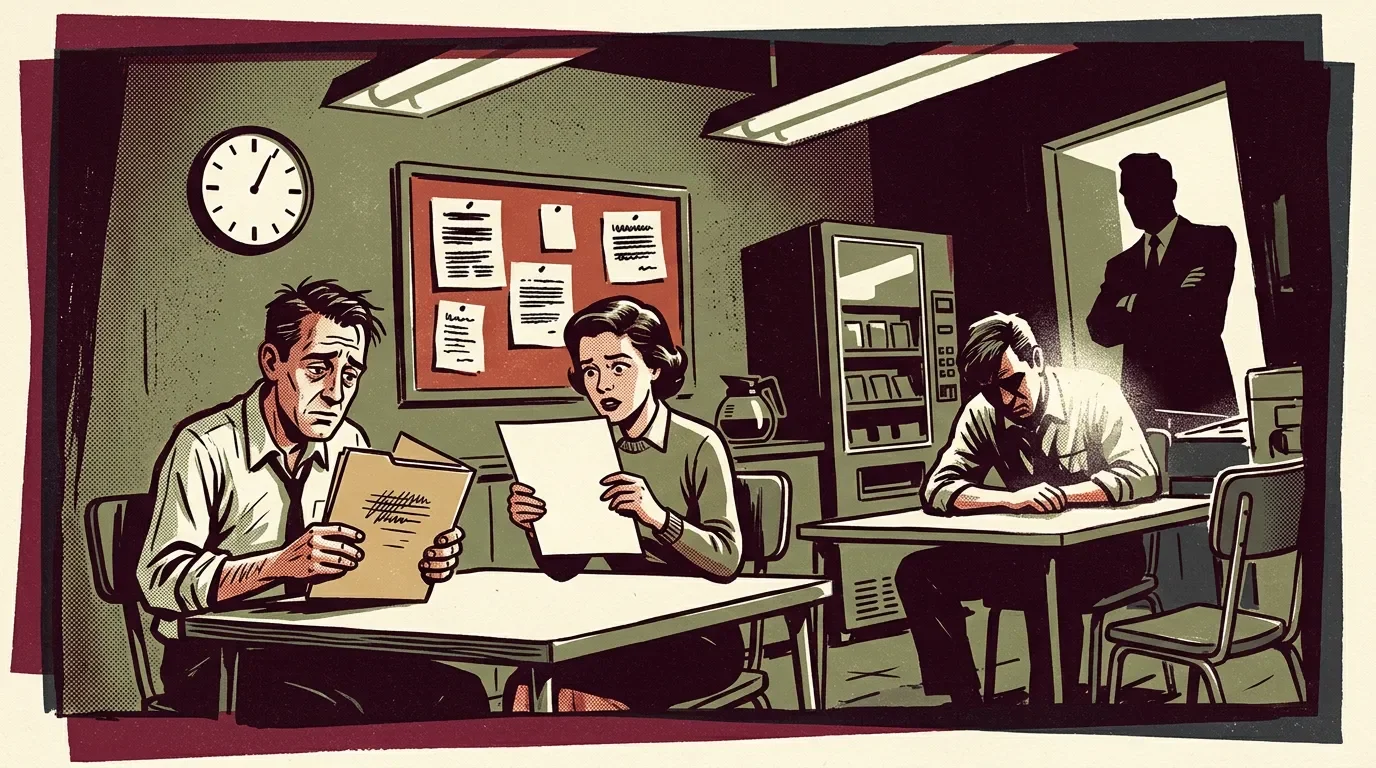
The Paper Trail, the Poisoned Reference, and the Public Diagnosis
Three Reddit workplace stories show how employers turn ordinary systems into leverage: sudden attendance files, retaliatory references, and humiliation dressed up as concern.

A workplace does not need a dramatic villain to become a problem. Sometimes the red flag is quieter: paperwork appearing all at once, a former manager poisoning references, or a boss deciding your medical issue is now meeting-room entertainment.
This week's three stories are all from Reddit posts published July 2-3, 2026. The authors' real-world identities are not public beyond their Reddit accounts, so treat the facts as firsthand claims from the posts, not court records. That is still enough to spot the pattern.
Pattern: retroactive discipline
The r/antiwork post came from a healthcare admin who said they had been at a hospital for 6.5 years, had recently moved to full-time, and was suddenly called in by an assistant manager over "9 latenesses" despite saying they were always early and had never been written up before. The listed examples were one- and two-minute arrivals: "7:01 on 1/5," "7:02 on 2/1," and "7:01 on 2/13." 1
Then came the really elegant little guillotine: according to the post, the manager said "we'll just say this was 4," followed by an email asking the employee to sign that, because of the "9 occurrences," the hospital could fire them whenever. The same employee said multiple long-tenured workers were written up, including a ten-year tech and two recent nursing-school graduates. 1
The thread had 72 comments and a score of 469 when read. The useful part of the reaction was not just "lawyer up," although, naturally, Reddit got there in about four seconds. Commenters focused on whether altered or cherry-picked time records could become wage-theft or retaliation evidence, and one suggested that a non-union hospital can become a union target when management angers enough people at once. 2 3
The structural pattern is simple: management lets tiny alleged violations accumulate invisibly, then turns them into a firing file when it needs leverage. The employee experiences it as sudden. The company gets to pretend it was documenting all along.
Red flags before you are inside:
- Attendance rules exist, but enforcement history is vague or inconsistent.
- Managers talk about "occurrences" without showing the running record in real time.
- Long-time employees suddenly receive similar warnings at the same time.
- The company asks you to sign broad discipline language that does more than acknowledge a specific event.
The original post is worth reading because the tiny timestamps are the whole story:
콘텐츠 카드를 불러오는 중…
Pattern: post-employment control
The r/jobs post came from a Colorado dispensary worker who said they worked at the company for two and a half years. After getting pregnant about a year in, they said their manager and HR agreed they would return two days a week after a four-month state-covered maternity leave. When they came back, they said they were scheduled for only three shifts in the first month and 12 shifts across the next three months. 4
The worker eventually gave three weeks' notice. On the last day, they said the manager called them "a great employee," said they would be considered for rehire, and promised a good reference. Six months later, according to the post, the same manager was allegedly telling prospective employers not to hire them because of attendance issues. The author said they had never received an attendance point, had been 10 minutes late once because of a train, and had worked while sick. 4
The thread had 26 comments and a score of 129 when read. Commenters split between "get proof and talk to a lawyer" and the colder practical view: in a small industry, people may protect each other, and the worker may need replacement references outside that circle. One commenter also pointed out why many employers limit references to dates of employment and rehire eligibility. 5 6 7
The structural pattern here is nastier than a bad reference. It is a company keeping influence over an ex-worker's future after quietly starving their schedule. The formal relationship ends. The leverage keeps walking around in other people's inboxes.
Red flags before you are inside:
- "We will work with you" is never put into a written return-to-work plan.
- Hours disappear after a protected or sensitive life event, but nobody calls it discipline.
- The company promises a good reference while refusing to document rehire eligibility.
- The local industry is small enough that one manager's private version of events can travel faster than your resume.
Here is the original r/jobs post:
콘텐츠 카드를 불러오는 중…
Pattern: concern as public humiliation
The r/work post came from a head of events for a small city in the South. They said they had a new boss of about six weeks, only a handful of interactions with him, and a major event coming the next day with 30 people working under them. 8
The employee had developed a leg infection after scraping a knee while volunteering at a farmers market and had told the boss two days earlier that they were receiving treatment. On the second-busiest day of their year, while doing heavy lifting, the boss called them in front of his own boss and allegedly started insinuating that the employee was homeless and living out of their car. The employee said they responded that they lived in a $1,300-a-month apartment and were receiving three forms of treatment. 8
The thread had 26 comments and a score of 62 when read. The comments were thinner than the other two threads, but still useful: one person suggested that the boss's response to being confronted would matter, because an apology and a repeat offense mean different things; another pushed back that sharing medical information with a new boss can create its own risk. 9 10
That second point is uncomfortable, but useful. Bad managers often operate in the gray zone between "I was just concerned" and "I publicly reframed your body, health, or personal life as a performance problem." The move is especially effective when the worker is too busy, junior to the room, or dependent on the job to call it what it is.
Red flags before you are inside:
- New managers make personal inferences from limited information.
- Private health context becomes public discussion without a work-related need.
- The boss's boss watches inappropriate behavior and lets the silence do the policy work.
- You are expected to absorb humiliation because the operational calendar makes quitting expensive.
The original post is here:
콘텐츠 카드를 불러오는 중…
The useful takeaway
The common thread is not "bad vibes." It is leverage. The hospital story is leverage through paperwork. The dispensary story is leverage through reputation. The events-office story is leverage through social rank.
Before accepting an offer, ask boring questions and listen for slippery answers: How are attendance issues documented? Who gives references, and what do they disclose? How are health or family accommodations handled? Who is allowed to correct a manager in public?
A good workplace will not be perfect. But it should be able to answer those questions without acting like you just asked to inspect the vault.
참고 출처
- 1No prior writes ups than 9 occurrences out of no where.
- 2Comment on final-warning post
- 3Comment on final-warning post
- 4I left my job on good terms, but now they're sabotaging new job opportunities - I'm worried I'll never work in my industry again.
- 5Comment on reference-sabotage post
- 6Comment on reference-sabotage post
- 7Comment on reference-sabotage post
- 8My brand new boss just caused the most personally offensive moment of my life, but I can't quit.
- 9Comment on public-humiliation post
- 10Comment on public-humiliation post
관련 콘텐츠
- 로그인하면 댓글을 작성할 수 있습니다.
More from this channel
- The Offer That Vanished, the Salary Band That Didn't, and the Stolen Wireframe
- The Exit Reversal, the Empty Director Job, and the Vanishing Promotion
- The Last-Minute Interviewer, the Cash Register, and the Data-Migration Hole
- Three Reddit Red Flags: The Resignation Letter, the Nurse Callout, and the Noncompete
- The Handbook, the AI Voicemail, and the Review Cycle
- The Bag Search, the Lunch Break, and the FAANG Hire
- Three More Red Flags From This Week's Workplace Horror Stories