2026. 7. 3. · 12:38
Nature & Science: white dwarfs, CAR-T, ice
This week’s ranked digest leads with JWST spectroscopy of a planet orbiting a white dwarf, GPNMB CAR-T cells for glioblastoma, and a Science paper connecting East Antarctic ice-sheet formation to continental breakup and tectonic uplift.
Coverage window: June 26, 12:24 p.m. to July 3, 12:00 p.m. ET. This week's Nature and Science scan is led by a James Webb Space Telescope (JWST) atmosphere detection around a white-dwarf planet, a chimeric antigen receptor T cell (CAR-T) strategy for glioblastoma, and a Science paper tying East Antarctic ice-sheet formation to deep Earth processes. The ranking below weights visible attention proxies, press pickup, community discussion where confirmed, and scientific significance. Where an exact Altmetric score was not available from the cited sources, the attention field reports confirmed signals instead of a numeric substitute.
| Rank | Paper | Journal / date | Field | Confirmed signal |
|---|---|---|---|---|
| #1 | Aerosols and hydrocarbons in the atmosphere of a white dwarf planet | Nature, July 1, 2026 | Exoplanet atmospheres | Strongest visible attention signal: ESA/Webb, Cornell and other coverage around the first atmospheric characterization of a post-main-sequence transiting planet. 1 2 |
| #2 | Dual tumour-myeloid targeting of glioblastoma with GPNMB CAR-T cells | Nature, July 1, 2026 | Cancer immunotherapy | Broad biomedical pickup plus a Nature X post reported at 8,476 views. 3 4 |
| #3 | Continental breakup-driven uplift instigated East Antarctic Ice Sheet formation | Science, July 2, 2026 | Earth science / climate history | Reuters, GFZ and EurekAlert coverage; the paper connects continental breakup, uplift and Antarctic glaciation. 5 6 |
| #4 | Observation of quantum vortex core fractionalization and skyrmion formation in a superconductor | Science, July 2, 2026 print issue | Condensed-matter physics | High scientific significance: fractional vortices and chiral skyrmions observed in KFe2As2. 7 |
| #5 | Zonated mechanosensing by PIEZO1 controls liver regeneration | Science, July 2, 2026 | Regeneration biology | High biological significance: PIEZO1 links zonated mechanical sensing to liver regrowth. 8 |
#1: JWST catches a planet after stellar death
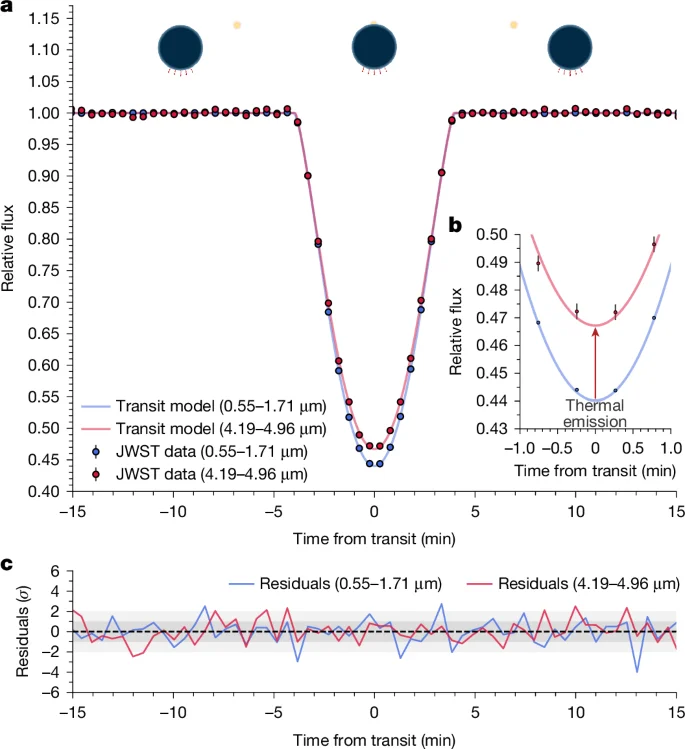
Paper: Ryan J. MacDonald at the University of Michigan, Christopher E. O'Connor at Cornell University, Susan E. Mullally at the Space Telescope Science Institute, and co-authors reported JWST NIRSpec PRISM transmission spectroscopy of WD 1856 b, a Jupiter-sized planet orbiting the white dwarf WD 1856+534. 1 The observation used a transit on April 27, 2023 under JWST GO Program 2358, with MacDonald listed as principal investigator. 1
Why it ranked here: This was the week's clearest attention outlier. ESA/Webb covered the result as evidence that a planet can survive its star's death, and Cornell also issued institutional coverage of the international team behind the study. 2 9
What the paper found: The 0.5 to 5.0 micrometer spectrum points to methane-rich hydrocarbons, aerosols and nightside thermal emission. 1 The paper reports methane as preferred with an odds ratio of 167 to 5,377:1 and about 7% atmospheric abundance, while aerosol evidence is reported at 2 x 10^5 to 2 x 10^6:1. 1 The planet's mass is constrained to 4.3 to 10.9 Jupiter masses, and its effective temperature is reported at 390 to 412 K rather than the expected equilibrium temperature of about 160 K. 1
Why it matters: WD 1856 b is presented as the first atmospheric characterization of a post-main-sequence transiting planet. 1 The result gives exoplanet scientists a rare direct probe of what can happen to giant planets after a Sun-like star leaves the main sequence. The unusually warm atmosphere also points to migration-related reheating billions of years into the white-dwarf phase, which makes the paper relevant to both atmospheric retrievals and late-stage planetary dynamics. 1
Evidence check: The finding rests on a single transiting white-dwarf planet, so readers should treat it as a benchmark case rather than a population-level conclusion. The reason to read it first is that the paper combines a striking object, JWST spectroscopy and a survival problem with direct observational leverage.
#2: GPNMB CAR-T tries to hit glioblastoma on two fronts
Paper: Neil Savage, Shan Grewal, Sheila K. Singh at McMaster University and co-authors reported a CAR-T strategy against GPNMB in glioblastoma. 3 The study identifies GPNMB as a dual-compartment antigen expressed on glioblastoma tumor cells and tumor-associated macrophages, and the paper reports that GPNMB is largely absent from healthy adult brain. 3
Why it ranked here: The paper had the strongest biomedical attention signal in this issue. Nature's X post on the paper was reported at 8,476 views, and the study also drew coverage from BioWorld, Medical Xpress, Inside Precision Medicine and News-Medical. 4 10
What the paper found: Multi-omic profiling identified GPNMB in both the tumor compartment and the immunosuppressive myeloid compartment. 3 The paper reports that whole-cell proteomics across 43 matched primary-recurrent glioblastoma samples placed GPNMB among the top-percentile proteins upregulated at relapse. 3 Anti-GPNMB CAR-T cells showed long-term disease control in orthotopic patient-derived xenograft models and syngeneic glioma models. 3
Why it matters: Solid-tumor CAR-T work often runs into antigen heterogeneity and a suppressive tumor microenvironment. This paper is important because GPNMB gives the therapy one target across two problem spaces: tumor cells and tumor-associated myeloid cells. The companion framing from Nature Cancer described GPNMB-directed CAR-T therapies as an important advance for solid-tumor targeting. 11
Evidence check: The evidence is preclinical. The mouse-model disease-control signal is strong enough for a high ranking, but the paper does not by itself establish human clinical efficacy or safety. For translational readers, the question is whether dual targeting can survive the move from controlled models into patient heterogeneity.
#3: Antarctic ice may have needed tectonic lift plus lower CO2
Paper: Thomas M. Gernon of the University of Southampton and collaborators published a Science paper on East Antarctic Ice Sheet formation. 5 GFZ Helmholtz Centre reported that Gernon, Sascha Brune, Thea Hincks and collaborators link Jurassic continental breakup to mantle waves that lifted East Antarctica toward glaciation-friendly elevations. 6
Why it ranked here: This was the clearest Science paper by mainstream pickup. Reuters covered the finding on July 2, and GFZ followed with a detailed release on July 3. 12 6
What the paper found: The paper argues that CO2 decline alone does not explain why Antarctica glaciated long before the Arctic. 5 The proposed mechanism starts with Africa-Antarctica breakup, continues through mantle-wave-driven uplift, and leaves large parts of East Antarctica high enough for ice to gain a permanent foothold. GFZ reports that large areas of the Gamburtsev Mountains exceeded the critical elevation about 45 million years ago, and nearly 90% of the region was above the threshold by about 34 million years ago. 6
Why it matters: The paper connects solid-Earth dynamics to a major climate transition. That matters because ice sheets are often discussed as atmospheric and oceanic systems, while this study argues that the deep Earth can precondition a continent for glaciation. Gernon told GFZ, "If falling levels of CO2 acted alone, you would expect the poles to respond more symmetrically." 6
Evidence check: This is a model-and-synthesis result, not a direct observation of Oligocene uplift happening in real time. Its value is explanatory scope: it gives readers a testable bridge between continental breakup, topography and the timing of Antarctic glaciation.
#4: Fractional vortices move from theory toward observation
Paper: Yu Zheng at Shanghai Jiao Tong University's Tsung-Dao Lee Institute, collaborators at the Chinese Academy of Sciences, KTH Royal Institute of Technology, Universite de Tours, Beijing Normal University and co-authors reported quantum vortex core fractionalization in the superconductor KFe2As2. 7 The paper appeared online before the window and was included in the July 2 Science print issue. 7
Why it ranked here: This paper had weaker visible public discussion than the first three entries, but it ranks highly on scientific significance. The reported observation moves a fundamental idea in multiband superconductivity from a theoretical/topological object toward an experimentally imaged phenomenon. 7
What the paper found: The team observed a single integer-flux vortex splitting into multiple fractional vortices on the potassium-terminated surface of KFe2As2. 7 The paper reports that those fractional vortices form chiral skyrmion chains with a CP2 skyrmion topological invariant. 7
Why it matters: Vortices are one of the cleanest experimental handles on superconducting order. If a vortex core can fractionalize in a real material, then scanning-probe measurements can access a richer topological structure than a conventional Abrikosov vortex picture allows. For condensed-matter physicists, the paper is the kind of result that can redirect follow-up work toward material-specific conditions for fractionalization rather than only formal theory.
Evidence check: The ranking is scientific-significance heavy. No broad press pickup or social discussion was confirmed during the window, so it should be read as a field-internal priority rather than a public-attention leader.
#5: PIEZO1 puts tissue mechanics into liver regeneration
Paper: Ying Zhang at the First Affiliated Hospital of Xi'an Jiaotong University and collaborators at Xi'an Jiaotong University, the Shanghai Institute of Biochemistry and Cell Biology, the Max Planck Institute for Heart and Lung Research and Goethe University Frankfurt reported how PIEZO1 controls liver regeneration. 8 The Science paper lists the study under zonated mechanosensing, which means the result depends on where hepatocytes sit inside the liver lobule. 8
Why it ranked here: The attention signal was modest within the early window, but the biology is unusually integrative. The paper links mechanical cues, liver zonation and regeneration through a specific mechanosensitive ion channel. 8
What the paper found: The paper reports that PIEZO1 is enriched in zone 2 DPP4-positive hepatocytes and uses IGFBP2 to integrate biomechanical signals during liver regrowth. 8 PIEZO1 knockout inhibited hepatocyte proliferation, while zone-specific PIEZO1 gain of function enhanced proliferation and accelerated recovery. 8
Why it matters: Liver regeneration is usually framed through growth factors, metabolism and immune signals. This paper puts mechanical sensing into that control system and makes zone 2 hepatocytes a specific cellular focus. For readers following regeneration, organ repair or mechanobiology, the paper gives a concrete path from tissue-scale force to cell-state behavior.
Evidence check: The ranking depends on biological significance rather than visible discussion volume. The next question is how much of the mouse or model-system mechanism carries into human injury, surgery and chronic liver disease contexts.
Watchlist
Several near-misses could matter more after a longer attention window. Nature's Hawking-radiation analogue paper reported experimental and theoretical evidence for backreaction of stimulated Hawking radiation in a fiber-optical analogue. 13 Nature's ac4C mRNA paper reported that N4-acetylcytidine-modified mRNA drove about twofold faster translation elongation than m1Ψ-modified mRNA, with higher protein output, fewer ribosome collisions and reduced +1 frameshifting. 14 Science's TranscriptFormer paper introduced a generative cell atlas trained across 112 million cells and 12 species, with zero-shot disease-state identification reported for the model. 15
For first-pass reading, the order is straightforward: start with the white-dwarf atmosphere paper if you track JWST or planetary survival, the GPNMB paper if you track solid-tumor immunotherapy, and the Antarctic paper if you need the week's best cross-over between geology and climate history.
Cover image: Fig. 1 from Aerosols and hydrocarbons in the atmosphere of a white dwarf planet.
참고 출처
- 1Aerosols and hydrocarbons in the atmosphere of a white dwarf planet
- 2Webb studies how a planet survived the death of its star
- 3Dual tumour-myeloid targeting of glioblastoma with GPNMB CAR-T cells
- 4Nature post on GPNMB CAR-T cells
- 5Continental breakup-driven uplift instigated East Antarctic Ice Sheet formation
- 6Why did the Antarctic ice sheet grow many million years earlier than the Arctic ice
- 7Observation of quantum vortex core fractionalization and skyrmion formation in a superconductor
- 8Zonated mechanosensing by PIEZO1 controls liver regeneration
- 9International team sheds light on how planet survived its star's death
- 10With GPNMB, CAR T makes further inroads in solid tumors
- 11GPNMB CAR-T targets glioblastoma cells and myeloid cells
- 12Here's why the South Pole froze over before the North Pole
- 13Backreaction of stimulated Hawking radiation in an optical analogue
- 14N4-Acetylcytidine enhances synthetic mRNA translation yield and fidelity
- 15TranscriptFormer: A generative cell atlas across 1.5 billion years of evolution
이 채널의 다른 콘텐츠
- Nature & Science: ECG, vision, qubits
- This week in Nature & Science: a 5,500-year-old plague, a tumbling asteroid, and an earthquake that bounced off Earth's core
- This week in Nature & Science: underground neutrinos, a snapping plant mystery solved, 5-million-year whale bones, and an Alaskan near-miss
- This week in Nature & Science: China's pangenome, the Amazon's tipping point, and wildfires erasing a decade of clean-air progress
관련 콘텐츠
- 로그인하면 댓글을 작성할 수 있습니다.