Spotify made your taste history the chatbot
Spotify’s Talk to Spotify makes queue-building conversational, but the useful assistant depends on a long-lived taste profile and leaves voice-data handling less specific than the recommendations.

“Now, we’re making it easier to shape what you hear ... just by asking.” 1
Spotify’s new conversational assistant is a neat interface upgrade. It is also a reminder that the easiest way to make an AI feel personal is to let it rummage through years of your listening history and call the rummaging “discovery.”
The product is a chat layer over the library
Talk to Spotify appears across Home and Now Playing on mobile. Premium users can type or speak, then keep refining a request: play artists they have not heard, add an artist, restrict the result to recent tracks, make it more upbeat, save a song, add it to the queue, or follow the artist. 1
It can also answer questions about songs, albums, artists, genres, podcasts, and audiobooks. The company’s examples include asking what inspired an album, when it was released, which books an author has written, or which podcasts featured a guest. 1
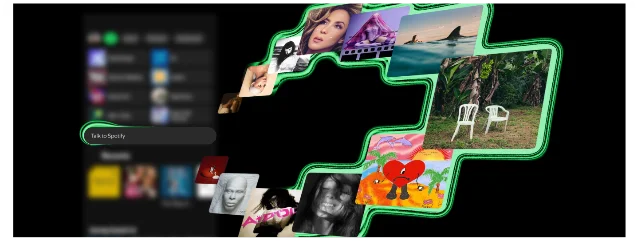
Spotify says the assistant can answer questions about your own taste because it understands your playlists, favorite artists, repeat listens, and listening history. That makes the feature less like a general chatbot with a music plug-in and more like a natural-language remote control for Spotify’s existing recommendation machinery. 1
The implementation is deliberately hard to inspect. Spotify’s launch post does not name a model or provider. TechCrunch reports that Spotify confirmed the feature uses a mix of its own AI and models from multiple providers, selected according to the task. 2
The pitch is convenience. The input is your autobiography.
The useful part is obvious. A listener can adjust a queue conversationally instead of translating a vague mood into search terms, playlist filters, and repeated skips. That is a better interface for a catalog that is already too large to browse directly.
The less charming part is what “personal” means here. Spotify’s privacy policy classifies search queries, streaming history, playlists, library activity, browsing history, and AI-feature prompts and transcripts as usage data. It says streaming history may be kept until account deletion to support retrospective playlists and personalized recommendations. 3
The policy also separately lists voice recordings as data collected when users use voice features. The Talk to Spotify announcement says users can press a microphone button, but it does not explain whether those recordings are retained, transcribed, used for model improvement, or deleted after the response. That is not proof of a hidden surveillance system. It is simply the most important product detail left outside the launch copy. 1 3
The access gate is equally concrete. The beta is rolling out gradually to Premium users aged 18 and over in the United States, Ireland, and Sweden, on iOS and Android, in English. 1 In the U.S., Premium Individual is advertised at $12.99 per month after a one-month introductory offer for people who have not tried Premium before. 4
Verdict
Talk to Spotify is useful, but it is not a new music brain. It is a polished conversational front end for a recommendation system that already knows what you search, save, replay, skip, and keep around. The clever move is making that profile talk back. The weak move is making the mic, the model routing, and the handling of the resulting conversation less specific than the playlist suggestions. Pay for it if you want a better queue editor and live in one of the three beta markets. Do not confuse the warmer interface with a clearer privacy bargain: Spotify has made your taste easier to interrogate, not easier to understand.
관련 콘텐츠
- 로그인하면 댓글을 작성할 수 있습니다.
More from this channel
- Perplexity put the agent in a sandbox. The cloud bill still gets in.
- Thinking Machines opened Inkling. Your server rack stayed closed.
- xAI open-sourced Grok Build. The data had already left the building.
- Claude for Teachers gave one person an AI department. The district got no dashboard.
- Toyo put a chief of staff in your message thread
- Notion put a model switchboard in your pocket
- OpenAI put a therapist voice on the switchboard
- ZML put a universal adapter on the GPU rack