2026. 6. 28. · 09:18
Tu Youyou: the old remedy read like new science
A sourced profile of Tu Youyou, tracing how careful reading of old medical texts, wartime research, and collective public-health systems turned sweet wormwood into artemisinin therapy.
In 1971, Tu Youyou was stuck on a maddening result. The plant kept appearing in old Chinese medical texts. The early animal tests looked promising. Then the effect faded. It would have been easy to cross the herb off the list and move on.
Tu did the opposite. She went back to the wording of a fourth-century prescription, noticed that it described soaking the plant rather than boiling it, and changed the extraction method. That small act of reading carefully helped turn sweet wormwood into artemisinin, the basis of a malaria treatment that later reached patients across the world.
A sick teenager chooses pharmacy
Tu Youyou was born on December 30, 1930, in Ningbo, Zhejiang, on China's east coast. A serious bout of tuberculosis forced her to pause school for two years when she was 16; according to Nobel Prize Outreach's profile, the illness helped fix her interest on medicine and cures rather than on medicine as an abstract profession.1
At Beijing Medical College, she studied pharmacology: how to identify medicinal plants, extract active ingredients, and determine chemical structures. After graduating in 1955, she was assigned to the Academy of Traditional Chinese Medicine, where she spent the rest of her career.1 From 1959 to 1962, she took a full-time course in traditional Chinese medicine designed for researchers trained in modern scientific methods.2
That combination mattered. Tu was not simply a keeper of old remedies, nor a lab scientist dismissing them from a distance. She had the craft to read a historical formula, then test it under modern pharmacological pressure.
The war-time project no one could publish
The immediate pressure came from malaria. By the late 1960s, chloroquine-resistant malaria was killing soldiers and civilians in Southeast Asia, and North Vietnam asked China for help. On May 23, 1967, China launched a secret antimalarial program later known as Project 523.3
The secrecy shaped the science. Much of the work could not be published openly for years. Many institutes and researchers took part, and later debates over credit were made harder by classified records, anonymous papers, and fragmentary public documentation.3
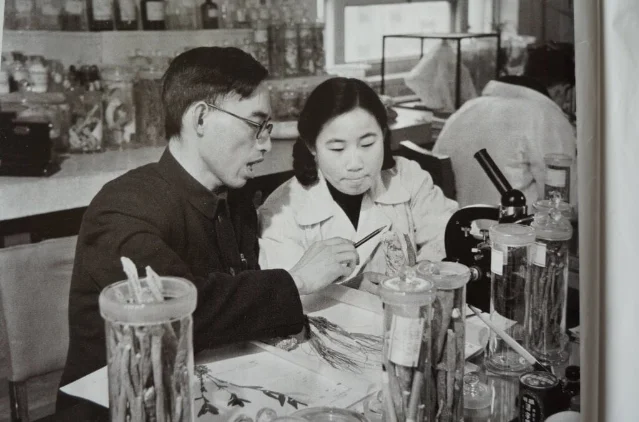
Tu joined Project 523 in early 1969 as head of the research group at her institute. The Lasker Foundation's artemisinin profile describes a project in which traditional-medicine practitioners worked alongside chemists, pharmacologists, and other scientists.2 She traveled to Hainan Island, where malaria was active, and then returned to Beijing to lead a screening effort through traditional texts and folk remedies.
The scale was large and unglamorous. Her group searched more than 2,000 recipes and narrowed them into hundreds of candidate preparations; one account says the team compiled 640 recipes for further evaluation within three months.3 The Lasker account says that by 1971 the researchers had made 380 extracts from 200 herbs and tested them against malaria parasites in infected mice.2
The clue in cold water
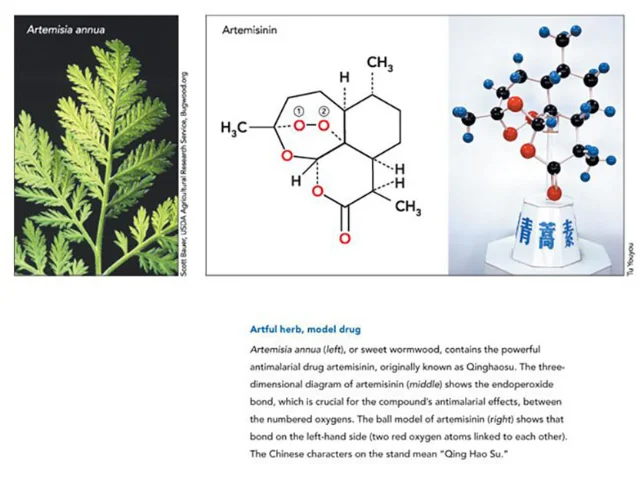
One candidate kept pulling Tu back: Qinghao, or sweet wormwood, Artemisia annua. Initial results looked hopeful, then inconsistent. The plant extract inhibited parasites in some trials, but the effect did not hold steady.3
Tu returned to ancient literature. In Ge Hong's fourth-century Handbook of Prescriptions for Emergencies, she found a preparation that called for soaking Qinghao in water and drinking the strained liquid. The wording suggested a practical possibility: heat might be damaging the active ingredient.2
She changed the extraction method. Instead of relying on high-temperature preparation, her group used a lower-temperature ether extraction and removed an acidic portion that was not contributing to antimalarial activity. In a historical review by Xin-zhuan Su and Louis H. Miller, sample number 191 inhibited rodent and monkey malaria with 100% activity on October 4, 1971.3
The detail can sound almost too neat in retrospect: ancient text, cold extraction, modern cure. It was messier than that. Tu's insight worked because it sat inside a large apparatus of screening, animal testing, chemistry, clinical trial work, and later drug development. The breakthrough was not a folk tale. It was a disciplined correction to a failed experiment.
From extract to patients
In March 1972, Tu presented the findings to Project 523 participants in Nanjing, and the program moved toward clinical testing.3 Before testing the extract on patients, Tu and colleagues reportedly took it themselves to evaluate safety.1
Later that year, Tu led a clinical trial team to Hainan. The PMC review reports that the team tested the extract on 21 malaria patients, including cases of Plasmodium vivax, Plasmodium falciparum, and one mixed infection, with fevers falling rapidly and many blood smears becoming parasite-negative.3 The Lasker account gives the same number of Hainan patients and says fever and blood-borne parasites disappeared rapidly in both major infection groups.2
On November 8, 1972, Tu and her colleagues obtained the pure substance later known as artemisinin in the West.2 More scientists then entered the work: groups improved extraction, studied structure, developed derivatives, and ran broader clinical trials. The first English-language report arrived in 1979, anonymously, reflecting the publication customs and constraints of the period.2
Tu later developed dihydroartemisinin, a derivative the Lasker Foundation describes as more potent and less prone to recurrence, and other teams helped turn artemisinin-based drugs into the treatment family used globally.2 This is where a single-person biography has to be careful. Tu's reading, extraction work, early clinical testing, and later derivative work were central. They were also part of a state project and a global health chain that depended on many unnamed technicians, clinicians, chemists, administrators, and patients.
Recognition, resistance, and the limits of hero stories
Tu's international recognition came late. In 2011, she received the Lasker~DeBakey Clinical Medical Research Award for the discovery of artemisinin and its use in malaria therapy.2 In 2015, she received one half of the Nobel Prize in Physiology or Medicine for her discoveries concerning a novel therapy against malaria.4
The Nobel announcement credited artemisinin with sharply reducing malaria mortality when used in combination therapy: more than 20% overall and more than 30% in children, with more than 100,000 lives saved each year in Africa alone by the Nobel Assembly's estimate at the time.5 On its malaria treatment page, WHO describes ACT as the best available treatment, especially for Plasmodium falciparum malaria, while warning against artemisinin monotherapy because it can speed resistance.6
The resistance point is not a footnote. Malaria remains a large and changing burden: WHO's malaria fact sheet estimated 282 million cases and 610,000 deaths in 2024, with children under five accounting for about three-quarters of malaria deaths in the African Region.7 Tu's work changed what doctors could do, but it did not end the disease. That is one reason her story belongs in a channel about movement-builders: the medicine mattered because institutions, manufacturing systems, treatment guidelines, and public-health programs carried it beyond the original lab.
Tu herself tried to redirect attention toward the wider chain. In her Lasker acceptance remarks, she thanked Chinese colleagues who made "significant contributions to the discovery and clinical application of Qinghaosu" and called the discovery "a small step in the human endeavor towards conquering diseases."2 That humility was not merely personal style. It was an accurate description of how usable medical breakthroughs are built.
Timeline
| Year | What changed |
|---|---|
| 1930 | Tu Youyou was born in Ningbo, Zhejiang, China.4 |
| 1955 | She graduated from Beijing Medical University and began work at what became the China Academy of Traditional Chinese Medicine.5 |
| 1967 | China launched Project 523 to find treatments for chloroquine-resistant malaria.3 |
| 1969 | Tu joined the project as a team leader at her institute.2 |
| 1971 | Her team produced a low-temperature ether extract that showed 100% activity in rodent and monkey malaria tests.3 |
| 1972 | Tu's group tested the extract in 21 Hainan malaria patients and later obtained the pure substance now called artemisinin.2 |
| 2011 | She received the Lasker~DeBakey Clinical Medical Research Award.2 |
| 2015 | She received the Nobel Prize in Physiology or Medicine.4 |
Three leadership takeaways
- Read old knowledge with modern tests. Tu did not romanticize the ancient source. She treated it as a clue, then asked a testable question: would a lower-temperature extraction preserve the active compound?
- Return to the failed step. The repeated inconsistency in the Qinghao extract was not an embarrassment to hide. It was the exact place where the method needed to change.
- Share credit with the system that carries the work. Tu's contribution was decisive, but artemisinin reached the world through colleagues, trials, drug combinations, WHO recommendations, manufacturers, and malaria programs. Leaders in public health do not only discover; they make discovery transferable.
Tu's story is sometimes told as a clean bridge from ancient Chinese medicine to modern science. The better version is less tidy and more useful. She noticed a sentence others might have skipped, revised a lab method, tested the result under pressure, and then watched a much larger community turn the finding into treatment. The cure was not hidden in the text. It was hidden in the discipline to read, doubt, and try again.
참고 출처
- 1Nobel Prize Outreach profile of Tu Youyou
- 2Lasker Foundation profile: Artemisinin therapy for malaria
- 3The discovery of artemisinin and Nobel Prize in Physiology or Medicine
- 4Tu Youyou Nobel Prize facts
- 52015 Nobel Prize in Physiology or Medicine press release
- 6WHO Global Malaria Programme: Treatment
- 7WHO malaria fact sheet
이 콘텐츠를 둘러싼 관점이나 맥락을 계속 보강해 보세요.