Weekly YouTube Digest - Jul 6-12, 2026
Six transcript-backed AI and tech videos this week: GPT-5.6 agent demos, Google DeepMind on interpretability, DeepSeek inference speedups, local frontier-model testing, retrieval in the reasoning era, and diffusion ODE solver theory.

GPT-5.6 and local-model economics are the practical thread this week. The best general-audience watches are Matthew Berman's GPT-5.6 demo, Google DeepMind's interpretability conversation, and sentdex's local-model benchmark walk-through. Microsoft Research supplies two useful specialist entries: retrieval in the reasoning-model era, and a theory-heavy diffusion sampling seminar.
Fast triage
| Video | Channel | Duration | Verdict |
|---|---|---|---|
| GPT-5.6 is FINALLY HERE (WOAH) | Matthew Berman | 8:55 | Watch if you care about agentic coding and browser/computer-use demos. |
| Understanding the inner thoughts of AI | Google DeepMind | 53:06 | Watch if interpretability, model auditing, or AI safety is part of your work. |
| DeepSeek's Absolutely Insane AI Speed Hack | Two Minute Papers | 5:45 | Watch for a short, clear explanation of speculative decoding speedups. |
| In search of frontier AI at home | sentdex | 36:22 | Watch if you run local models or care about quantization tradeoffs. |
| Panel: Is Retrieval Relevant in the Age of Reasoning? | Microsoft Research | 1:09:22 | Skim if you build RAG, search, or enterprise knowledge systems. |
| Convergence Analysis for Fast High-Order ODE Solvers in Diffusion Probabilistic Models | Microsoft Research | 58:52 | Specialist-only for diffusion sampling and theory readers. |
1. GPT-5.6 is FINALLY HERE (WOAH)
Channel: Matthew Berman
Published: Jul 9, 2026
Duration: 8:55
Source: YouTube video
Berman's strongest example is not a benchmark table. It is Codex running for days on broad product prompts, then producing working software demos that look closer to long-running agent work than normal chat completions 1.
- A short prompt asking Codex to make an Excel clone reportedly ran for more than five days and produced a web app with formulas, sorting, conditional formatting, data validation, tables, find/replace, and pivot tables 1.
- The demo also includes a Minecraft-style clone that ran for about seven days, with the speaker saying it began to look like the target game after roughly one day and then kept adding world, mob, and biome features 1.
- The video frames GPT-5.6 as unusually strong at browser and computer use, including tasks such as sorting email or changing DNS settings from one prompt 1.
- Berman says the model line has Luna, Terra, and Sol sizes, with different reasoning levels, which makes routing across model sizes part of the cost story 1.
- The caveat matters: the Excel clone is still a subset of Excel, the run was not finished, and the video is a product-review style demo rather than a neutral benchmark study 1.
Worth watching? Watch if you care about agentic coding and computer-use demos. Skim if you only want independent benchmark analysis.
2. Understanding the inner thoughts of AI
Channel: Google DeepMind
Published: Jul 10, 2026
Duration: 53:06
Source: YouTube video
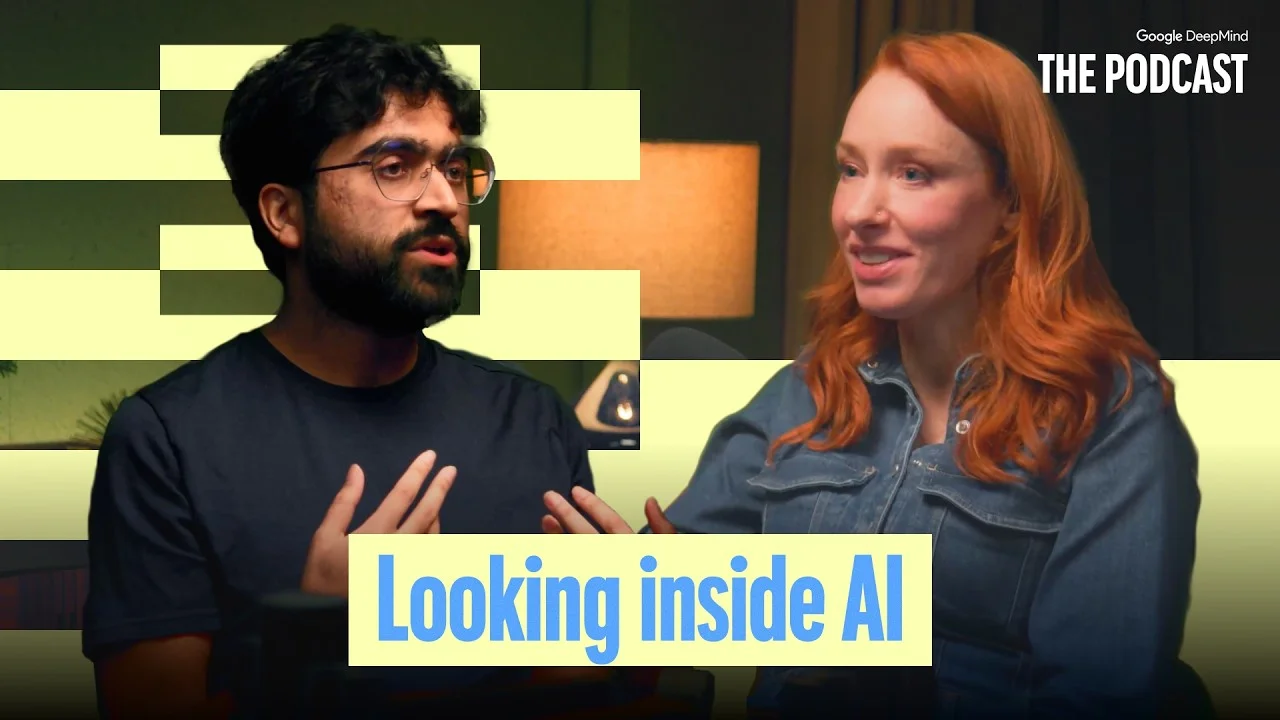
This is the cleanest interpretability entry of the week. Hannah Fry and Neel Nanda spend most of the conversation on what researchers can actually inspect inside models, and where those methods still fail 2.
- Chain-of-thought monitoring is treated as one useful window into model behavior because it can expose cheating, deception, or misuse plans when the model writes down its intermediate reasoning 2.
- Probes are presented as cheap tools for detecting internal concepts or states in model activations, such as true/false, emotional tone, or a board-game position 2.
- Sparse autoencoders try to discover internal concepts automatically, including whether a model recognizes an entity or is drifting toward a hallucinated answer 2.
- Nanda's practical safety point is layered defense: interpretability can help with monitoring, audits, debugging, hidden-goal detection, and misuse defenses, but it is not a single fix for alignment 2.
- The limits are stated plainly. Future models may learn to hide or compress their scratch work, sparse autoencoders can miss concepts, and evaluations can be distorted when models realize they are being tested 2.
Worth watching? Watch. It is broad enough for AI practitioners and specific enough for people building model monitoring or safety tooling.
3. DeepSeek's Absolutely Insane AI Speed Hack
Channel: Two Minute Papers
Published: Jul 7, 2026
Duration: 5:45
Source: YouTube video
The topic is DeepSpark, DeepSeek's work on speeding up generation by making speculative decoding more useful. The short version: let a cheaper draft model propose several tokens, then have the stronger model accept or reject them faster than it would generate every token from scratch 3.
- The video explains speculative decoding through a senior-editor/junior-writer analogy: the junior writer drafts quickly, and the senior editor checks which proposed tokens survive 3.
- DeepSpark adds a small amount of memory to the draft model, so one drafted token can influence the next instead of each guess falling apart independently 3.
- It also tries to detect when later draft tokens are unlikely to survive, saving verification work when the continuation has already gone wrong 3.
- The claimed practical gain is a 60% to 85% speedup against DeepSeek's older MTP-1 production baseline, while a much larger 661% throughput number is described as a corner case rather than the normal result 3.
- The method is not a switch that can be added from the outside to any closed API; it needs a matching draft model, access to target-model probabilities, and serving infrastructure that can exploit the setup 3.
Worth watching? Watch. It is under six minutes and gives a good intuition for why inference engineering can matter as much as model size.
4. In search of frontier AI at home
Channel: sentdex
Published: Jul 9, 2026
Duration: 36:22
Source: YouTube video
sentdex tests local models against Terminal-Bench v2.1 and uses the results to talk about a more practical question: which models feel usable for daily agentic coding when hardware, quantization, KV cache settings, and latency all matter 4.
- His current favorite local model in this test is DeepSeek V4 Flash, which he says is fast enough and capable enough to use as a daily coding/development model 4.
- Reported Terminal-Bench v2.1 scores include roughly 56% for DeepSeek V4 Flash, 52% for GLM52 4-bit, 46% for GLM52 2-bit, 24% for GLM52 with 8-bit KV cache, and 64% for an OpenRouter API version 4.
- The largest practical warning is that KV-cache quantization can damage results more than a headline model comparison suggests, especially on long-context or agentic tasks 4.
- He argues that 2-bit and 4-bit GLM52 results can feel closer in human-in-the-loop work than their benchmark gap implies, because a person can correct or steer the run before small errors compound 4.
- The caveat is heavy: one benchmark, one workflow, specific hardware, and many variables, including quantization method, PCIe version, tensor parallelism, pipeline parallelism, concurrency, and cache precision 4.
Worth watching? Watch if you run local models. Skim if you want a general AI-news hit, because the value is in the hardware and benchmark details.
5. Panel: Is Retrieval Relevant in the Age of Reasoning?
Channel: Microsoft Research
Published: Jul 6, 2026
Duration: 1:09:22
Source: YouTube video
The panel's shared answer is mostly yes: retrieval is still relevant, but it may become less visible to end users as reasoning models hide search, lookup, and evidence-gathering behind a single assistant interface 5.
- Several panelists treat retrieval and reasoning as overlapping tools for satisfying information needs, rather than cleanly separated product categories 5.
- A recurring point is that parameter memory is lossy compression; for fresh, high-risk, or evidence-sensitive answers, external retrieval is still the path to attribution and verification 5.
- Hybrid systems appear under several labels, including RAG, generation-augmented generation, and retrieval-augmented reasoning, which all point to the same pressure: generation alone is not enough for many real systems 5.
- Classic methods such as BM25, Boolean retrieval, hashing, and algebraic structures remain useful in domains where speed, traceability, or exact matching matter, including law, code, and finance 5.
- The business-side warning is that if retrieval becomes invisible inside model workflows, research funding and product attention may shift away from it even while the system still depends on it 5.
Worth watching? Skim. The best audience is builders working on RAG, search, legal/financial retrieval, code search, or enterprise knowledge systems.
6. Convergence Analysis for Fast High-Order ODE Solvers in Diffusion Probabilistic Models
Channel: Microsoft Research
Published: Jul 9, 2026
Duration: 58:52
Source: YouTube video
This is the narrowest entry, but useful if diffusion sampling speed and theory are part of your work. The talk analyzes high-order ODE solvers for the reverse process in diffusion models, with attention to where sampling error actually comes from 6.
- The core setup treats diffusion sampling as a forward process that adds noise to data, followed by a reverse ODE flow that tries to map noise back into the data distribution 6.
- Higher-order solvers such as Runge-Kutta-style methods are presented as a way to get better accuracy with fewer sampling steps than first-order Euler-style solvers 6.
- The analysis splits sampling error into initialization error, learned-score error, and solver discretization error, which is a useful mental model even if the details are math-heavy 6.
- The speaker says score error often dominates in experiments, and connects total variation error tightly to score error in Gaussian-mixture tests 6.
- The limits are also theory-shaped: learned neural scores do not automatically satisfy classical smoothness assumptions, dimension factors can still appear in the bounds, and some numerical checks are done in controlled settings rather than full real-world image distributions 6.
Worth watching? Specialist-only. If you just want product or engineering takeaways, stop after the error-decomposition intuition.
What I would skip
Matthew Berman's J-Space video is a valid transcript-backed interpretability explainer, but this week Google DeepMind's episode is the better single watch on the same theme because it spends more time on probes, sparse autoencoders, auditing, and safety limits 7. The sub-two-minute Matthew clips are too short for this channel's transcript-summary format, and Lex Fridman's newest feed item was a Roman and Byzantine history episode published outside this week's window, not an AI/tech entry 8.
참고 출처
- 1GPT-5.6 is FINALLY HERE (WOAH)
- 2Understanding the inner thoughts of AI
- 3DeepSeek's Absolutely Insane AI Speed Hack
- 4In search of frontier AI at home
- 5Panel: Is Retrieval Relevant in the Age of Reasoning?
- 6Convergence Analysis for Fast High-Order ODE Solvers in Diffusion Probabilistic Models
- 7We just figured out how AI actually works (J-Space)
- 8The Rise and Fall of the Roman Empire and the Byzantine Empire | Lex Fridman Podcast #498
관련 콘텐츠
- 로그인하면 댓글을 작성할 수 있습니다.