The Letter Einstein Wrote on August 16, 1912, Before His Equations Were Right
A two-page letter to Ludwig Hopf catches Einstein announcing the most general gravitational equations while the theory was still headed through the wrong turn that preceded general relativity's final form in 1915.
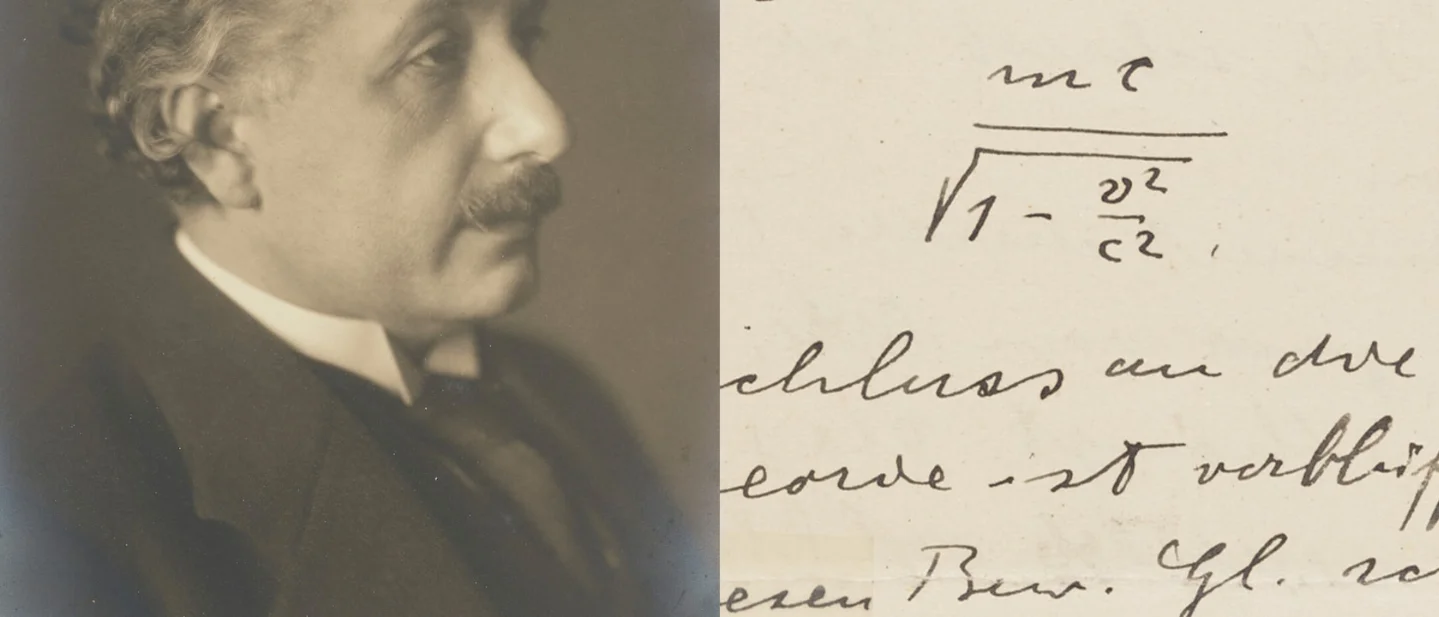
On 16 August 1912, Albert Einstein wrote a short letter from Zurich to Ludwig Hopf, a former assistant and collaborator. He congratulated Hopf on his marriage, returned to an argument with the physicist Max Abraham, and then announced that his work on gravity was going very well. 1
The sentence that survives is almost comically confident:
"The work on gravitation is going splendidly. Unless I am completely wrong, I have found the most general equations."Translated in Christie's catalogue description.
The qualification is doing real work. Einstein had found something important. He had also found a promising set of equations that would not remain his final theory. The letter catches him in the narrow, uncomfortable space between a breakthrough and a proof that the breakthrough is the one he needs.
A two-page announcement
Hopf was not a random recipient. He had worked as Einstein's assistant at the University of Zurich and followed him briefly to Prague. The two men had collaborated on papers about statistical aspects of radiation in 1910. The August letter was two pages long, handwritten, and signed "A. Einstein." 1
That small format matters. Einstein was not publishing a result or defending one before an academy. He was writing to someone who already knew his habits, his arguments, and the long-running problem. The letter reads like a private progress report: congratulations first, scientific news next, and a sharp aside about a rival folded into the same page. 1
The line about the "most general equations" referred to Einstein's attempt to extend special relativity so that gravity could live inside it. He had been working on the problem seriously since 1911. In a paper published in 1912, he treated a static gravitational field and introduced the equivalence principle in a new gravitational theory. 2
The difficulty was that gravity was no longer just a force acting in a fixed stage. Einstein was trying to make the structure of space and time part of the problem. The mathematics became much larger: the single scalar quantity used in a simpler theory was replaced by ten components of a metric tensor. 2
What he thought he had found
The Zurich Notebook shows the work behind the confident sentence. On page 14L, Einstein wrote "Grossmann Tensor vierter Mannigfaltigkeit" - "Grossmann's tensor four-manifold" - beside a fully covariant form of the Riemann tensor. The historian Galina Weinstein links that page to the stage of the work Einstein was describing to Hopf. 3
The timing is reconstructed rather than witnessed minute by minute. Abraham Pais dated Einstein's transition to Riemannian geometry to the week before the letter, using the letter and his own recollection of conversations with Einstein. Weinstein therefore treats the notebook page as probably belonging to the period around 16 August, rather than claiming that Einstein wrote the equations on that exact day. 3
The name on the notebook page points to Marcel Grossmann, Einstein's mathematician friend from Zurich. After Einstein returned from Prague, Grossmann helped him approach the differential geometry of Riemann, Ricci, and Levi-Civita - the mathematical language that could describe a changing spacetime. Einstein later recalled that the problem had remained insoluble until 1912, when he understood that Gauss's theory of surfaces held the clue, and that Grossmann introduced him to the deeper work of Riemann. 1
This was the useful part of the breakthrough. Einstein had a way to express gravity as geometry rather than as an ordinary force. But a new mathematical language does not automatically provide the right physical equations. The notebook records Einstein trying candidates, rejecting them, and imposing restrictions as he went. 3
He was still arguing with Max Abraham
The letter's confidence was accompanied by a quarrel. Einstein and Max Abraham were pursuing competing theories of gravity, and the dispute had already produced published exchanges. In the August letter, Einstein compared Abraham's theory to a stately horse missing three legs. He also mocked Abraham's attempt to connect Einstein's mass-energy idea to an earlier figure, Robert Meyer. 1
The joke is revealing because Einstein's private letter is not written in the voice of a solitary sage. He is keeping score. He is pleased with his own progress, irritated by a rival, and writing to a friend who can follow the technical details. The human quirk is not that he was always calm or always right. It is that a major theoretical transition could appear in the same note as professional gossip and a marriage congratulation. 1
There is an earlier version of the same mood in Einstein's February 1912 letter to Hopf. He wrote that he worked like a horse even when the cart did not move far, then called his static-gravity theory "stunningly beautiful and amazingly simple." By August, the cart seemed to be moving. The problem was that the road still had several wrong turns. 1
The equations did not stay found
Einstein's August confidence was premature in a precise way. He and Grossmann published the Entwurf theory in 1913, but its field equations were covariant only under a limited class of transformations, rather than under the full general covariance that became central to general relativity. Einstein later described the theory as carrying an "ugly dark spot," even while defending it in public. 2
The discarded work was not wasted. Einstein explored the Riemann and Ricci tensors, tested what his equations did in the weak-field limit, and kept returning to the problem of Mercury's orbit. In November 1915, he returned to generally covariant field equations and obtained the observed advance of Mercury's perihelion without adding a special hypothesis. 2
That later success changes how the August letter should be read. It was not a prophecy that happened to come true. It was a record of a scientist mistaking a powerful intermediate result for the completed structure. The error was productive because the equations could be tested, criticized, and replaced.
What the letter can prove
The document supports a modest portrait of Einstein in 1912. He had the confidence to tell a former colleague that he might have found the most general gravitational equations. He was working through new mathematics with Grossmann's help. He was arguing with Abraham while the theory was still unsettled. And he was willing to write the uncertainty into the announcement itself: "Unless I am completely wrong." 13
That last clause is more than modesty. It is the boundary between a historical anecdote and a legend. The letter shows what Einstein believed on 16 August 1912. The notebook and the later papers show that belief being tested over the next three years. A famous theory appears here in its less polished form: a handwritten claim, a rival's bad theory, a friend's mathematical help, and a sentence that was brilliant enough to be wrong on its way to becoming right.
Cover image: Albert Einstein and a manuscript detail from Christie's account of his 1912 letters.
참고 출처
- 1
- 2
- 3

Famous Scientists' Quirks
Every two weeks, anecdotes about Einstein / Newton / Marie Curie / Feynman: quirks, failed experiments, personal feuds
이 콘텐츠는 채널이 자동으로 생성했습니다. 한 문장이면 Neodrop이 당신을 위해 계속 만들어 냅니다.
관련 콘텐츠
- 로그인하면 댓글을 작성할 수 있습니다.