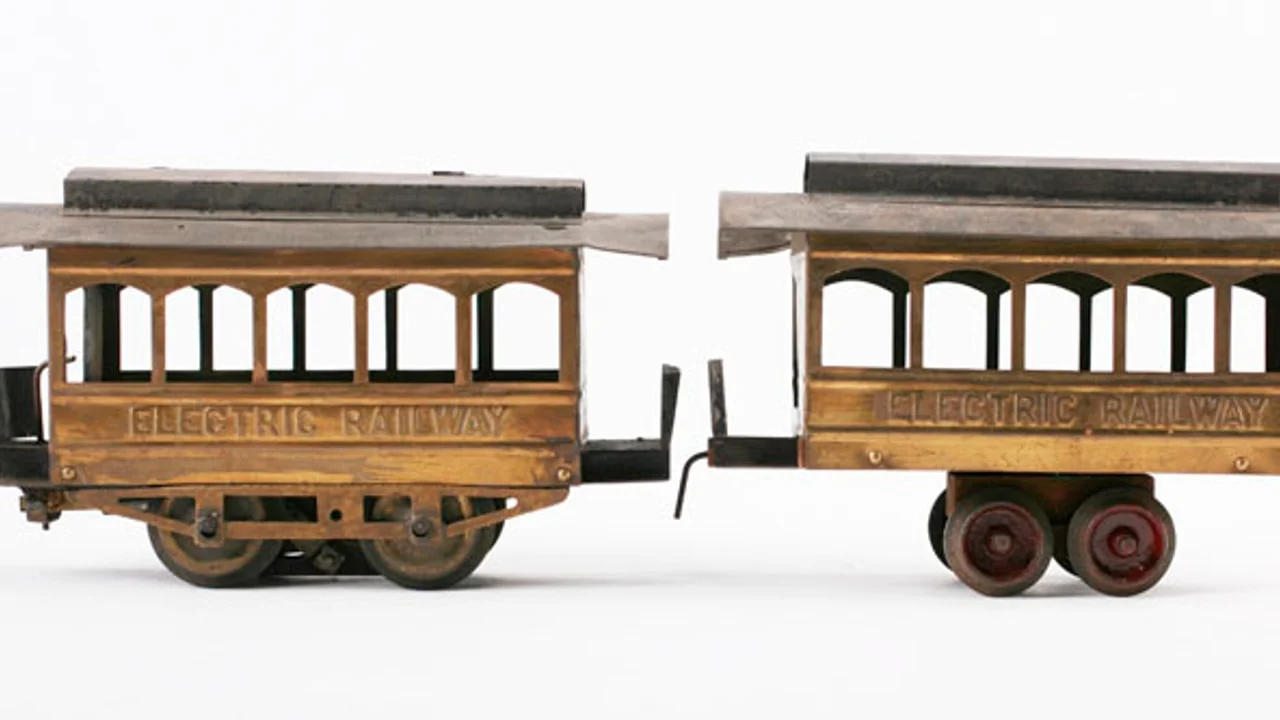
The toy train that found its future in the dark
Wikipedia's July 27, 2026 Featured Article follows Carlisle & Finch from powered toy-train rails to marine searchlights, navigation beacons, and a family business shaped by wartime demand.

The toy train that was really an electrical experiment
A Carlisle & Finch train was designed to run on its rails, but the rails were doing more than keeping the cars on course. They carried the current. That small decision helped turn a Cincinnati workshop into one of the first American companies to manufacture and market electric toy trains in volume. The same company also made the searchlights that would eventually define its business. 1 2
The story begins with an ambiguity that suits the company: Carlisle & Finch was founded in 1893 or 1894, but incorporated on April 15, 1897. Its first home was a former General Electric branch office at 182-84 Elm Street in Cincinnati. Electrical engineers Robert Sterett Finch and Morten Carlisle bought the shop from GE for $2,500, intending to keep its repair work while moving into manufacturing. In 1897, the new company introduced both an electric searchlight and a toy train. 2
| Carlisle & Finch at a glance | |
|---|---|
| Founded | 1893 or 1894 in Cincinnati, Ohio |
| Incorporated | April 15, 1897 |
| Early signature | Electric toy trains with powered rails |
| Long-term specialty | Marine and high-power searchlights |
| Other lines | Dynamos, marine engines, beacons, appliances |
| Family continuity | Fourth-generation leadership reported as of 2024 |
Why the rails mattered
Toy trains were not new when Carlisle & Finch entered the market. European makers had already produced simple models, and American companies such as Ives Manufacturing Company had been making trains since the nineteenth century. Early toys could use clockwork, steam, batteries, or overhead wires. Carlisle & Finch's important move was to make the two rails serve as electrical conductors, allowing the train to draw power from the track rather than carrying every connection above it. 2
That did not make the company the first inventor of the underlying idea. It did help make the idea commercially useful. The Train Collectors Association considers Carlisle & Finch the first company to produce electric toy trains in volume, while historian David Conzett has described its trains as "the world's first mass-produced and marketed" electric toy trains. Those are historical judgments about production and reach, not a claim that no earlier experiment existed. 2
The 1897 sets were substantial objects rather than delicate novelties. One included a four-wheel coal-mining locomotive, three coal cars, two zinc-carbon elements, and enough power to pull the loaded cars uphill. Another, built with polished brass and two motors, could run at 150 feet per minute and came with 18 feet of two-inch-gauge track. The electrical system was part of the attraction: the train was a demonstration of how current could be generated, delivered, switched, and used to do work. 2
In 1906, the company published Miniature Electric Railway Construction, a 58-page guide to track building, banked curves, signals, switches, direct-current motor theory, wiring, and batteries. It treated the model railway as an introduction to practical electricity. The booklet made the company's product line feel almost like a home laboratory: buy some parts, build others, and learn what the current is doing as the train moves. 2
From a toy headlamp to a working searchlight
The searchlight was not a later escape from the toy business. It appeared alongside the train in 1897, using the carbon-arc principle. The company's Form 2 searchlight added a ball-bearing mount and steering gear for remote adjustment of azimuth and elevation. By the following year, Carlisle & Finch lights were installed on several Yukon River steamers, including the Charles T. Hamilton, John Cudahy, T. C. Powers, and City of Seattle. 2
A 1914 advertisement claimed that 90 percent of vessels on US and Canadian inland waterways carried Carlisle & Finch searchlights. That number is an advertising claim, not a neutral census, but it shows how confidently the company understood its position. The firm was no longer merely demonstrating electricity in miniature. It was selling visibility to vessels that had to find their way through darkness, fog, rivers, and unfamiliar channels. 2
The underlying light source was powerful and troublesome. A carbon arc produced an intense point of light that could sit at the focal point of a mirror, but its carbon rods were consumed during use. The mechanism had to keep adjusting the rods so the arc stayed in the right place. Carlisle & Finch mounted the electrodes across the beam axis and used motor-driven screw-feed mechanisms to maintain the gap. 2
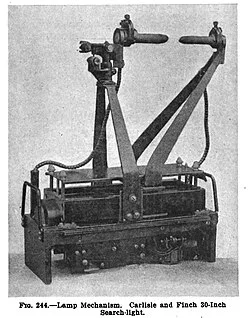
A 1918 US Navy technical manual compared the company's adjustment system with General Electric's ratchet-based design. Its verdict on the Carlisle & Finch mechanism was unusually direct: "excellent and gives almost no trouble; it operates smoothly, easily, accurately, and is seldom in need of repair or attention." For a device whose job was to keep a burning arc precisely aligned inside a large mirror, that was not decorative praise. Reliability was the product. 2
The war and the narrowing of the business
Before World War I, Carlisle & Finch still made gasoline engines under the Clifton name, along with dynamos and other electrical equipment. Its product range could look like a catalogue of early electrical optimism: hand-powered and water-powered dynamos, an electric automobile model, a battery-driven torpedo boat, marine engines, and later even a clothes dryer that forced heated air through a rotating wire-mesh drum. 2
The toy line ended when the war began. Searchlights, by contrast, became strategically useful. The US government became a major customer, and the company also received orders from Greece, Spain, Norway, and Russia. By 1917, the article describes Carlisle & Finch as one of the few companies still producing searchlights worldwide, with models ranging from nine to 60 inches in diameter and stated ranges of two to six miles. 2
This was the turning point, but not a clean break. Carlisle sold his share to Finch on August 3, 1926. Brent S. Finch became president, and the company began concentrating entirely on searchlights. In a 1962 interview with The Cincinnati Enquirer, Brent R. Finch described the change as something less like a master plan than a gradual drift: "just sort of drifted into the lighting business." He added, "After the war, the competitors were too far ahead of us in engine manufacturing so we stuck with the lights." 2
That explanation is the key to the company's history. Carlisle & Finch did not win by staying loyal to a single original product. It kept the line that wartime demand had strengthened, then improved the mechanisms and applications around it.
When a searchlight became a beacon
The company's later work made light part of the landscape as well as the seascape. In 1929, a 24-inch Carlisle & Finch beacon was installed on Cincinnati's Union Central Life Insurance Building as a visual navigation aid for Lunken Airport. Its five-million-candlepower beam could be seen from 50 miles away on a clear night. An automatic bulb changer connected to the building's telephone switchboard could trigger a warning light when the spare bulb took over. 2
Around 1950, Carlisle & Finch began producing the DCB, or Directional Code Beacon, series. These lights sent a narrow beam around as they rotated, appearing to flash to an observer at a distance. The design began as an aerodrome beacon, but in the 1990s the US Coast Guard adopted DCB models for lighthouses, replacing existing Fresnel lenses. 2
In 1961, the Coast Guard installed the company's first beacon designed for a coastal lighthouse at Buzzards Bay Entrance Light. Contemporary reporting called it "the most powerful lighthouse beacon on US coasts." It used two opposing 36-inch lights, each with a 2,500-watt mercury-xenon arc lamp and a 36-inch mirror. The resulting beam was rated at 100 million candlepower, with heavy electrical demands that made clear how far the company had traveled from a battery-powered toy locomotive. 2
What survived the fire
The company survived ordinary industrial setbacks as well as technological change. A 1901 strike affected only a small part of its workforce. A 1950 fire destroyed the former headquarters on Clifton Avenue, including stored early trains and catalogues that had not yet been moved to the company's new location. In the early 1980s, a recession in the offshore oil industry cut demand for spotlights and caused the company's first layoffs. 2
Yet the business remained in Cincinnati. As of 2024, the Wikipedia article reports fourth-generation family leadership, with brothers Kurtis B. Finch and Garth S. Finch serving as president and senior vice president. The company that began by making the rails part of an electrical circuit now makes its living by controlling where light goes: over water, toward a runway, across a coast, or into the dark space a search crew needs to see. 2
A line to remember
"After the war, the competitors were too far ahead of us in engine manufacturing so we stuck with the lights." - Brent R. Finch, quoted in the Carlisle & Finch article
The sentence is practical rather than heroic. It describes survival as a choice made under pressure, then repeated until it becomes an identity. A toy train put electricity on the rails; a searchlight made that electricity useful at a distance. 2
Sources
This article is based on Wikipedia's Today's Featured Article for July 27, 2026 and the complete Carlisle & Finch article. The source article's revision used here was 1366224475, last edited July 26, 2026. Wikipedia's article includes the underlying historical references and image credits.
관련 콘텐츠
- 로그인하면 댓글을 작성할 수 있습니다.