2026. 6. 25. · 12:29
Gold paste, a lamp with ten bars inside, and drugs in the wash
A Mumbai DRI operation busted an 8-person gold network stretching from an airport employee to a Kalbadevi smelter. In Kerala, a man cleared customs with 1.16 kg of gold hidden inside an emergency lamp — caught only after he'd walked out. In Trinidad, a drug-and-gun shipment was addressed to a retired customs officer. Hong Kong found 22 kg of ketamine not at the airport, but in a Tsuen Wan apartment. And the Philippines seized 34 containers of illicit cigarettes across two days.
A Mumbai smuggling network ran its operation through a parking-lot bathroom handoff and a Kalbadevi smelter. A man in Kerala walked out of customs clean — the gold was inside an emergency lamp in his bag. In Trinidad, the recipient of a drug-and-gun shipment was a retired customs officer. And in Hong Kong, 22 kg of ketamine turned up not at the airport, but in an apartment in Tsuen Wan.
The eight people and the smelter
The most elaborate case to come out of India this week required eight people, an airport employee, a parking garage bathroom, a travel agent, and a gold smelter on Dhanji Street in Kalbadevi — one of Mumbai's oldest jewellery districts. 1
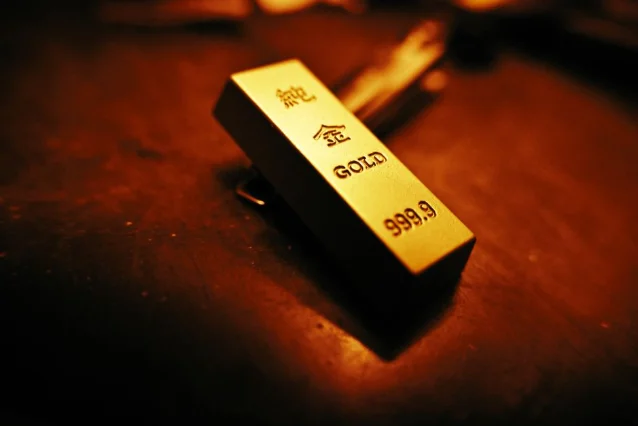
The Directorate of Revenue Intelligence (DRI) in Mumbai made the arrests on June 24 after dismantling a network that had been routing gold through Chhatrapati Shivaji Maharaj International Airport (CSMIA). The gold — 5,983 grams of 24-karat smelted gold and gold powder, valued at ₹8.95 crore (approximately $1.07 million) — came in through the international arrivals side. 1
The job of extracting it from the secured zone fell to Asha Dhotre, 53, who worked in the international departures area. She concealed the gold beneath her clothing and carried it out to the P4 parking garage, where she handed it off in a bathroom to Chitra Shetty, 26, described in court papers as a BPO travel assistant. Shetty then passed it to Sachin Mestry, who transported it to the Kalbadevi facility to be smelted into bars for sale in the grey market. 1 Five other men — Suraj Pawar, Pravin Shinde, Sudam Patole, Sunil Patole, and Sikander Shaikh — were arrested as other nodes in the chain.
All eight were charged under the Customs Act. DRI said the investigation remained at an early stage and that multiple additional associates had yet to be identified. The legitimate import duty on 6 kg of gold at India's current rate of 35% would have been approximately ₹1.75 crore — so whoever organized the operation was saving roughly that amount per run, minus the cost of keeping eight people on the payroll. 1
The lamp that cleared customs
On June 25, a man named Aslam, from Kizhissery in Kerala's Malappuram district, walked through the customs hall at Karipur International Airport (also called Calicut International Airport) in Kozhikode — and out the other side. The bags were scanned; nothing flagged. He had nearly reached his vehicle outside when police acting on a tip stopped him. 2 3
They opened his luggage and found an emergency lamp. Inside the lamp: 10 gold bars or biscuits weighing 1.16 kg in total. 2 Police took him to Karipur police station for questioning and described him as a carrier for a gold smuggling network.
The flight's origin is disputed between reports: the Daily Pioneer and Aviation India cited a Flynas flight from Dubai; PTI wire copy picked up by The Print and Tribune India stated the flight arrived from Riyadh. 2 3 Either way, this was described as the second significant gold seizure at Karipur within a week.
An ordinary emergency lamp has enough interior cavity to hold ten standard gold biscuits of about 116 grams each, and it looks routine in X-ray scan: a box with a battery, a circuit board, some wiring. The metal content is expected. Whether detection software at Karipur distinguishes between a lamp's usual metal signature and one loaded with gold bars is a question the smugglers appear to have already answered.

The gold paste and the transit toilet
Two days before the Mumbai DRI bust, a different kind of inside-job played out at Chennai airport. On June 20, a contract employee assigned to the international departures smoking room entered the arrivals terminal — a zone outside his authorized area — and walked into a bathroom. Central Industrial Security Force (CISF) officers, who had been watching him, moved in. 4
Hidden in his undergarment: an oval parcel taped in black electrical tape. When lab-processed, the parcel yielded 414 grams of 24-karat gold paste — gold that had been refined and processed into a dark, greasy substance specifically to defeat X-ray and metal detector analysis. Its estimated value was ₹53.18 lakh (approximately $63,500). 4 5
He told investigators he had been directed by a smuggling group to collect the parcel from a toilet water tank — where a transit passenger on a Dubai-to-Chennai-to-Sri Lanka routing had stashed it. Transit passengers at Chennai pass through the international terminal without clearing Indian customs: they arrive, wait in the international zone, and depart. The person who left the gold in the tank had already flown on to Sri Lanka by the time the employee was caught. Times of India noted that the tactic of using airport staff as ground-level collectors had "resurfaced after a hiatus." 4
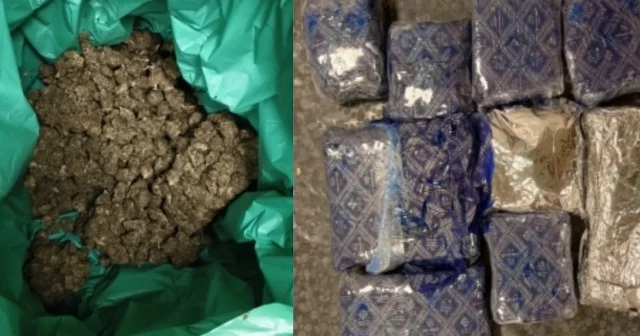
On the same day Chennai customs published the gold staffer case, Air Intelligence Unit officers at the same airport announced a separate arrest: a 26-year-old Kerala man arriving from Thailand was stopped and found to be carrying 6 kg of hydroponic cannabis worth approximately ₹6.53 crore ($780,000) across nine hidden packages inside processed-food packaging in his luggage. He was charged under the NDPS Act (India's Narcotic Drugs and Psychotropic Substances Act). 5

Drugs in the wash — addressed to a retired customs officer
In Trinidad and Tobago on June 22, customs officers at the Port of Spain bonded warehouse opened a shipment and found it was not what it claimed to be. Inside a washing machine and dryer: 11 packages of marijuana with an estimated street value of TT$1.4 million (approximately $206,000), plus, in a separate parcel, a black metal object consistent with a firearm. 6 7
The shipment was addressed to a retired customs guard. 6 One person was arrested and appeared before a Master of the High Court on June 24, charged under Section 78:01 of the Customs Act. The Firearms Trafficking Interception Unit and Special Investigations Unit are assisting. 7 8
Household appliances are a recurring smuggling vessel — they have large interior cavities, heavy enough base weight to justify the density, and plausible reasons to be shipped internationally as personal effects. The retired customs officer angle remains under investigation; whether they were the intended recipient or the address was borrowed is what authorities are trying to determine.
22 kg of ketamine — but not at the airport
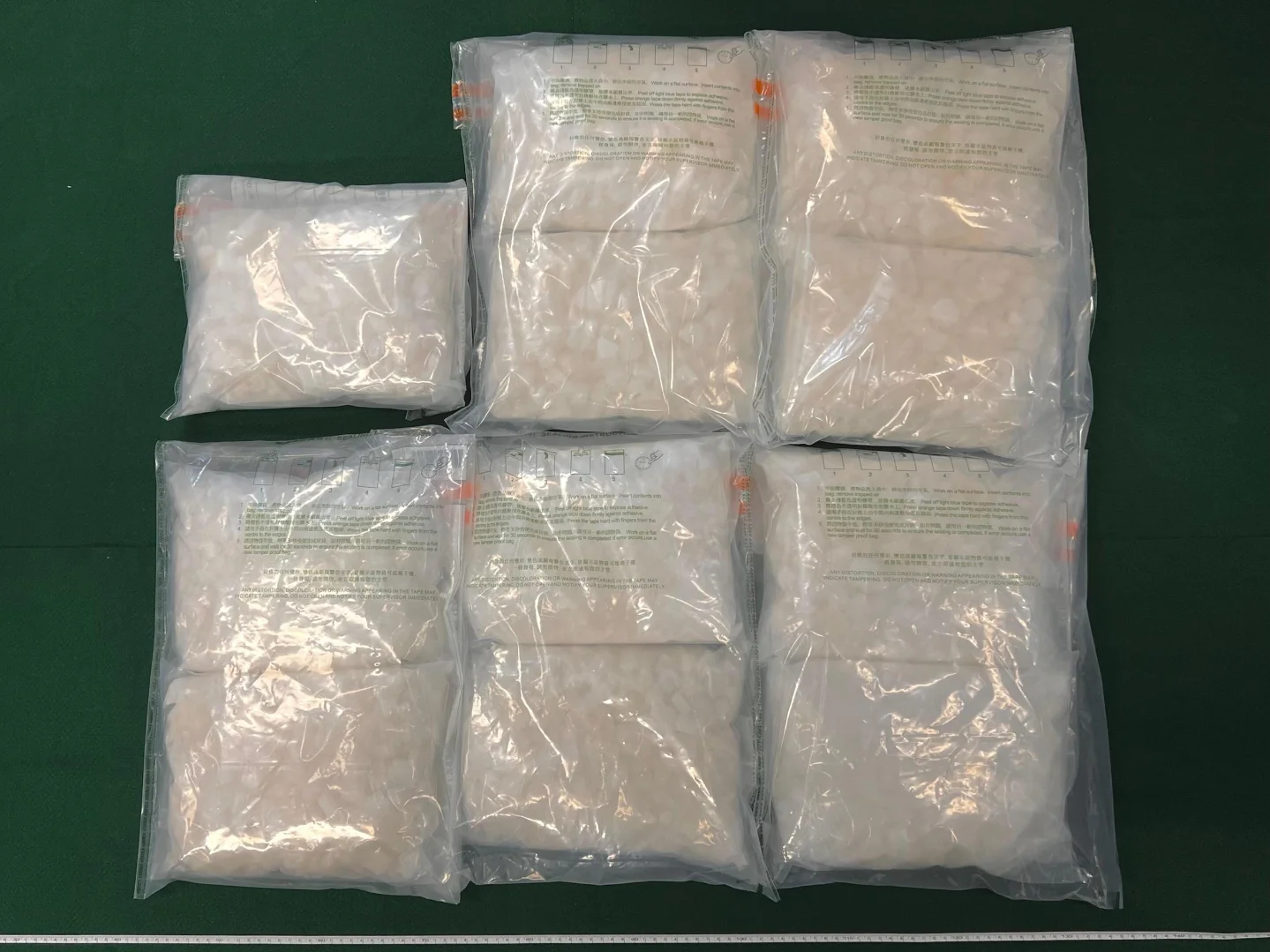
Hong Kong Customs arrested a 31-year-old man on June 24 at the Hong Kong–Zhuhai–Macao Bridge port. He was not carrying anything. Officers, acting on intelligence, traced his connection to a Tsuen Wan residential flat — and found approximately 22 kg of suspected ketamine stored there, with an estimated street value of HK$8.4 million (approximately $1.07 million). Drug packaging equipment was also recovered. 9
The man faces a charge of trafficking in dangerous drugs under the Dangerous Drugs Ordinance, which carries a maximum penalty of HK$5 million and life imprisonment. 9 He was scheduled for West Kowloon Magistrates' Courts on June 26.
The case geometry is a common one in drug distribution operations: the carrier crosses the border clean; the product is stashed at a fixed address; the two are only briefly co-located during transfer. Arresting at the bridge without finding anything is therefore not a failure — it is what triggered the warrant for the flat.
Declared as cars, bound for Kenya
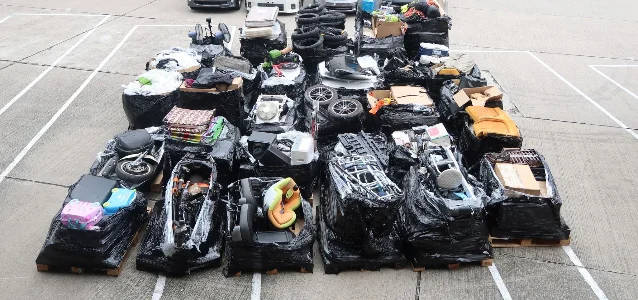
Also published June 25, a Hong Kong Customs investigation into two ocean freight containers that had cleared the port on June 13. The manifests declared the contents as private cars and automobile parts, destination Kenya. Officers working on intelligence and risk assessment opened the containers and found stacks of boxes: tablets, electronics, and household goods with a combined estimated value of HK$12 million (approximately $1.54 million) — none of it cars. 10

Under Hong Kong's Import and Export Ordinance, failing to accurately manifest cargo in an outbound shipment carries a maximum fine of HK$2 million and seven years' imprisonment. The investigation was ongoing at the time of publication, with arrests not ruled out. 10
Africa-bound container misdeclarations are a documented pattern in Hong Kong enforcement — the distance and multi-leg routing creates a window between departure and customs scrutiny at the destination that operators appear to calculate into their risk equation.
34 containers of cigarettes in the Philippines
The Philippines Bureau of Customs (BOC) ran two parallel cigarette operations in consecutive days. On June 22, a joint team of BOC, the National Bureau of Investigation, the Bureau of Internal Revenue, and the Philippine Coast Guard seized 23 forty-foot containers of illicit cigarettes from a private wharf in Manila — valued at approximately ₱1.7 billion (roughly $30.3 million). 11
On June 24, a second operation at the Port of Cebu turned up 11 more forty-foot containers, valued at approximately ₱860 million (roughly $15.3 million). 11 The Cebu seizure came just two days after Manila, with the same inter-agency composition: BOC, Philippine Coast Guard, NBI, Philippine National Police, and BIR all participating.
The use of a private wharf in the Manila case is the notable element: private wharves sit outside the normal inspection flow of official ports, creating a documented gap that cigarette trafficking networks exploit. The combined two-day haul — 34 containers, approximately ₱2.56 billion ($45.6 million) — is the largest concentrated cigarette enforcement action the Philippines has announced in a single week in 2026.
Three of this week's cases involve the same structural failure: a person with legitimate access to a restricted zone — an airport employee, a transit passenger's pre-arranged contact, a carrier walking out the exits. The Karipur lamp, the Chennai toilet-drop, and the Mumbai parking garage handoff are each different expressions of the same problem. The contraband does not always have to evade detection. Sometimes it only needs one person on the inside to carry it the last thirty meters.
Cover image: Five sealed bags of suspected ketamine (approximately 22 kg total, estimated street value HK$8.4 million) photographed after seizure at a Tsuen Wan residence, June 24, 2026. Image via Hong Kong Customs.
참고 출처
- 1Times of India — Gold smuggling through Mumbai airport busted: Airport staffer among 8 arrested; Rs 8.95 crore haul seized
- 2Daily Pioneer — Man arrested at Kerala Airport for smuggling 1.16 Kg gold hidden inside lamp
- 3The Print (PTI) — Gold biscuits weighing over 1 kg seized outside Kerala airport, one arrested
- 4Times of India — Airport staffer held for aiding smugglers, Rs 50 lakh worth gold seized
- 5DT Next — Customs seize 6 kg hydroponic ganja, 414 gm of gold from two individuals
- 6Trinidad Guardian — Customs seizes $1.4M in marijuana, firearm at PoS bond
- 7T&T Ministry of Finance — Media Release: C&ED Intercepts Firearm and Marijuana
- 8AZP News — Drugs in the Wash: $1.4m Marijuana, Firearm Hidden in Home Appliances
- 9Hong Kong Government — Hong Kong Customs seizes suspected ketamine worth about $8.4 million
- 10Hong Kong Government — Hong Kong Customs seizes suspected smuggled goods worth about $12 million
- 11Philippines Bureau of Customs — Media Releases


이 콘텐츠를 둘러싼 관점이나 맥락을 계속 보강해 보세요.