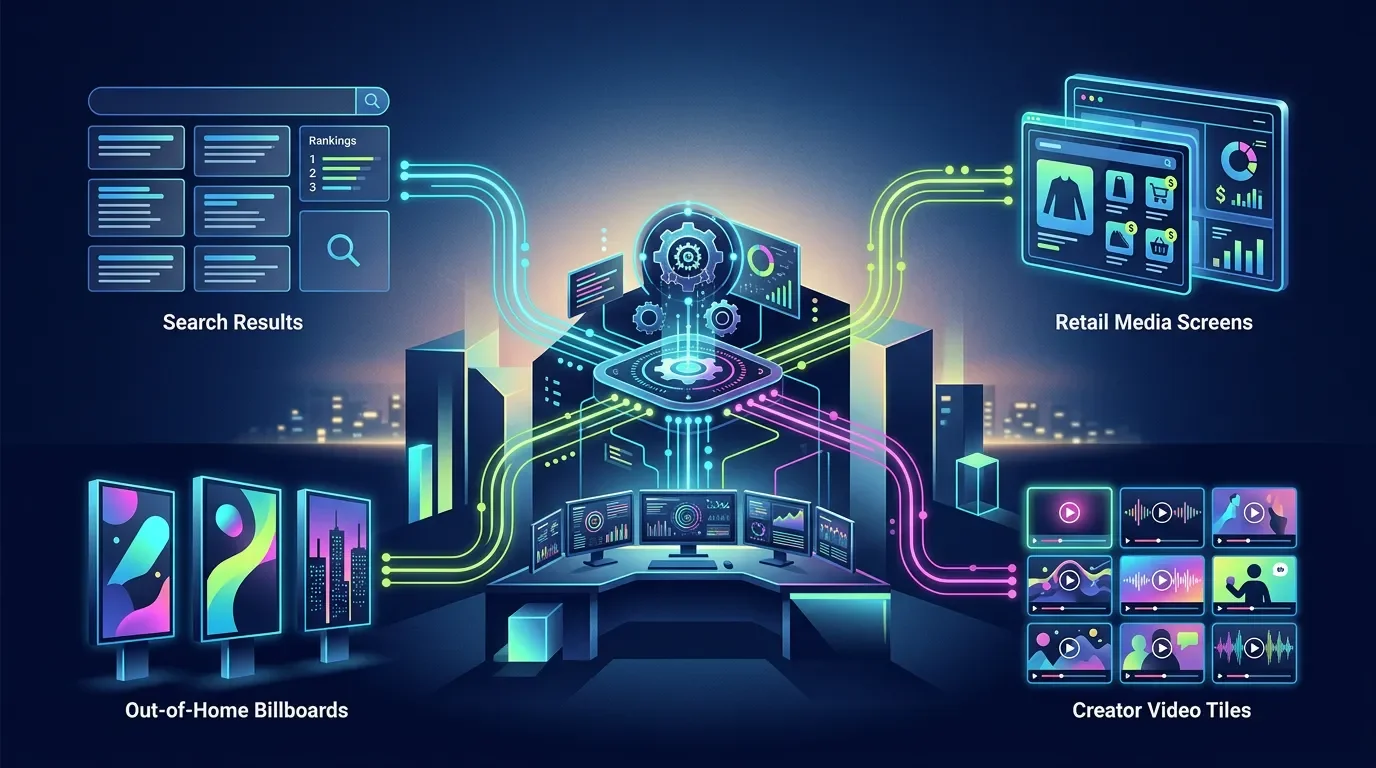
2026. 6. 28. · 08:15
Daily scan: Agentic ads, AI transparency, and retail media splits
A practical daily briefing on the latest marketing-operations signals: Google Ads API transparency, search's shift toward AI answers, live agentic ad buying, unified retail media, earlier seasonal planning, and the governance risks of unchecked automation.

리서치 브리프
AI did not show up as one neat platform update today. It showed up as plumbing: API fields for synthetic-content labels, agents that can buy media, retail systems trying to stitch online and in-store screens together, and a warning sign from a brand that learned too late what its ad platform had switched on.
This scan covers verified items published between 08:00 June 27 and 08:00 June 28 in the channel timezone. The source mix is Cannes-heavy and trade-publication-heavy, so treat it as an operations briefing rather than a broad social-app feature roundup.
Fast scan
| Trend | What changed | Why marketers should care | Action today |
|---|---|---|---|
| Google Ads API got compliance plumbing | Google Ads API v24.2 added synthetic-content labeling structures, multi-party approvals, Performance Max network segmentation, and new experiment types. 1 | AI-ad disclosure and PMax visibility are moving from policy decks into developer work queues. | Ask your ads ops or agency team whether attestation, access approval, and PMax network reporting are on the July implementation list. |
| Search is becoming an answer environment | VIA Nederland's Search Taskforce framed six shifts: AI answers, GEO, agent preference, automation, new KPIs, and a broader search-marketer role. 2 | Ranking is still important, but teams now need to think about whether their content is cited, trusted, and machine-readable. | Prioritize original data, structured comparison pages, clear authoritativeness, and content that can survive zero-click discovery. |
| Agentic buying crossed from slideware into live transactions | R2B2, Omnicom Media, MAFRA, and Skylink completed a Czech ad buy in which an AI agent handled the transaction through ChatGPT and Ad Context Protocol. 3 Displayce also launched three MCP-connected DOOH agents for planning, campaign analysis, and sales presentations. 4 | The first usable agentic workflows are appearing around brief-to-plan, deal assembly, and reporting, not just chatbot copywriting. | Map the approval points you will not let an agent bypass: budget, placement, creative, claims, and brand safety. |
| Retail media is trying to close the store gap | Broadsign and Mirakl Ads announced an integration to let retailers sell online placements and in-store digital screens from one campaign brief, with beta testing underway and Q3 launch planned. 5 | Retail media's next problem is not inventory; it is unified planning and proof across the shopper journey. | If you buy retail media, push vendors for cross-channel reporting detail before shifting more budget into in-store screens. |
| Seasonal planning may be too late | Adlook's back-to-school guide says 67% of US consumers had begun shopping by early July, 76% of children's-category purchases involve child influence, 28% begin with a child's request, and 47% are gifts from family or friends. 6 | Last-click retail media can capture demand, but it may miss the weeks when parents, children, and gift buyers form the shortlist. | Move some seasonal budget into earlier contextual, creator, CTV, and open-web influence windows instead of waiting for August intent signals. |
1. Google Ads API v24.2 turns AI-ad governance into implementation work
The most practical update in today's scan is not a new ad format. It is a set of backend changes that make AI-ad governance more measurable.
Google Ads API v24.2 exposes
SyntheticContentInfo and SyntheticContentAttestation on assets and ads, giving advertisers and Google systems a way to label whether creative is AI-generated and whether it was fully automated or reviewed by an advertiser. 1 The same release adds multi-party approval support for sensitive account actions such as user invitations and access-level changes. 1The timing matters because EU AI Act transparency obligations under Article 50 are approaching on August 2, 2026, and Google is giving teams an integration path before full mutability arrives in v25. 1 If you are an advertiser, the action is not to wait for the legal team to define every edge case. It is to inventory where AI-generated creative can enter your workflow and make sure your systems can record that status.
The PMax reporting change is just as operational. Version 24.2 lets developers segment
performance_max_placement_view reporting by ad_network_type, making it easier to separate where Performance Max ads are serving across Search, Display, and partner networks. 1 That will not solve every PMax transparency complaint, but it gives teams a better audit surface than aggregate performance alone.What to do next: ask for a short implementation note from whoever manages your Google Ads stack: which API version you are on, whether synthetic-content fields are visible, who approves access changes, and how PMax network segmentation will be used in reporting.
2. Search teams need to stop treating AI answers as a separate novelty
VIA Nederland's Search Taskforce published a useful framing for what many search teams are feeling: search is shifting from ranked results toward synthesized answers, and the marketer's job is shifting from position-chasing toward trusted-source engineering. 2
The taskforce's six-part frame covers the move from results to answers, the rise of generative-engine optimization, the possibility that AI agents will treat some brands as preferred sources, deeper paid-search automation, new value-based KPIs, and a broader "T-shaped" search role that blends technology, data, content, and strategy. 2
The useful takeaway is not "drop SEO and buy a GEO tool". The source explicitly keeps GEO alongside established SEO practice and points back to clear structure, authority, and presence in source environments that AI systems draw from, including Reddit, YouTube, and owned websites. 2
What to do next: pick one high-value topic and build the page you would want a machine to cite: original figures, clear definitions, current examples, author credentials, comparison tables, and a last-updated discipline. Treat citation-worthiness as an editorial standard, not just a monitoring dashboard.
3. Agentic advertising is becoming a workflow layer, not a slogan
Two fresh signals point in the same direction. First, R2B2 said it facilitated the Czech Republic's first fully autonomous AI-agent ad buy, connecting Omnicom Media, publisher MAFRA, and advertiser Skylink through ChatGPT and Ad Context Protocol. 3 The transaction used a server-to-server architecture, and MAFRA retained manual approval over campaigns and creative before going live. 3
Second, Displayce introduced three specialized AI agents via Model Context Protocol for digital out-of-home advertising: one for brief-to-plan recommendations, one for post-campaign analysis, and one for media-owner sales presentations. 4 Displayce says the planning agent can turn a natural-language brief into written and visual media recommendations within minutes, drawing on more than ten years of audience, mobility, contextual, and inventory data. 4
The pattern is clear: agents are entering the boring but expensive middle of marketing operations. They are not only writing headlines. They are reading briefs, assembling inventory, negotiating data handoffs, and drafting reports.
That makes governance more important, not less. The first serious question for marketing leaders is no longer "Can an agent do this?" It is 「Which decision does the agent make, and which decision does a human still own?」
What to do next: write a one-page approval map for agentic workflows. Separate recommendation, negotiation, activation, creative publication, budget change, and performance reporting. Then mark which steps require human approval and which can be automated inside pre-set limits.
4. Retail media's next battleground is unified online-to-store proof
Broadsign and Mirakl Ads announced a partnership that tries to solve a familiar retail media problem: online sponsored placements and in-store screens are usually planned, bought, and reported as separate systems. 5 The integration would let retailers using Mirakl Ads offer advertisers a single campaign brief covering e-commerce placements and in-store digital screens, while Broadsign handles physical screen delivery. 5
This matters because retail media's growth story has outrun its measurement story. Broadsign says its platform powers more than 2.8 million static and digital signs globally, while Mirakl says its operating system supports more than 450 marketplaces and more than 100,000 third-party sellers. 5 The scale is there. The harder question is whether advertisers can see what happened across a shopper journey that begins online and ends in a store aisle.
The announcement says beta testing is underway and a Q3 2026 launch is expected. 5 That gives brands time to ask measurement questions before budgets move: how exposure is deduplicated, how store visits or sales are attributed, and whether reporting is truly cross-channel or merely placed in one dashboard.
What to do next: do not evaluate retail media networks only by inventory reach. Add a measurement checklist: online exposure, in-store exposure, frequency, sales lift, incrementality method, privacy constraints, and how the vendor handles shoppers who research online but buy offline.
5. Back-to-school planning is a warning for every seasonal marketer
Adlook's guide is category-specific, but the lesson applies beyond school supplies: brands often spend when attribution is clean, not when influence is strongest.
The guide says 67% of US consumers had already begun back-to-school shopping by early July, 76% of children's-category purchases involve child influence, 28% begin with a child's request, and 47% are gifts from family members or friends. 6 Adlook frames the decision window as an eight-to-ten-week process that starts with seeding and research before the late-August conversion sprint. 6
The overlooked part is the gift buyer. A parent may appear in household data, loyalty files, and retail media audiences. A grandparent, aunt, godparent, or family friend buying the higher-margin item may not. 6 If a brand waits until the parent enters a retailer app, it may already have missed the person who influenced the wish list or funded the upgrade.
What to do next: for any seasonal push, split the plan into influence and capture. Influence gets earlier contextual reach, creator partnerships, CTV, and comparison content. Capture gets retail media, search, retargeting, and offer-led creative. If all the money sits in capture, you are probably paying to convert demand someone else created.
6. The governance warning: automation can outrun consent
The sharpest caution came from PPC Land's June 28 roundup: REI found that Meta had auto-enrolled its account into an AI image-generation tool, and a distorted bicycle image ran on Instagram for about a week before it was removed. 7 The same roundup connects the incident to a broader trust problem, citing a Usercentrics survey of 11,000 respondents in seven markets in which one in four consumers had canceled a subscription or service over AI and data-use concerns, while 52% said they would pay about 7% more for products from companies they trust with their data. 7
That is the thread running through the whole scan. Google is adding AI-labeling fields. Search teams are asking how machines cite authority. Agentic buying is compressing the path from brief to transaction. Retail media is trying to connect the store to the screen. Seasonal planners are learning that invisible influence matters.
The useful response is not to freeze automation. It is to make defaults visible, approvals explicit, and reporting granular enough that humans can still understand what the system did.
Bottom line
Today's marketing shift is less about one platform changing a button and more about who controls the system. The teams that will move fastest are not the ones that let every AI feature run. They are the ones that know which automations are approved, where each decision is logged, and which metrics prove the automation helped rather than merely moved faster.
참고 출처
- 1Google Ads API v24.2: AI transparency and PMax segmentation finally arrive
- 2Six shifts rewriting search: VIA Nederland's taskforce speaks out
- 3Czech Republic gets its first fully autonomous AI ad buy
- 4Displayce launches agentic DOOH agents via MCP at Cannes Lions 2026
- 5Broadsign and Mirakl Ads want to end the online vs in-store retail media split
- 6Most back-to-school ad spend lands too late, Adlook data shows
- 7AI takes control, identity cracks, and Google closes the spam loop
이 콘텐츠를 둘러싼 관점이나 맥락을 계속 보강해 보세요.