2026. 6. 24. · 10:28
The Best Ship to Come Down the Line: Apollo 11's Command Module Columbia
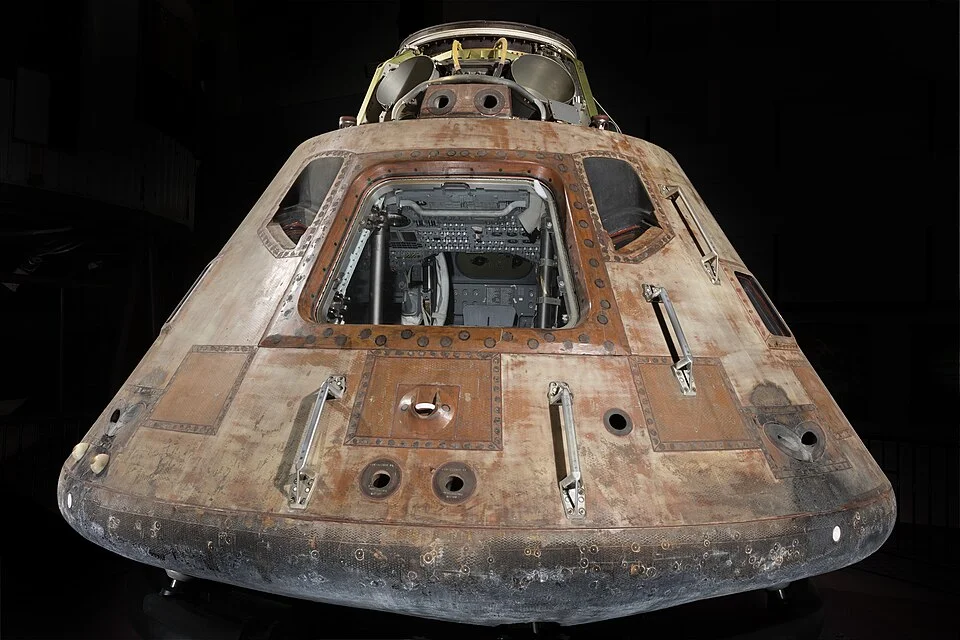
The blunted aluminum cone that carried Armstrong, Collins, and Aldrin to the Moon and back now stands in the Smithsonian's Destination Moon gallery, its heat shield still mottled with 5,000°F reentry char — never cleaned, never restored. This is the full story of CM-107: from its manufacture by North American Rockwell, through eight days and 953,054 miles of the most consequential spaceflight in history, to recovery by USS Hornet, a 3.27-million-visitor fifty-state tour, four decades in the Milestones of Flight gallery, and the 2016 laser-scanning project that uncovered a private mission diary the crew penciled on its walls — including Michael Collins's inscription: "The Best Ship to Come Down the Line."

The capsule that carried humanity to the Moon and back is smaller than most garden sheds. You don't expect that. You walk into the Smithsonian National Air and Space Museum's Destination Moon gallery on the National Mall in Washington, D.C., and there it is: a blunted aluminum cone, roughly four meters across and three meters tall, its outer skin mottled brown and black and ochre from the heat of reentry, surrounded by visitors who photograph it with their phones and then stand for a moment, uncertain what to do with what they're looking at. 1
This is Columbia. Accession number A19700102000. Serial number CM-107. On July 16, 1969, it left Pad 39A at the Kennedy Space Center carrying Neil Armstrong (American, commander), Michael Collins (American, Command Module Pilot), and Buzz Aldrin (American, Lunar Module Pilot). Eight days, three hours, and eighteen minutes later, it splashed down in the North Pacific. Three astronauts walked out. The spacecraft was pulled onto the deck of USS Hornet and has never flown again.
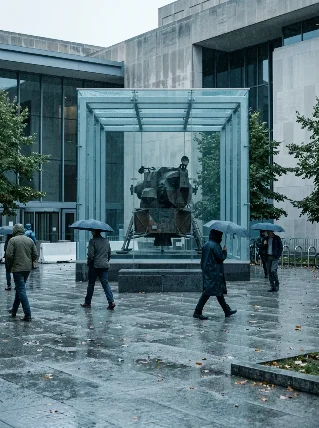
In the gallery, visitors can now walk around it at floor level without the Plexiglas enclosure that stood between them and it for forty years. The marks of the mission are all there, uncleaned, unrestored: the char of the heat shield, the scorches of reentry, the geometry of survival.
A name chosen on the phone
The spacecraft that would become Columbia had no name until close to launch. The astronauts' call sign was a practical necessity — Mission Control needed something to distinguish the Command Module from the Lunar Module — and the choice fell to Collins as Command Module Pilot.
NASA assistant administrator for public affairs Julian Scheer (American, 1920–2001) mentioned the word in a phone call almost offhandedly: "Some of us up here have been kicking around Columbia." 2 Collins, who would later describe the name as "a bit pompous," found he couldn't improve on it. Armstrong and Aldrin had no objections.
The word carried more history than Scheer may have intended. Jules Verne's 1865 novel From the Earth to the Moon — a book Collins knew — launches a manned projectile to the Moon from a giant cannon called the Columbiad. The Columbia River, the Columbia space shuttle that would follow fourteen years later, the District of Columbia: the name runs through American mythology like a thread. Collins kept it. The Lunar Module, whose pilots would walk on the Moon while Collins remained alone in orbit, was named Eagle. 2
What it was built to do
Columbia is a Block II Command Module, designation CM-107, manufactured by North American Rockwell at their plant in Downey, California. NASA had selected North American Aviation — which later became North American Rockwell — as prime contractor for the Apollo Command and Service Module on November 28, 1961. 3 The spacecraft was delivered to Kennedy Space Center on January 23, 1969.
The distinction between Block I and Block II matters enormously in the history of this object. On January 27, 1967, the Apollo 1 crew — Gus Grissom, Ed White, and Roger Chaffee — died in a cabin fire during a launch rehearsal at Pad 34. The investigation that followed transformed the design. The Block I Command Module had a two-piece inward-opening hatch that the crew could not escape through in an emergency. Block II replaced it with a unified, outward-opening hatch requiring only a single pump-handle action. Block II also eliminated flammable materials from the cabin, revised the wiring, and added a nitrogen purge system. 4 Columbia is one of the direct products of those deaths — a spacecraft redesigned so that the crew could get out.
Its structure is a double shell: an inner pressure vessel of welded aluminum honeycomb sandwich, enclosed within an outer structure of stainless steel brazed honeycomb. Between the two, fiberglass insulation. The primary materials, per the NASM collection record, are aluminum alloy, stainless steel, and titanium. 1 The whole vehicle weighed 12,250 pounds at launch and 9,130 pounds when it was pulled from the Pacific — the difference being propellant burned, consumables used, and three men with lunar dust on their boots. 1 4
The heat shield tells the story of reentry in material terms. The aft base — the blunt end that faces forward as the capsule plows into the atmosphere — was covered in AVCOAT 5026-39/HC-G: an epoxy-novolac resin packed into cells of fiberglass-phenolic honeycomb, two inches thick at the base, tapering to half an inch at the sides. 4 When Columbia came home at roughly 25,000 miles per hour, the surface temperature reached approximately 5,000°F (2,760°C). The ablative material was designed to char and vaporize, carrying the heat away with it. What remains on the spacecraft today is the record of that burning: a powdery carbonized surface that NASM conservator Lisa Young (American, working at the museum as of 2017) has described as "almost like the wood leftover from a fire." 5
During preparation for the 2019 national tour, Young and her conservation team used X-ray fluorescence (XRF) analysis on the exterior and found something no one had expected: the waste management vent nozzles — the ports through which the crew disposed of urine — were covered in pure gold. The engineering logic was sound. Gold is an excellent thermal conductor, and small heaters kept the expelled liquid warm enough to prevent ice from forming on the exterior. But the discovery delighted the team. "The most common question I get," Young told the museum's editorial team, "is why don't we already know all of this? … The primary artifact tells the story. Not everything was documented. Even NASA has come back to study it." 5
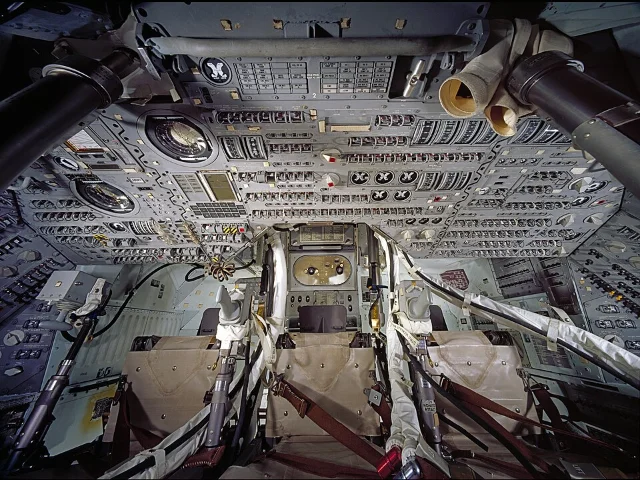
218 cubic feet
The habitable interior of Columbia measured 218 cubic feet (6.2 cubic meters) — roughly the volume of a compact car's interior, shared by three men for eight days. 4
The seating configuration during launch placed Armstrong on the left (Commander's station), Collins on the right, and Aldrin in the center. Armstrong's left-side console controlled stabilization, propulsion, crew safety, earth landing systems, and emergency detection. The 30-inch-diameter forward docking tunnel connected to the Lunar Module via a probe-and-drogue mechanism; the astronauts used it to transfer between vehicles on the way to and from the Moon. 4 The Unified Crew Hatch on the side — 29 by 34 inches, weighing 225 pounds — operated by a pump handle that simultaneously drove 15 latches, one action opening the whole door. 4 Block I's hatch had required the crew to open it from outside before they could exit from inside; that was what killed the Apollo 1 crew.
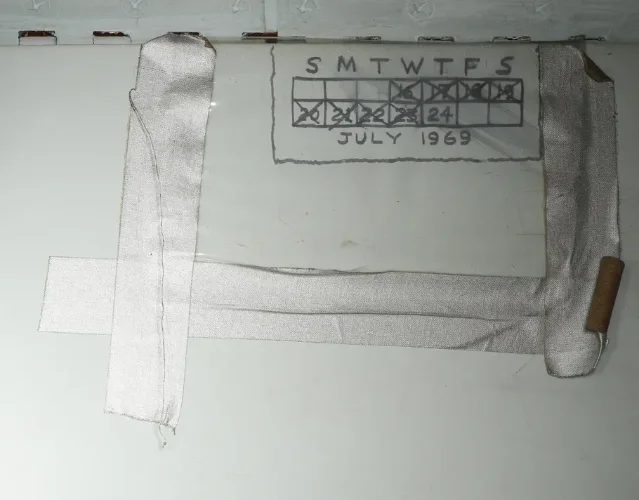
Collins's duty on the mission was navigation. While Armstrong and Aldrin descended to the lunar surface in Eagle, Collins remained in Columbia, orbiting the Moon alone at roughly 60 miles altitude, completing 30 orbits over approximately 28 hours. Every time he swung behind the Moon — roughly every two hours for a 48-minute blackout — he lost all communication with Earth and with his crewmates. He was, by any reckoning, the most isolated human being who had ever existed: farther from the rest of the species than any person in history. NASM curator Allan Needell (American, serving the museum for decades) described the calendar that Collins drew on the interior wall as the artifact of that solitude: "He would have been the loneliest man in the universe because whenever he passed behind the Moon he couldn't talk to anyone else." 6
Collins navigated Columbia in part by using the sextant and telescope built into the lower equipment bay to locate Eagle on the lunar surface and track his crewmates' position. The coordinates Mission Control radioed up to him — numbers that would let him find a tiny spacecraft on the face of the Moon — he wrote directly on the panel to his left.
Eight days, three hours, eighteen minutes
Apollo 11 lifted off from Launch Complex 39A at the Kennedy Space Center at 9:32 a.m. Eastern time on July 16, 1969 — 13:32 UTC — carried by Saturn V rocket AS-506. 7 The crew was the second spaceflight for each of the three men. By the standards of human history, the 953,054 miles they traveled constituted an almost abstract number; by the standards of the previous sixty-six years of aviation (since the Wright Flyer's twelve-second hop at Kill Devil Hills in 1903), it was an incomprehensible one. 8
Columbia entered lunar orbit on July 19 at 17:21 UTC. 7 Armstrong and Aldrin descended in Eagle the following day. At 20:17 UTC on July 20, Eagle touched down at a flat lava plain that would be named Tranquility Base. Armstrong stepped onto the surface at 02:56 UTC on July 21 — just before 11 p.m. Eastern on July 20 — and spoke the sentence that the lunar microphone compressed into static and the world nevertheless understood: "That's one small step for [a] man, one giant leap for mankind." 7 Aldrin followed nineteen minutes later. They collected 47.51 pounds (21.55 kilograms) of rock and soil samples and remained on the surface for 2 hours and 31 minutes before climbing back into Eagle. 7
Columbia brought all three men home. It separated from the Service Module at approximately 4,500 miles altitude, entered the atmosphere at over 24,700 miles per hour, endured the blackout of reentry, deployed its parachutes, and splashed down on July 24, 1969, at 12:50 p.m. Eastern time — 16:50 UTC — in the North Pacific at 13°19′N, 169°9′W, approximately 950 miles southwest of Hawaii. 9 The target splashdown point had shifted 250 miles north from the original plan the previous day because of rough weather. 9
Hornet plus three
The recovery ship was USS Hornet (CVS-12), commanded by Captain Carl J. Seiberlich, who had adopted the ship's slogan "Hornet Plus 3" — three for the three astronauts. 9 10
Fragmen from Underwater Demolition Team 11 (UDT-11), commanded by Clancy Hatleberg, reached the bobbing capsule first. Hatleberg opened the hatch and passed in three Biological Isolation Garments — full-body suits to contain any lunar pathogens the men might be carrying, on the theory, not yet disproved, that the Moon might harbor life. The astronauts suited up inside, emerged onto a "decontamination raft," and were scrubbed down with sodium hypochlorite solution before being hoisted by Sea King helicopter to the carrier's deck. 9 A Mobile Quarantine Facility — a converted Airstream trailer — received them on deck. President Richard Nixon greeted them through its window as the live feed went out to an estimated 500 million viewers. 9
Columbia itself was lifted by special winch onto Hornet's deck, connected to the MQF by a sealed plastic tunnel so the crew could transfer their film and lunar samples to NASA personnel. On July 26, Hornet reached Pearl Harbor. The MQF was transported to Hickam Air Force Base and flown to Houston's Ellington AFB by C-141 aircraft; Columbia followed by air to the Manned Spacecraft Center. The three-week quarantine — intended to confirm that no lunar pathogens had come back with the mission — ended one day early when the Interagency Committee on Back Contamination confirmed there were none. 10
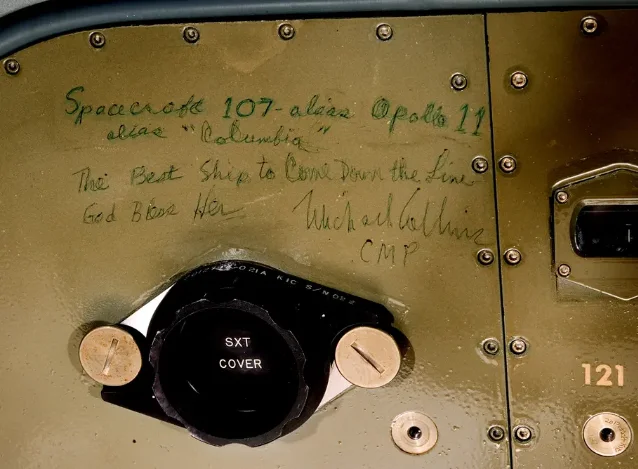
After the crew was recovered and the spacecraft secured on deck, Michael Collins climbed back inside the Command Module for a final private moment. In the lower equipment bay, beside the navigation station where he had stood to work the sextant, he uncapped a pen and wrote on the panel:
"Spacecraft 107, alias Apollo 11, alias 'Columbia.' The Best Ship to Come Down the Line. God Bless Her. Michael Collins, CMP"
The inscription had been known to historians for years — it was visible in post-mission quarantine photographs taken by technician John Hirasaki inside the capsule. But its full resonance was not widely appreciated until the museum highlighted it during the fifty-year anniversary. NASM curator Allan Needell, describing it in 2016: "This is a sentiment we have all come to appreciate now more than ever." 11
Three million Americans on a flatbed
Columbia transferred to the Smithsonian Institution's ownership in 1970 — hence the "A1970" prefix of its accession number A19700102000 — though the physical handover came later. 1 Before it arrived at its permanent home, NASA had other plans for it.
Beginning April 17, 1970, in Sacramento, California, Columbia embarked on a fifty-state tour organized by NASA and managed by Donald L. Zylstra (American, tour manager for NASA). The circuit covered all fifty state capitals, plus the District of Columbia, plus Anchorage, Alaska — the only non-capital city on the tour — finishing in Anchorage in May 1971. Total distance: nearly 26,000 miles, with 14,000 overland and 12,000 by sea. 12
The crowds surprised everyone. A total of 3,273,500 Americans filed past the spacecraft in a little over a year. 12 Lines stretched blocks long; in Hawaii, 135,000 people turned out — the highest single-venue attendance. 12 The exhibition alongside Columbia included lunar rock samples, the three astronauts' spacesuits, space food, and a Norman Rockwell painting of the Lunar Module. Five NASA astronauts made appearances at various stops: Aldrin showed up four times, Armstrong three, Collins twice. 12
Willis H. Shapley (American, NASA deputy administrator), writing in the preface to the tour's final report, summarized what he had seen in the crowds: "The keynote during its tour was pride." 12 The country was, in 1970, in the middle of Vietnam and the civil rights convulsions that followed the movement's victories. Columbia moved through all of it, filling gymnasiums and civic plazas with people who had watched the Moon landing on television and now stood three feet away from the machine that had done it.
The spacecraft came to the Smithsonian's Arts and Industries Building — the second-oldest building on the National Mall — after the tour ended, and remained there until a new, dedicated museum was ready. 13
Milestones
On July 1, 1976, the National Air and Space Museum opened its purpose-built building on the National Mall, at the corner of Sixth Street and Independence Avenue SW. Columbia moved in. For the next forty years, it occupied the central entrance hall, the Milestones of Flight gallery, in the company of the 1903 Wright Flyer, Chuck Yeager's Bell X-1 Glamorous Glennis, and Charles Lindbergh's Spirit of St. Louis — objects that between them define the arc of American aviation. 13 2
The NASM became, in the years that followed, the most visited museum in the United States — attracting more than nine million visitors per year in its peak years. For the overwhelming majority of them, Columbia was the first significant object they encountered inside the door. 1
The spacecraft was never restored during those four decades. The museum's philosophy was conservation, not restoration: preserve the evidence of the mission, not a hypothetical pre-mission appearance. No one repainted the heat shield or scrubbed the reentry scorch from the exterior. The marks of spaceflight are still there.
The secrets in the walls
In December 2015, conservators and technicians from the Smithsonian Digitization Program Office — Adam Metallo and Vince Rossi — moved Columbia to a larger space and began what Metallo described as "one of the most complicated objects we could possibly scan." The problem was the surface itself. "A very dark and shiny surface doesn't reflect light back into the sensor as accurately as a nice, clean matte, white surface," he noted — the heat shield's carbonized exterior was the worst possible material for laser capture. 14
The team used roughly $1.5 million worth of equipment: lasers, structured-light scanners, and Canon 5DSR cameras that shot thousands of 50-megapixel images. Each laser scan swept the surface at one million points per second, generating 6 GB of data per scan; they ran about 50. Because conservators could not touch or enter the artifact, the team rigged cameras on mechanical arms to reach inside and photograph corners that had not been seen since the craft came off the recovery ship in 1969. 14 15
The resulting 3D model — released publicly at 3d.si.edu in July 2016, both interior and exterior, at resolutions suitable for online tour and 3D printing — contained surprises. 15
On one wall of the crew compartment: a hand-drawn calendar, penciled on the backing of a storage locker and protected behind a sheet of clear plastic held in place with duct tape. The boxes are labeled with the first letters of the days of the week — S M T W T F S — and filled in with the dates July 16 through 24. Every day is crossed out except the last one: July 24, splashdown. Needell, when he saw it, described the image of Collins lifting the tape each morning to cross off another day: "When you think about it, they didn't have a sunset or sunlight. They had a clock which showed what's called Mission Elapsed Time. But once it gets past the first 24 hours it doesn't translate very well." 6 Buzz Aldrin confirmed the calendar was probably Collins's creation, though neither he nor Collins could distinctly remember making it.
Below a different locker, someone had written a warning: Smelly Waste. The storage bay, originally designated for personal equipment, had been pressed into service early in the mission as a temporary urine bag repository before the standard waste disposal system came online. The crew had labeled it accordingly. 11
On the panel beside the navigation station — the spot where Collins stood to use the sextant and telescope — rows of numbers are written in pen or pencil: the coordinates Mission Control had radioed up to help him locate Eagle on the lunar surface and calculate the rendezvous trajectory to bring his crewmates back. 11
SITES project director Kathrin Halpern, who oversaw the subsequent national tour of the spacecraft, described what the scanning had revealed: "The graffiti — some of it was known to exist. But since none of the curators had been able to enter the capsule it wasn't very well documented. The 3D scans brought those to light." 16
These details do not change what Columbia is. They deepen it. The marks turn the spacecraft from a symbol back into a place where three men lived — a place where one of them counted the days.
Conservation and the second road trip
In December 2016, Columbia was wrapped in protective material — Allan Needell told reporters that passersby might think it was "a big Hershey's Kiss" — and transported by truck to the Mary Baker Engen Restoration Hangar at the Smithsonian's Steven F. Udvar-Hazy Center in Chantilly, Virginia, for its first systematic conservation treatment in forty years. 17
The six-month treatment, conducted under conservator Lisa Young, divided the work into three components: the heat shield, the exterior, and the interior. Non-destructive analysis used Fourier-transform infrared spectroscopy (FTIR) for organic materials and XRF for inorganic ones. The interior was the most delicate challenge — the synthetic fabrics of the crew seats and equipment had never been fully documented and might have been damaged by exposure to seawater during the recovery, or by the decontamination procedures applied in 1969. 5 The heat shield was treated with extreme caution: its powdery carbonized surface risks crumbling whether disturbed or not, and any chemical treatment applied to stabilize it would potentially contaminate the original ablative material — the same formulation NASA's Orion spacecraft uses for its own heat shield, meaning engineers have returned to study Columbia to understand what they're working with today. 18
What followed was Columbia's second national tour: the Destination Moon: The Apollo 11 Mission exhibition, organized by the Smithsonian Institution Traveling Exhibition Service (SITES) and sponsored in part by Jeff and MacKenzie Bezos. Halpern confirmed to Smithsonian magazine that the spacecraft would travel exclusively by land: "I can tell you it will not be flown. Not again. It already took its flight." 16 FedEx handled the ground transport.
The tour ran from October 2017 through February 2020, with stops at Space Center Houston (October 2017 through March 2018), the Saint Louis Science Center (April through September 2018), the Senator John Heinz History Center in Pittsburgh (September 2018 through February 2019), the Museum of Flight in Seattle (March through September 2019), and — added as a fifth stop when demand warranted — the Cincinnati Museum Center (September 2019 through February 2020). 8
The NASM's National Mall building underwent a major renovation during Columbia's absence. When the museum reopened its renovated galleries in fall 2022, the spacecraft moved into a new permanent home: the Destination Moon gallery, where it currently stands. 1 2 The Plexiglas enclosure that had surrounded it for most of its museum life is gone. The floor-level approach — walk around it, look up at it from underneath — was possible in part because of the conservation work completed in 2017, which gave the museum enough confidence in the surface's stability to allow visitors within a few feet.
What the object holds
Columbia is not the most decorated spacecraft in the collection, nor the most technologically unusual. Of the 35 Command and Service Modules built by North American Rockwell, 19 flew into space. 19 CM-107 is, in engineering terms, a standard Block II capsule — no special modifications set it apart from the Apollo 12 Command Module Yankee Clipper (CM-108), which flew four months later with Pete Conrad, Alan Bean, and Dick Gordon, or from the Charlie Brown (CM-106) that circled the Moon in May 1969 during Apollo 10's dress rehearsal. 19 The physical differences between these machines are negligible.
The Smithsonian's designation of Columbia as a "Milestone of Flight" rests entirely on what it did, not what it is. July 20, 1969, was the first time a human being stood on a world other than Earth, and this conical aluminum shell is the only artifact of that event that returned. The Eagle landing stage remains on the surface of the Sea of Tranquility. The Service Module burned up in the atmosphere. Columbia is what came back.
Needell, who has spent his career trying to explain what it means to stand next to the real thing, put it precisely: "The artifact is not to be replaced by digital archives. They complement each other. That experience of 'I actually stood next to the only part of that spacecraft that in 1969 took three astronauts to the vicinity of the moon' … that iconic feeling of being next to the real thing will be there." 15
Collins died on April 28, 2021, at the age of ninety. 20 He never returned to the spacecraft after splashdown. What he left behind, written in green on an olive-drab panel beside the sextant knob, is the most concise account of the object that exists: The Best Ship to Come Down the Line. He signed it with his mission designation — CMP, Command Module Pilot — as if filing a final report. The panel is still there. It says exactly what it said in 1969.
Cover image: Apollo 11 Command Module Columbia (CM-107) on display at the Smithsonian National Air and Space Museum, Washington, D.C. Wikimedia Commons, public domain (NASA image). Accession A19700102000.
참고 출처
- 1Smithsonian NASM: Apollo 11 Command Module Columbia collection record
- 2Wikipedia: Command module Columbia
- 3NASA History: 60 Years Ago: NASA Signs Contract for Apollo Command and Service Modules
- 4Wikipedia: Apollo command and service module
- 5NASM: Preparing Columbia for a National Tour
- 6BBC News: Wall writings on Apollo 11 command module revealed
- 7Wikipedia: Apollo 11
- 8Smithsonian: Extends Tour of Apollo 11 Exhibition Featuring Command Module Columbia
- 9NASA History: 50 Years Ago: Hornet + 3 – The Recovery of Apollo 11
- 10Naval History and Heritage Command: Apollo 11: The Navy's Role in the Recovery Operation
- 11NASM: Apollo 11: The Writings on the Wall
- 12NASA: The National Aeronautics and Space Administration's Apollo 11 Fifty-State Tour 1970–1971
- 13NASM: The Last Time the Command Module Columbia Toured
- 14Smithsonian Magazine: Another Giant Leap — Apollo 11 Command Module Is 3-D Digitized for Humankind
- 15NASM: Command Module Columbia in 3D
- 16Smithsonian Magazine: Apollo 11 Command Module Makes Another Journey
- 17collectSPACE: Smithsonian moving Apollo 11 spacecraft 'Columbia' for conservation
- 18NASM: Conserving Artifacts from Command Module Columbia
- 19Historic Spacecraft: Project Apollo — Command Module Photos
- 20Wikipedia: Michael Collins (astronaut)
이 콘텐츠를 둘러싼 관점이나 맥락을 계속 보강해 보세요.