2026. 6. 15. · 14:01
The Almond Paradox: Your Calorie App Is Overcharging You
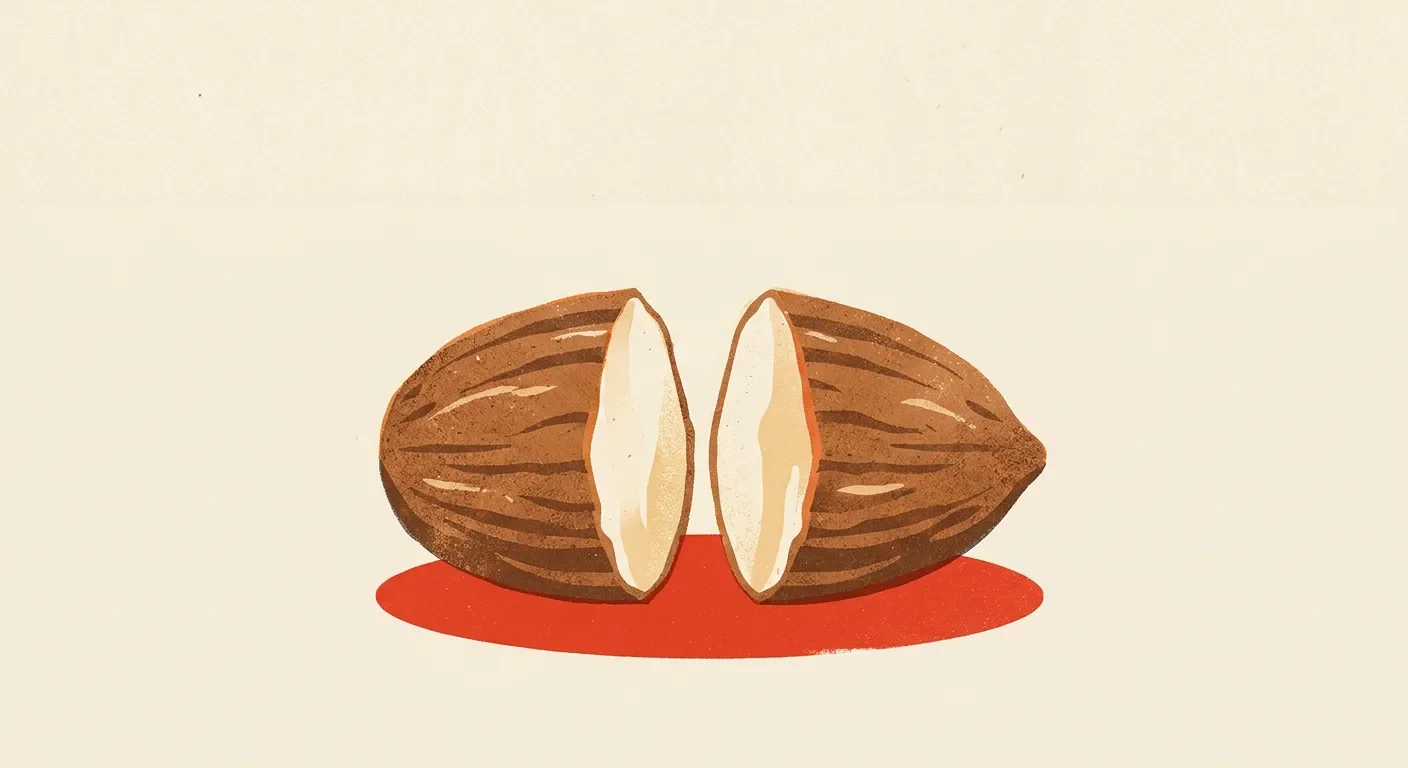
The 160-calorie-per-ounce figure on almond labels comes from a 19th-century formula that ignores the nut's intact cell walls. USDA research shows whole raw almonds deliver about 32% fewer absorbed calories than labeled -- and multiple RCTs confirm they don't cause the weight gain you'd expect.
Your almond app is lying to you. Not maliciously, just with an outdated formula from the 1800s.
A one-ounce serving of almonds (about 23 nuts) carries a label claim of roughly 160 to 170 calories. That number comes from the Atwater system, developed by American chemist Wilbur Atwater in the late 19th century. Atwater assigned fixed calorie values to protein, fat, and carbohydrate regardless of the food they came from: 4 calories per gram of protein, 9 per gram of fat, 4 per gram of carb. Add up the macros, get the calories. It works reasonably well for eggs, white bread, and most processed foods. For whole almonds, it's off by a meaningful margin.1
Why the label number is wrong
USDA Agricultural Research Service physiologists David Baer and Janet Novotny ran a series of controlled feeding studies in which volunteers ate precise amounts of nuts. Researchers then collected fecal and urine samples to measure how much fat, protein, carbohydrate, and energy actually left the body unused.
For whole raw almonds, the Atwater factors overestimated metabolizable energy by about 32 percent: 129 calories actually absorbed versus the 168-170 on the label.1 A 2021 randomized crossover trial published in Mayo Clinic Proceedings confirmed similar results, finding almond energy bioaccessibility at around 78.5 percent, with an average energy loss of 40.6 kcal per day in the full-dose almond phase.2
통계 카드를 불러오는 중…
The mechanism is the almond's own cell wall. Fat inside an almond is enclosed in tough plant cells made of indigestible fiber. Unless those cells rupture during chewing or processing, digestive enzymes can't reach the fat inside them. Whole raw almonds break down less completely than roasted or chopped ones, which is why the calorie discount is largest for whole raw (32% below Atwater) and smaller for chopped roasted (17% below Atwater). Almond butter, where the cell walls are obliterated, comes much closer to the label value.1
This is not a small rounding error in a food diary. If you eat a daily handful of whole raw almonds, the gap between label calories and absorbed calories could easily run to 30-40 kcal per day. Over a year that adds up to the caloric equivalent of a few extra pounds in the other direction, calories your body never received but your tracking app charged you for.
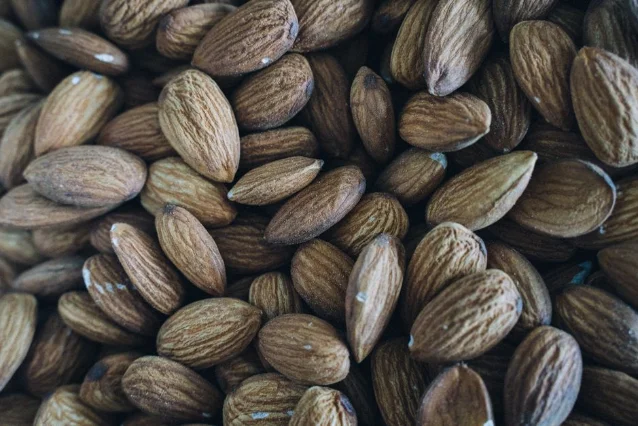
The calorie that doesn't land doesn't count
Even setting aside bioavailability, almonds are genuinely strange from a weight perspective. Multiple research groups have run experiments where they added a daily almond portion on top of a person's habitual diet, predicted the expected weight gain from those extra calories, and then watched it not happen.
The most cited example: in a crossover trial, 20 healthy women added 60 grams of raw almonds per day (344 kcal by label) to their usual diet for 10 weeks, with no guidance on what to cut elsewhere. The predicted fat gain was 3 kg. The actual change in body weight was not statistically significant. Where did those calories go? The researchers tracked three routes: 74% was compensated by spontaneously eating less of other foods; 7% appeared in fecal excretion (the intact-cell-wall effect again); and 24% showed up as increased resting energy expenditure.4
That last number is worth sitting with. A quarter of the label calories from almonds went to running your metabolism faster, not to your fat tissue. That's the thermic effect of food (TEF) in action, and it's higher for protein and fiber-rich foods than for refined carbohydrates. Almonds are about 20% protein and high in fiber; both have higher TEF than fat or starch. When you eat a handful of almonds and feel full for hours, the protein and fiber are doing actual metabolic work, not just sitting inert in your stomach.
A 2021 comprehensive review analyzed 64 randomized controlled trials (RCTs) and 14 systematic reviews on almonds and weight measures. The finding that consistently stands out: almonds were the only nut in multiple meta-analyses to show a small but significant reduction in both body mass and fat mass compared to control diets.4 A 2024 perspective paper by an expert panel convened by researchers from Wake Forest, UC San Diego, Harvard, and the University of Toronto confirmed the same pattern holds across the most current evidence: almond consumption does not result in weight gain, and higher intakes (around 50 g/day or more) are associated with slight weight loss in some populations.5
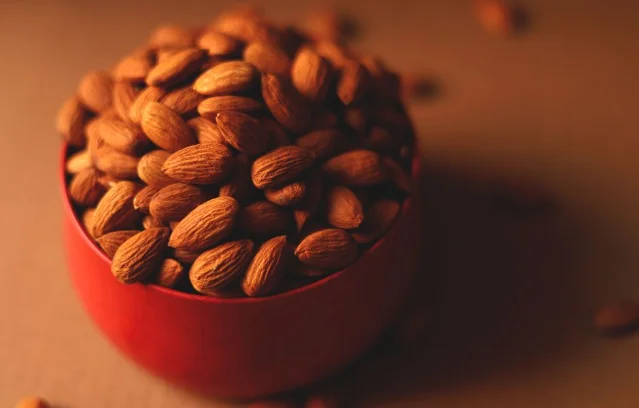
The myth's backstory
Almonds got their bad reputation by association. Nuts are a high-fat food, and for decades the dominant dietary advice in North America was that dietary fat causes obesity and heart disease. A single ounce of almonds provides around 14 grams of fat, which looks alarming on a low-fat diet framework. The number felt dangerous before anyone examined what that fat does in the body.
The fat in almonds is predominantly monounsaturated (oleic acid, the same fat in olive oil) with a meaningful proportion of polyunsaturated fats. There is strong evidence that replacing saturated fat with these unsaturated fats reduces cardiovascular risk.5 Multiple meta-analyses have found that regular almond consumption produces a small but significant reduction in LDL cholesterol (approximately 5 mg/dL on average) and a modest reduction in diastolic blood pressure.5 These are clinically modest effects for any individual, but meaningful at a population level when combined with other dietary patterns that target LDL and blood pressure, such as the Portfolio diet or DASH.
The fat-phobia framing also led people to avoid almonds while reaching for low-fat crackers or fat-free yogurt loaded with added sugar. Those are foods where the Atwater factors work just fine, where the calories land exactly as labeled, where there's no satiety bonus from intact cell walls, and where there's minimal protein or fiber to push up thermogenesis.
What this actually means for you
The evidence is strongest and clearest on a few specific points:
Whole raw almonds deliver meaningfully fewer absorbed calories than the label says, somewhere in the range of 20-32% less, because intact plant cell walls prevent full fat digestion.1 Almond butter does not have this discount; when the cells are pulverized, the fat is fully accessible.
Adding almonds to a diet without compensating elsewhere does not, in well-controlled RCTs, produce the expected weight gain from their label calories. This reflects spontaneous reduction in appetite, a small fecal calorie loss, and a real increase in resting energy expenditure.4
The satiety effect is real and has practical use. Almonds consumed as a mid-morning snack in one RCT were more effective at reducing pre-lunch hunger than a calorie-matched energy-free snack.4 Afternoon almond snacking was most effective at suppressing overall hunger across a full day.
What this doesn't mean: almonds have zero calories, or that you can eat them without any consideration. The calorie deficit relative to the label is real but not unlimited. And if your diet already fills your energy needs, displacing something will be part of the picture.
A reasonable frame: a one-ounce handful of whole raw almonds probably delivers somewhere around 120-130 calories to your metabolism, not 160-170. It keeps you full longer than most 130-calorie snack alternatives. It slightly improves your LDL numbers over time. And it does not, based on the best available evidence, cause weight gain.
If you've been avoiding them because the label said 160, that number was wrong. The more interesting question now is what else your food tracker is overcharging you for.
A note on evidence strength: The bioavailability findings come from rigorous controlled studies at the USDA and in peer-reviewed journals. The weight neutrality findings come from multiple independent RCTs and meta-analyses. Both are strong. The mechanisms behind energy compensation (appetite, thermogenesis, microbiome effects) are plausible and supported by emerging data but are not yet fully worked out. The specific calorie discount applies to whole almonds; almond-derived products vary. This article is general nutrition information, not personalized dietary advice.
참고 출처
- 1Going Nuts Over Calories, USDA AgResearch Magazine
- 2Almond Bioaccessibility in a Randomized Crossover Trial, Mayo Clinic Proceedings
- 3Almond nuts in close-up shot, Pexels / Anna Tarazevich
- 4Dreher ML, A Comprehensive Review of Almond Clinical Trials, Nutrients 2021
- 5Trumbo PR et al., Current Scientific Evidence on Almonds in Cardiometabolic Health, Current Developments in Nutrition 2024
- 6Almonds in Red Bowl, Pexels / Nixon Johnson

이 콘텐츠를 둘러싼 관점이나 맥락을 계속 보강해 보세요.