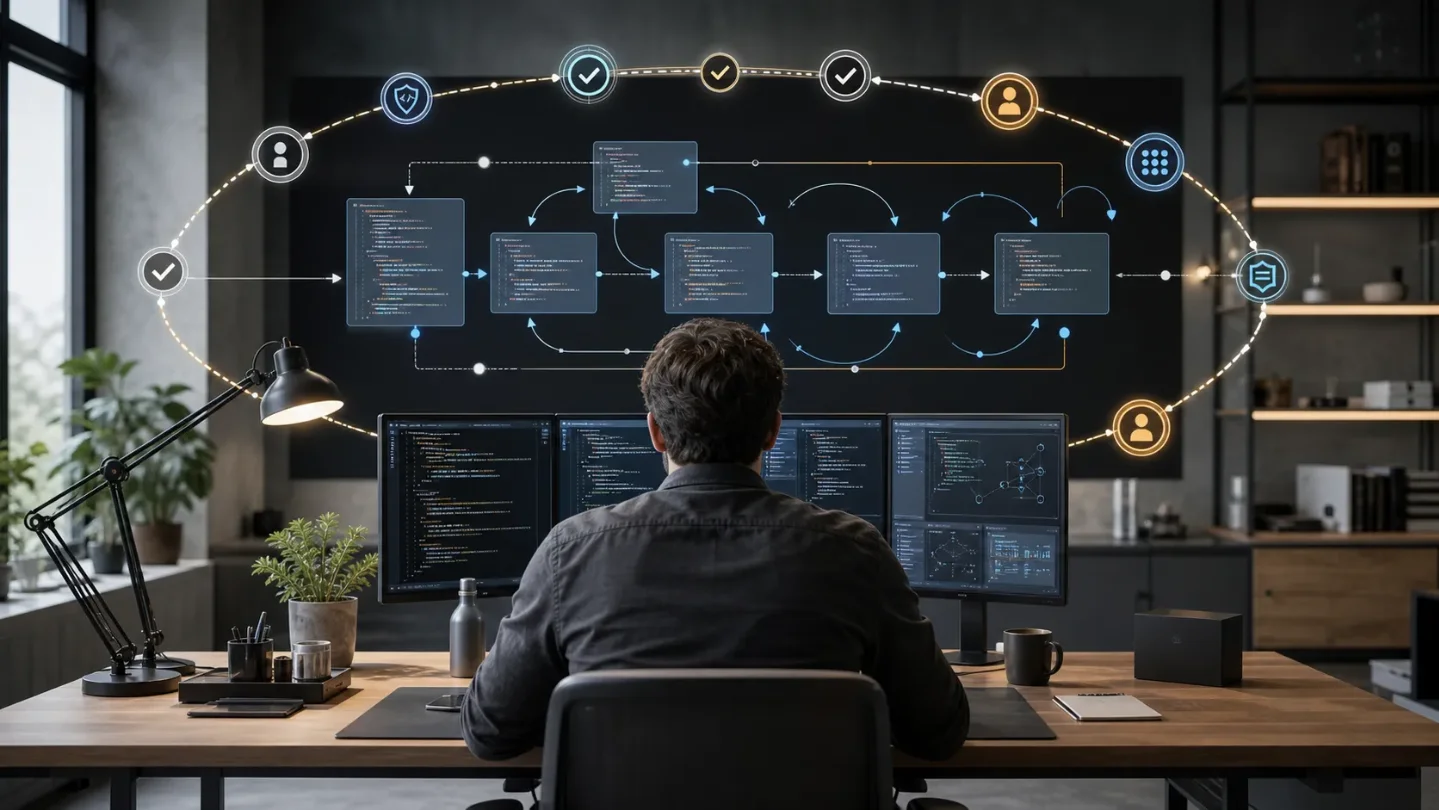
AI engineering is moving from agents to the control layer
The AI Daily Brief's survey of AI Engineer World's Fair argues that the next phase of agentic work is less about full autonomy than the harnesses, loops, skills and human checkpoints that make agents dependable.

The real shift is happening around the model
The latest episode of The AI Daily Brief uses five themes from AI Engineer World's Fair 2026 to make a broader argument: the next phase of AI engineering is less about making a single agent look autonomous and more about building the system that makes agentic work dependable. The episode's own framing is aimed at non-engineers because AI engineers often encounter new working methods before they become ordinary workplace practice. 1
Richard MacManus's source article makes the same point more concretely: AI engineering has moved from proving that agents can act toward managing context, permissions, evaluation, persistent state and production workflows. 2 That is a useful correction to the usual autonomy narrative. The hard problem is no longer only whether a model can complete a task. It is whether a team can give the model enough authority to be useful without losing the ability to inspect, redirect and improve what it does.
Harnesses turn models into working systems
The first trend is a change in the unit of design. An agent is not just a model with a prompt and a tool call. It sits inside a harness that manages workflows, context, permissions, evaluations, persistent state and continuous improvement. The source article contrasts Lilian Weng's 2023 description of autonomous agents, centered on planning, memory and tool use, with her newer account of harness engineering for self-improvement. 3
That distinction matters because the same model can behave very differently under different surrounding conditions. A coding agent with repository access, a test runner, a sandbox, a review gate and a memory of prior failures is a different operational object from a chatbot that returns a code snippet. The model still supplies the intelligence, but the harness determines what the intelligence can see, change and learn from.
For practitioners, this shifts attention away from prompt polish. The useful questions become architectural: Which context is available? Which actions require approval? What counts as a failed run? How is state persisted? How does the system notice that a seemingly successful answer made the underlying product worse?
Loops are the missing control layer
The second trend is the rise of loop engineering. The episode describes a distinction between an inner loop, where an agent performs the work, and an outer loop, where people evaluate the result, change the system and set direction. That distinction appears throughout the Latent Space reporting from the event, including Roland Gavrilescu's description of autoresearch as a system that studies and maintains the primary system. 2
This is a more useful model of autonomy than the simple picture of a human handing over a task and waiting for a finished artifact. An agent may run many execution steps without supervision, but the surrounding process still needs feedback signals, evaluation criteria and escalation paths. Human judgment moves outward rather than disappearing.
That outer loop is also where product responsibility remains. A team decides which failures are tolerable, which changes are high risk, how much latency or cost is acceptable, and when a system should stop. The agent can own more of the repetitive execution loop; the human still owns the direction and the boundaries.
Enterprise deployment makes the boundaries visible
The third trend is AI engineering's move into the enterprise, through forward-deployed engineers and what several speakers called a software factory. The phrase can sound grander than the implementation, but the underlying problem is ordinary: connect an agent to the company's repositories, data, tools and approval processes, then make sure the result keeps working after the specialists leave.
The Latent Space report describes Cursor's enterprise work in terms of cloud agents, long-running agents, automations and applications built on its SDK. It also quotes Warp CEO Zach Lloyd on selecting which parts of the software lifecycle to automate and where humans should re-enter the loop, especially for higher-risk changes. 2
This is where the autonomy discussion meets governance. An enterprise does not only ask whether an agent can write code. It asks who can authorize a deployment, how sensitive context flows through the system, how costs are monitored, and how security and compliance are enforced. The "software factory" is therefore less a replacement for engineers than a standardized environment for deciding what agents may do and when people must review them.
Coding agents are becoming the interface
The fourth trend is a change in the developer's primary interface. In the earlier Copilot model, AI helped complete the next few lines while the developer remained inside an IDE-led workflow. The newer generation of tools, including Claude Code, Codex, Gemini CLI, Cursor and Warp, can take a broader objective, inspect a codebase, edit multiple files, run tests, debug failures and iterate before returning control. 2
That does not mean the IDE disappears overnight. It means the interface is moving up a level of abstraction. The developer increasingly states an outcome, reviews a chain of changes and intervenes when the agent's plan or evidence is weak. Vercel's Andrew Qu describes agents as a new type of software because their outputs are more dynamic and less predictable than those of conventional web applications. 2
The practical consequence is that testing, sandboxes and observability become part of the interface. A system that can make ten changes at once needs a better way to show what happened than a blinking cursor and a final answer.
Skills package judgment, but they need maintenance
The fifth trend is the spread of skills: portable descriptions of workflows, quality gates and best practices that agents can invoke when needed. In the source article, Andrew Qu calls skills portable, on-demand knowledge, while Google DeepMind's Philipp Schmid argues that declarative files can reduce the need for bespoke orchestration code. 2
Skills are attractive because they make tacit expertise more explicit. A team can encode how it reviews a pull request, checks a design, handles a support escalation or prepares a release. That gives an agent more than a generic instruction to "do your best." It gives the system a repeatable operating procedure.
But skills are not permanent deposits of wisdom. Paul Bakaus warns that common skills can make outputs converge toward the same look, and other speakers caution that skills need to be revisited as models change. A skill that worked for one model may be too vague, too restrictive or simply wrong for the next one. The new maintenance job is partly curriculum design: decide what the agent should know, how it should prove it followed the process, and when the process itself needs revision.
Autonomy is becoming a management problem
Taken together, the five trends describe a maturing division of labor. Models and agents handle more of the inner execution loop. Harnesses provide context and permissions. Loops provide feedback and control. Enterprise systems define the boundaries. Skills encode repeatable judgment. People remain responsible for goals, exceptions and the standards by which work is accepted.
That is why the episode's most durable idea is not that AI engineers are building more autonomous systems. It is that they are learning where autonomy must stop being a slogan and become an operating discipline. The winning design is unlikely to be the one that removes every human checkpoint. It will be the one that makes the checkpoints meaningful, the failures visible and the system easier to improve than the work it replaces.
Listen to the episode
콘텐츠 카드를 불러오는 중…
관련 콘텐츠
- 로그인하면 댓글을 작성할 수 있습니다.
More from this channel
- AI self-regulation is a boundary fight, not a safety shortcut
- Kimi K3 looks frontier-class on paper. The catch is the stack
- The AI jobs shock may begin as a quiet productivity J-curve
- Open weights are turning model choice into an ownership question
- AI risk debates are becoming more useful
- AI's price war is moving below the model
- AI is splitting tech work by identity
- Booking thinks AI travel agents need an operating stack