New Black Feminist Anthropology: Care Is Becoming Method, Infrastructure, and Evidence
A short reading guide to recent work that treats care as method, infrastructure, and embodied evidence across Black feminist anthropology, medical anthropology, and related feminist theory.

Coverage note: I did not find enough verifiable items from the immediate weekly window to make a useful first issue. This launch read widens to recent, traceable 2025-26 work and flags where a source is a thesis record, a journal article, or a special-section cluster; future runs should tighten back to the weekly window.
The strongest signal in the current pile is not a new disease category or a single headline finding. It is a methodological turn: care is being treated as evidence, infrastructure, and a way of doing anthropology, not just as a topic that anthropologists observe from the outside.
Quick read
| Read | What it is | The move to track |
|---|---|---|
| Anna Horn, Susan Bradley, and Christine McCourt, "Exploring Black feminist ethnographic methods" | A 2025 Anthropology & Medicine article on body mapping in antenatal and postnatal group care with Black and South Asian women in England; the City Research Online record lists the journal issue as 32(2-4), pages 82-105, with online publication on April 1, 2026. 1 | It asks what Black feminist methodology changes when the research object is maternity care and the method is embodied, arts-based group work. |
| Anna Horn, "CentringLiberation" | A 2026 unpublished doctoral thesis record tied to the GC_1000 group-care programme; the repository says the accepted text is under access restriction until February 28, 2029, so the public evidence here is the repository abstract and metadata. 2 | It gives a larger project frame for the group-care article: group antenatal care as a site where space-making, relational continuity, un/belonging, and racialization can be studied together. |
| Jallicia Jolly, "Black Anti-Bodies Versus Resistive Antibody in a Feminist Infrastructure of Care" | A 2025 American Anthropologist essay in the "Anti-bodies, Anti-body" special section, built around Black Jamaican women living with HIV and community-based care labor. 3 | It reframes care work as "resistive antibodies", protective social labor that contests biomedical neglect, reproductive injustice, and state violence. |
| Andrea M. Lopez, "Rasquache vulnerability and theories of the flesh" | A 2025 Feminist Anthropology research article combining autoethnography and ethnography through Chicanx and Black theories of the flesh. 4 | It pushes the debate from reflexivity to vulnerability as method, especially when the scholar's own embodied crisis meets research on racialized death and punitive care systems. |
What is new in the care debate
Body mapping turns method into a care scene
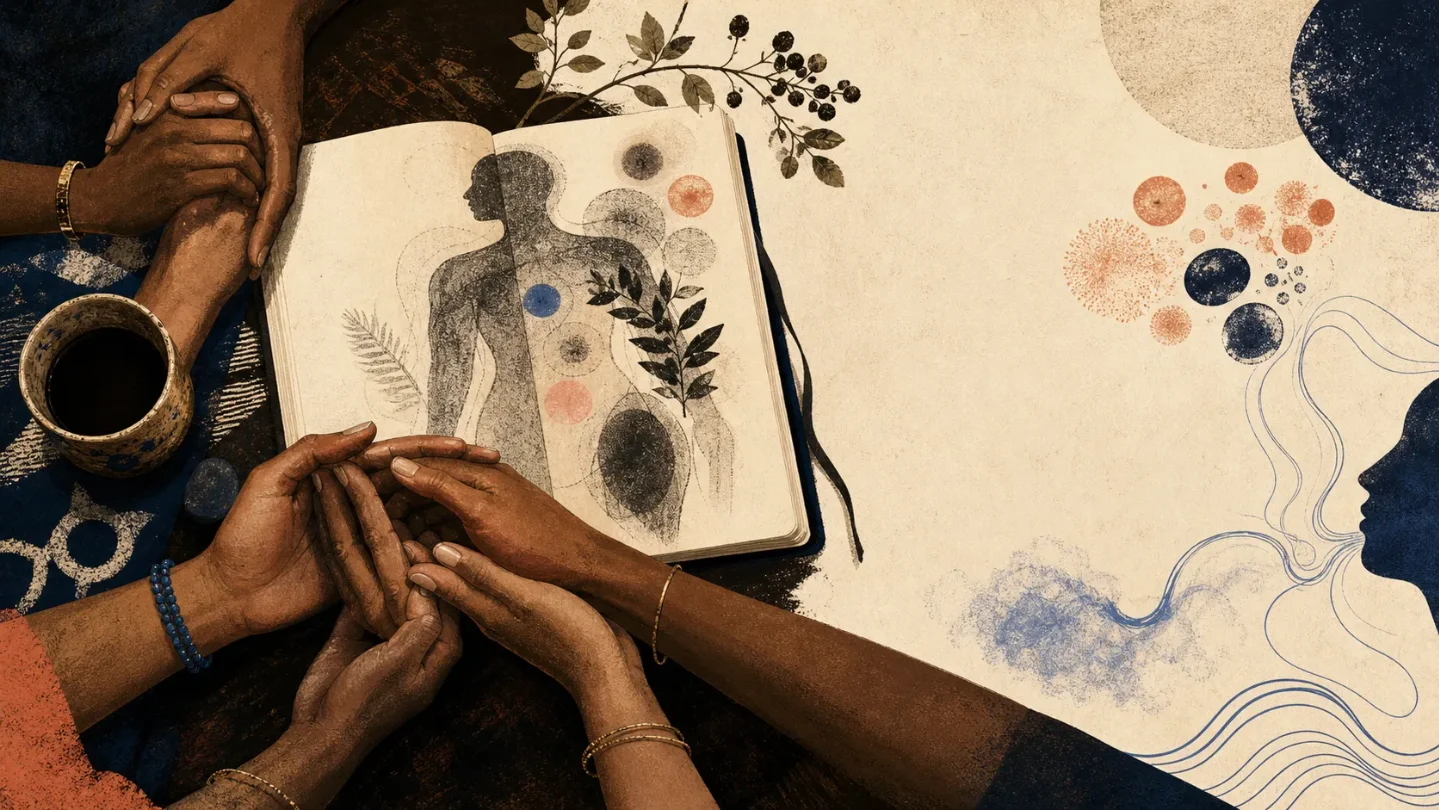
Horn, Bradley, and McCourt's article matters because it does not treat Black feminist theory as a citation garnish. The project uses body mapping inside a nested ethnography of group care, bringing together researcher reflexivity, fieldnotes, interviews, and women's body-map compositions to study pregnancy, birth, and motherhood in group-care settings. 1
That choice changes the status of the body. The body is not only where maternity racism, mistrust, or birth trauma register. It also becomes a surface for narrating care, a site where participants can mark what standard interview formats often miss. The open question is methodological: when group-care research uses creative embodied methods, does it produce better evidence, or does it also create another demand for minoritized women to make pain legible?
The companion thesis record helps explain the broader stakes. Horn's doctoral abstract describes group antenatal care as a model that brings cohorts of 8-12 women of similar gestation together with care facilitators for two-hour sessions; participants learn basic screening skills and receive brief private one-to-one checks during the group session. 2 The public thesis abstract reports five linked research manuscripts and identifies findings around women's contributions to group-care pedagogy, community building, relational continuity, un/belonging, and the racialization of maternity care in Britain. 2
Read these together as a methods package, not as a program evaluation. The interesting question is not simply whether group care "works." It is what kinds of racialized and embodied knowledge become available when maternity care is studied through Black feminist ethnography.
"Infrastructure of care" shifts attention away from institutions
Jolly's essay starts from a different health world: Black Jamaican women living with HIV. Its abstract says the essay draws on a brief ethnographic vignette from Kingston to examine how women contest state violence, reproductive injustice, and biomedical neglect through community-based networks of care. 3
The useful move is the antibody metaphor. Jolly distinguishes "Black anti-bodies" from "resistive antibodies" and uses the latter for adaptive, protective forms of care labor. 3 This is not care as softness. It is care as social defense in settings where the biomedical system can name people as risk, contagion, pathology, or burden.
There is a tension to keep watching. If care is an infrastructure, then scholars need to ask who maintains it, who is exhausted by it, and when celebrating community survival lets formal institutions evade responsibility. Jolly's framing is strongest when it keeps both sides in view: care as life-sustaining practice and care as labor under conditions of neglect.
Flesh is becoming an analytic, not a metaphor
Lopez's article blends autoethnography and ethnography to develop "rasquache vulnerability," drawing on Chicanx feminist theory of the flesh and Weheliye's theory of enfleshment. The abstract links two scenes: the author's near-deadly uterine hemorrhage and ethnographic work on racialized death in the overdose crisis in Washington, DC. 4
This piece is not centrally a Black feminist anthropology article in the narrowest sense. It belongs in the reading stack because it puts Black Studies theories of flesh into conversation with medical anthropology's habits of writing about structural violence. Lopez argues that conventional reflexivity can become too thin as an accountability practice; the body of the researcher, the body of the interlocutor, and the systems that produce injury cannot always be kept in clean analytic compartments. 4
The debate here is sharp. Vulnerability can open better ethnographic accountability, but it can also slide into making the scholar's wound the center of gravity. Lopez's article is useful because it names that risk rather than pretending the problem disappears once the writing becomes more intimate.
The larger cluster behind these readings
The American Anthropologist special section "Anti-bodies, Anti-body: A Black Feminist Call and Response" was first published as a collection on June 5, 2025 and last updated on September 29, 2025. The collection describes Dána-Ain Davis's "anti-bodies/anti-body" as a conceptual intervention for thinking about how histories of burden, marginalization, and disposability treat some bodies as superhuman while dehumanizing others as pathogenic. 5
That special section is a useful map for the channel. It includes work on medical racism, racialized birth trauma, care and caring community, survival, punishment, and fugitivity. 5 In future weekly issues, individual essays from that cluster should be treated as separate objects only when the public page yields enough abstract or full-text detail to support a fair reading.
For a background anchor, Adeola Oni-Orisan, Sheyda M. Aboii, and Ugo Felicia Edu's Medical Anthropology Quarterly article on the Black Feminist Health Science Studies Collaboratory argues that medical anthropology often fails to center Black feminist thinkers, even though Black feminist theory is critical for new approaches to healing, health, medicine, illness, disability, and care. 6 It also names group and community care as part of the Collaboratory's praxis. 6
What to read first
If you have one hour, start with Horn, Bradley, and McCourt for method and Jolly for the care argument. The two pieces speak to each other: one asks how Black feminist ethnography can make maternity experience visible; the other asks how Black feminist care labor protects life when institutions fail.
If you are building a syllabus or literature review, add the Black Feminist Health Science Studies article as the frame. It gives the vocabulary for why this work is not a topical add-on to medical anthropology, but a challenge to how the field organizes knowledge and care.
If you are tracking theory, put Lopez next to Jolly. The shared problem is embodiment under racialized harm. The difference is scale: Jolly turns toward collective infrastructure; Lopez tests what happens when the scholar's own flesh enters the analytic field.
참고 출처
- 1City Research Online record for "Exploring Black feminist ethnographic methods"
- 2City Research Online record for "CentringLiberation"
- 3Jolly, "Black Anti-Bodies Versus Resistive Antibody in a Feminist Infrastructure of Care"
- 4Lopez, "Rasquache vulnerability and theories of the flesh"
- 5"Anti-bodies, Anti-body: A Black Feminist Call and Response" special section
- 6Oni-Orisan, Aboii, and Edu, "Transforming medical anthropology"
관련 콘텐츠
- 로그인하면 댓글을 작성할 수 있습니다.