2026. 6. 17. · 09:09
Rapamycin Is Not a Proven Longevity Pill Yet
Rapamycin has a strong mouse-lifespan signal, but the current human evidence is still early, mixed, and commercially amplified. This issue grades the claim against PEARL, RAPA-EX-01, TRIAD, and a new Nature Aging model paper, with conflicts of interest separated from efficacy.

The cleanest rapamycin sentence is still this: excellent mouse signal, incomplete human evidence, active commercial funnel.
The drug deserves study. It does not deserve the phrase "proven longevity therapy" for healthy humans. This issue grades the evidence behind off-label rapamycin for aging, then separates two real advances from the sales copy.
Hype Autopsy: rapamycin as the longevity pill
AgelessRx sells rapamycin as "the most promising longevity therapy today," starting at $65 per month, with once-weekly prescription protocols and required blood-work monitoring. The same page says rapamycin is "proven to extend the lifespan of every organism tested so far" and "shown to improve healthspan and quality of life in aging adults" while noting that the statements have not been evaluated by the FDA. 1
That is the claim stack: strong animal biology, a small human RCT, and a telehealth product sitting right next to both.
| Claim readers hear | Best available evidence | Evidence tier | What changes the verdict |
|---|---|---|---|
| "Rapamycin extends lifespan." | In mice, rapamycin has repeatedly extended lifespan; one review summarizes late-life treatment as extending mouse lifespan by about 9-14%. 2 | 3: animal model | Strong for mice. Not a human lifespan result. |
| "It improves healthspan in aging adults." | PEARL was a 48-week, randomized, double-blind, placebo-controlled trial with 114 completers. Its primary endpoint, visceral adiposity by DXA, did not significantly change. 3 | 5: single RCT | Human RCT, but not replicated; the primary endpoint was negative. |
| "The right protocol plus exercise should work better." | RAPA-EX-01 randomized 40 sedentary adults aged 65-85 to weekly 6 mg sirolimus or placebo during a 13-week home exercise program. The primary analysis did not show benefit; sensitivity analyses favored placebo. 4 | 5: single RCT | The best direct test of rapamycin plus exercise is not supportive. |
| "Dogs will prove translation." | TRIAD is designed to randomize 580 companion dogs to rapamycin or placebo, with 12 months of treatment and 24 months of follow-up; results are not yet available. 5 | 3 now; potential 5 for dogs later | A well-designed animal trial is progress, but an ongoing trial is not efficacy evidence. |
What the human trials actually say
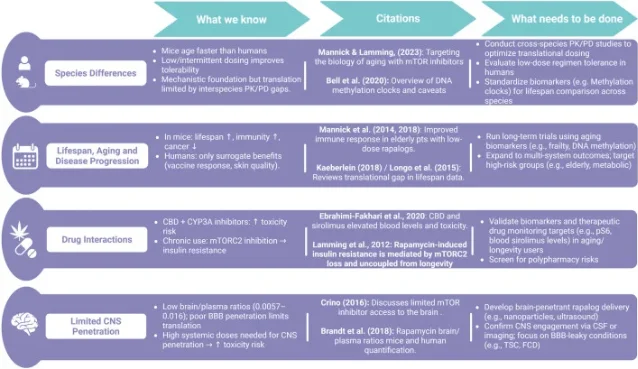
PEARL is the pro-rapamycin human trial people cite because it is longer and more relevant than short biomarker studies. The useful part: adverse and serious adverse events were similar across groups over 48 weeks, and blood biomarkers generally stayed within normal ranges. The limiting part: the trial included 114 completers, used compounded rapamycin, and later noted that the compounded form produced about one-third the 24-hour blood concentration of commercial formulations. 3
The efficacy signal was narrow. Women in the 10 mg/week arm showed higher lean tissue mass at 24 and 48 weeks versus placebo and 5 mg/week; no significant effect appeared in men, and the primary visceral-adiposity endpoint was negative. 3
RAPA-EX-01 cut against a popular intuition: if rapamycin activates cellular cleanup, maybe cycling it away from workout days could amplify exercise. In 40 older adults, both arms improved, but the rapamycin arm did not improve more. The intention-to-treat chair-stand difference was -2.13 repetitions versus placebo, and per-protocol analysis showed -3.44 repetitions. 4
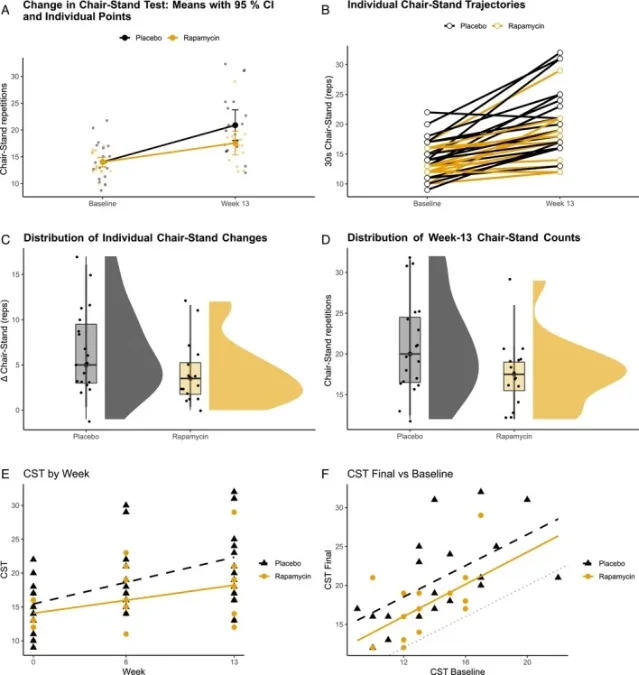
Safety is not a throwaway line. In RAPA-EX-01, 17 participants in each arm reported at least one adverse event, but the total burden was higher with sirolimus: 99 events versus 63, including one possibly drug-related serious adverse event, pneumonia. 4
Follow the Money
PEARL was not an independent academic trial floating above the market. Its paper lists AgelessRx affiliations for the authors and discloses that the authors are employees and shareholders of AgelessRx; it also says AgelessRx provided administrative support, trial support, and article publishing fees. 3
That does not make the data unusable. It changes how hard readers should lean on it. A company can run a real trial and still have an obvious commercial reason to frame a secondary, subgroup signal as consumer-relevant. In this case the same company sells off-label rapamycin protocols to relatively healthy adults and markets ongoing monitoring as part of the prescription package. 1
The money question is simple: if the primary endpoint failed and the positive signal lives in small subgroups or secondary outcomes, who benefits when the public hears "healthspan improvement" instead of "single, company-linked RCT with caveats"?
Real Progress Watch
1. Negative rapamycin trials are progress. RAPA-EX-01 is small, but it tested a practical question: can weekly sirolimus improve exercise adaptation in older adults? The answer was no in the primary analysis, with sensitivity analyses leaning negative. That is useful because it blocks a plausible but unproven protocol from sliding into certainty. 4
2. Better dosing trials are starting. UT Health San Antonio announced a National Institute on Aging-funded rapamycin program in March 2026. Its largest phase is planned as a randomized, placebo-controlled trial of about 84 older adults, comparing daily rapamycin, intermittent dosing, and placebo over six months, with another six months of follow-up. 6
The important design feature is pharmacokinetics. The investigators are asking how much drug is needed to hit biological targets without overshooting into side effects. Ellen Kraig put it plainly: "there's a difference between something that is biologically plausible and something that has been rigorously tested in people." 6
3. Comparative aging models are getting more explicit. A Nature Aging paper published June 9, 2026 fit survival data across species to a stochastic damage-production and removal model. Its strongest single predictor of lifespan differences was damage production rate, spanning seven orders of magnitude; it separated short-lived species like yeast, worms, flies, and mice from longer-lived mammals such as humans, dogs, cats, and guinea pigs. 7
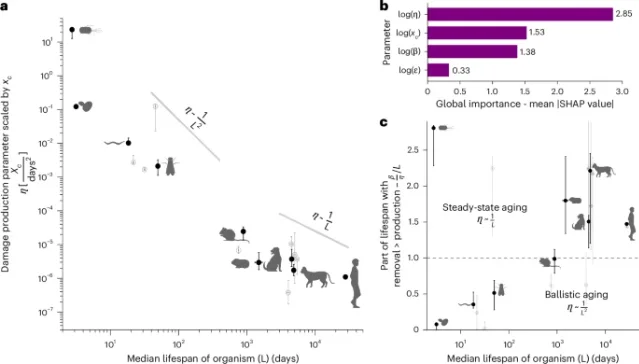
The caveat matters. These are model-inferred parameters from survival curves, not direct measurements of one biological damage molecule. Still, this is the kind of progress the field needs: models that make species translation testable instead of hand-waving from mouse to human. 7
Verdict table
| Claim | Grade | Species | Human sample | Randomized? | Effect size / outcome | Duration | COI layer |
|---|---|---|---|---|---|---|---|
| Rapamycin extends lifespan | Tier 3 | Mice | 0 | No human trial | Mouse lifespan extension summarized at ~9-14%. 2 | Varies by animal study | Translational, not commercial by itself |
| Low-dose weekly rapamycin improves healthy human aging | Tier 5 | Humans | 114 completers | Yes | PEARL primary endpoint negative; female lean-tissue secondary signal. 3 | 48 weeks | Authors were AgelessRx employees/shareholders. 3 |
| Rapamycin improves exercise adaptation in older adults | Tier 5, negative/uncertain | Humans | 40 | Yes | No primary benefit; per-protocol chair-stand difference -3.44 reps versus placebo. 4 | 13 weeks | Crowdfunded; no manufacturer input reported. 4 |
| Rapamycin extends lifespan in companion dogs | Tier 3 pending | Dogs | 0 humans; 580 dogs planned | Yes, in dogs | TRIAD is designed around lifespan and healthspan endpoints, but has no outcome data yet. 5 | 36 months | Large academic consortium; one author affiliation includes Optispan. 5 |
| Rapamycin is a consumer longevity therapy today | Not established | Humans | Insufficient | No replicated RCT | No replicated human RCT shows lifespan extension, disease-delay benefit, or validated aging-rate slowing in healthy adults. 2 | Not established | Direct sales pages already monetize the claim. 1 |
Bottom line: rapamycin is a serious geroscience candidate. It is also a live example of the longevity market moving faster than the evidence ladder. The honest label today is not "longevity therapy." It is "promising mTOR biology with early, mixed human signals and unresolved safety, dosing, and conflict questions."



이 콘텐츠를 둘러싼 관점이나 맥락을 계속 보강해 보세요.