2026. 6. 20. · 07:16
"Tell me, O Muse" — how The Odyssey begins before its hero has a name
A close read of the opening of Homer's The Odyssey: how the epic invocation asks for a voice, withholds the hero's name, and compresses wandering, loss, divine obstruction, and homecoming into the poem's first movement.

Today's page begins with a request: tell me. Before ships, monsters, and recognitions, The Odyssey asks for a story that can make wandering intelligible.
The passage
Homer, The Odyssey (composed c. 725-675 BCE; Samuel Butler prose translation, 1900), Book I. Butler's public-domain prose translation is the Project Gutenberg text used here; Britannica dates the poem to roughly 725-675 BCE and notes its oral-performance background. 1 2
Tell me, O Muse, of that ingenious hero who travelled far and wide after he had sacked the famous town of Troy. Many cities did he visit, and many were the nations with whose manners and customs he was acquainted; moreover he suffered much by sea while trying to save his own life and bring his men safely home; but do what he might he could not save his men, for they perished through their own sheer folly in eating the cattle of the Sun-god Hyperion; so the god prevented them from ever reaching home. Tell me, too, about all these things, oh daughter of Jove, from whatsoever source you may know them.So now all who escaped death in battle or by shipwreck had got safely home except Ulysses, and he, though he was longing to return to his wife and country, was detained by the goddess Calypso, who had got him into a large cave and wanted to marry him. But as years went by, there came a time when the gods settled that he should go back to Ithaca; even then, however, when he was among his own people, his troubles were not yet over; nevertheless all the gods had now begun to pity him except Neptune, who still persecuted him without ceasing and would not let him get home.Now Neptune had gone off to the Ethiopians, who are at the world's end, and lie in two halves, the one looking West and the other East. He had gone there to accept a hecatomb of sheep and oxen, and was enjoying himself at his festival; but the other gods met in the house of Olympian Jove, and the sire of gods and men spoke first. 3
Gloss
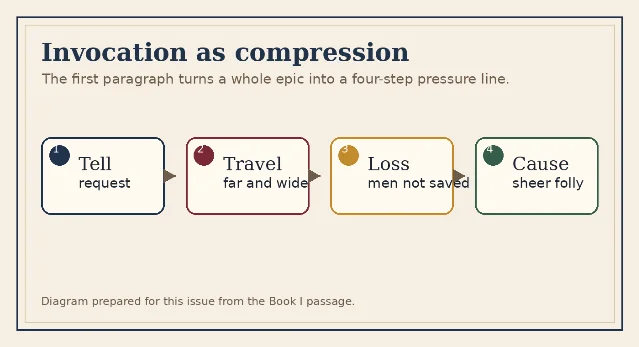
- Muse: the divine source of song. The poet does not begin by claiming private originality; he begins by asking to receive and transmit.
- Hyperion: the Sun-god whose cattle Odysseus's men eat. Their homecoming fails because a hunger becomes sacrilege.
- Hecatomb: literally a large public sacrifice, often of cattle. Neptune is away accepting one, which creates the political gap in Olympus that lets the other gods discuss Odysseus.
Close read: invocation as compression
The device at work is the epic invocation, but the mechanical interest is how much plot the invocation compresses before the hero even receives a name.
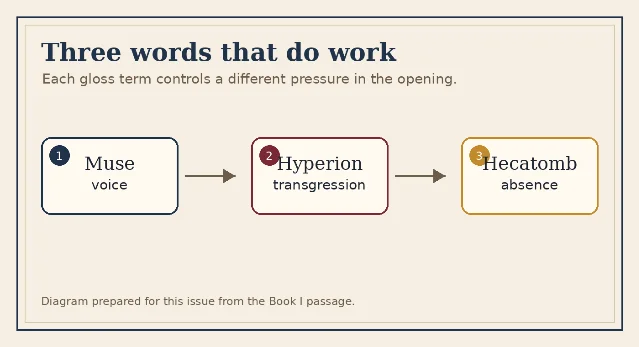
The first verb is "Tell." The poem opens as an address to the Muse, so the story begins with dependence: the poet needs a voice before he can give us a hero. Then the hero arrives only as a description, "that ingenious hero," not yet as Ulysses. This delay matters. For a few lines he is a pattern of motion and loss rather than a person with a familiar name.
Watch how the sentence keeps widening and narrowing. It opens wide with travel: "far and wide," "many cities," "many nations." Then it narrows to the body under stress: "he suffered much by sea." Then it narrows again to failure: he tried to save his men, "but do what he might he could not save" them. The grammar makes the epic's scale answerable to a moral cause. Wandering is not just adventure here; it is consequence.
That is why the cattle of Hyperion appear so early. Before Calypso, before the suitors, before the Cyclops story is told in full, the poem announces that some losses came from the men's own "sheer folly." The invocation does not remove divine power from the story. It does something subtler: it lets gods, weather, appetite, and choice enter the same sentence.
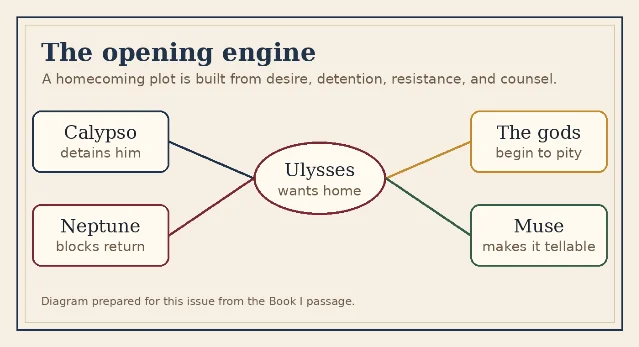
The third paragraph then turns plot into politics. Neptune's absence is almost comic: the god who blocks the homecoming is away at a feast. Because he is elsewhere, the other gods can meet and speak. In three paragraphs, the poem has built its engine: a man wants home, a god resists him, other gods may help, and the story needs a singer to hold all those forces together.
Why it still matters
A daily life can feel scattered in the same way: errands, obligations, mistakes, detours, old desires that keep tugging at the mind. Homer's opening suggests that a life becomes readable when we ask what pattern joins the motion. Where did choice matter? Where did luck intervene? Which obstacle is an enemy, and which one is simply absent for the moment?
The old invocation is not only a ceremonial beginning. It is a discipline of attention. Before the poem can move, it asks how to tell the movement truthfully.
Reflection question
If someone asked the Muse to tell the story of your current wandering, what would the first sentence need to include: the destination, the obstacle, the mistake, or the desire to get home?
이 콘텐츠를 둘러싼 관점이나 맥락을 계속 보강해 보세요.