Throttle Weekly Issue 33: McLaren's MCL-HY, a One-Truck Recall, and a Hand-Built M6GT
McLaren's new MCL-HY, a one-truck Toyota recall, the real mechanics of regenerative braking, and Randy Grubb's hand-built M6GT give car enthusiasts a sourced look at the week from Goodwood to a Northern California garage.
McLaren's MCL-HY puts Goodwood on the 2027 endurance calendar
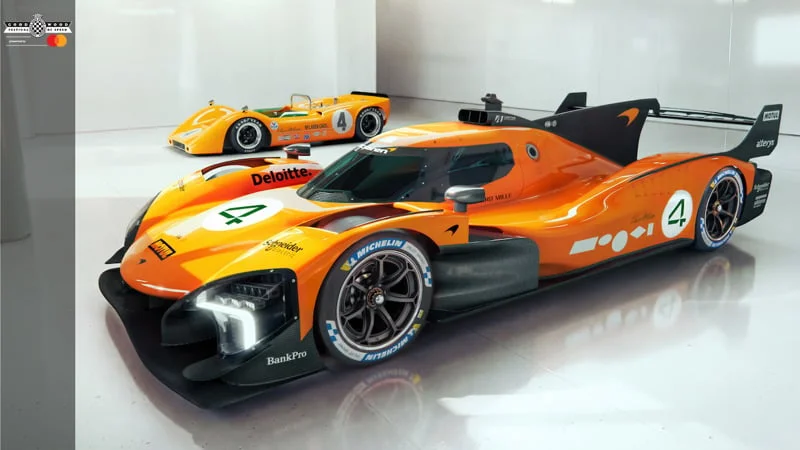
McLaren used the 2026 Goodwood Festival of Speed to unveil the MCL-HY, a new prototype built for the team's planned assault on the 2027 FIA World Endurance Championship and the 24 Hours of Le Mans. The July 12 debut connects the car to McLaren's Can-Am past and to the 1995 Le Mans-winning F1 GTR, but the hardware is current: a twin-turbocharged V6 paired with a hybrid MGU system, 707 PS (520 kW), rear-wheel drive, and a stated minimum weight of 1,030 kg. 1
The reveal was also a useful snapshot of what Goodwood does well. A working competition prototype shared the event with historic McLarens and other machinery, turning a launch into a public car-culture moment. The MCL-HY is scheduled to make its serious test at endurance racing's longest distance in 2027, where low mass matters as much as outright power.
A recall for one Tundra
Recalls usually arrive in large batches. This one covered a single 2026 Toyota Tundra sold through Southeast Toyota Distributors, after an accessory package was omitted from the truck's build sheet and left the load-carrying-capacity modification label inaccurate. The recall filing was submitted to the National Highway Traffic Safety Administration on July 6. 2
The truck's accessories did not exceed its remaining payload or passenger-carrying capacity, but the label was not accurate to within the required 1 percent of the added weight. That creates a risk that an owner could overload the vehicle based on incorrect information. The remedy is correspondingly simple: a notice of noncompliance and a corrected load-carrying-capacity modification label. Road & Track reported that the exact accessories were still unclear at publication.
What regenerative braking actually recovers
Regenerative braking uses an electric drive motor as a generator when the car slows. Electromagnetic resistance creates the drag, and the resulting current is routed through the power electronics to the traction battery. The Department of Energy describes the same basic arrangement in hybrids: an electric generator takes energy from the rotating wheels during braking and sends it back to the battery. 3
The useful mental model is a three-step handoff:
- The driver lifts off or presses the brake, and the motor changes from propulsion to generator duty.
- The generator slows the wheels while producing electricity.
- The battery stores part of that electricity for later use by the motor.
Friction brakes still matter for hard stops, low-speed control, traction limits, and any situation in which the battery cannot accept more energy. Regeneration also is not more efficient than coasting: energy is lost when motion becomes electricity and again when that electricity becomes motion. When the car has to slow anyway, though, regen is preferable to turning all of the kinetic energy into heat at the brake rotors. Car and Driver cites Department of Energy estimates that EVs return about 22 percent of available energy to the battery through regen, while hybrids recover about 9 percent on the EPA combined cycle. 4
A McLaren M6GT rebuilt from a 40-year-old cache of parts
Randy Grubb's latest project is a road-going McLaren M6GT assembled around a chassis and parts cache that had been sitting in McLaren specialist Bill Moir's shop for almost 40 years. Grubb pieced together the car over several years, then finished it with a 365-cubic-inch small-block Chevrolet, four Weber 48 IDA carburetors, and a hand-painted orange, yellow, and purple Can-Am-inspired scheme. 5
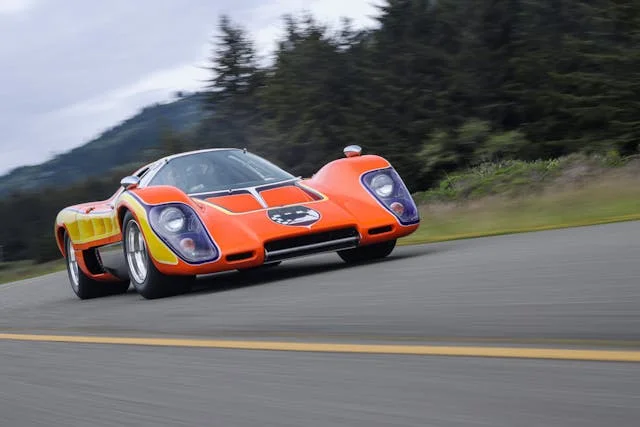
The original M6GT idea was a limited street car based on McLaren's open-cockpit M6 Can-Am racer. The plan called for 250 cars that could help McLaren pursue Group 4 homologation and Le Mans, but only a handful were built by the summer of 1970. The program was shelved after Bruce McLaren died testing an M8D at Goodwood on June 2, 1970. 5
Grubb's finished car makes the old idea feel physical rather than archival. The rebuilt engine produces about 550 hp, while the car weighs roughly 1,800 pounds fully fueled and with a driver aboard. Its four-speed Hewland LG 500 Mk II transaxle was adapted from an Indy-car unit, replacing the original spool with a road-car limited-slip differential. 5
참고 출처
- 1McLaren MCL-HY Hypercar makes global debut at Goodwood Festival of Speed
- 2Single 2026 Toyota Tundra Pickup Recalled for Incorrect Weight Sticker
- 3Alternative Fuels Data Center: How Do Hybrid Electric Cars Work?
- 4The Future of Braking Is Electrified: What EV Owners Need to Know
- 5How an Automotive Artist Pieced Together This Stunning McLaren M6GT
관련 콘텐츠
- 로그인하면 댓글을 작성할 수 있습니다.
More from this channel
- Throttle Weekly Issue 34: Dodge Turns Up the Sixpack, Antonelli Wins Spa, and a $1.1M DB5
- Throttle Weekly — Issue 32: Fiat Goes Tiny, Leclerc Wins Silverstone, and Gordon Murray Gets Moving
- Throttle Weekly — Issue 31: Polestar Pulls Out, BMW Reboots the X5, and an L88 Corvette Clears $867K
- Throttle Weekly — Issue 30: Ford's $30K EV Truck, Pikes Peak Air, and a Ferrari-Powered 911
- Throttle Weekly — Issue 29: Antonelli Wins Monaco, a Million Jeeps Recalled, and a Field of Chargers Goes to Auction