A Greek Plato, from Florence to the Vatican
Vatican manuscript Vat.gr.2196, a fourteenth-century Greek codex containing Plato's Republic and six related texts, is now freely viewable on DigiVatLib, with a Renaissance ownership trail still visible in its catalog record and pages.

One of the Vatican's recent additions to its digital library is not an illustrated luxury codex. It is a dense Greek working book: a fourteenth-century copy of Plato whose pages carry a long run of the Republic, five shorter Platonic dialogues, and a small companion text attributed to Timaeus of Locri. The manuscript is Vat.gr.2196, and its page images are now freely open on DigiVatLib.
An independent tracker of Vatican manuscript additions records Vat.gr.2196 on July 9, 2026, within its Week 27 batch; the batch page identifies the manuscript as a Greek Plato from 1351–1400. 1 2
What is in the codex
Vat.gr.2196 is a Greek manuscript whose contents are arranged in a sequence that rewards browsing rather than sampling a single famous opening. The catalog records:
- Clitophon, ff. 2–3v
- Republic, ff. 3v–91v
- On the nature of the universe and the soul, attributed to Timaeus of Locri, ff. 91v–95v
- Laches, ff. 96–105
- Lysis, ff. 105–112v
- Euthydemus, ff. 112v–126v
- Protagoras, ff. 126v–146v
The final leaves, ff. 147–148v, are blank. This inventory comes from Biblissima's record, which draws its textual descriptions from the CNRS/IRHT Pinakes database. 3 4
That makes the Republic the codex's gravitational center. Plato's dialogue moves from a question about justice into arguments about education, political order, the soul, and the kind of knowledge a good city would need. More broadly, Plato's middle and later works combine ethics, political philosophy, moral psychology, epistemology, and metaphysics rather than separating them into modern academic departments. 5
The manuscript lets readers see that philosophical tradition as a physical sequence. The Republic occupies most of the volume, but it is surrounded by dialogues that turn to courage, friendship, eristic argument, and the education of a young man. The result is not a complete Plato; it is a particular reading route through Plato.
A book with a provenance trail
The codex also preserves a Renaissance history of Greek reading. Pinakes records Giovanni da Salviati, a Florentine cardinal and collector, as a former owner. His library later passed into the Salviati-Colonna family library, which the catalog says was acquired by the Vatican in 1821. 4
A more tentative clue points further back. Pinakes lists the humanist Guarino Veronese as a possible owner, noting that the attribution rests on notes at folio 6v. That distinction matters: the record does not call Guarino the scribe, and it does not present the ownership as certain. It presents a hypothesis that can now be tested against the page images. 4
The catalog's bibliography also includes a study whose title describes the manuscript as a Platonic codex used for learning Greek. Even without treating that title as proof of every detail of the book's use, it gives the volume a useful frame. This is a manuscript that belongs to the history of reading and instruction, not just to the history of which ancient texts survived.
What to look at first
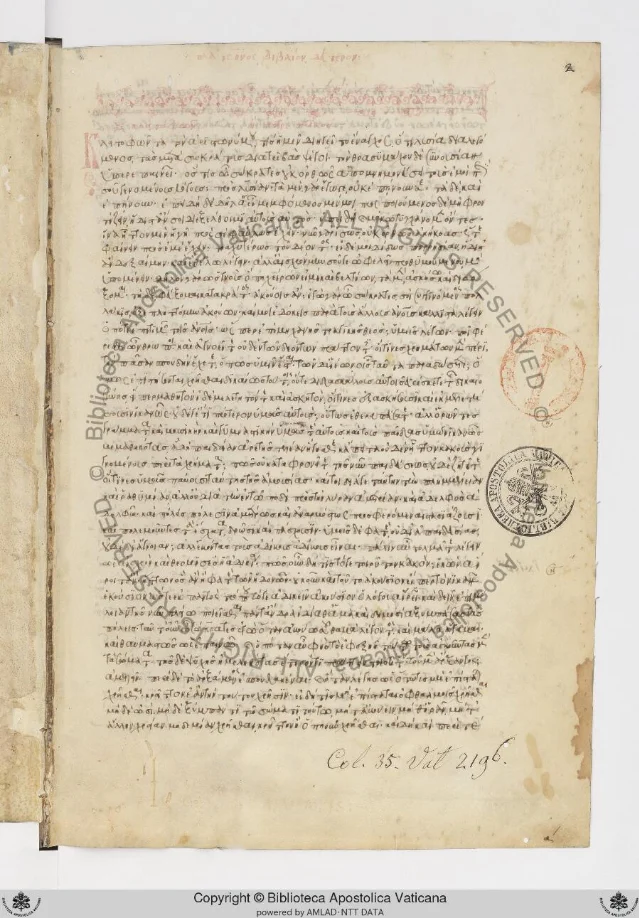
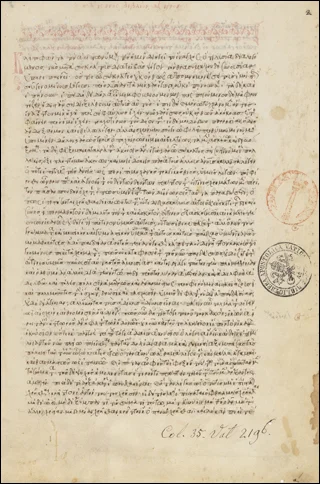
The page is crowded with Greek prose, with a red heading at the top and circular library stamps along the outer margin. A handwritten shelfmark, "Col. gr. 2196," remains visible near the lower edge. The page has no miniature or theatrical opening; its interest lies in the layered evidence of text, handling, cataloguing, and institutional custody.
Then open the full Vat.gr.2196 viewer on DigiVatLib. The Biblissima and Pinakes descriptions make the page sequence easy to navigate: check the opening table on folio 1v, the start of the Republic at folio 3v, the transition to Timaeus of Locri at folio 91v, and the run of shorter dialogues that follows. Folio 6v is the place to inspect the notes connected, cautiously, with Guarino Veronese.
The appeal of this new release is its scale of access. A reader can move from a page of tightly written Greek to the catalog's ownership history, then back into the manuscript to ask how a philosophical curriculum was assembled and used. Vat.gr.2196 is now a book to investigate rather than a title to take on trust.
Cover image: opening scan of Vatican manuscript Vat.gr.2196, Biblioteca Apostolica Vaticana / DigiVatLib. Open the manuscript record
관련 콘텐츠
- 로그인하면 댓글을 작성할 수 있습니다.