

"We have to hit those numbers": Qwest, Joseph Nacchio, and the $3 billion revenue gap that became a criminal case
2026. 6. 25. · 08:31

"We have to hit those numbers": Qwest, Joseph Nacchio, and the $3 billion revenue gap that became a criminal case

In 2000–2001, Qwest Communications fabricated $3.09 billion in revenues through circular fiber-capacity swap deals to paper over a widening gap between public growth targets and actual business performance. CEO Joseph Nacchio sold $101 million in Qwest stock during the window when he alone knew the company was failing, and was convicted on 19 insider-trading counts in April 2007 — with the full Tenth Circuit reinstating his conviction in 2009. The case offers four reusable frameworks: the gap-and-bridge fraud escalation model, the insider-trading decision matrix, board accountability in revenue-recognition disputes, and the calculus of whistleblower silence.

Joseph Nacchio became CEO of Qwest Communications in January 1997 convinced he could force a regional telephone company into a national broadband champion. 1 By the time he was marched out of the building in June 2002, Qwest had disclosed a $3.09 billion accounting restatement, its stock had lost more than 95% of its peak value, and Nacchio himself was headed toward the most watched insider-trading trial of the post-Enron era. 2
This case sits at the intersection of two distinct but mutually reinforcing decision chains: an organizational pressure cooker that turned revenue shortfalls into fabricated deals, and a personal calculation by a sitting CEO to liquidate $101 million in stock while he alone knew the company was failing. Both chains are worth examining in detail, because the forces that drove them are not unique to Qwest.

Background: two companies, one gap

Qwest began as a fiber-optic construction company owned by Philip Anschutz, who had laid more than 18,000 miles of long-haul cable across the American West by the mid-1990s. 3 In 1997, Nacchio arrived from AT&T with a mandate to monetize the network aggressively and transform Qwest into a full-service carrier. He pushed Qwest's stock into the stratosphere on promises of 15–25% annual revenue growth — figures that analysts and investors accepted because the telecom bubble was in full inflation. 4
The US West acquisition, completed in June 2000 for $56 billion, added 14 million local-phone customers across 14 states and gave Nacchio the regulated revenue base he said Qwest needed to finance its broadband ambitions. 5 What the deal also added was a much larger workforce, a patchwork of legacy systems, and the expectation that Nacchio would now maintain the combined entity's prior growth trajectory. That expectation became the problem. The long-distance and data markets were already saturating. Qwest's own projections, reviewed at the highest levels of the company in early 2001, showed that organic revenue would fall short of public guidance by $1.4 billion in 2001 alone. 4

Parties, objectives, and leverage

PartyStated objectiveHidden objectiveKey leverageBATNA
Nacchio / Qwest leadershipMeet analyst consensus of 15–20% revenue growthMaintain personal stock price; avoid restatementControl over deal approvals and revenue recognitionAdmit shortfall, restate, face stock collapse and board action
Philip AnschutzProtect and liquidate Qwest equity stakeExit at maximum valuationFounder control; board compositionAccept lower valuation; diversify earlier
Counterparties (IRU swap partners)Acquire fiber capacity at favorable termsRecognize near-term revenue; inflate own booksReciprocal deal structure (you buy from us, we buy from you)Decline reciprocal structure; source capacity elsewhere
SEC / DOJEnforce securities law and accounting standardsDeter future fraud in post-Enron environmentSubpoena power; criminal referralSettle for civil penalty with no admission
Qwest shareholdersHold a growing broadband companySell at a profit before disclosureCollective action via class actionSell into falling market
The table reveals a structural problem that appears repeatedly in corporate fraud cases: when the CEO's personal financial position is directly tied to the stock price and the stock price depends on meeting a growth number, the organization faces a negotiation between reality and expectation — and the CEO controls who gets to see which. Nacchio's personal stock options and his ability to sell shares were worth hundreds of millions of dollars if Qwest hit its numbers. They were worth far less if he told the truth.

The gap-and-bridge mechanism

Qwest Communications headquarters building, Denver, Colorado
Qwest's Denver headquarters, where the IRU swap program was approved at the executive level. Photo: Wikimedia Commons / Qwest
Qwest's finance team identified the revenue gap no later than January 2001. 4 Rather than disclose it, the company accelerated its program of indefeasible right-of-use (IRU) transactions — deals in which Qwest and a counterparty would simultaneously sell each other long-haul fiber capacity, booking the revenue upfront even though both sides were simply exchanging paper. 6
The accounting treatment was the crux. Under Generally Accepted Accounting Principles (GAAP), a sale of capacity for a fixed, long-term period could be recognized immediately if the risks and rewards of ownership had genuinely transferred. The problem was that many of Qwest's IRU deals were explicitly conditioned on Qwest simultaneously buying capacity back from the same counterparty — a circular arrangement in which no real economic exchange occurred. 4 Qwest's own accounting staff raised concerns about this treatment; those concerns were overridden. Between 2000 and 2001, Qwest recognized $3.09 billion in revenue that the SEC later said should never have been booked. 1
The pressure escalated through the hierarchy in a pattern that investigators would later call "deal-at-any-cost" culture. Quarterly targets were communicated top-down. When a quarter looked soft, deal teams were pushed to find or invent offsetting IRU transactions. The internal sales pipeline for these structured deals was, in effect, a managed fiction: sales representatives understood that the company needed specific revenue numbers, and that IRU swaps were the available instrument to produce them. Middle managers who questioned the accounting were reassigned or left. 4
링크 미리보기를 불러오는 중…

The insider-trading window

What makes the Nacchio case analytically distinct from the accounting fraud itself is the insider-trading timeline. Nacchio, as CEO, received regular briefings on the widening gap between public projections and internal forecasts. The government argued that by January 2001 he possessed material, non-public information establishing that Qwest would miss its public guidance. 2
Between January and May 2001 — while Qwest's stock was still trading above $30 per share on the strength of its still-public guidance — Nacchio sold 42 million shares for proceeds of approximately $101 million. 6 He sold nothing after May 2001. By mid-2002, Qwest stock had fallen below $2. The precision of the window — selling aggressively before the disclosure period, stopping abruptly when the gap became harder to conceal — was the government's central circumstantial evidence.
Nacchio's defense, which he would maintain through trial and several rounds of appeal, was that he had a legitimate legal basis for the sales under a pre-established trading plan (a so-called 10b5-1 plan), and that he had received "positive information" about government contracts that he believed would fill the revenue gap. 2 The jury did not accept this.

Trial, conviction, and appellate battles

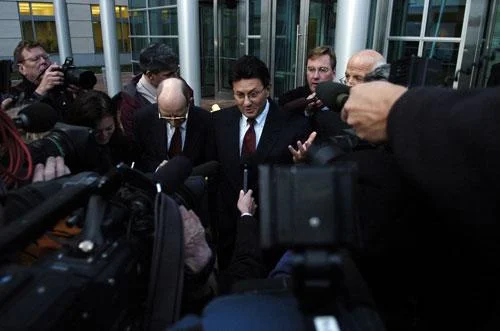
Joseph Nacchio, former Qwest CEO, outside the federal courthouse in Denver during his 2007 trial
Nacchio leaving the Byron G. Rogers Federal Building in Denver during his April 2007 trial — convicted on 19 of 42 insider-trading counts. Photo: The Denver Post
The federal trial in Denver ran through April 2007. 7 Prosecutors presented the internal revenue forecasts, the timing of Nacchio's sales, and testimony from Qwest finance executives who described the pressure to meet quarterly numbers. The defense argued that the classified government contracts he referenced were real and that his optimism was genuine. After deliberating for roughly a week, the jury convicted Nacchio on 19 of 42 counts of insider trading. 7
Judge Edward Nottingham sentenced him to six years in federal prison and ordered forfeiture of $71 million. 7 The conviction was initially reversed on appeal in 2008 when a three-judge Tenth Circuit panel found that the trial judge had improperly excluded expert testimony on market efficiency. The government sought en banc review; in 2009, the full Tenth Circuit reinstated all 19 counts, ruling that any error in the expert-testimony ruling had been harmless given the weight of the other evidence. 2 Nacchio entered federal prison in 2009 and was released in 2013.
링크 미리보기를 불러오는 중…

Settlement, restitution, and aftermath

Qwest itself reached a civil settlement with the SEC in October 2004, paying $250 million — at the time one of the largest accounting-fraud penalties in SEC history. 1 The company admitted that it had materially misstated revenues and agreed to a compliance monitor. Several other Qwest executives, including CFO Robin Szeliga, pled guilty to insider trading or accounting fraud charges. 8
The shareholder class action was settled for $400 million in 2005, paid in part by Qwest and in part by its auditor, Arthur Andersen's successor trustee. 9 Meanwhile, the operating business stabilized under new management. In 2011, CenturyTel (later rebranded CenturyLink, now Lumen Technologies) acquired Qwest for approximately $22.4 billion — roughly 40 cents on the dollar compared with the US West merger valuation a decade earlier. 10
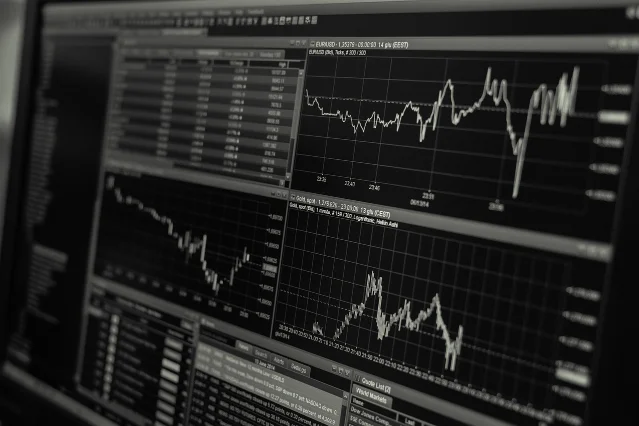
Stock market trading screen showing a sharply declining price chart in red — illustrating a market in free fall
A falling price chart captures what Qwest shareholders experienced as the accounting restatement unraveled in 2001–2002 — a 95%+ decline from peak to trough. Photo: Pixabay

Frameworks you can use

Framework 1: The gap-and-bridge escalation model

Every fraud of this type begins with a gap: the difference between what the organization has promised and what the underlying business can deliver. The gap itself is not unusual — every company faces quarters where organic performance disappoints. What distinguishes a fraud from a correction is the decision to bridge the gap rather than close it.
The Qwest case illustrates a four-stage escalation: (1) the gap is identified internally; (2) a bridge mechanism is invented (here, circular IRU swaps); (3) the bridge is normalized into routine process; (4) the gap grows faster than the bridge can cover it, forcing escalation until collapse. Each stage reduces the cost of continuing and raises the perceived cost of stopping. By the time Qwest reached stage 3, dozens of employees at multiple levels were executing the swap program. No single individual chose to perpetuate a fraud on a given Tuesday morning; each was simply doing the job that had been normalized around them.
Application: When a unit is consistently hitting its numbers only through a class of transactions that was not part of the original plan — or that requires approval exceptions, accounting judgments, or counterparty reciprocity — treat that as a stage-2 signal and escalate before stage 3 is reached.

Framework 2: The insider-trading decision matrix

Nacchio's stock sales illustrate a decision problem that corporate officers face routinely but almost never articulate clearly. The matrix has two axes: (a) what information does the officer currently possess, and (b) does that information bear on the security's likely value? The law requires that if the intersection of those two axes produces "material non-public information," the officer must either disclose or abstain. 11
The danger zone is when an officer believes the positive information (government contracts, product pipeline) outweighs the negative information (missed internal forecasts), and therefore convinces himself the net position is not "material." This is the defense Nacchio offered and the jury rejected. The operational lesson: when a 10b5-1 plan is adopted during a period when an officer holds material negative information, the plan provides no safe harbor. The timing of the plan's adoption is itself evidence.

Framework 3: Board accountability in revenue-recognition disputes

One of the most examined aspects of the Qwest case is the near-complete absence of board-level resistance to the IRU accounting treatment. Qwest's audit committee received presentations on the swap transactions; the minutes reflect no dissent on accounting methodology. 4
This reflects a structural dynamic that Sarbanes-Oxley (enacted in 2002, partly in response to Qwest and its contemporaries) attempted to address: audit committees staffed by directors who lacked the accounting depth to interrogate complex revenue-recognition arguments, combined with an auditor (Arthur Andersen, also Enron's auditor) whose independence was compromised by consulting relationships. 12 The board's failure was not malicious; it was structural. Directors approved what management presented without asking the one question that would have exposed the problem: "Show us the deals where we sold without a simultaneous reciprocal purchase."
Application: An audit committee's job is not to approve revenue-recognition methods; it is to ask management to disprove the null hypothesis that the method is aggressive. That is a different cognitive posture and requires different questions.

Framework 4: Whistleblower dynamics and the cost of silence

Internal Qwest employees who raised concerns about the IRU accounting were not prosecuted for the fraud itself — but several who stayed silent and executed the deals were. The Sarbanes-Oxley whistleblower provisions were, ironically, enacted too late to protect anyone at Qwest; they came into force in August 2002, weeks after Nacchio's departure. 12
The Qwest case demonstrates that the cost of a compliance escalation is always lower than the eventual cost of continued execution — for the individual, for the company, and for shareholders. The operative question for a mid-level manager who suspects that a revenue program is constructed to meet a number rather than reflect a genuine transaction is not "Am I certain this is fraud?" but "Can I articulate the legitimate business purpose that this transaction would have if the number-meeting objective were removed?" If the answer is no, the escalation case is made.

What to remember

  • A growth target that cannot be met organically creates a negotiation between management and reality. The side that controls information also controls how long the negotiation can continue — but not how it ends.
  • The insider-trading window in the Nacchio case was defined by what he knew, not what he disclosed. Officers who hold negative non-public information while selling stock do not gain protection by also holding offsetting positive information; the material negative must be disclosed or sales must stop.
  • Board oversight fails when directors are asked to approve rather than interrogate. The absence of dissent in Qwest's audit committee minutes is not evidence that nothing was wrong — it is evidence that the committee was not asking the right questions.
  • The gap-and-bridge model escalates automatically. Once a bridge mechanism (like circular IRU swaps) is embedded in the quarterly process, the organization's incentive structure will produce more of it without any single further directive from leadership. The only exit before collapse is a deliberate decision to stop and restate — which, at Qwest, was never made until regulators forced it.

Cover image: AI-generated editorial illustration.

관련 콘텐츠

이 콘텐츠를 둘러싼 관점이나 맥락을 계속 보강해 보세요.

  • 로그인하면 댓글을 작성할 수 있습니다.