2026. 7. 5. · 18:26
Lean Ethereum, VALR, CLARITY
Vitalik Buterin framed Lean Ethereum as the network’s third major iteration, while Jeff Yan positioned Hyperliquid as liquidity infrastructure through VALR. Armstrong’s CLARITY reaction, Stani’s Aave V4 push, and Cronje’s Flying Tulip metrics round out a week focused on who controls crypto’s operating layer.

Vitalik Buterin made Ethereum's next protocol era explicit. Jeff Yan turned Hyperliquid's liquidity into someone else's exchange product. Brian Armstrong found a cleaner political opening for CLARITY. Stani Kulechov and Andre Cronje kept pushing DeFi toward owned infrastructure and observable cash flows.
The useful read this week is not that crypto leaders were bullish. The useful read is where they want control to move: from foundations to protocol specs, from venues to liquidity layers, from token narratives to operating metrics, and from regulatory opposition to negotiated market structure.
| Fault line | Strongest statement this week | What to watch next |
|---|---|---|
| Ethereum roadmap | Vitalik Buterin, Ethereum co-founder, called Lean Ethereum the network's "third major iteration" and said it will arrive as a 3-4 year set of upgrades rather than one hard fork. 1 | Whether Ethereum can shorten the timeline without turning the roadmap into a research wish list. |
| Onchain liquidity | Jeff Yan, Hyperliquid's founder, said VALR will use Hyperliquid's onchain liquidity for its core perps product. 2 | Whether more centralized venues treat Hyperliquid as infrastructure rather than a competing exchange. |
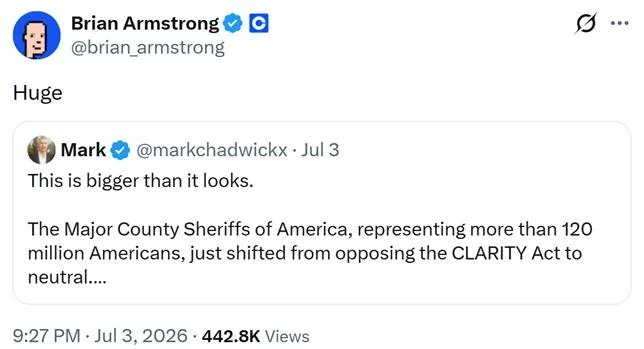
| U.S. market structure | Armstrong, Coinbase's co-founder and CEO, answered the MCSA's CLARITY Act reversal with one word: "Huge." 3 | Whether law-enforcement neutrality helps the Senate path before the August recess. |
| DeFi mechanics | Stani Kulechov, Aave's founder, said Aave V4 deposits passed $250 million, while Cronje published Flying Tulip metrics and a 94%+ FT burn plan. 4 5 | Whether growth turns into repeatable revenue, liquidations, and token-holder alignment rather than TVL headlines. |
Lean Ethereum becomes the week's protocol anchor
Vitalik published the highest-signal statement of the window on July 4 at 1:28 p.m. ET. His Lean Ethereum thread was based on a recent Ethereum researcher meeting in Berlin and an April discussion in Svalbard with client teams; the thread had 987,263 views, 4,319 likes, and 1,078 bookmarks in the research capture. 1
The headline is bigger than another roadmap graphic. Vitalik wrote: "Lean Ethereum is not a single one-shot upgrade, it is a collection of improvements that will come online to the Ethereum network over the course of three or four years. But make no mistake, this IS the third major iteration of Ethereum in the same way that the Merge was the second." 1
The plan reaches every L1 sublayer. Vitalik said recursive STARKs will become an enshrined first-class protocol component, quantum safety has moved sharply higher in priority, and consensus should decouple the available chain from finality to get one- or two-round finality with simpler and faster properties. 1 He also said H-star, or Hegota, will be the last thematically "pre-Lean" hard fork, while I-star begins the run of upgrades with a clear Lean style. 1
The state section is the part investors and app teams should read twice. Vitalik called state changes "probably the single most disruptive part of the plan" and described a future with about 2 TB of current dynamic state plus about 100 TB of more scalable but restricted state types, including keyed nonces, ring buffers, UTXOs, statically accessible state, and temporary state. 1 He said apps will not need to be rewritten, but ERC-20 tokens that migrate to a new UTXO storage design could see transaction fees fall by more than 10x. 1
Vitalik also moved privacy and verification from side concerns into the design center. He said privacy is now a first-class goal for frames, mempool design, and state trees, and he tied formal verification to canonical protocol components that can be defined as bytecode. 1 His VM direction was blunt: Ethereum needs a VM beyond the EVM, with leanISA or RISC-V as the likely candidates, though he said the ideal endpoint is still far away. 1
The pushback was mostly about time and market relevance, not the ambition itself. Dankrad Feist, an Ethereum Foundation researcher associated with danksharding, argued the 3-4 year path is too slow and that LLMs could make a roughly one-year target realistic; Matt Liston argued that the foundation should underpromise from a communications perspective. 6 Ivan on Tech asked whether the roadmap had been checked against what dapp developers and users need before committing years of effort. 1
That tension is the Ethereum story now. The roadmap is large enough to reframe Ethereum after the Merge, but the market will not underwrite 3-4 years of abstraction unless the near-term forks show clearer throughput, fee, privacy, and developer-experience progress.
Hyperliquid moves from venue to infrastructure
Jeff Yan broke a seven-week posting gap on July 3 with a partnership announcement rather than a market take. He said VALR, described in the research package as Africa's largest crypto exchange, will power its core perpetuals offering directly with Hyperliquid's onchain liquidity. 2
Yan framed the deal as infrastructure. He wrote that cloud computing let startups test ideas quickly while trusting that infrastructure would scale with the business, and he argued Hyperliquid can play the same role in the global economy because builders can "tap into the deepest onchain liquidity" and focus on product and users. 2
VALR's Perps product is scheduled for July 6 and covers more than 200 cross-asset perpetual markets, including crypto, stocks, indices, commodities, precious metals, and FX pairs, according to the captured VALR/NFTevening reporting. 7 The same package reports Hyperliquid TVL at about $5.85 billion and 30-day perpetual volume at about $237.7 billion. 7
Arthur Hayes, BitMEX co-founder and Maelstrom's public investment voice, pushed the adjacent trade from the token side at the beginning of the window. On June 28, he said he still wants long exposure to the Hyperliquid ecosystem but wants asymmetry, then named Hypercall, owned by $SYN, as an options DEX challenger to Deribit. 8 The research package also records reports that Hayes bought about 6.16 million SYN through Flowdesk for roughly $2.2 million. 8
These are different claims. Yan is saying Hyperliquid can be a liquidity backend for other apps. Hayes is saying the ecosystem still has asymmetric token opportunities. The common test is whether Hyperliquid's liquidity advantage can travel outside its own interface without losing the execution quality that made it valuable.
Armstrong gets a cleaner CLARITY opening
Armstrong's shortest post was the one with the clearest policy signal. On July 3 at 9:27 p.m. ET, he posted "Huge" after the Major County Sheriffs of America changed its CLARITY Act position from opposition to neutrality. 3 MCSA represents 113 sheriff offices in counties with more than 500,000 people and covers more than 130 million Americans, according to the captured news.bitcoin.com report. 9
MCSA's letter to Senate Banking Committee leaders Tim Scott and Elizabeth Warren said the organization is now neutral on H.R. 3633 after further discussion with the administration over Section 604, the non-custodial developer protection provision. 9 MCSA did not endorse the bill; it still asked Congress for state and local law-enforcement representation in the Section 309 Treasury study and for funding tied to training, technology, blockchain forensics, and investigation resources. 9
The reversal matters because one law-enforcement objection became less binding without becoming full support. BeInCrypto reported that NOBLE had become the first major law-enforcement organization to endorse CLARITY the night before, while Galaxy Research placed 2026 passage odds at 50% and CoinDesk noted that the Senate still needs 60 votes before the August recess. 10 11
Armstrong's longer political post this week was less directly actionable but showed the same hard-money frame. On July 1, he argued that the U.S. Constitution lacks two mechanisms: a cap on government spending growth and a requirement for hard-backed currency. 12 He cited $39 trillion in U.S. debt, roughly $1 trillion of additional debt every 100 days, and interest payments now exceeding defense spending, then listed AI, robotics, and crypto-enabled growth as one possible way to outrun inflation. 12
CZ, Binance's co-founder, did not offer an equivalent U.S. policy statement this week. His more concrete exchange signal was geographic. On July 2, he wrote "Real liquidity for Philippines" and also posted "Slowly, but surely," as Binance-related materials pointed to expansion in the Philippines and a new Binance Japan general manager effective July 1. 13
CZ's high-interaction social signal was lower quality but still revealing. On July 5, he replied with a thumbs-up to a post arguing that BNB Chain has "real community value" compared with Solana memecoins; the reply drew 242,000 views, 494 replies, and 158 quote posts in the research capture. 14 15 The read should stay narrow: one emoji can move BNB Chain meme attention, but it is not evidence of a durable ecosystem rotation by itself.
DeFi founders sell mechanics, not vibes
Stani's week was about turning Aave V4 into a product and distribution story. On July 4, he said Aave V4 reached a new all-time high and that "quarter billy is here," referring to deposits passing $250 million. 4 He also said this is Aave's busiest cycle and that the path ahead includes more crypto-backed loans and expansion into securities-backed lending. 4
The more interesting Aave item was not the ATH post. EtherFi submitted a July 1 governance proposal for a dedicated Aave V4 whitelabel instance on OP Mainnet to power EtherFi Cash, its Visa card product, and Stani confirmed on July 4 that EtherFi would manage the infrastructure while Aave V4 replaces the existing lending stack. 16 17 He described the setup as "whitelabel essentially." 17
That is a different Aave growth model from generic market deployment. If the proposal proceeds, Aave V4 becomes credit infrastructure inside someone else's user product, with EtherFi owning the front-end relationship and Aave supplying the lending engine. 16
Andre Cronje, the lead public voice behind Flying Tulip, delivered the week's most detailed DeFi operating update. Flying Tulip's June update reported ftUSD supply of $3.94 million, up from $2.07 million the prior month; Lend TVL of $9.56 million, up from $4.89 million; 12,261,963.4 FT bought back and burned; $982,310 in cumulative revenue generated; and $50.59 million in backing capital. 5
The token-design claim was explicit. Flying Tulip said that once protocol revenue can sustain team operations at more than $3,500 per day, unallocated and divested FT supply amounting to more than 94% of total supply is planned to be burned. 5 The update also said the final week of June saw more than 30 stressed RFQ liquidations with an average haircut below 1%, and it listed BNB Smart Chain expansion, spot, leverage trading, and total return swaps among the next product steps. 5
Cronje reinforced the model on July 1 with a technical thread arguing that RFQ-based liquidations should become the future of DeFi lending. 18 His argument was that traditional fixed liquidation bonuses force users to accept large haircuts, while a competitive RFQ process can fill only the minimum debt needed and make liquidation look more like a stop-loss than a position wipeout. 18
Hayden Adams, founder of Uniswap Labs, gave the broadest DeFi vision statement but with less supporting detail. On July 2, he wrote that Uniswap's end state is "every asset on earth" with conversion handled seamlessly in the backend at transaction time. 19 Product context moved in that direction: Uniswap Labs said Uniswap v2, v3, v4, and UniswapX are live on Robinhood Chain, and that Robinhood Stock Tokens are available through UniswapX and AMMs from day one. 20
Hayden also spent social capital defending Polymarket founder Shayne Coplan against conspiracy claims. On July 2, he called the claims "psycho shit" and said Shayne was 19, named his first project after Union Pool, built a good product, and grew because people used it. 21 That post matters less as a Polymarket diligence item than as a boundary marker: Adams is willing to use his own reputation to reject founder-origin conspiracy narratives when he thinks the product explanation is enough.
What deserves follow-through
This week's monitor list is short. For Ethereum, watch whether Lean Ethereum turns into fork-level deliverables rather than a long-range vocabulary. For Hyperliquid, watch whether VALR's July 6 Perps launch creates more venue integrations. For CLARITY, watch whether MCSA neutrality and NOBLE support translate into Senate votes before recess. For DeFi, watch whether Aave's whitelabel path and Flying Tulip's RFQ liquidations produce repeatable numbers rather than one-month screenshots.
Cover image: Brian Armstrong's CLARITY Act reaction, via news.bitcoin.com.
참고 출처
- 1Vitalik Buterin: Lean Ethereum mega-thread
- 2Jeff Yan: VALR partnership announcement
- 3Brian Armstrong: "Huge" tweet
- 4Stani Kulechov: Aave V4 ATH
- 5Flying Tulip: June Update
- 6BeInCrypto: Vitalik's Lean Ethereum roadmap draws pushback
- 7NFTevening: VALR taps Hyperliquid to launch 200+ perps markets
- 8Arthur Hayes: Hyperliquid/SYN thesis
- 9news.bitcoin.com: Major County Sheriffs of America moves to neutral on CLARITY Act
- 10BeInCrypto: Major County Sheriffs drop opposition to CLARITY Act
- 11CoinDesk: Clarity and Congress's summer break
- 12Brian Armstrong: U.S. Constitution thread
- 13CZ timeline: Philippines and Japan updates
- 14CZ: thumbs-up reply to BNB Chain post
- 15ddotaek: BNB Chain endorsement post
- 16Stani Kulechov: EtherFi V4 proposal
- 17Stani Kulechov: EtherFi whitelabel reply
- 18Andre Cronje: RFQ liquidation thread
- 19Hayden Adams: every asset on earth
- 20Uniswap Blog: Robinhood Chain is live
- 21Hayden Adams: Polymarket defense
관련 콘텐츠
- 로그인하면 댓글을 작성할 수 있습니다.