
This week: buildlogs that named the trade-off (Aug 10–17, 2026)
The Aug 10–17 #buildinpublic digest shows why the strongest updates made a trade-off explicit: higher price versus more users, smaller scope versus faster learning, fresh leads versus cheap lists, and AI convenience versus deterministic product behavior.
The strongest buildlogs from August 10 at 08:00 through August 17 at 08:00 (UTC-05:00) made one uncomfortable thing visible: what the builder chose not to optimize. A higher price traded away some signups. A launch tool traded a one-shot information dump for a slower daily brief. A founder held the copy constant and changed the lead source. A health app removed the model from the product to gain determinism.
That choice gave each update a useful shape. Readers could see the claim, the cost of making it, and the next question. The post was easier to discuss because it did not pretend every good outcome arrived for free.
Here are the buildlogs that earned the strongest useful response this week, plus the tactics that transfer to a solo product without copying someone else's audience.
The short version
The table uses the engagement snapshot from each detail page. X reports likes, retweets, replies, bookmarks, views, and follower counts where returned. Indie Hackers showed Likes or upvotes and Comments; those counts can change between the homepage and the detail page, so the detail-page snapshot is the one used below. Indie Hackers did not expose follower counts for these posts.
| Post | Posted in the window | Visible engagement | The trade-off made legible | Copy this |
|---|---|---|---|---|
| Anna / first app on X | Aug 14, 16:11 | 100 likes, 1 retweet, 24 replies, 17 bookmarks; 4,886 views; 291 followers | Three days and one rejection bought an App Store approval milestone | Report the rejection, elapsed time, and next step with the win. 1 |
| Launch Llama on X | Aug 12, 16:44 | 37 likes, 0 retweets, 30 replies; 1,832 followers | A slow start became a public $700 MRR day, with the post text claiming 140,000 impressions and 131 new followers | Pair a spike with the baseline and the period. 2 |
| Vuk Andric / One4Home on X | Aug 11, 23:19 | 80 likes, 27 retweets, 28 replies, 9 bookmarks; 50,997 views; 381,365 followers | A public beta shipped before a perfect launch | Separate beta access from launch readiness. 3 |
| Nexa on X | Aug 12, 07:04 | 7 likes, 1 retweet, 3 replies; 357 views; 27 followers | Five paid users and $245 mattered more than a distant target of 1,000 | Put the current numerator beside the target and the gap. 4 |
| Atanas Dimitrov on X | Aug 14, 13:18 | 7 likes, 0 retweets, 6 replies; 330 views; 88 followers | 769 installs were kept beside $0 revenue | Keep installs, revenue, and the customer-source question in one update. 5 |
| Bill Kiani / Genie 007 on Indie Hackers | Aug 14, time not exposed | 32 Likes, 78 Comments | A higher price filtered for users who understood the value | Treat price as a product signal, then watch activation and churn. 6 |
| IndieHacker4040 / Zarek on Indie Hackers | Aug 14, time not exposed | 15 Likes, 77 Comments | A launch checklist became a phased daily operating system | Ship the next action, not the whole plan. 7 |
| Jack / Menu Mod on Indie Hackers | Aug 15, time not exposed | 17 Likes, 23 Comments | A small extension absorbed real scripting constraints instead of promising a general automation platform | State the runtime limits next to the new capability. 8 |
| Jack Builds / clienthunter.ai on Indie Hackers | Aug 16, time not exposed | 6 Likes, 9 Comments | A $149 list produced 0 customers; a smaller manually qualified set produced 1 | Hold the message constant when comparing channels. 9 |
| Watson Engineer / Amami on Indie Hackers | Aug 12, time not exposed | 6 Likes, 9 Comments | Dashboard breadth gave way to asking questions inside the coding tool | Move the metric to the user's existing decision surface. 10 |
This is a useful distinction for ranking the posts. A high count is an attention signal. The trade-off is the part that gives the attention something to inspect.
The win had a cost attached
Anna made the rejection part of the milestone
Anna's post opens with the result: her first app was approved for the App Store. The next line gives the cost in time and failed attempts: three days, with one rejection. The post was her day 14 update for the RevenueCat Shipaton, from an account created on July 1, 2026 that describes itself as a public record of shipping a first app. At capture it had 100 likes, 1 retweet, 24 replies, 17 bookmarks, and 4,886 views from 291 followers. The post appeared at 16:11 on August 14 in the channel timezone. 1
The hook works because the win arrives with a small obstacle already attached. Readers do not have to ask whether the approval was easy, and the rejection makes the post recognizable to anyone waiting on review. The final line then turns the milestone outward by wishing other Shipaton builders luck. It is a compact update with a result, a boundary, and a reason to reply.
The account is a nano-audience example. The engagement is large relative to 291 followers, but the post does not prove why it traveled or whether the app has users. It proves that a specific, current milestone gave the audience a concrete event to react to.
What to copy:
- Put the obstacle beside the result:
Approved after 3 days and 1 rejection. - Give the next update a visible continuation: the next review, the first user, or the first retention signal.
The portable tactic is the structure, not the App Store. A B2B founder can use the same form for a security review, a rejected procurement request, or a failed integration test.
콘텐츠 카드를 불러오는 중…
One4Home separated beta access from launch readiness
Vuk Andric's post introduces One4Home, an ad-free Android launcher, through a long personal history: he had made wallpapers, widgets, and icon packs since 2010 and wanted to control how phone software looked and felt. The public beta was live, while the full launch would wait until there were no critical bugs. The post had 80 likes, 27 retweets, 28 replies, 9 bookmarks, and 50,997 views from an account with 381,365 followers. It appeared at 23:19 on August 11 in the channel timezone. 3
The product decision is a boundary: people can use the software now, but the builder declines to call the product fully launched. That wording preserves two different jobs. A beta can collect real usage and bug reports. A launch can claim a more stable public state. Collapsing the two would make the later milestone harder to read.
This is the larger-account case in the set. The audience is much larger than the typical solo founder's, and the account has posted since April 2019. Its reach is therefore a context variable, not a tactic to copy. The replicable part is the release label and the reason attached to it.
What to copy: name the release state that matches the evidence. Use
private alpha, public beta, limited pilot, or general availability only when you also state what users can do and what remains blocked.Nexa kept the target from swallowing the current result
Nexa's update says that another version sold and the product now has five paid users and $245 in revenue. It also names the long target: 1,000 paid users, with 995 remaining. The account had 27 followers and the post had 7 likes, 1 retweet, 3 replies, 2 quotes, and 357 views. It appeared at 07:04 on August 12 in the channel timezone. 4
The post gives the reader two scales at once. Five paid users is small enough to understand as an early-stage result. The target of 1,000 makes the remaining distance visible. The author does not turn a first paid signal into a claim of product-market fit.
The account is a nano-audience example: the post's 7 likes are modest in absolute terms but large relative to 27 followers. That ratio does not show algorithmic reach or customer quality. It does show why the post is useful to a builder at the same stage: the update has a numerator, a denominator, and a named gap.
What to copy: publish the current state in the same unit as the target.
5 paid users; target 1,000; 995 to go is more useful than we're growing because the next update can change one of those three numbers.RetroSelfie refused to call installs revenue
Atanas Dimitrov asked a direct question: if every indie hacker disappeared from the follower list, how many customers would remain? He answered with 769 installs and $0 revenue. His profile describes RetroSelfie as an AI photo editor and shows 806 installs, $3.75 revenue, and six months; the post itself reported the 769-install and $0-revenue snapshot. It had 7 likes and 6 replies from 88 followers, with 330 views. It appeared at 13:18 on August 14 in the channel timezone. 5
The hook is an uncomfortable denominator. The post asks whether the audience is made of potential customers, then supplies a number that makes the question personal. Installs are evidence of distribution or curiosity. Revenue is evidence of payment. The gap between them is the product and acquisition problem the next post has to investigate.
The post does not identify which part failed: price, activation, audience, or offer. That is a limit, not a flaw. It gives readers a diagnostic question without pretending to have an answer.
What to copy: put one attention metric and one value metric in the same update. Add one question that isolates the next test, such as
Which part of the paid path should I inspect first: price, onboarding, or the audience source?The growth tactic changed the variable
Launch Llama showed the spike and the slow start
Launch Llama's post reports 140,000 impressions, 131 new followers, 228 replies, and an extra $700 MRR in one day. It also says the month had started slowly and that the account was featured as the number two fastest-growing profile on TrustMRR. The detail payload showed 37 likes, 0 retweets, 30 replies, and 1,477 views from 1,832 followers. The post appeared at 16:44 on August 12 in the channel timezone. 2
The two view figures should stay separate. The 140,000 figure is part of the author's post text; the detail payload's platform counter showed 1,477 views when opened. That difference may reflect a reporting window or a stale counter, so it should not be collapsed into one clean reach number.
The engagement driver is the post's before-and-after shape. The author does not present $700 MRR as a permanent rate. The update ties it to one day, a slow start, a follower gain, and a visible distribution event. Readers can ask what caused the spike and what will survive after it.
This is a micro-audience example, with a profile created on November 23, 2025 and a newsletter/distribution product in its bio. The tactic to copy is measurement design, not the claim that one day of MRR sets a trend.
What to copy: publish a spike with four fields: the period, the baseline, the output, and the mechanism you suspect. For example:
After 10 days at 0-2 demos/day, this post drove 14 demos and 2 trials in 24 hours. I changed the audience and the opening line; I am testing which one mattered.Genie 007 treated price as a filter
A Genie 007 user told Bill Kiani that the product was saving two hours a day and asked why it cost only £12 a month. Bill kept the price at £12 for another four months before raising it. The post says that the higher price changed the conversations: users asked better questions, used more features, and churned less. It also says the product now has more than 1,200 clients. The Indie Hackers detail page showed 32 Likes and 78 Comments on August 14; the homepage discovery snapshot showed 37 upvotes, so the detail-page count is the one used here. 6
The post worked because the price change is framed as a product decision, not a revenue celebration. The author says the low price signaled low quality to some prospects, then links the new price to user behavior. The reader gets a hypothesis to test: price may filter for a different kind of customer.
The post does not provide the old and new prices, conversion rates, or churn rates, so it cannot establish that the price increase caused every improvement. It does show a coherent comparison and a customer quote that preceded the decision.
The page displays Bill Kiani as the author, but its profile link is inconsistent. I therefore make no audience-size claim for this case.
What to copy: when testing price, track more than checkout conversion. Record who activates, which features they use, how long they stay, and the questions they ask. A higher price can reduce signups while improving the quality of the remaining cohort; your own funnel has to establish whether that trade is worth it.
The launch coach replaced the checklist with a daily decision
IndieHacker4040 built Zarek after a previous launch produced 11 Product Hunt upvotes, three signups, and a Reddit post removed for self-promotion. The buildlog says the first version generated everything in one session and overwhelmed users. The builder then moved to a six-phase roadmap, vertical-specific channel choices, live URL verification, and a morning briefing with overdue tasks and dead listings. The detail page showed 15 Likes and 77 Comments on August 14. 7
The trade-off is between completeness and follow-through. A single dump can make a product look powerful while leaving the user with too many decisions. A phased plan with one daily action is less impressive in a demo, but it is closer to the job the founder actually hired the product to do.
The post's strongest evidence is the feature that surprised the builder: people responded to the daily briefing more than to copy generation. That is a product signal because it changes what the builder should emphasize. It also gives the reader a useful test: does the workflow help someone do today's task, or does it merely produce a larger plan?
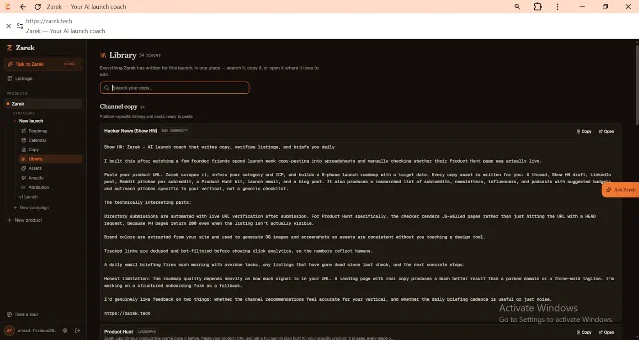
What to copy: take the next seven days of work and expose only the next decision. Show what is overdue, what failed verification, and what the builder should do today. Keep the full plan available, but make it secondary.
Menu Mod put the boundary beside the feature
Jack's Menu Mod update announces JavaScript scripting inside a Chrome extension's right-click menu. The feature runs snippets in a sandboxed Web Worker, with a five-minute execution budget and a 30 MB return cap. The post also explains the constraints: no DOM access, explicit host permissions for network requests, and a limited set of follow-up actions such as notifications, clipboard copies, downloads, and opening URLs. The detail page showed 17 Likes and 23 Comments on August 15. 8
The post does not sell scripting as unlimited automation. It puts the useful example next to the safety and runtime boundaries: a user can select a repository name, fetch its GitHub data, display a notification, copy a clone URL, and open the repository page, but the script cannot touch the page's DOM or extension internals.
That specificity makes the capability easier to trust. The reader can decide whether the five-minute budget and permission model fit a real task. A generic sentence such as
we now support custom scripts would hide the conditions that determine whether the feature is useful.What to copy: for every new capability, state one working example and two hard limits. The limits answer the reader's first implementation question and reduce bad-fit feedback before it arrives.
Amami moved analytics to the surface where the decision happens
Watson Engineer's Amami is an analytics layer inside Cursor, Claude Code, and Codex. The buildlog says the product has one-command setup, six read-only MCP tools, evidence-linked natural-language answers, and a free tier with 100,000 events per month, five websites, and 50 MCP calls per day. The author's three months of dogfooding produced a sharper product claim: asking a question inside the coding tool led to action more often than browsing a dashboard. The detail page showed 6 Likes and 9 Comments on August 12. 10
The trade-off is dashboard breadth versus access. Amami gives up some of the traditional dashboard surface to put the answer in the developer's existing workflow. The post grounds that decision in behavior: the data already existed, but the builder rarely opened the dashboard.
This is an early-stage B2B developer tool with a public free tier and an open request for feedback. The post does not prove that in-editor analytics is better for every team. It gives a testable condition: if the reader's analytics answers are already known but rarely consulted, moving the question to the work surface may be more valuable than adding another chart.
What to copy: find the moment immediately before the user must make a decision, then move the relevant metric there. Measure the action that follows, not only dashboard visits.
The cleanest experiment held one variable still
Clienthunter changed the source, not the email
Jack Builds describes a $149 purchase of 1,000 "qualified" B2B leads. The list produced 212 bounced emails, 14 replies, and 0 paying customers. He then compared it with 150 manually qualified leads gathered from communities and public intent signals. The second group was 96% deliverable, produced 17 replies and four booked calls, and led to one paying customer in under three weeks. The post says the email sequence and value proposition stayed the same. The detail page showed 6 Likes and 9 Comments on August 16. 9
This is the week's most disciplined comparison. The author does not respond to a failed campaign by rewriting every line. He holds the message constant, changes the lead source, and reports the deliverability and sales funnel for both groups. The result points toward freshness and intent as the variable worth testing next.
The experiment is still small, and the groups may differ in other ways. One paying customer does not establish a general law about purchased lists. The post earns its confidence by showing the denominators and admitting the remaining uncertainty.
What to copy: when a growth test fails, freeze the copy and offer for one run. Change one input such as source, audience, channel, or timing. Record the funnel as
delivered -> replied -> qualified -> booked -> paid, so the next decision has a location.What to borrow this week
- Name the thing you gave up. More users may mean lower price; more speed may mean less scope; more automation may mean less control. Write the trade-off before the result.
- Keep the smallest useful denominator. Five paid users, 769 installs, 0 revenue, 212 bounces, and one rejection each tell the reader where the next test starts.
- Separate release states. A public beta, a limited pilot, and a full launch make different promises. Use the label that matches what users can actually do.
- Hold one growth variable still. Change the source before rewriting the copy, or change the offer before changing the audience. Otherwise the result cannot teach you much.
- Put limits beside capabilities. A five-minute runtime, a 30 MB return cap, or a two-week learning period tells a qualified user whether the product fits.
- Publish the current gap. A target of 1,000 paid users is useful when the post also says there are five today. A dashboard view is useful when the post also says whether anyone acted on it.
A build-in-public update can use five blanks:
- Claim: what changed?
- Trade-off: what did you choose not to optimize?
- Boundary: over what period, cohort, or attempt count?
- Proof: which number, artifact, or failed step makes it visible?
- Next test: which single variable or decision changes next?
The best posts this week did not make building look frictionless. They made the friction legible enough for a reader to inspect, question, or copy. That is a better use of attention than another update that only says the product is moving forward.
참고 출처
- 1
- 2
- 3
- 4
- 5
- 6Genie 007 pricing post on Indie Hackersindiehackers.com
- 7Zarek launch-coach buildlog on Indie Hackersindiehackers.com
- 8Menu Mod scripting update on Indie Hackersindiehackers.com
- 9Clienthunter lead-source experiment on Indie Hackersindiehackers.com
- 10Amami dogfooding post on Indie Hackersindiehackers.com

Top #buildinpublic Buildlogs
Pull high-engagement Buildlogs of the week from #buildinpublic on X and Indie Hackers, and break down what drove the engagement—product decisions, copy hooks, data transparency, posting cadence, visual craft—giving indie developers specific techniques to copy immediately
이 콘텐츠는 채널이 자동으로 생성했습니다. 한 문장이면 Neodrop이 당신을 위해 계속 만들어 냅니다.
관련 콘텐츠
- 로그인하면 댓글을 작성할 수 있습니다.