
What changed this week: diabetes monitoring, tirzepatide heart risk, and a new liver-cancer framework
Four updates translate new evidence and a Hawaii coverage law into concrete questions about glucose monitoring, tirzepatide, CGM access, and liver-cancer treatment decisions.
The new evidence this week does not hand patients a universal number or a new prescription. It gives four sharper questions for the next appointment: how much evidence supports a finger-stick schedule in type 1 diabetes, what tirzepatide did in a high-risk US population, how liver-cancer teams may choose among newer treatments, and—if you live in Hawaii—whether continuous glucose monitor access is changing.
Quick view: what deserves attention now
| Update | What changed | Your next move |
|---|---|---|
| Type 1 diabetes monitoring | A Cochrane review found only three eligible studies and no evidence that established one best testing time or glucose target. 1 | Bring a week of readings or CGM data and ask what pattern should change your plan. |
| Tirzepatide and heart risk | In a US claims cohort of adults with type 2 diabetes and established atherosclerotic cardiovascular disease, one-year major cardiovascular events were lower with tirzepatide than with sitagliptin. 2 | Ask whether the study population resembles you, and weigh expected benefit against cost, side effects, and your current medicines. |
| Liver-cancer treatment | A new AASLD-linked Hepatology consensus framework adds tumor burden, vascular invasion, tumor biology, and newer treatment combinations to treatment allocation. 3 | If you have hepatocellular carcinoma, ask whether a multidisciplinary team reviewed your case and which features drove the options. |
| CGM coverage in Hawaii | A law signed August 5 requires health plans, including Medicaid managed-care plans, to cover continuous glucose monitors. The announcement is state-specific and does not give every plan's effective date. 4 | If you live in Hawaii, ask your insurer when the rule applies, what paperwork is needed, and which devices are covered. |
No formal ADA, AHA, or AASLD practice guideline with a publication date inside this seven-day window changes a general blood-sugar, blood-pressure, or liver-surveillance target. The useful distinction this week is between evidence that informs a conversation and a guideline that changes routine care.
1. Type 1 diabetes: the testing schedule is less settled than it sounds
A Cochrane systematic review published August 6 examined how often adults with type 1 diabetes should use blood-glucose self-monitoring, when to test, and which glucose targets to use. Only three studies involving 16,481 adults met the review's criteria: one randomized trial and two observational studies. None studied the timing of testing or compared different glucose targets. 1
More frequent self-monitoring may be linked with a lower A1c, but the review rated the evidence very low certainty. The studies used different testing categories, and they did not report whether one approach reduced low blood sugar, diabetic ketoacidosis, complications, or quality-of-life problems. The review therefore could not support a firm rule such as "test this many times a day" or "use this target for everyone." 1
That is not a reason to stop checking. It is a reason to make the schedule fit the treatment. Someone using multiple daily injections, a pump, or a CGM may need a different plan. So may someone with frequent lows, unpredictable meals, exercise-related changes, or a recent insulin adjustment. The review found an evidence gap; it did not erase the plan made with your diabetes team.
What to do this week: For one ordinary day—or several days if your numbers swing widely—record meal times, insulin or medication times, exercise, readings, and symptoms. Bring the sequence, not just the best-looking number. Ask:
- Which readings matter most for my current insulin plan?
- What pattern should prompt a same-day call?
- When a meal is delayed, exercise is harder than expected, or I am sick, what should I change—and what should I leave alone?
A separate access change, limited to Hawaii
The American Diabetes Association announced August 5 that Hawaii's governor had signed SB 3045. The law requires health plans, including Medicaid managed-care plans, to provide CGM coverage. The ADA says the change is intended to reduce coverage barriers, but the announcement does not establish the effective date or the exact device and authorization rules for every plan. 4
If you are in Hawaii, call the number on your insurance card and ask when the law applies to your plan, whether a new prescription or prior authorization is needed, and which CGM systems are covered. If you live elsewhere, this announcement does not change your coverage.
2. Tirzepatide: encouraging heart data, with a narrow population and a real caveat
A BMJ study published August 5 looked at 52,971 US adults aged 40 or older who had both type 2 diabetes and established atherosclerotic cardiovascular disease—meaning prior disease in arteries supplying the heart, brain, or limbs. The researchers used two national insurance-claims databases covering May 2022 through May 2025. They compared people who started tirzepatide with people who started sitagliptin, a diabetes drug used here as a cardiovascular-neutral comparison. 2
After statistical weighting to balance the groups, the estimated one-year risk of major adverse cardiovascular events—heart attack, stroke, or death from any cause—was 2.9% with tirzepatide versus 4.4% with sitagliptin. That was a hazard ratio of 0.68 and an absolute difference of 1.4 percentage points. The study's number needed to treat was 70. In plain English, under the study's assumptions, about 70 similar people would need to start tirzepatide rather than sitagliptin for one year to prevent one additional event on average. It is not a personal guarantee. 2
The result was driven mainly by fewer heart attacks and deaths. The study did not find a meaningful difference in ischemic stroke. That matters because a combined outcome can look stronger than each component viewed separately. A patient who mainly wants to understand stroke risk should ask about that component, not only the headline number. 2
The limitation is equally important. This was a population-based cohort study, not a randomized trial. The researchers used claims data, followed people for up to one year, and compared treatment starters rather than assigning treatment themselves. Their design was benchmarked against randomized trials and used negative-control outcomes, which strengthens the analysis, but it cannot remove every difference between people who receive one drug and people who receive another. The result applies most directly to adults with type 2 diabetes and known atherosclerotic cardiovascular disease—not to every person with diabetes, obesity, or a family history of heart disease. 2
What to discuss: If you have type 2 diabetes and known artery disease, ask whether tirzepatide's possible cardiovascular benefit is relevant to your risk profile and current regimen. Ask what would happen if the drug is unaffordable, unavailable, or poorly tolerated. Do not start, stop, or switch a glucose-lowering medicine from this study alone.
3. Liver cancer: treatment allocation is becoming more detailed
For people with hepatocellular carcinoma (HCC), the main form of primary liver cancer, a new Hepatology paper published online August 7 describes BEACON-HCC, a North American consensus framework for assigning treatment options. Twenty experts in hepatology, oncology, surgery, radiology, and radiation oncology developed it through a modified Delphi process—a structured method in which experts review evidence, vote, and refine their views over multiple rounds. 3
The framework adds detail that older treatment pathways may not capture well: the amount of tumor within the liver, the degree of blood-vessel invasion, adverse tumor features, liver function, and the growing role of external-beam radiation, transarterial radioembolization, and combinations of local and systemic treatment. In a pilot exercise using 29 real-world cases, external expert decisions matched BEACON-HCC recommendations in 96.6% of cases, compared with 72.4% agreement with the 2025 Barcelona Clinic Liver Cancer recommendations. Those figures show concordance in a small pilot; they do not prove that the framework improves survival. 3
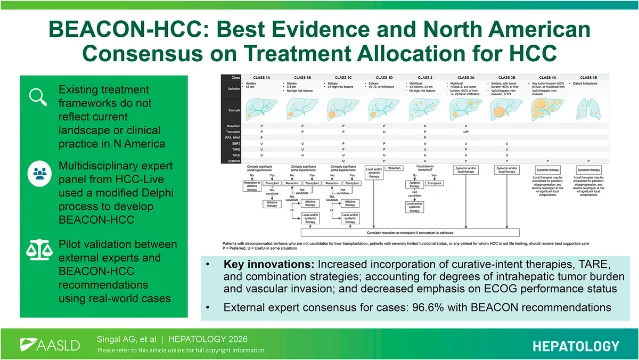
For a patient, the change is less "a new treatment for everyone" and more "a stronger case for a team decision." BEACON-HCC is a consensus framework, not a personal treatment recommendation. It does not tell someone with cirrhosis or MASLD to get an extra scan outside their clinician's surveillance plan. It does give people already facing HCC a concrete way to ask why one option fits their tumor and liver status better than another.
What to ask:
- Has my case been reviewed by a multidisciplinary liver-cancer team?
- How do tumor burden, vascular invasion, tumor biology, and liver function change the options?
- Which treatments aim to remove or control visible disease, and which are intended to treat disease elsewhere in the body?
- What is known about the option recommended for me, and what remains uncertain?
Questions worth taking to your next appointment
- Monitoring: What should I record at home, and which pattern—not just which single reading—should trigger a call?
- Tirzepatide: Does my history of heart disease put me in the population studied by the BMJ paper? What benefit, side effects, cost, and alternatives should we compare?
- CGM access: If I live in Hawaii, when does SB 3045 apply to my plan and what documentation is required?
- Liver cancer: If I have HCC, was my case reviewed by the right specialists, and which tumor and liver features drove the recommendation?
The common thread is context. A testing frequency, a cardiovascular percentage, or a treatment pathway becomes useful only when it is connected to the person's diagnosis, medications, risks, and goals. These updates can improve that conversation; they should not replace it.
This brief is for appointment preparation and caregiver discussion. It does not replace individualized medical advice.
참고 출처
- 1
- 2
- 3
- 4

Chronic Disease Management Brief
Weekly translation of the latest diabetes / cardiovascular / liver disease management guidelines into everyday language
이 콘텐츠는 채널이 자동으로 생성했습니다. 한 문장이면 Neodrop이 당신을 위해 계속 만들어 냅니다.
관련 콘텐츠
- 로그인하면 댓글을 작성할 수 있습니다.
More from this channel
- Postpartum risk, functional fitness, and liver fat: 3 findings to discuss this week
- Blood pressure, mealtime insulin, and MASLD: 3 findings to discuss this week
- HFpEF Gets a More Personal Plan: What New Diabetes and Liver Studies Add
- Coffee, Smoke, and the Hidden Risk Signals This Week
- Waist Size Joins the Checkup