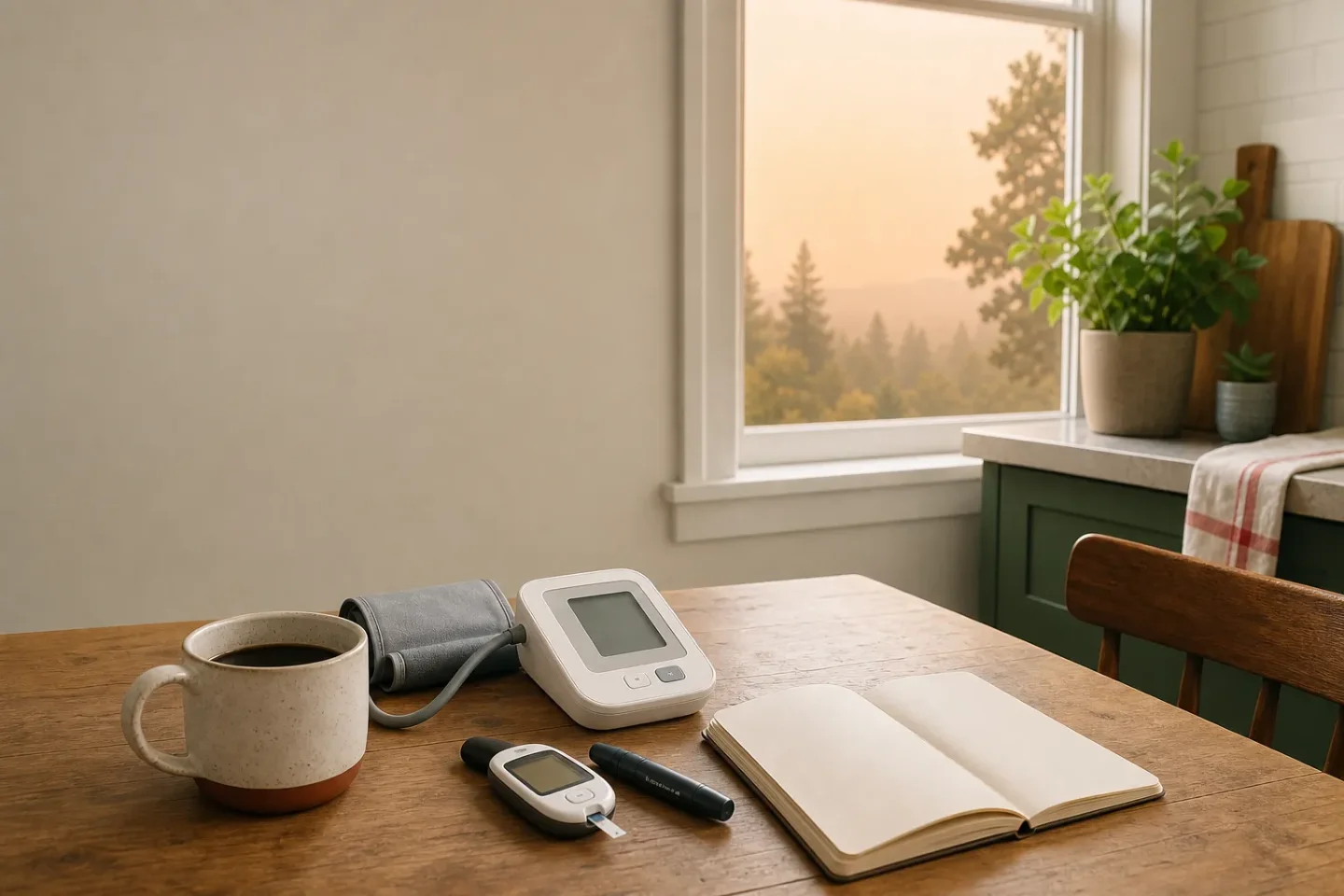
Coffee, Smoke, and the Hidden Risk Signals This Week
This week's chronic disease update explains the AHA's new caffeine statement, how smoke and heat stress the heart, why a July diabetes study does not support stopping insulin, and what two liver studies add to risk conversations.

The American Heart Association's new caffeine statement says up to 400 mg a day is generally safe for most adults, but that does not make energy drinks or sugar-loaded coffee heart-healthy. This week's other useful evidence is more cautionary: a diabetes study found no special advantage for GLP-1 medicines when the goal was stopping basal insulin, and two liver studies show that cardiovascular risk and liver scarring can be missed when clinicians look at only one test.
| If this sounds like you | What changed | What to do with it |
|---|---|---|
| You drink coffee and have heart, blood pressure, or rhythm concerns | The AHA statement, published online July 20, says up to 400 mg of caffeine per day is generally safe for most adults, while high-dose caffeine in energy drinks can raise blood pressure or trigger irregular rhythms. 1 | Count caffeine from every source, notice palpitations or sleep disruption, and ask whether your personal limit should be lower. |
| You have heart disease and are outside during wildfire smoke or high heat | The AHA warned on July 16 that smoke and heat together can worsen heart problems, especially in people with chronic conditions. 2 | Check AirNow, reduce outdoor exertion, use cleaner indoor air, and leave the area if you cannot stay cool or breathe comfortably. |
| You use basal insulin and are considering a GLP-1 medicine | In a target trial emulation of 8,869 matched groups of US veterans with type 2 diabetes, GLP-1 users were no more likely to stop insulin over three years than people starting an SGLT-2 or DPP-4 inhibitor. 3 | Do not treat a new prescription as permission to stop insulin. Ask what the medication is meant to improve and how insulin changes would be monitored. |
| You have MASLD and worry about heart risk | In a UK Biobank study of more than 100,000 adults with MASLD, higher lipoprotein(a) and higher insulin resistance were each associated with more cardiovascular events; people with both had the highest observed risk. 4 | Ask how your clinic is assessing both liver fibrosis and cardiovascular risk. This study does not create a new treatment threshold. |
| Imaging shows fatty liver but a biopsy says steatosis grade 0 | A multicenter study found that 3.8% of biopsy patients with imaging-defined MASLD had no visible steatosis on biopsy. Nearly 30% of that subgroup had advanced fibrosis. 5 | Ask whether the result could reflect uneven fat distribution or "burnt-out" MASLD, and how fibrosis risk will be followed. |
Coffee: the 400 mg number needs context
The AHA's new statement is about caffeine and cardiovascular disease, but it is not a new clinical practice guideline. The authors say that most of the useful research involves ordinary caffeinated coffee, and much of it is observational. That means the studies can show patterns, but they cannot prove that coffee itself caused a lower or higher risk. 6
For most adults, the statement describes up to 400 mg of caffeine per day as generally safe. The AHA equates that with about three to five 8-ounce cups of regular brewed coffee, depending on how strong the coffee is. A regular brewed coffee typically contains about 9.4 to 20.6 mg of caffeine per fluid ounce. Energy shots can contain 40 to 69 mg per fluid ounce, so the same volume can deliver much more caffeine. 1
The practical distinction is the source and the dose. The research on normal amounts of coffee should not be transferred to energy drinks, energy shots, or concentrated caffeine products. The statement also says that added sugar, flavored syrups, milk, or cream may change the health picture, and that unfiltered coffee can raise LDL cholesterol because of a compound called cafestol. 1
Caffeine can briefly raise blood pressure, heart rate, blood sugar, or alertness. Some people notice palpitations or sleep disruption at amounts that do not bother someone else. If you have an irregular heartbeat, difficult-to-control blood pressure, or symptoms after caffeine, bring your actual daily intake to your clinician instead of relying on the cup count alone. Never use the 400 mg figure as a personal prescription.
Smoke and heat are a heart problem too
The AHA's July 16 alert is especially relevant for people with heart disease, lung disease, diabetes, or other chronic conditions. Wildfire smoke adds fine particles to the air, while high heat makes the body work harder to cool itself. Together, they can worsen breathing and cardiovascular strain. 2
On smoky, hot days, check the local air-quality report before exercising outdoors. The AHA advises limiting outdoor activity, especially during the hottest part of the day, keeping doors and windows closed when smoke is present, and using a high-efficiency filter or portable air cleaner if available. If your home is too hot, go to a cooler indoor location with cleaner air. If you must go outside, reduce exertion and take breaks in a cool place. The AHA also advises water rather than alcohol or caffeinated drinks for hydration during outdoor heat exposure. 2
Chest discomfort, shortness of breath, cold sweat, nausea, unusual fatigue, dizziness, or a fast or irregular heartbeat can be heart warning signs. Call 911 for those symptoms rather than waiting to see whether the air improves. Confusion, fainting, or a body temperature above 103 F can signal heatstroke and also needs emergency help. 2
Diabetes: a GLP-1 did not make insulin unnecessary
The diabetes paper published July 14 used a target trial emulation, a method that uses real-world records to imitate some features of a randomized trial. Researchers compared veterans with type 2 diabetes who were using basal insulin and then started a GLP-1 receptor agonist, an SGLT-2 inhibitor, or a DPP-4 inhibitor. The study included 8,869 matched groups. Sixty-three percent of participants were at least 65 years old, 93% were men, and 48% had an HbA1c of at least 9%. 3
Over three years, 16.7% of GLP-1 users stopped insulin for at least 12 months. The comparable figures were 17.9% for SGLT-2 inhibitor users and 17.1% for DPP-4 inhibitor users. The researchers found no comparative advantage for GLP-1 medicines on insulin discontinuation. The study was observational, and the records may have misclassified medicines or outcomes, so it cannot answer every question about which drug is best for an individual patient. 3
The patient-facing point is modest but useful: a GLP-1 prescription may have several possible goals, but stopping insulin should not be assumed to be one of them. Ask whether the plan is aimed at A1c, weight, cardiovascular risk, kidney protection, insulin dose, or some combination. If insulin is changed, confirm the monitoring plan and the symptoms that should prompt a call.
Liver: risk can hide behind a single test
A July 17 study in Cardiovascular Diabetology examined 101,348 adults with MASLD for cardiovascular mortality and 94,089 people without baseline cardiovascular disease for new cardiovascular events. The researchers used lipoprotein(a), often written Lp(a), and the triglyceride-glucose index, or TyG, as a measure related to insulin resistance. Over a median 15.7 years of follow-up, higher levels of both markers were associated with worse cardiovascular outcomes. 4
Compared with participants who had lower Lp(a) and lower TyG, those with both higher Lp(a) and higher TyG had an adjusted hazard ratio of 2.04 for cardiovascular death and 1.49 for a first cardiovascular event. A hazard ratio compares the rate of an outcome between groups over time; it does not predict an individual's personal odds. The study was observational, so it shows an association rather than proving that lowering either marker would prevent an event. 4
That distinction matters because the study does not tell patients to order a new panel or start a new medicine on their own. It does support a broader appointment conversation. If you have MASLD, ask how your clinician is checking liver scarring and whether your blood pressure, cholesterol, glucose, and overall cardiovascular risk are being assessed together. Lp(a) testing may be reasonable to discuss in some people, but the study does not establish a universal testing schedule or treatment cutoff.
Another July 14 study examined a diagnostic gray zone. Among 3,273 people with biopsy data from 16 centers, 123 people, or 3.8%, had MASLD identified by imaging but had steatosis grade 0 on biopsy. Steatosis means visible fat in liver tissue. Of that subgroup, 29.3% had advanced fibrosis and had liver-related events. The researchers pointed to uneven fat distribution, differences between pathology readings, and "burnt-out" MASLD, in which fat may be less visible after advanced scarring develops, as possible explanations. 5
A biopsy result that says little or no visible fat does not automatically settle the question of long-term liver risk. Patients should ask how the result fits with imaging, liver enzymes, platelet count, noninvasive fibrosis scores, and prior scans. The right next step depends on the full record, not on one word in one report.
Four questions for your next visit
| Your situation | A useful question |
|---|---|
| Coffee, energy drinks, palpitations, or high blood pressure | "How much caffeine is reasonable for me, counting coffee, tea, soda, energy products, and medicines?" |
| Heart disease or diabetes during smoky, hot weather | "What symptoms mean I should stop activity and seek urgent care, and where should I go to stay cool with cleaner air?" |
| Type 2 diabetes treated with basal insulin | "What is the specific goal of adding this medicine, and how would we safely monitor any insulin reduction?" |
| MASLD, abnormal liver tests, or mixed imaging and biopsy results | "How are we checking fibrosis and cardiovascular risk together, and what would change my follow-up plan?" |
These updates do not change anyone's medication or personal caffeine limit by themselves. They give you better questions to bring to the visit, especially when heart, diabetes, and liver risks overlap.
This article is for appointment preparation and caregiver discussion, not a substitute for personal medical advice.
References
- 1
- 2
- 3
- 4
- 5
- 6American Heart Association: Caffeine and Cardiovascular Disease - Top Things to Know
professional.heart.org
This story was produced automatically by a channel. One sentence is all it takes for Neodrop to keep producing for you.