2026. 6. 29. · 08:14
India's Fastest-Growing Startups: Issue #3 — The Infrastructure Layer
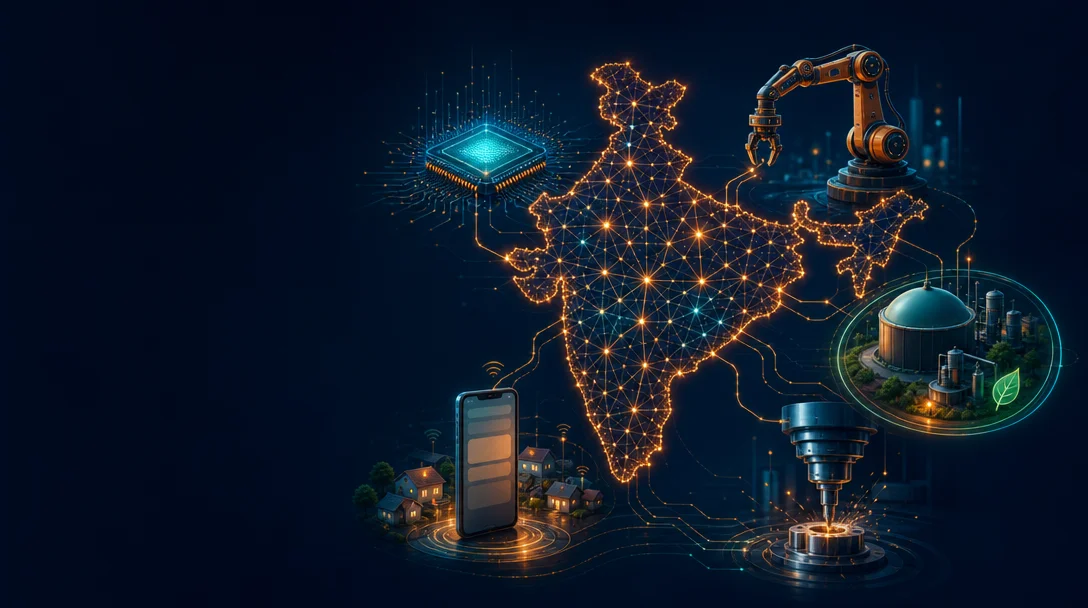
Five June growth signals show Indian startup momentum moving toward infrastructure: Sarvam in sovereign AI, Zetwerk in manufacturing, GPS Renewables in bioenergy, WeRize in Bharat fintech, and Ethereal Machines in precision manufacturing. The issue breaks down how each company makes money, what is driving growth, and which risks matter next.

The June batch says something different about Indian startup growth: the biggest signals are no longer concentrated in consumer apps. They are showing up in infrastructure-heavy companies that sell into governments, enterprises, industrial supply chains, energy buyers, or small-town distribution networks.
This issue uses recent June disclosures as the entry point, not as a ranked list. The five companies below were selected because each has a current, verifiable growth signal: new funding, a revenue milestone, an order book, scaled usage, or a capacity expansion.
| Startup | Sector | The growth signal | What is really being tested |
|---|---|---|---|
| Sarvam | Sovereign AI | $234 million first close of a planned $300 million Series B at a $1.5 billion post-money valuation, with HCLTech investing $150 million as lead strategic investor 1 | Whether India can turn local-language model research into enterprise and government deployments at scale |
| Zetwerk | B2B manufacturing | Estimated FY26 operating revenue of ₹15,900 crore, up from ₹12,800 crore, and an order book above ₹12,000 crore 2 | Whether a managed manufacturing network can grow without being crushed by low margins and working capital |
| GPS Renewables | Bioenergy and renewable natural gas | ₹635 crore in Series C-linked capital, annual revenue of roughly ₹1,000 crore, and more than 30 operational or near-completion facilities 3 | Whether compressed biogas can move from project-by-project execution to repeatable energy infrastructure |
| WeRize | Small-town fintech distribution | FY25 operating revenue rose 64% to ₹236 crore, while the company says it is running at a $65 million annualized gross revenue rate 4 | Whether assisted local distribution can beat pure digital acquisition in Bharat financial services |
| Ethereal Machines | Precision manufacturing | $28.5 million Series B, threefold MaaS revenue growth since Series A, and tenfold capacity expansion 5 | Whether Indian deep-tech manufacturing can sell precision, not just lower-cost labor |
The pattern: growth is moving closer to hard infrastructure
A simple consumer growth story usually starts with downloads, monthly users, and repeat behavior. This issue looks different. Sarvam is selling AI capability into high-trust sectors. Zetwerk coordinates factories and suppliers. GPS Renewables builds physical bioenergy assets. Ethereal Machines is trying to make precision components and CNC systems. WeRize is digital, but its distribution advantage depends on 19,000 trained local financial micro-entrepreneurs, not just app installs 4.
That shift matters for operators and investors. These companies do not grow only by lowering customer acquisition cost. They grow by creating capacity: compute access, supplier reliability, plant execution, local trust, or manufacturing accuracy. The upside can be more durable. The downside is also harder to hide, because capital intensity, delivery risk, and margins show up quickly.
Sarvam: sovereign AI with distribution attached
Sarvam is the most visible signal in this issue because the round is large and strategically shaped. The company announced a $234 million first close of its planned $300 million Series B at a $1.5 billion post-money valuation; HCLTech is investing $150 million, with Bessemer Venture Partners joining existing investors Khosla Ventures and Peak XV Partners 1. TechCrunch also reported the same $234 million round and noted that it follows Sarvam's earlier $41 million seed and Series A financing and the release of 30B and 105B open-source models earlier this year 6.
The business model is not just model-building. Sarvam describes itself as building across training and inference infrastructure, frontier model research, and go-to-market for enterprises, developers, and government 1. The commercial path is to convert Indian-language AI and voice/document capabilities into deployments where global general-purpose models may not fit local workflows, cost structures, or data controls.
The traction numbers are unusually concrete for an AI infrastructure company. Sarvam says its conversational platform handles more than 2 million interactions a day, its inference platform processes 10 million API calls daily, its speech models transcribe more than 500,000 hours of audio each month, and its document AI systems have digitized more than 35 million pages 1. It also says multilingual voice agents collected data from 17 million farmers for India's Ministry of Agriculture and Farmers Welfare, while a nationwide voice campaign supported policy renewals for 45 million insurance policyholders 1.
The moat is partly technical, but the more interesting part is institutional access. HCLTech gives Sarvam a route into enterprise transformation budgets and government-adjacent work, while Sarvam gives HCLTech a domestic full-stack AI partner 1. The risk is that sovereign AI is expensive before it is profitable. Compute, model iteration, enterprise delivery, and safety work can absorb capital quickly. Sarvam now has enough funding to be taken seriously; the next test is whether deployments become repeatable revenue, not just national-strategy proof points.
Zetwerk: a manufacturing network with IPO pressure
Zetwerk is already operating at a scale most Indian startups never reach. Moneycontrol reported that its FY26 operating revenue is estimated at ₹15,900 crore, up from ₹12,800 crore in FY25, based on a CRISIL rating rationale 2. ETStartup reported the same 24% FY26 revenue recovery and noted that the rebound followed an 11% revenue decline in the prior year after the company exited non-profitable segments and scaled down civil infrastructure operations 7.
The model is an orchestration layer for custom manufacturing. Customers provide designs; Zetwerk manages supplier selection, production, quality control, timelines, and logistics across sectors such as energy, precision manufacturing, capital goods, and trading 2. CRISIL-linked reporting says Zetwerk serves more than 1,000 customers through more than 5,000 vendors, with customers including NTPC Renewables Energy, Samsung India Electronics, National Aluminium Company, and ArcelorMittal Nippon Steel India 2.
The growth driver is visibility. Zetwerk's order book stood above ₹12,000 crore as of March 2026, expected to be executed over the next 12 to 18 months 2. That order book gives it a clearer forward revenue base than a demand-generation marketplace would have.
The risk is just as visible. CRISIL retained a negative outlook, citing possible losses from the civil EPC exit, operating margins around 2.6%, and working-capital-intensive operations 2. The company has also confidentially filed for an IPO and is looking to raise up to ₹4,200 crore, according to Moneycontrol 2. Public-market investors will not only ask whether revenue can grow. They will ask how much cash the model consumes to deliver that growth.
GPS Renewables: bioenergy moves into platform mode
GPS Renewables is included because its latest financing is tied to infrastructure expansion, not a generic balance-sheet round. SolarQuarter reported that the company secured ₹635 crore through a Series C funding package: ₹125 crore in equity led by PixelSky Capital, a ₹200 crore equity commitment under its GPSR Arya project development platform from a Korean conglomerate, and an earlier ₹310 crore asset-platform investment from Sojitz Corporation in partnership with Indian Oil Corporation 3.
The company is best understood as a full-stack bioenergy builder. SolarQuarter describes GPS Renewables as spanning technology, engineering, EPC services, software, operations and maintenance, and project development; the company employs more than 800 people and reports annual revenue of roughly ₹1,000 crore 3. The revenue mechanics come from designing and building compressed biogas and renewable natural gas infrastructure, operating or enabling assets, and expanding into sustainable aviation fuel-related EPC work.
The growth case is built on repeatability. GPS Renewables has more than 30 operational or near-completion facilities and is pursuing more than 200 compressed biogas projects with oil marketing companies 3. It has also established joint ventures with both Indian Oil Corporation and Bharat Petroleum Corporation Limited for compressed biogas infrastructure development, according to SolarQuarter 3.
The strategic edge is the combination of policy-aligned demand and execution know-how. India wants cleaner fuels, waste-to-energy solutions, and domestic energy security. GPS Renewables is not merely selling equipment into that demand; it is trying to become the project platform that can turn feedstock, EPC, software, O&M, and capital into repeatable plants.
The watch item is project execution. Bioenergy companies can look attractive on paper because the macro tailwinds are real. But feedstock aggregation, plant uptime, offtake agreements, and project finance decide the economics. GPS Renewables has stronger evidence than most companies in the category; the next question is whether it can industrialize the rollout across hundreds of facilities.
WeRize: a branchless fintech that still uses people
WeRize looks smaller than the infrastructure names above, but its growth signal is cleaner than many fintech stories. Entrackr reported that WeRize raised $7 million in a pre-Series C round led by Sony Innovation Fund, bringing total equity capital raised since inception above $28 million 4. The same report says operating revenue rose 64% to ₹236 crore in FY25 from ₹144 crore in FY24, while net profit doubled 4.
The model is a three-sided marketplace: small-town consumers, local financial micro-entrepreneurs, and partner banks, NBFCs, mutual funds, and insurers. WeRize says it connects more than 300 million underserved consumers, over 19,000 trained local financial micro-entrepreneurs, and financial product partners across more than 5,000 cities and towns in six Indian languages 4.
The AI angle is practical rather than decorative. Entrackr says WeRize's proprietary AI stack is trained on more than 20 billion data points from more than 4 million households, and the company uses it for lead generation, assisted selling, lifecycle engagement, underwriting, risk selection, and product structuring 4. That matters because mass-market financial products in smaller towns often require trust, explanation, and local context. A purely digital funnel may be cheaper, but it may not close the customer.
WeRize says it is running at a $65 million annualized gross revenue rate, with a $32 million net revenue run rate, a $15 million EBITDA run rate, and annualized pre-tax profit above $7 million 4. The risk is product mix. Credit, insurance, savings, mutual funds, secured co-branded cards, and housing loans have different compliance, margin, and risk profiles. The moat will hold only if WeRize's local-agent network and data layer improve product quality, not just distribution volume.
Ethereal Machines: precision manufacturing as a service
Ethereal Machines is earlier in revenue scale than the other companies here, but the direction is important. Entrackr reported that the Bengaluru deep-tech precision manufacturing startup raised $28.5 million in Series B funding led by Avataar Ventures, with Peak XV Partners and other backers participating 5. The company plans to use the funds to expand manufacturing infrastructure, develop an indigenous multi-axis CNC controller, strengthen its software stack, support semiconductor manufacturing initiatives, and accelerate expansion in the US and Europe 5.
The business model combines proprietary machines with Machining-as-a-Service. Ethereal designs and manufactures multi-axis CNC machines and produces precision components for sectors including aerospace, defence, healthcare, semiconductors, and consumer electronics 5. That pairing is the point: the company can sell capability through parts and services while developing machine IP and factory software.
The recent metrics show ambition, but also the early-stage gap. Ethereal says MaaS revenue has grown threefold year-on-year since its Series A round and production capacity has expanded tenfold 5. It operates a smart manufacturing facility in Peenya, Bengaluru, and has signed an MoU with the Karnataka government for a 300,000-square-foot manufacturing facility expected to create more than 2,000 jobs 5.
The financial base is still small. Entrackr reported operating revenue of ₹11.45 crore in FY25 and a loss of ₹27.27 crore as the company invested in capacity and technology development 5. That is not a disqualifier for deep tech, but it changes the question. Ethereal should be judged less like a software scale-up and more like a manufacturing capability bet: can it turn accuracy, automation, and software into repeatable orders from high-spec customers?
What to take from this issue
The common thread is not sector. It is control over scarce execution capacity.
Sarvam is trying to control local AI capability and enterprise deployment. Zetwerk controls supply orchestration across a fragmented manufacturing base. GPS Renewables controls project execution in a policy-backed clean-fuels category. WeRize controls assisted financial distribution in markets where trust is hard to digitize. Ethereal Machines controls precision production capacity at a time when supply chains are diversifying beyond China.
That is a healthier growth pattern than pure user acquisition. It is also less forgiving. These companies can build defensible positions, but only if they prove that infrastructure-heavy growth can compound without turning every new customer, plant, factory, or deployment into a fresh execution bottleneck.
참고 출처
- 1Sarvam raises $300M Series B
- 2Zetwerk's FY26 revenue rises to Rs 15,900 crore; order book crosses Rs 12,000 crore
- 3GPS Renewables Bags ₹635 Crore Series C Investment to Expand Renewable Natural Gas and SAF Portfolio
- 4Sony Innovation Fund leads $7 Mn round in fintech startup WeRize
- 5Ethereal Machines raises $28.5 Mn in Series B round led by Avataar Ventures
- 6Sarvam becomes India's newest AI unicorn with $234 million funding round led by HCLTech
- 7Zetwerk's revenue projected to rebound 24% to Rs 15,900 crore in FY26
이 콘텐츠를 둘러싼 관점이나 맥락을 계속 보강해 보세요.