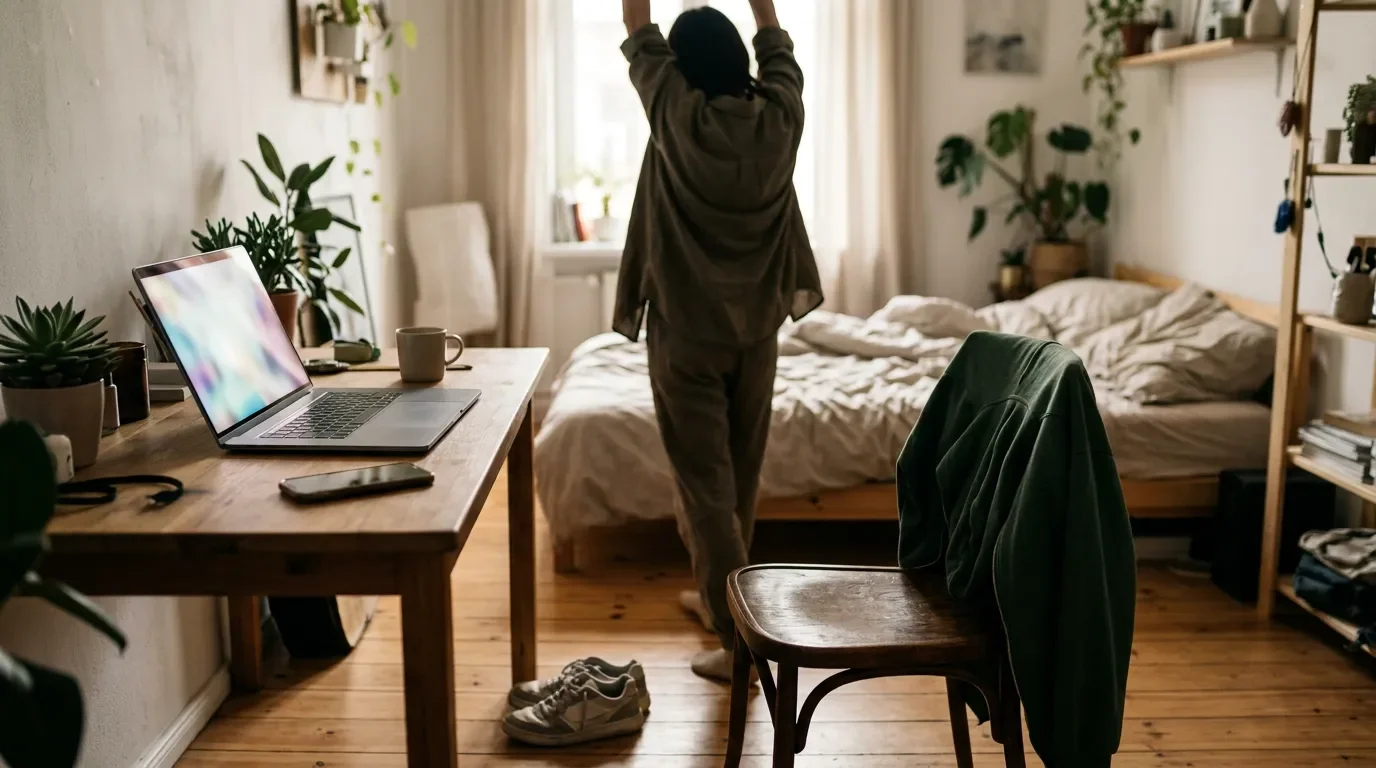
Your chair is not neutral. Here's the movement-snack plan.
A practical guide to breaking up long sitting days with tiny movement breaks: what counts, how often to do it, how screen breaks fit in, and when stiffness or exercise symptoms deserve real attention.
If your day quietly turns into bed, chair, couch, repeat, your body does notice. Not in a dramatic "you ruined your health" way. More like: your hips feel stuck, your back starts negotiating with you, your brain feels foggy at 3 p.m., and somehow the short walk to the kitchen feels like a quest.
The fix is not becoming a gym person overnight. It is breaking the spell of uninterrupted sitting.
The problem is the uninterrupted part
Sedentary behavior means low-energy awake time spent sitting, reclining, or lying down. WHO links higher amounts of sedentary behavior with worse health outcomes, including higher risk of cardiovascular disease, type 2 diabetes, some cancers, and early death. 1
That does not mean one lazy day is a medical emergency. It means the body is built for regular position changes, muscle contractions, and light movement. When your legs stay parked for hours, you miss those small signals that help with blood flow, glucose handling, stiffness, and alertness.
The official weekly target is still real: adults should aim for at least 150 minutes of moderate-intensity activity a week, or 75 minutes of vigorous activity, plus muscle-strengthening work on 2 days. 2 But the CDC also says some activity is better than none, and adults who sit less gain health benefits even from smaller amounts of movement. 2
So do not treat a 45-minute workout as permission to stay frozen for the other 15 waking hours. Think of movement as two jobs: your workout is one job, and breaking up long sitting is the other.
What a "movement snack" actually is
A movement snack is a short burst of activity dropped into your day. The research term is usually "exercise snacks": brief, repeatable bouts of movement spread across multiple points in the day, often lasting from a few seconds to a few minutes. 3
A 2026 review found that exercise snacks may improve sedentary patterns and can help some people increase activity levels, especially when the movement is easy to fit into real life. The same review is careful about the limits: evidence is still mixed for outcomes like body composition and longer-term clinical results. 3
A 2025 systematic review of 26 studies found benefits across areas like post-meal glucose response, blood pressure, strength, cardiorespiratory fitness, mood, fatigue, and cognitive performance, but the studies used different movement types and doses. 4 Translation: movement snacks are promising and low-friction, but they are not magic. They work best as a simple way to make your day less motionless.
The 30-2 reset
Start with this: after about 30 to 60 minutes of sitting, move for 2 minutes.
You do not need sweat, a mat, or a watch that congratulates you. You need to get your muscles doing something different. Pick one:
- Walk to refill water.
- Do 10 slow squats to a chair.
- Walk up and down one flight of stairs.
- Do 20 calf raises while your coffee heats.
- Stand up and reach overhead, then rotate your upper back a few times.
- Pace while listening to one voice memo or one song.
If 30 minutes feels annoying, use natural triggers instead: after a class, after a meeting, after a game, after a chapter, before lunch, after brushing your teeth, when your laundry timer goes off. The best cue is the one you will actually obey.
Build the day like this
| Situation | Do this | Why it works |
|---|---|---|
| You have been at a laptop for an hour | 2 minutes of walking, stairs, squats, or calf raises | It breaks the long sitting block without turning your day into a workout production. |
| You just ate | Take a 5 to 10 minute easy walk if you can | Short activity breaks have shown benefits for post-meal glucose and insulin responses in some studies. 3 |
| Your eyes feel fried | Look 20 feet away for 20 seconds every 20 minutes | The American Optometric Association recommends the 20-20-20 rule for digital eye strain. 5 |
| You are too tired for exercise | Do one low-effort snack: walk outside, stretch, or do sit-to-stands | MedlinePlus says even small chunks of exercise can help, and starting slowly is fine. 6 |
| You keep forgetting | Pair movement with something you already do | Habit beats motivation here. Phone alarm if you like it; environmental cue if alarms make you want to throw the phone. |
This is the part people overcomplicate. The move does not have to be optimized. It just has to happen often enough to stop your day from becoming one long sit.
What counts, without making it weird
Good movement snacks are boring on purpose.
A useful snack should be quick, repeatable, and safe in normal clothes. It should not require changing outfits, psyching yourself up, or apologizing to everyone nearby. If you are in a dorm, library, office, or shared apartment, pick quiet options: calf raises, wall pushups, marching in place, standing hip hinges, shoulder rolls, or a walk to the bathroom that takes the long route.
Do not make every break intense. If every snack is burpees, you will quit by Thursday. Save harder bursts for moments when they make sense, like stairs between classes or a short bodyweight circuit before a shower.
Also: standing still is not the same as moving. A standing desk can help you change position, but your legs still need actual contractions. Shift, walk, raise your heels, squat to the chair, or take the call while moving around.
When stiffness is not just "desk body"
Most sitting-related stiffness improves when you change positions, move gently, sleep, hydrate, and stop pretending your neck is a phone stand. But some symptoms deserve more attention.
Stop the activity and get help right away if exercise brings on chest pain, extreme shortness of breath, dizziness, or a feeling that something is seriously wrong. MedlinePlus also says chest pain during or after exercise is a reason to seek emergency care. 7
For non-emergency stuff, book care if pain keeps coming back, a joint swells, numbness or weakness shows up, or a headache or vision issue does not settle after screen breaks. If you have a heart condition, recent surgery, major injury, fainting history, or trouble with balance, ask a clinician what level of activity is safe before ramping things up. 6
The lazy version still works
If this all sounds like one more wellness chore, use the minimum plan:
- Move for 2 minutes after your first long sit of the day.
- Take one short walk after one meal.
- Do one screen break where your eyes look far away.
- Repeat tomorrow.
That is not a full fitness program. It is a pressure release valve for a screen-heavy life. Your chair can be part of your day, but it should not be the place your body spends the whole plot.
관련 콘텐츠
- 로그인하면 댓글을 작성할 수 있습니다.
More from this channel
- Your allergy pill can still make you sleepy. Here's the antihistamine plan.
- Your Q-tip is not an ear-cleaning tool. Here's the earwax plan.
- Your back-seat nausea is not random. Here's the motion-sickness plan.
- Your sore throat is not automatically strep. Here's the throat-check plan.
- Your period app is not the backup plan. Here's what to do after a condom break.
- Your nicotine pouch is not a harmless mint. Here's the ZYN-label reality check.
- Your burning pee is not a cranberry-juice problem. Here's the UTI plan.
- Your road-trip playlist cannot fix drowsy driving. Here's the stay-awake plan.