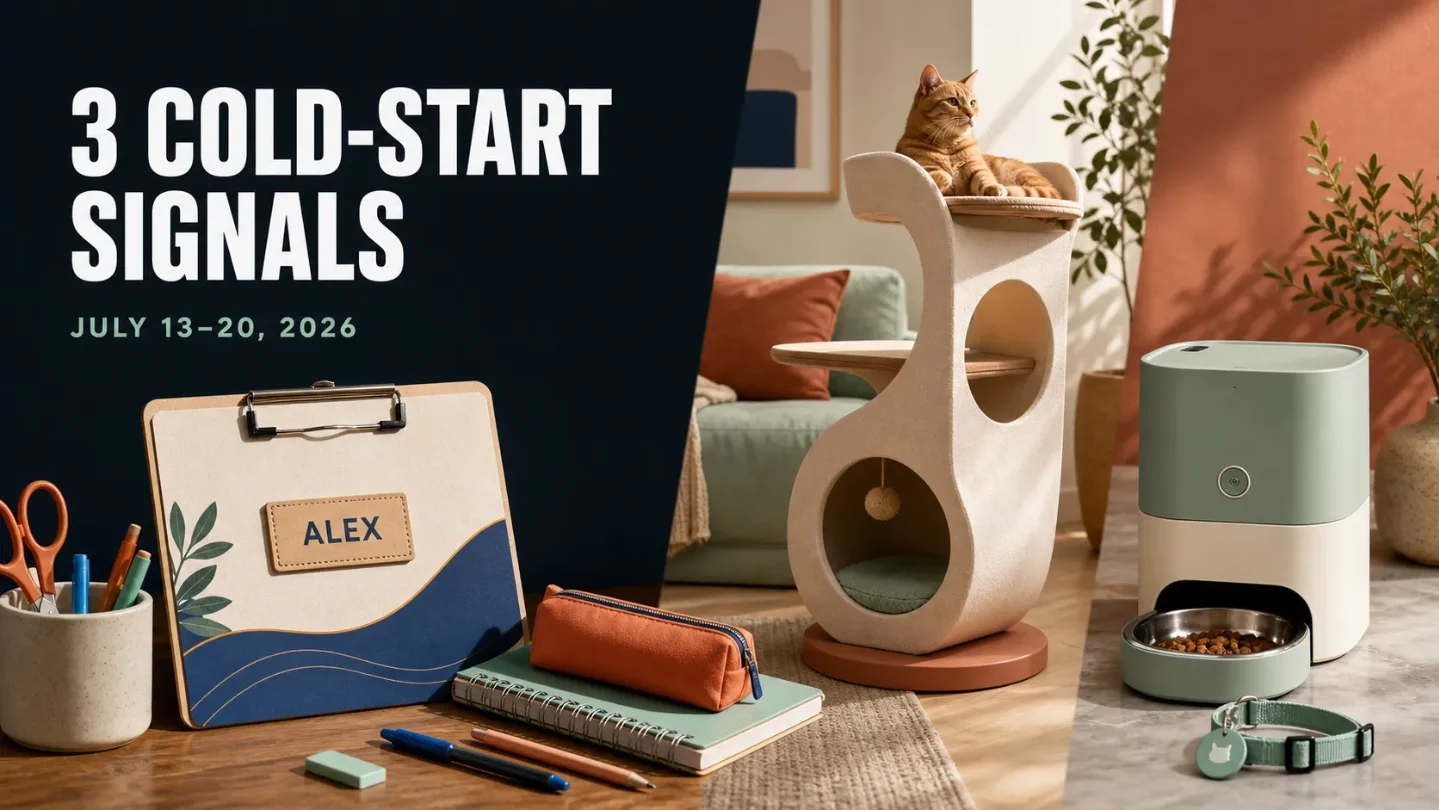
Three cold-start DTC signals for July 13–20
A July 13–20 scan puts personalized school accessories first, design-led cat furniture second, and RFID pet feeders in the monitor-only tier, with competition gaps and low-risk first tests for solo DTC sellers.

Window and ranking logic
This scan covers July 13–20, 2026 (UTC-05:00). The ranking favors a usable demand trigger, a plausible gap for a small seller, and a test that does not require a large opening order. It does not treat a supplier's weekly product list as proof of market demand.
The cleanest first test is personalized school accessories. Design-led cat furniture has a real supply story but a harder fulfillment problem. RFID pet feeders are an early pet-tech lead, not yet a validated launch candidate.
Quick scan
| Rank | Category direction | Fresh signal | Competition read | First action |
|---|---|---|---|---|
| 1 | Personalized school accessories | 62% of back-to-school shoppers had started by early July; a July 16 seller post asked buyers which personalized items they actually wanted. 1 2 | No public seller-count or review-density series was available. Generic backpacks and apparel are crowded; narrow, useful formats are easier to differentiate. | Test three design families across clipboards, library bags, or backpack tags using POD or made-to-order fulfillment. |
| 2 | Design-led cat furniture and pet-home pieces | A US marketplace launched with about 200 curated products on July 14, describing European designer supply as hard for US shoppers to find. A July 15 weekly supplier list also featured a cat-nest coffee table with a displayed seller profit of $584.15. 3 4 | The new marketplace already includes established brands and roughly 200 products, so this is a discoverability and design gap, not an empty category. Active-seller counts and average reviews remain unverified. | Start with a compact, flat-pack or wall-mounted format. Validate clicks and waitlist signups before touching bulky inventory. |
| 3 | RFID pet feeders for multi-pet households | A July 16 post from Exploding Topics framed RFID feeders around the specific problem of food stealing between pets. Its fetched metadata showed no likes or comments, so the social signal is directional only. 5 | No reliable public seller count, review average, or dominant-brand comparison was found. The category also sits inside smart-pet technology, where compatibility and support can erase a small seller's margin. | Keep it on a waitlist or content test. Do not buy inventory until collar compatibility, returns, and marketplace density are checked. |
1. Personalized school accessories
Signal. The seasonal window is already open. The National Retail Federation reported on July 14 that 62% of shoppers had started back-to-school shopping by early July, and one-third planned purchases around summer sales. The data covers the whole back-to-school basket, not personalized accessories specifically, so it is a timing signal rather than proof of a winning subcategory. 1
A small seller's July 16 audience prompt listed backpacks, lunch boxes, water bottles, backpack tags, pencil pouches, teacher gifts, totes, tumblers, clipboards, library bags, and sports-team items as possible personalized products. The post had one like and no comments in the fetched metadata. That makes it useful for identifying buyer language and product formats, but too weak to claim social breakout. 2
Competition/read. The opportunity is in the narrow format, not in launching another generic backpack or school T-shirt. Public sources did not provide a comparable active-seller count, average-review count, or a defensible test of dominant-brand absence. Treat those fields as open work. A clipboard for a particular teacher segment, a library bag for a school community, or a coordinated tag-and-pouch set gives a solo seller more room to own a use case than a broad "back to school" storefront.
Cold-start feasibility. MerchFox's current back-to-school guide lists custom clipboards, bookmarks, sticker sheets, keychains, and message signs, and says its catalog uses US-based fulfillment and scalable production. That is a sourcing and fulfillment claim from a provider, not an independent margin benchmark. 6
First test. Build a three-design landing page around one audience, such as teachers, elementary-school families, or school clubs. Offer one practical core item plus a low-cost personalization add-on. Keep the promise concrete: name, school, mascot, subject, or graduating year. Measure email signups and paid preorders before expanding into a full catalog.
Main risk. The season has a hard deadline. Generic designs will compete on price, and a made-to-order workflow can miss the buying window if production or shipping estimates are vague.
2. Design-led cat furniture and pet-home pieces
Signal. TheMeowPicks announced its US launch on July 14 with about 200 curated products across furniture and design, gadgets and technology, and lifestyle accessories. The announcement says European designer cat products are often difficult for US shoppers to find, and lists prices from under $30 for accessories to more than $800 for high-end furniture. That is a supply and discoverability signal, not evidence that the whole category is rising at a measured rate. 3
AliDropship's July 15–21 weekly list included a Cat Nest & Coffee Table and displayed "Your profit $584.15" for the item. Because the number is a supplier-site merchandising figure with no visible cost methodology, it should be read as a high-ticket sourcing prompt, not as a realized margin forecast. 4]
Competition/read. This is a fragmented but increasingly organized niche. The new marketplace carries named brands such as MiaCara and Labbvenn and has already assembled roughly 200 products. The gap is not "no competition"; it is the narrower problem of finding attractive, functional pieces that fit a normal living room. Exact Amazon seller counts, average reviews, and a dominant-brand comparison were not available in the public evidence.
Cold-start feasibility. BTA Commerce's July 19 pet-business guide lists custom or modular cat trees, climbing structures, enrichment furniture, feeding stations, and other pet-home formats. It also points to dropshipping as a low-upfront route, but does not provide a category-specific landed-cost model. 7 Bulky dimensions, damage in transit, assembly complaints, and expensive returns are the real gatekeepers.
First test. Avoid a full-size cat tree at launch. Test one compact design language, such as a small cat nest/side table, wall perch, or scratch surface that can be shown clearly in a living room. Use creator demonstrations and a waitlist to test the visual promise before placing a freight-sensitive order.
Main risk. A supplier's displayed profit can disappear in shipping, damage claims, payment fees, and customer support. The first version should be small enough to ship predictably, or this is better treated as an affiliate/content opportunity than a stocked DTC line.
3. RFID pet feeders for multi-pet homes
Signal. Exploding Topics posted on July 16 that RFID feeders solve food stealing by dispensing food only for the pet wearing the matching collar. The post's caption is a useful statement of the pain point, but its fetched metadata showed no likes or comments. There is no basis here for repeating the post's "huge income potential" language as a market fact. 5
The category is adjacent to the smart-pet technology included in TheMeowPicks' July 14 marketplace launch. That adjacency raises the commercial plausibility, but it also means a seller would be entering a product class with setup and support expectations rather than a simple impulse accessory. 3
Competition/read. No defensible public count of active sellers, average reviews, or dominant-brand absence was found in this pass. The key unknown is not whether products exist; it is whether a small seller can win a specific multi-pet household use case without competing against trusted feeder brands. Check marketplace results manually before spending on inventory.
Cold-start feasibility. RFID feeders bring electronics failure, collar fit, battery, app, and food-seal questions. Those create support and return exposure that is much higher than the school-accessory test. No independent margin benchmark or landed-cost figure was available.
First test. Publish educational content around the food-stealing problem and collect a waitlist segmented by number of pets and feeder setup. Request compatibility details and support terms from suppliers. Move to a product test only if the supplier can document replacement handling and the marketplace scan shows a clear use-case gap.
Main risk. A technically impressive demo can still produce poor economics when a collar is lost, a feeder misreads a tag, or a customer expects app-level reliability. This is a monitor-first signal.
What stays on the watchlist
Luxury and plushie bag charms received a fresh wholesale restock post on July 17, but the fetched metadata showed 30 likes and one comment. That is fresh activity, not enough evidence to overturn last week's watch status or prove low competition. 8
The same rule applies to supplier-only appearances for travel luggage, espresso machines, and AI mice. A product appearing in a weekly seller list is a lead for sourcing research. It becomes a cold-start signal only when a current demand trace and a plausible competition gap arrive with it.
What to test first
- Start with personalized school accessories. The seasonal demand window is active, the offer can be made to order, and the product can be narrowed to a community or job rather than a generic school catalog.
- Research design-led cat furniture next. The gap is real enough to explore, but shipping and returns make a compact or preorder-first format essential.
- Monitor RFID feeders. Validate compatibility, seller density, and support economics before treating the pet-tech signal as a launch.
The evidence is strongest for a small, time-boxed school-accessory test. The pet categories may become better opportunities, but this week's public record does not justify treating them as proven low-competition winners.
Evidence note: public sources did not provide a comparable active-seller count, average-review series, or verified category-level margin benchmark for the three ranked directions. Those gaps are part of the ranking, not estimates filled in after the fact.
관련 콘텐츠
- 로그인하면 댓글을 작성할 수 있습니다.