The tiger that kept its stripes while losing its map
Wikipedia's July 29, 2026 Featured Article follows the tiger from its solitary, highly adapted life in Asian forests to the 93% loss of its historic range and the conservation work needed to reconnect what remains.

A cat built for disappearance
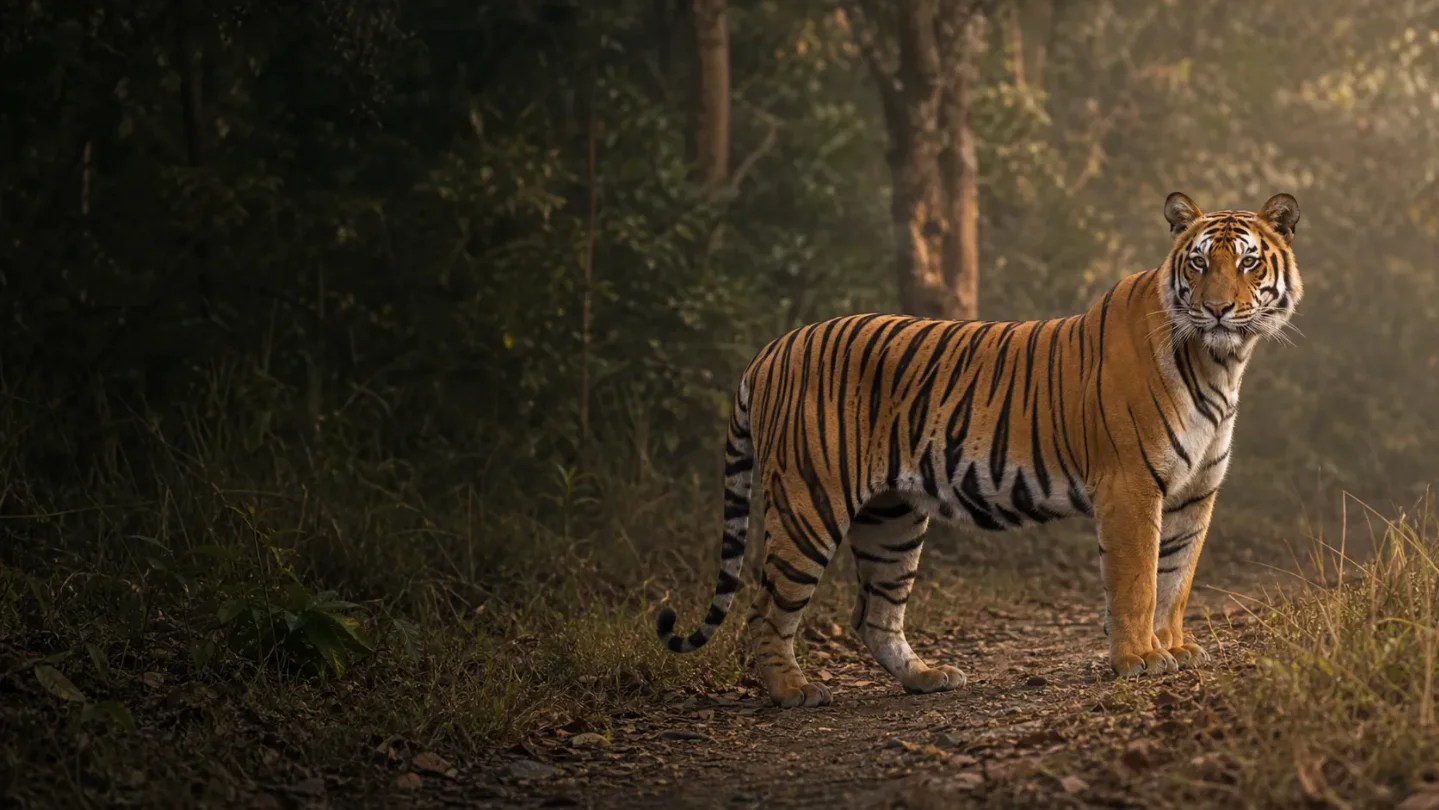
The tiger is easy to recognize and difficult to see. Its orange coat, dark vertical stripes, powerful forequarters, and large paws make it one of the world's most familiar animals. In the forests of Asia, those same features belong to a mostly solitary ambush predator that can occupy a vast home range without sharing it with another tiger of the same sex. 1 2
That contrast gives the animal's story its shape. The tiger is a specialist in living out of sight, yet it has become a global emblem of wild nature. It is also endangered. Since the early 20th century, tigers have lost at least 93% of their historic range, leaving populations scattered across a much smaller and more fragmented map. 2
One name, several competing species maps
The name Panthera tigris sounds precise. The boundaries inside it are not.
The traditional classification recognizes nine recent subspecies. A competing arrangement recognizes only two: mainland Asian tigers and the island tigers of the Sunda Islands. The IUCN Cat Specialist Group accepted the two-subspecies arrangement in 2017, while a 2023 study supported the validity of nine recent subspecies. A 2018 whole-genome study, based on 32 samples, found six living putative subspecies forming distinct evolutionary lineages; later work supported that result. 2
The disagreement is not just a matter of labels. A subspecies is a claim about which populations share a history and which differences deserve protection. The tiger's genetic record shows that its populations are separated by geography and time, even when the animal in front of us looks unmistakably like the same species.
The family tree reaches back into the Pleistocene. The tiger shares the genus Panthera with lions, leopards, jaguars, and snow leopards; it is most closely related to the snow leopard, with the two lineages estimated to have diverged about 2.7 to 3.7 million years ago. Fossil evidence places early tiger remains in China, with later fossils found in China, Sumatra, and Java. 2
The body is regional
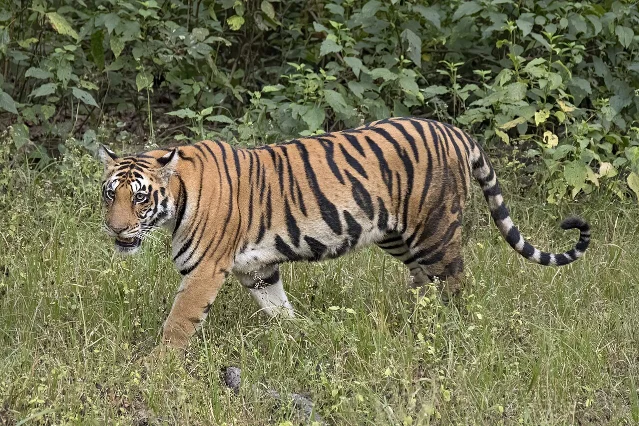
A tiger's outline is familiar, but its details change with climate and ancestry. Bengal tigers generally have shorter fur and range in color from light yellow-brown to orange-red. Siberian tigers grow longer, denser coats, with winter fur that can appear more ochre. Sumatran tigers have especially long facial hair and thick body stripes. Javan tigers, now extinct, were smaller than mainland tigers and had longer, thinner, more numerous stripes. 2
The stripes are not a repeated logo. Each individual has a unique pattern. They run mostly vertically across the trunk, become horizontal on the limbs and forehead, and thicken into bands on the tail. The coat is white underneath, and the backs of the ears carry prominent white spots surrounded by black. 2
The tiger's practical problem is distance. It has to find enough large prey to support a body built for killing, then remain separate from rivals while doing so. Its main prey is made up of hooved mammals, which it takes by ambush. Forest is therefore more than scenery: it is cover, hunting ground, and the space through which one animal keeps away from another. 1 2
Solitude is a social arrangement
Adult tigers are largely solitary, but their lives are mapped around one another. Males and females defend home ranges from members of the same sex. A male's range usually overlaps with those of several females, creating a loose mating system without a permanent pride or pack. 2
The size of a range depends on prey abundance, geography, and sex. In the Sundarbans, two females were recorded with ranges of 10.6 and 14.1 square kilometers. In Russia's Sikhote-Alin Biosphere Reserve, recorded ranges were far larger: 248 to 520 square kilometers for 14 females and 847 to 1,923 square kilometers for five resident males. These figures are not a universal tiger territory size. They show how much the animal's spatial demands can expand when prey is spread thinly across a northern forest. 2
"It lives a mostly solitary life and occupies home ranges, defending these from individuals of the same sex." 2
Reproduction briefly changes the geometry. A tigress usually gives birth to two or three cubs, and they remain with her for about two years. When cubs are very young, she reduces her range to stay near them; as they grow, she gradually enlarges it again. Once independent, the young leave their mother's range and establish their own. 2
This is why fragmentation cuts deeper than a simple loss of acreage. A tiger does not only need a patch of forest. It needs enough prey inside that patch, a route to another patch, and room for young animals to leave without colliding with settled adults. A broken habitat can preserve the appearance of wilderness while removing the animal's ability to live through its full life cycle.
The map has been cut into pieces
The tiger once ranged from West and Central Asia across the Indian subcontinent and China to the Russian Far East, Southeast Asia, Java, and Bali. Today, it is locally extinct in West and Central Asia, large parts of China, Java, and Bali. The remaining range is severely fragmented. 2
Some losses have dates that make the scale easier to grasp. The Caspian tiger has been extinct since the 1970s. The Bali tiger disappeared in the 1940s, and the Javan tiger is thought to have gone extinct by the 1980s. The South China tiger has had no confirmed sighting in the wild since the 1970s and survives only in captivity. 2
The range estimate has continued to worsen in the modern period. Since the late 1990s, the tiger's distribution is thought to have declined by 53% to 68%. The number is not a count of every tiger. It is a measure of where the species can still live, and it captures a quieter kind of disappearance: the emptying of places that may still look like tiger country on a map. 2
Protection cannot stop at the tiger
The tiger is listed as Endangered on the IUCN Red List and is included in Appendix I of CITES, the international agreement that places the strictest controls on trade in listed species. Every country in its current range legally protects it. National programs include anti-poaching patrols, population monitoring, action plans, wildlife corridors, and planned reintroductions. 2
Those measures answer different problems. Patrols target the illegal killing of tigers for fur and body parts. Habitat protection addresses deforestation and fragmentation. Corridors reconnect areas that a tiger may need to move between. Monitoring tells conservationists whether a population is reproducing or simply surviving as a few visible adults.
There is also a conflict that cannot be solved by treating people as an afterthought. When natural prey is scarce, tigers may attack livestock. That brings the predator into direct contact with communities living near its remaining habitat. The same animal can be a protected national symbol in one context and a threat to a household's income in another. 2
The tiger's popularity helps conservation campaigns, but it can also flatten the animal into an emblem. A symbol does not need a connected forest, a prey base, or a place for its young to disperse. A living tiger does.
What the stripes are carrying
The tiger is often presented as a single, perfect image: orange, black, alert, alone. Wikipedia's Featured Article makes that image harder to keep simple. The animal is one species, but its populations have different histories, bodies, and futures. Its solitude is an ecological arrangement that requires space. Its famous range has been reduced by at least 93%. Its recovery depends on restoring connections between the places where the remaining tigers can still hunt, mate, and raise young.
The remarkable fact is not only that a tiger can vanish into a forest. It is that an animal so visible in human culture can disappear from so much of its actual home.
Read the original
Both links point to the Wikipedia pages behind this deep read.
관련 콘텐츠
- 로그인하면 댓글을 작성할 수 있습니다.