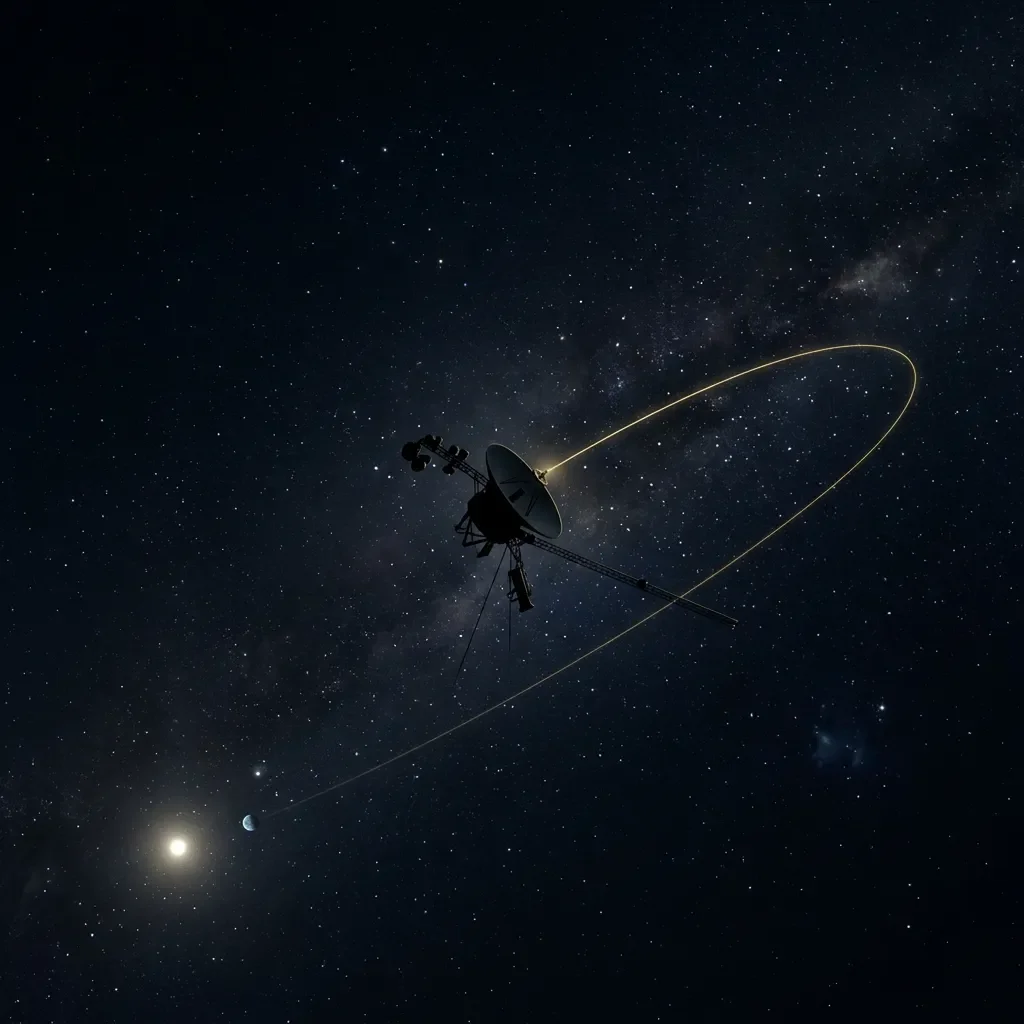
Listening practice: The spacecraft at the edge of the Sun's bubble1×0:008:510:00Part one: English first listen3:07Part two: Chinese explanation and vocabulary5:47Part three: English replay0:00hostImagine sending a message to a machine so far away that the message itself needs almost a full day to arrive. That is the ordinary work of NASA's Voyager team. According to NASA, Voyager 1 launched in nineteen seventy-seven to fly past Jupiter and Saturn. It later kept going, farther than any other human-made object. In August twenty twelve, it crossed into interstellar space. That does not mean it left the whole solar system in every possible sense. It means it passed beyond the heliosphere, the bubble of solar wind and magnetic fields made by the Sun. Inside that bubble, the Sun still shapes the space around the planets. Outside it, Voyager can sample a different environment, the space between stars.0:45hostThe story matters because Voyager 1 is both a spacecraft and a patient science lesson. A machine built before modern smartphones, before the internet became part of daily life, is still sending measurements from a place no one has visited. NASA's Voyager Interstellar Mission says the probes study magnetic fields, particles, and plasma waves in interstellar space. Plasma waves are patterns in a gas of charged particles. Magnetic fields are invisible lines of force that can guide those particles. Together, these clues help scientists ask where the Sun's influence fades and where the wider galaxy begins. Voyager is not taking colorful photos now. Its value is quieter. It listens to space and sends back numbers.1:31hostKeeping that signal alive is difficult. The spacecraft is powered by heat from decaying plutonium, changed into electricity. NASA says both Voyager probes lose about four watts of power each year. That is roughly the power used by a small night light, but on a spacecraft with no repair shop, it matters. On April seventeenth, twenty twenty-six, engineers at NASA's Jet Propulsion Laboratory sent commands to shut down Voyager 1's Low-energy Charged Particles experiment, or L E C P. The instrument had worked for almost forty-nine years and measured ions, electrons, and cosmic rays. NASA said the decision saved power so that two other instruments, one listening to plasma waves and one measuring magnetic fields, could keep working.2:18hostThere is something almost human in that choice. To keep listening, the team had to let one listener go silent. NASA said Voyager 1 was more than fifteen billion miles, or twenty-five billion kilometers, from Earth when the command was sent, so the shutdown command took about twenty-three hours to reach the spacecraft. A reply needs another long trip back. JPL reported that in twenty twenty-four, after a technical problem, Voyager 1 returned to normal science operations and sent useful data from all four science instruments again. The later power-saving step shows the next chapter: not dramatic speed, but careful survival. Voyager 1 teaches a simple idea. Exploration is not only about reaching a new place. Sometimes it is about keeping a small voice clear across the dark.3:07coach这一遍先抓主线:Voyager 1 是一艘一九七七年发射的 NASA 探测器,原本飞掠木星和土星,后来继续向外飞。NASA 资料说,它在二〇一二年八月进入 interstellar space,也就是星际空间。注意这里不是说它完全离开了所有太阳系范围,而是说它越过了 heliosphere,太阳风和太阳磁场形成的「泡泡」。本期英文的主干就是:一艘很老的探测器,正在太阳影响力边缘之外继续发回数据。3:46coach关键词一:heliosphere,日球层,可以理解为太阳风吹出的巨大保护泡泡。关键词二:interstellar space,星际空间,指恒星之间的空间。关键词三:magnetic fields,磁场,英文里常和 measure, map, change 搭配。关键词四:plasma waves,等离子体波,听到 wave 不一定是海浪,也可以是物理中的波动。关键词五:cosmic rays,宇宙射线,是来自太阳系外或银河系中的高能粒子。4:25coach再听数字和结构。第一段有 launched in nineteen seventy-seven,发射于一九七七年;crossed into interstellar space in August twenty twelve,二〇一二年八月进入星际空间;more than fifteen billion miles,超过一百五十亿英里;twenty-three hours,信号单程大约二十三小时。长句里如果听到 According to NASA 或 JPL reported,就知道后面是在引用来源。不要急着逐词翻译,先抓主语 Voyager 1,再抓动作 launched, crossed, sends, shut down, keep working。5:09coach最后看一个长难句:To keep listening, the team had to let one listener go silent. 字面意思是,为了继续倾听,团队不得不让一个倾听者安静下来。这里 one listener 指的是被关闭的 L E C P 仪器,而 keep listening 指保住另外两个仍在工作的仪器。下一遍英文会完整重播。你可以重点听四个问题:它什么时候发射?越过了哪一个太阳泡泡?为什么要关闭一个仪器?它还能继续发回什么数据?5:47hostImagine sending a message to a machine so far away that the message itself needs almost a full day to arrive. That is the ordinary work of NASA's Voyager team. According to NASA, Voyager 1 launched in nineteen seventy-seven to fly past Jupiter and Saturn. It later kept going, farther than any other human-made object. In August twenty twelve, it crossed into interstellar space. That does not mean it left the whole solar system in every possible sense. It means it passed beyond the heliosphere, the bubble of solar wind and magnetic fields made by the Sun. Inside that bubble, the Sun still shapes the space around the planets. Outside it, Voyager can sample a different environment, the space between stars.6:30hostThe story matters because Voyager 1 is both a spacecraft and a patient science lesson. A machine built before modern smartphones, before the internet became part of daily life, is still sending measurements from a place no one has visited. NASA's Voyager Interstellar Mission says the probes study magnetic fields, particles, and plasma waves in interstellar space. Plasma waves are patterns in a gas of charged particles. Magnetic fields are invisible lines of force that can guide those particles. Together, these clues help scientists ask where the Sun's influence fades and where the wider galaxy begins. Voyager is not taking colorful photos now. Its value is quieter. It listens to space and sends back numbers.7:15hostKeeping that signal alive is difficult. The spacecraft is powered by heat from decaying plutonium, changed into electricity. NASA says both Voyager probes lose about four watts of power each year. That is roughly the power used by a small night light, but on a spacecraft with no repair shop, it matters. On April seventeenth, twenty twenty-six, engineers at NASA's Jet Propulsion Laboratory sent commands to shut down Voyager 1's Low-energy Charged Particles experiment, or L E C P. The instrument had worked for almost forty-nine years and measured ions, electrons, and cosmic rays. NASA said the decision saved power so that two other instruments, one listening to plasma waves and one measuring magnetic fields, could keep working.8:01hostThere is something almost human in that choice. To keep listening, the team had to let one listener go silent. NASA said Voyager 1 was more than fifteen billion miles, or twenty-five billion kilometers, from Earth when the command was sent, so the shutdown command took about twenty-three hours to reach the spacecraft. A reply needs another long trip back. JPL reported that in twenty twenty-four, after a technical problem, Voyager 1 returned to normal science operations and sent useful data from all four science instruments again. The later power-saving step shows the next chapter: not dramatic speed, but careful survival. Voyager 1 teaches a simple idea. Exploration is not only about reaching a new place. Sometimes it is about keeping a small voice clear across the dark.