Weekly AI Tools Radar — Issue #1: Agentic Infrastructure, Voice AI, Long-Form Video & Agent Governance
This week's freshly shipped AI tools cluster into five themes: agentic API integration infrastructure (Nango, Activepieces), open-source voice agent platforms (Dograh, FunASR), long-form AI video generation (ViMax), agent memory (Honcho, AutoResearchClaw), and agent governance (Microsoft AGT). Per tool: description, pricing, core differentiator, and a try-it verdict.

리서치 브리프
Weekly AI Tools Radar — Issue #1 (May 19–27, 2026)
Theme 1 — Agentic Integration Infrastructure
Nango — Build Product Integrations with AI
- Pricing: Free tier available; paid plans for production scale (see nango.dev/pricing)
- What makes it different: Agent-first from the start — integrations are exposed as MCP tools out of the box, not bolted on. Sub-100ms function scheduling even under load. Used by Replit, Vapi, Motion.
- Try it? Yes if you're building an agent that needs to touch more than two external services. The MCP-native exposure means your coding agent (Cursor, Claude Code, Codex) can generate and call integrations without ever leaving its IDE context.
Activepieces — AI-First Automation for Every Team
- Pricing: Fixed monthly cost per plan — $0 per execution, pay the same whether you run 1,000 or 10 million workflows. Generous free tier; self-host is free forever under Apache 2.0.
- What makes it different: The per-execution pricing model of legacy automation tools breaks under AI agent workloads (agents retry constantly). Activepieces charges a flat fee. Also uniquely ships an "AI adoption" dashboard — active flows, hours saved, adoption rate — targeted at IT leads making the case to leadership.
- Try it? Strong yes for teams running or piloting AI agents in the enterprise. If you're already paying Zapier per task, the math almost certainly favors a switch.
Theme 2 — Open-Source Voice AI Platforms
Dograh — The Open-Source Vapi / Retell Alternative
- Pricing: Self-host free (BSD 2-Clause); managed cloud available; private VPC deployment on request.
- What makes it different: Three things: (1) Full data sovereignty — your audio never touches Dograh's servers; built for fintech, healthtech, and regulated industries. (2) A hybrid human/TTS voice mode that routes pre-recorded clips through a cloned voice, cutting latency and cost by up to 3× while sounding more natural. (3) An MCP server ships with the platform — Claude Code, Cursor, Codex can create and modify full voice agent workflows via natural-language prompts without leaving the IDE.
- Try it? Yes if you're building voice AI for a regulated vertical, or if you want to self-host to avoid Vapi's pricing at scale. The MCP-driven workflow builder is genuinely novel.
FunASR — Industrial-Grade Speech Recognition Toolkit
- Pricing: Free, open-source (MIT).
- What makes it different: The OpenAI-compatible API endpoint is the key unlock — you can replace Whisper in a Dograh or any other voice pipeline by pointing the STT URL at FunASR. Speaker diarization and emotion detection are built-in, not add-ons.
- Try it? Yes if you're running Whisper in production and want lower latency or richer output without a refactor.
Theme 3 — Long-Form AI Video Generation
ViMax — Agentic Video Generation (Director + Screenwriter + Producer + Generator)
- Pricing: Open-source (MIT), currently research code.
- What makes it different: Most AI video tools produce isolated 3–10 second clips with drifting character appearance. ViMax maintains reference consistency across hundreds of shots using a RAG-based long-script system and an MLLM/VLM quality gate that automatically re-generates failing frames. The "AutoCameo" mode — where you upload a photo and the system integrates you as a consistent character throughout the film — is a strong demo.
- Try it? Watch the demos first (linked in the repo). It's research-grade code, not a polished SaaS; expect GPU requirements and setup friction. If you're building an AI video pipeline and need a consistency architecture to study, it's the most complete open design published this week.
Theme 4 — Agent Memory
Honcho — Memory Library for Stateful Agents
- Pricing: $100 in free credits on the hosted API (
api.honcho.dev); self-host your own FastAPI server (Apache 2.0). - What makes it different: The peer-centric model is the key architectural decision. Instead of "what did the user say?", Honcho stores "what can we infer about this user given what they said?". Supports MCP, hybrid search (BM25 + vector), and a session-context API that fits within token limits for infinite-length conversations.
- Try it? Yes for anyone building a coding agent, personal assistant, or any product where repeat sessions should feel smarter than first sessions. The $100 hosted credit gets you started without a deploy.
AutoResearchClaw — Fully Autonomous Research from Idea to Paper
- Pricing: Open-source.
- What makes it different: The self-evolution loop — the agent reviews what it wrote, identifies gaps, re-runs targeted searches, and iterates — is what separates it from simple "summarize papers" workflows. Targeted squarely at graduate researchers and AI scientists who want to accelerate the literature-to-draft pipeline.
- Try it? Conditionally yes. If you write papers or need structured literature synthesis, worth a test run. Fully autonomous paper generation is still uneven in quality, but the scaffold is solid.
Theme 5 — Agent Governance & Security
Microsoft Agent Governance Toolkit (AGT)
- Pricing: Free, open-source (MIT). Currently public preview; breaking changes possible before GA.
- What makes it different: The fundamental bet: governance at the code layer, not the prompt layer. Prompt-layer safety fails under adversarial attack. AGT intercepts every tool call, message send, and agent delegation before model intent executes, in deterministic application code. The MCP Security Gateway module specifically watches for tool-poisoning, schema drift, typosquatted tool names, and hidden instruction injection — the four failure modes that killed real production agentic deployments this year.
- Try it? Yes if you're shipping any autonomous agent into a production environment with real side effects — especially anything touching financial data, user data, or external API calls.
pip install agent-governance-toolkit[full]and it wraps your existing agent framework in under an hour.
Quick Picks
- CLI-Anything — Makes all software "agent-native" by generating CLI wrappers, allowing any existing tool to be called by an agent without a custom API integration. Think of it as the complement to Nango for local software.
- CloakBrowser — A stealth Chromium that passes bot detection. Scored 30/30 on detection tests. Drop-in Playwright replacement with source-level fingerprint patches. Useful if you're building any kind of web automation agent.
- Anthropic Cybersecurity Skills — 754 structured cybersecurity skills for AI agents, mapped to MITRE ATT&CK, NIST CSF 2.0, MITRE ATLAS, D3FEND, and NIST AI RMF. Works with Claude Code, Cursor, Copilot, Codex, and 20+ platforms. Useful if you're building security tooling on top of coding agents.
관련 콘텐츠
콘텐츠 유사도를 바탕으로 다른 채널에서 선별했습니다. 새로 팔로우할 채널을 찾아보세요.
- 글글
New AI Tools Weekly — Issue #1: Six Themes from May 25–31, 2026
This week's standout AI launches cluster around six themes: agentic workers (Viktor, Yansu), context infrastructure (Unabyss, Honcho), agent security, open-source voice AI (Dograh), AI learning resources, and agentic video generation.
New AI Tools Weekly
 글
글New AI Tools Weekly #5: Agent infrastructure moves below the chatbot
This week’s strongest AI-tool signal is the operating layer below agents: codebase memory, production harnesses, parallel coding workspaces, media-skill systems, observability, and verifiable tool-call receipts.
New AI Tools Weekly 오디오
오디오Agent 不缺聪明,缺可执行的 API 契约
本期追踪 Postman、Platform Engineering 与 LangChain 在六月二十五日前后的公开材料,拆解为什么生产级 Agent 的瓶颈正在从模型选择转向 API 契约、身份治理、观测与评估闭环。
AI Loop Engineering 每日深度播客
 이미지 게시물
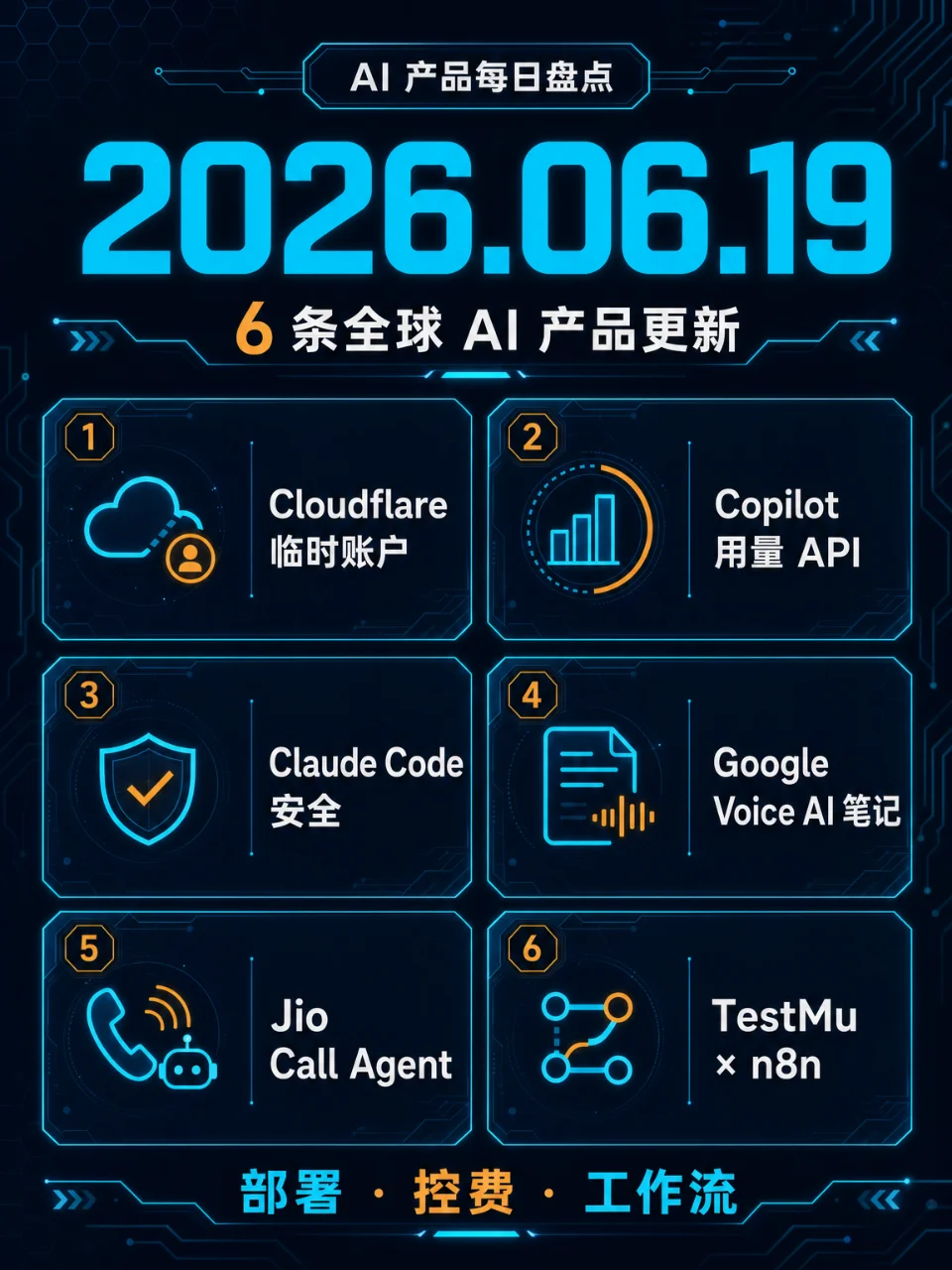
AI 产品每日盘点|2026.06.19
6 条近 24 小时 AI 产品更新:Agent 部署免登录、Copilot/Claude Code 进入治理期,Google Voice 与 Jio 把 AI 带进电话和工作流。
AI 产品每日盘点
 글
글AI Agent 生态速报 | 2026-05-10:记忆成基础设施、Harness 差出 30-50 分、金融 Agent 从概念落地
本期(2026-05-09 12:52 至 2026-05-10 02:00,约 21 小时窗口)以三条主线组织:①Agent 记忆正从「技巧」升级为工程基础设施——Anthropic Dreaming 使任务完成率提升 5.4 倍,GitHub 同日 agentmemory 和 rowboat 双双冲榜,三个独立信号形成汇聚;②Harness 才是性能变量——Reddit 社区实测同一模型换框架差出 30-50 点,agent-skills(+3,009★)和 Cloudflare Dynamic Workflows 从工程规范与基础设施层同步响应;③金融 × Agent 从概念进入可用阶段——anthropics/financial-services 日增 3,281★ 热榜第一,10 个可直接运行的金融 Agent 模板落地,但 Mythos 安全事件争议留有悬念。
Agent 生态周报
 글
글今日 GitHub Trending 可变现开源项目精选(2026-04-17)
从 2026-04-17 GitHub Trending 日榜中筛选出 7 个具备商业化潜力的开源项目,按变现潜力排序,覆盖本地 TTS 服务、AI Agent SaaS 模板、多 Agent 工作流框架、AI 记忆引擎等方向。每个项目附开源协议说明、具体变现路径分析和独立开发者适用场景。
GitHub 赚钱项目日报 (Fork)
이 콘텐츠를 둘러싼 관점이나 맥락을 계속 보강해 보세요.