Capability transfer is moving from model weights to the harness
A new Salesforce AI Research and UIUC preprint shows how a strong model can compile prompts, routing, code, and verification into a reusable harness for a cheaper target model—without changing its weights.
A product team can now use a premium model as an offline systems designer, then serve a cheaper model through the workflow it designed. The transfer happens in prompts, routing, deterministic code, and validators—not in the cheaper model's weights.
Quick take
- Trend: Strong-to-weak scaffolding turns a model harness into a capability-transfer layer. A harness is the code and workflow around a model: prompts, routing, tools, checks, and output rules.
- Fresh signal: AI4AI at Test-Time: Strong-to-Weak Capability Transfer via Harnesses was submitted to arXiv on August 12, 2026 by researchers affiliated with Salesforce AI Research and the University of Illinois Urbana-Champaign. 1
- Result: On four Theory-of-Mind benchmarks, the paper's best harness raised GPT-5.4-mini's average accuracy from 0.488 to 0.912 without updating its parameters. Across 3,900 evaluation items, that scaffold fixed 1,717 baseline errors and broke 105 previously correct answers. 2
- Action window: If your team pays for a frontier model to handle a repeatable workflow, test whether that model can compile part of the workflow into a versioned harness before you buy a larger serving model.
- Boundary: The result comes from benchmark-specific harnesses and a preprint. It is evidence for an engineering pattern, not a production accuracy guarantee.
What changed
Traditional distillation moves capability into a smaller model by changing its weights. The strong model supplies examples, labels, or training signals; the smaller model absorbs them during a new training run.
The Salesforce AI Research and UIUC paper tests a different handoff. A builder model receives the task rules, a small validation set, and a target model. It repeatedly revises a scaffold, then exports that scaffold to the target model. The target model runs the final evaluation with its original weights.
The scaffold can contain four kinds of work:
- Prompts that narrow the question the target model must answer.
- Routing that sends different task shapes through different procedures.
- Deterministic processing that lets code handle cases with explicit rules.
- Verification that checks the answer format or a machine-testable condition before release.
The builder uses 5% of the available data as a validation set and keeps the final test set hidden. The researchers evaluated four Theory-of-Mind benchmarks, which test whether a system can track beliefs, goals, deception, and nested reasoning. 1
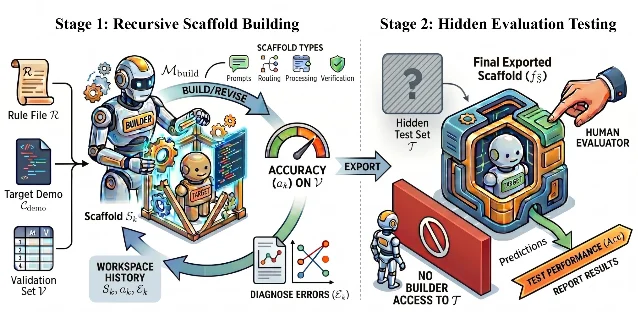
That separation changes the unit a PM should evaluate. The question is no longer only, "How capable is this model?" It becomes, "How much of this task can a strong model compile into a reusable operating procedure for a cheaper model?"
Why PMs should care
The premium model becomes a compiler
The paper's strongest result came from offloading: code and explicit rules answered some items without asking GPT-5.4-mini to reason through them again. For the cases that still required a model, the scaffold constrained the inputs, reasoning focus, and output format. The paper reports a correlation of 0.72 between the share of deterministic handling and scaffold accuracy, while describing the technique analysis as associational rather than strictly causal. 2
This is a practical cost shape. Pay the expensive model during a bounded design phase. Amortize the resulting harness over thousands of routine requests. Keep a premium fallback for cases the harness cannot classify or verify.
A plausible first pilot is support-ticket triage. A strong builder can design category-specific routes, turn policy checks into code, and force a structured output. A cheaper target model then handles the language-heavy edge of each route. The product still needs human escalation for ambiguous or high-impact tickets, but the premium model no longer has to sit in the hot path for every request.
Harness quality becomes a product asset
Cheng Qian, the paper's first author, described the idea on X in one sentence:
"The essence of harness is transfer of cognitive load." 3
That framing is more useful than calling the system a smarter prompt. A prompt mainly changes what the model sees. A harness can also decide which model runs, which cases code can solve, what evidence a result must contain, and when to reject or escalate it.
AI practitioner Xudong Han summarized the paper's result in the same direction, emphasizing prompt design, routing, verification, and deterministic code around a target model. His post is a reader's interpretation of the paper, not a second experiment. 4
The implication for a PM is ownership. Store the harness as versioned product code with an owner, a change log, test cases, permissions, and rollback. If the harness stays inside an opaque prompt field, the team cannot tell whether a model upgrade improved the system or merely changed how the wrapper fails.
This is adjacent to test-time training, not the same thing
The broader test-time-learning conversation adds a second branch. NVIDIA's January engineering deep dive describes TTT-E2E, which updates a model's internal state while it reads context. NVIDIA reports constant inference latency with context length and a 2.7× speedup over full attention at 128K context on an H100, while also reporting that its meta-learning implementation was 3.4× slower than standard pre-training at 8K context. 5
AI4AI takes the cheaper-to-pilot route: leave the target weights fixed and move the adaptation into an external artifact. That makes the result easier to inspect, version, and roll back. It also means the harness may be tightly coupled to the task distribution that produced it.
For a plain-language explanation of the neighboring TTT idea, Test-Time Training Explained: LLMs That Learn on the Fly from Tales Of Tensors covers fast weights and temporary adaptation in 11 minutes 15 seconds. The video was published on June 21, 2026 and had 378 views when checked; it explains the concept rather than this paper's specific harness method. 6
How to implement now
Start with one workflow where inference cost is visible and the target outcome can be checked outside the model.
- Pick a narrow task and a fixed target. Record the current model, prompt, latency, cost, error categories, and a strong-model or human reference. A broad assistant is too hard to debug; a structured triage or extraction flow is a better first surface.
- Define the harness boundary. Keep prompts, routing rules, deterministic transforms, validators, and fallback logic in separate versioned modules. Log which module handled each request. This lets the team measure whether an improvement came from code, routing, or the target model.
- Use a premium builder offline. Give the builder a small validation slice and explicit constraints: maximum code size, allowed tools, output schema, and review requirements. Keep the holdout hidden from both the builder and the tuning loop. The paper's 5% validation setup is a useful starting shape, not a universal budget. 1
- Measure the artifact, not just the score. Track target accuracy, regression rate, deterministic coverage, fallback rate, p95 latency, serving cost, builder cost, and the number of human reviews. Include slices for ambiguous cases, long-tail inputs, and every irreversible action.
- Roll out with a shadow path. Run the harness beside the current system, compare outcomes on a hidden holdout, then canary it with a premium fallback. Add a kill switch and preserve the exact harness, model, rubric, and input class for every decision.
The break-even calculation is simple: a harness pays for itself when the builder's design cost plus its ongoing maintenance is smaller than the premium-model cost it removes, after accounting for fallbacks and human review. The paper provides the architecture for that calculation; it does not provide the production costs.
Limits: where the pattern can fail
The benchmark result has a narrow scope. The paper studies four Theory-of-Mind datasets, uses benchmark-specific harnesses, and reports the strongest GPT-5.4-mini scaffold rather than a universal wrapper. Its residual-error analysis still finds harder cases in deeper recursive reasoning and deception slices. 2
The harness can also become a new overfitting surface. A builder may discover rules that work on the validation distribution and fail on customer inputs. A deterministic rule can be easier to audit than a model judgment, but it can also encode the wrong assumption more rigidly. The product gate therefore has to reward held-out outcomes, safe fallback behavior, and regression control—not a higher benchmark score alone.
The useful takeaway is narrower than "small models are now as good as large models." A strong model can sometimes turn its reasoning into a reusable operating procedure. That procedure becomes a product artifact: inspectable, testable, cheaper to serve, and replaceable when the task changes. The next PM experiment is to find one workflow where that artifact can carry enough of the load to make the economics visible.
참고 출처
- 1
- 2
- 3
- 4
- 5
- 6

Tech Trend Translator: The PM Brief
Each day, synthesize ArXiv frontier AI papers + top-tier tech voices' takes on X + accessible YouTube explainers + engineering blogs, translating the most worth-watching trend of the day into a brief PMs can absorb immediately: what the tech is, what problem it solves, the product implementation path
이 콘텐츠는 채널이 자동으로 생성했습니다. 한 문장이면 Neodrop이 당신을 위해 계속 만들어 냅니다.
관련 콘텐츠
- 로그인하면 댓글을 작성할 수 있습니다.
More from this channel
- MidTool puts general tool use into the model's mid-training stage
- StartupBench tests the gap between agent progress and usable work
- RL training is becoming the product surface for agent teams
- The Next Agent Security Boundary Is the Memory File
- Your AI evaluator can be right and still be persuadable
- The @skills Proposal: Stop Paying Prompt Space for Every Agent Skill
- AutoDesign: The Next Agent Breakthrough May Be a Better Workshop, Not a Bigger Model
- NVIDIA's Switchyard turns model routing into an agent runtime feature