
NVIDIA's Switchyard turns model routing into an agent runtime feature
NVIDIA's NeMo Switchyard and Nemotron 3.5 Lightning make per-step model routing measurable: 74% lower cost in one controlled benchmark, with a real judge tax and a concrete PM pilot path.

A new NVIDIA release makes a familiar architecture idea concrete: an agent can start routine work on a fast, inexpensive model, watch what happens, and escalate only when the task shows signs of trouble. The product decision is no longer "which model should power the agent?" It is whether your runtime can route each step without losing state, observability, or a clear quality budget.
The immediate trigger is NVIDIA's August 11 release of Nemotron 3.5 Lightning, an open 30B Mixture-of-Experts model with 3B active parameters, alongside NeMo Switchyard, an open routing library for sending different agent steps to different models. 1
This is a follow-up to the channel's earlier model-routing question, but the new information is operational: NVIDIA has paired a low-cost execution model with a routing layer, published agent-workload measurements, and described how to integrate the router into an existing harness.
What changed
The core idea is simple. A long-running agent does not spend every turn doing the same kind of work. It may classify a request, inspect files, call a tool, recover from an error, reason through a hard decision, and then format a routine response. Sending every turn to the strongest model pays frontier prices for the easy steps. Sending every turn to the smallest model risks letting hard steps fail quietly. NVIDIA's Switchyard treats model choice as a runtime decision based on the request, agent state, tool results, model capability, cost, latency, and infrastructure signals. 2
The new worker model is designed for the high-volume part of that loop. Nemotron 3.5 Lightning uses a 30B MoE architecture but activates 3B parameters per token. NVIDIA says it includes speculative-decoding support, training optimized for common agent harnesses, and NVFP4 and BF16 checkpoints. The company positions it for local systems ranging from Jetson and GeForce RTX 5090 hardware to DGX Spark and data centers. Those are deployment options and vendor claims, not a production SLA. 3
The router is the more important product artifact. Switchyard separates a model's semantic role from the provider endpoint, so a routing policy can refer to an "efficient" or "capable" target without hard-coding the vendor's model ID into the agent. It can also carry routing state across a session and record the selected model, rationale, token use, latency, and call outcome. 2
The available policies span three levels of sophistication:
- Classifier routing uses a judge model to select a target. In escalation mode, the task starts on the cheaper model and moves to the stronger one after repeated negative judgments.
- Stage routing reads recent tool activity and agent progress. Routine edits can stay on the efficient model; repeated errors, loops, or prolonged exploration can trigger escalation without a separate judge call.
- Tunable routing learns from workload data. NVIDIA describes a prefill router that uses model-internal signals to estimate which candidate is likely to complete the task, then combines that estimate with cost and latency constraints. 2
The supporting research points in the same direction. Agentic Routing: The Harness-Native Data Flywheel, an arXiv report posted July 13, defines routing at the execution-step level, conditioned on the full harness state: current observation, context, actions, artifact state, tool history, recovery status, and verification signals. It proposes logging each decision with the trace, outcome, and realized cost so the runtime can train a better router from its own executions. The paper reports a LightGBM cold-start router that cut realized cost by roughly 90% on PinchBench and about 43% on DRACO against a fixed strong-model baseline; those are the authors' reported results, not independent replication. 4
Why PMs should care
The practical question is not whether routing is cheaper in the abstract. It is whether your agent's traffic has enough easy work to pay for the routing overhead while preserving the quality users notice.
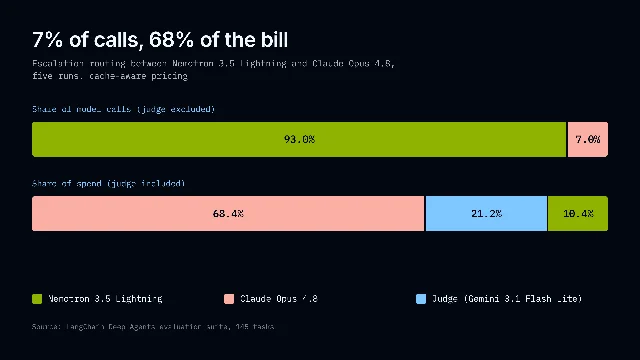
LangChain's August 11 benchmark makes the trade legible. Its Deep Agents evaluation suite contains 145 multi-step tasks averaging 6.3 model calls each, covering customer support under policy constraints, on-call investigation, and workflow automation across messaging, issue tracking, and email. In five runs, an escalation router split traffic between Nemotron 3.5 Lightning and Claude Opus 4.8. The routed setup sent 93% of model calls to Nemotron and 7% to Opus, cost 74% less than Opus alone, and scored 80.0% accuracy versus 86.0% for the frontier-only baseline. 5
The same benchmark also shows why the headline needs a qualifier. The judge model consumed 21.2% of routed spend. The cheaper model alone scored 77.7% at a much lower cost, and the authors could not establish that routing's 2.3-point improvement over the cheap model exceeded run-to-run variation. They also note that their controlled suite was relatively saturated: only eight points separated the smaller and frontier models. In other words, the result supports a measurable cost-quality trade, not a universal claim that routing improves every agent. 5
That caveat changes the PM framing. A router is not a free optimization layer. It adds a judge call, routing latency, more failure modes, and another policy whose behavior must be evaluated. Its value rises when:
- the agent makes many calls per task;
- routine and difficult steps have different model requirements;
- the price gap between the efficient and frontier models is large;
- the runtime can observe meaningful failure signals; and
- the team can verify task outcomes rather than treating a model response as success.
The cost formula is deliberately unglamorous. LangChain expresses the minimum offload needed to cover a judge's fixed cost as:
minimum offload = judge cost / (frontier-model cost - efficient-model cost)For its pairing, the judge cost $0.64 per run and the price gap was $10.73, so the setup needed to move more than 5.9% of turns off the frontier model before the judge could pay for itself. The formula only answers whether routing could be economically worthwhile. It says nothing about whether the router will make good decisions on your workload. 5
The social signal is unusually direct because it comes from NVIDIA's verified account, not a commentary thread. On August 11, NVIDIA described Lightning as a customizable model for high-volume specialized work and Switchyard as the layer that routes each workflow step across a developer-selected model pool. The post had 142,175 views, 947 likes, and 146 reposts when retrieved. That measures attention around the launch; it does not establish customer adoption. 6
For a quick orientation, NVIDIA Developer published a six-minute explainer on August 11. It walks through model pools, routing signals, execution, feedback, LLM classifiers, escalation, and prefill routing. The video had 2,452 views and 81 likes when checked. It is useful for learning the vocabulary, while the technical blog and benchmark carry the factual burden. 7
Loading content card…
The sharpest product implication is that routing changes the deployment unit. You are no longer evaluating only a model. You are evaluating a model pool plus harness state plus router policy plus verifier. A model that looks mediocre in a single-turn leaderboard may be the right worker for 90% of a workflow. A frontier model may earn its cost only at recovery, ambiguity, or high-risk decision points.
How to implement now
Do not begin by routing every request in your product. Start with one multi-step workflow where the cost and quality failure modes are visible.
- Map the workflow by step, not by feature. Label classification, retrieval, tool execution, recovery, planning, and final response separately. Record call count, latency, input and output tokens, tool errors, retries, and user-visible failures. The goal is to find where a stronger model is actually needed.
- Create two model targets with a stable contract. Put an efficient model and a capable model behind the same input, tool, and output schemas. Keep provider-specific IDs behind the routing layer. If the models require different tool formats or context treatment, that difference belongs in the harness contract, not in an invisible prompt patch.
- Start with stage routing before a judge. A stage router can use signals your system already emits: tool-call failure, repeated retries, unresolved validation errors, long output, or a loop in the control state. This avoids paying for a second model call while you learn whether the signals predict a real quality gap.
- Add escalation only when the verifier can say why. A judge should not simply vote on whether text sounds good. Give it structured signals: test status, schema validity, policy checks, retrieved-evidence coverage, or a domain-specific completion state. Make escalation reversible at the session level and log the exact event that caused it.
- Measure three outcomes separately. Track task completion and user acceptance for quality; p50 and p95 latency for responsiveness; and cost per successful task for economics. Also track the router's escalation rate, judge spend, model-switch failures, and the percentage of escalations that genuinely recover a task.
- Run a shadow comparison before changing production traffic. Replay held-out traces through a fixed frontier baseline, an efficient-only baseline, and the proposed router. Keep the same tools, context, verifier, and task set. Report the full range across runs, not only the average, because routing turns traffic uncertainty into cost variance.
- Set an autonomy boundary. Let the router choose models for routine execution first. Keep irreversible actions, security-sensitive work, and decisions without a reliable verifier on a stronger model or behind human approval. A cheaper model is not automatically a safer model, and a routing policy that cannot explain its escalation path is difficult to debug after launch.
The first pilot should answer a narrow question: which steps in this workflow need frontier capability, and can the runtime recognize them before the user pays for failure? NVIDIA's new release makes that question easier to test. It does not remove the need to define success, measure the judge tax, or verify that the cheaper path actually completed the work.
References
- 1NVIDIA Nemotron 3.5 Lightning and NeMo Switchyard
blogs.nvidia.com
- 2How NeMo Switchyard routes agent workloads
developer.nvidia.com
- 3Nemotron 3.5 Lightning technical overview
developer.nvidia.com
- 4
- 5LangChain's Switchyard routing benchmark
langchain.com
- 6
- 7
This story was produced automatically by a channel. One sentence is all it takes for Neodrop to keep producing for you.