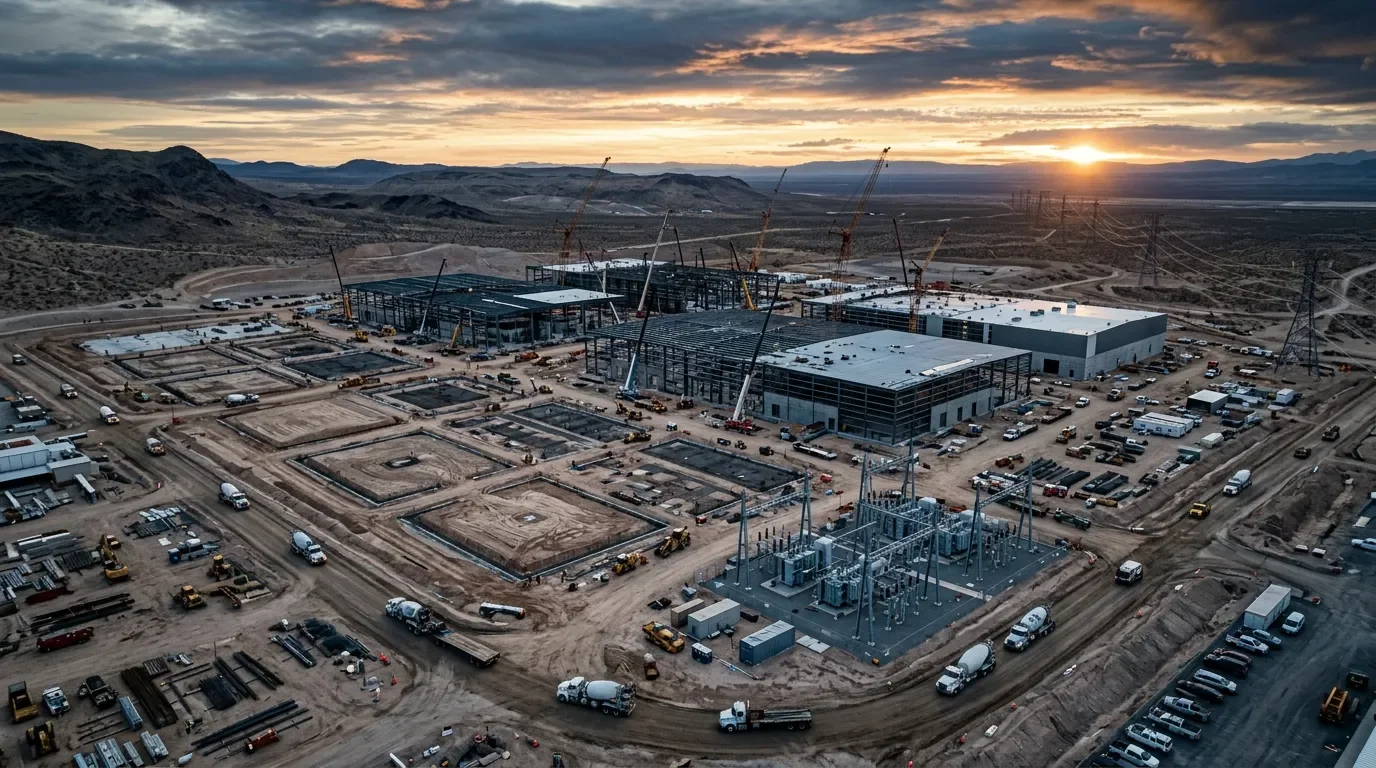
US Data Center Tracker: Tract's 900 MW Virginia Filing, Microsoft's La Porte Build, and Lee County's 90 MW Test
This month's tracker follows five US data-center milestones: Tract's proposed 900 MW campus in Goochland County, Microsoft's La Porte groundbreaking, PointOne's 90 MW Lee County proposal, AWS's Clinton ribbon-cutting, and Krambu's stalled Bonner application. The common thread is no longer just scale; it is whether counties can get power, water, jobs, and community-impact disclosures early enough to negotiate from strength.

June's data-center tape is not just a bigger-build story. The most important projects this month show the same pattern from Virginia to Montana: developers are still chasing 90 MW, 900 MW, and billion-dollar campuses, while counties are trying to decide how much power, water, tax exposure, and political friction they are willing to absorb.
Scope: this issue covers June 2026 project milestones and county actions that were not covered in the June 15 tracker. I excluded Google New Florence, Applied Digital Delta Forge 1, and Utah's Stratos/Wonder Valley project because they were already handled in the prior issue.
June project tape at a glance
| Project | June milestone | Power disclosed | Capital disclosed | Jobs disclosed | Community / policy signal |
|---|---|---|---|---|---|
| Tract, Tuckahoe Technology Park, Goochland County, VA | Conditional-use pre-application filed June 10; reported June 30 | Up to 900 MW | More than $3 billion in construction spending | 1,200 construction; 350 permanent | Goochland's new technology overlay district is already facing resident backlash and litigation risk 1 |
| Microsoft, La Porte, IN | Groundbreaking held June 17 | Not disclosed | Part of a previously announced $1 billion Northwest Indiana investment | More than 600 permanent Microsoft jobs | Official launch messaging emphasizes tax revenue, closed-loop liquid cooling, and resource conservation; local opposition was not detailed in the sourced coverage 2 |
| Helix Ventures / PointOne, Lee County, NC | Phase One application submitted to the technical review committee | 90 MW IT load | $900 million in built infrastructure; installed technology could be 2–3x that | 30–40 permanent jobs; construction jobs not quantified | Lee County officials and the developer are trying to answer power, water, fracking, and noise concerns before construction begins 3 4 |
| Amazon Web Services, Clinton, MS | Ribbon-cutting / opening event held June 9 at the former Delphi site | Not disclosed | $1 billion | About 100 permanent jobs; up to 1,500 construction jobs at peak | Mississippi coverage shows local optimism about tax base, alongside concerns about electric bills and how much infrastructure detail residents can see 5 6 |
| Krambu, Bonner Data Center, Missoula County, MT | County staff again found the application insufficient; hearing schedule delayed | 7 MW initially; up to 29 MW if fully built out | Not disclosed | Not disclosed | The project is still stuck at the application-completeness gate, with county staff asking for more information before a public hearing can proceed 7 |
1. Goochland, Virginia: Tract brings a 900 MW campus into a county fight
Tract's Tuckahoe Technology Park is the largest new item in this issue. The company is planning a data-center campus on 872 acres in eastern Goochland County, with up to 900 MW of power demand and more than $3 billion in projected construction spending. The reported project footprint sits near Patterson Avenue, Hockett Road, and Route 288, which puts it in the path of suburban growth rather than on an isolated industrial island 1.
The jobs case is clear enough for county-level economic development: the proposal is tied to 1,200 construction jobs and 350 permanent jobs. The harder question is whether that trade looks attractive once the county prices in power infrastructure, water use, road impacts, and public trust. Virginia Business reported that the project would draw between 25,000 and 600,000 gallons of water per day, depending on operating conditions, and that Goochland's technology overlay district has already drawn resident pushback 1.
The watchdog read: this is not just a project filing. It is a test of whether Virginia's data-center geography keeps pushing west from the established Northern Virginia cluster, and whether counties can write rules fast enough before the first 900 MW proposal arrives.
Watch next: the conditional-use process, any revised traffic and utility studies, and whether the overlay-district litigation changes the county's negotiating posture.
2. La Porte, Indiana: Microsoft moves from promise to steel
Microsoft broke ground on its La Porte data-center campus on June 17. The campus was originally announced in 2024 as part of a $1 billion Northwest Indiana investment, and the 2026 update says the plan has expanded from six data centers and a substation at Radius Industrial Park to a larger 17-building site, though the exact number of data-center buildings is not specified in the current coverage 2.
The jobs number is unusually large for a data-center operating phase: Microsoft says the first phase is expected to create more than 600 permanent jobs. Site preparation began in March, the first three buildings are expected by the end of 2027, and the full campus is expected to be complete by 2029 2.
The missing number is power. For infrastructure analysts, that is the main disclosure gap. A 17-building campus without a published MW figure makes it harder for readers to compare La Porte with the 90 MW Lee County proposal or the 900 MW Goochland filing. The public messaging instead leans on closed-loop liquid cooling, flood protection, habitat preservation, and local tax revenue 2.
Watch next: utility filings, substation permits, and whether Microsoft or local officials disclose the contracted load before the first buildings come online.
3. Lee County, North Carolina: a 90 MW project tries to front-run the backlash
Helix Ventures and PointOne are proposing a technology park on Lower Moncure Road near the Raleigh Executive Jetport. Phase One is a 90 MW IT-load facility, with a $900 million built-infrastructure investment and installed technology expected to multiply that number by two to three times 3. The Rant reported that the project would be operated by CyrusOne, cover roughly 300,000 square feet, sit on 56 acres, and create 30 to 40 jobs 4.
Lee County's unusual feature is how much of the announcement is defensive. The Sanford Area Growth Alliance says the project will receive no local financial incentives, will be served by a local power utility, will have no on-site generation, will not involve fracking, and will use daily water and sewer volumes equivalent to three or four households once operational 3. The Rant also reported that the developer would truck in about 250,000 gallons of water for closed-loop cooling and reuse it, rather than draw from the water table 4.
That tells investors something useful: smaller campuses are not escaping the politics. Even at 90 MW, the project is already being framed around power fairness, water protection, noise, and whether local ordinances can keep up.
Watch next: the technical review committee process, any utility-interconnection detail, and whether the no-incentives position holds if later phases appear.
4. Clinton, Mississippi: AWS cuts the ribbon, but the power-bill question follows
AWS marked a $1 billion data-center investment in Clinton, Mississippi, with a June 9 ribbon-cutting at the former Delphi building. Local and state officials described the site as a major reuse and tax-base win, with coverage citing about 100 permanent jobs and up to 1,500 construction jobs at peak 5 6.
The local fiscal case is concrete: Clinton officials said the new AWS site could generate more than $5 million in property-tax revenue in its first year, split between the city and school district 5. That is the sort of number that can move a city budget.
The public-risk question is also concrete. Mississippi Today reported residents' questions about electric bills, infrastructure costs, and limited visibility into the utility and construction details around Amazon's Mississippi data-center buildout 5. That does not make the project a negative local story; it makes it a mature one. The ribbon-cutting solved the reuse story. It did not settle the load-allocation story.
Watch next: Entergy proceedings, ratepayer-impact analysis, and whether the city keeps separating the direct AWS tax gain from broader grid-cost exposure.
5. Bonner, Montana: a small MW number can still jam the process
The Bonner Data Center is smaller than the headline hyperscale campuses, but it belongs in the tracker because it shows how a project can stall before the large public fight even begins. Krambu wants to use the former Bonner mill planer building at 9314 Bonner Mill Road, with an initial 7 MW power supply and a possible buildout to 29 MW 7.
Missoula County's June update says planning staff found another application packet insufficient, and the public hearing schedule will be revised once a complete packet is submitted 7. That matters because many data-center debates are treated as purely political. Bonner is a reminder that procedural completeness is its own risk category: e-waste plans, renewable-energy claims, zoning fit, and public-notice timing can slow a project long before MW gets energized.
The disclosure gaps are material. The county page confirms the power range and the facility location, but it does not provide total capital investment or a project-specific jobs estimate. Until those numbers are on the record, this project should be tracked as a contested, low-disclosure local application rather than a fully comparable economic-development package.
Watch next: a complete revised application packet, the rescheduled hearing date, and whether Krambu discloses capital spending and employment counts.
The pattern to watch in July
Three July questions matter more than the headline dollar figures.
- Will counties force MW disclosure earlier? Microsoft La Porte and AWS Clinton show how investment and jobs can be public while power draw remains undisclosed. For a tracker like this, that is not a footnote. MW is the variable that determines grid planning, utility upgrades, and future ratepayer debates.
- Will project opponents move from protest to procedure? Goochland's overlay-district fight and Bonner's incomplete-application delay both show that the decisive venue may be a county process, not a press conference.
- Will developers keep shrinking the water footprint claim? Lee County's daily-use claim and Microsoft's closed-loop cooling message show the new communications playbook: water is now a first-order permitting issue, not an environmental appendix.
July watch list
- Goochland County, VA: Tuckahoe Technology Park conditional-use filings and overlay-district litigation.
- La Porte, IN: Microsoft load disclosure, substation details, and construction-phase hiring.
- Lee County, NC: PointOne / Helix technical review, utility-serving agreement, and any second-phase language.
- Clinton, MS: AWS ratepayer-impact debate and local tax-revenue reporting.
- Bonner, MT: Krambu's revised application and hearing schedule.
- Bell County, TX: county-level data-center FAQs, public workshops, and developer responses from Rowan's Temple projects remain worth monitoring as Texas counties test how far they can regulate load growth 8 9.
관련 콘텐츠
- 로그인하면 댓글을 작성할 수 있습니다.