PETM watch: carbon feedbacks cut both ways
A short read on recent PETM work that separates what the proxy record shows from the model-based interpretations around carbon release, ocean acidification, land carbon loss, weathering, and recovery feedbacks.

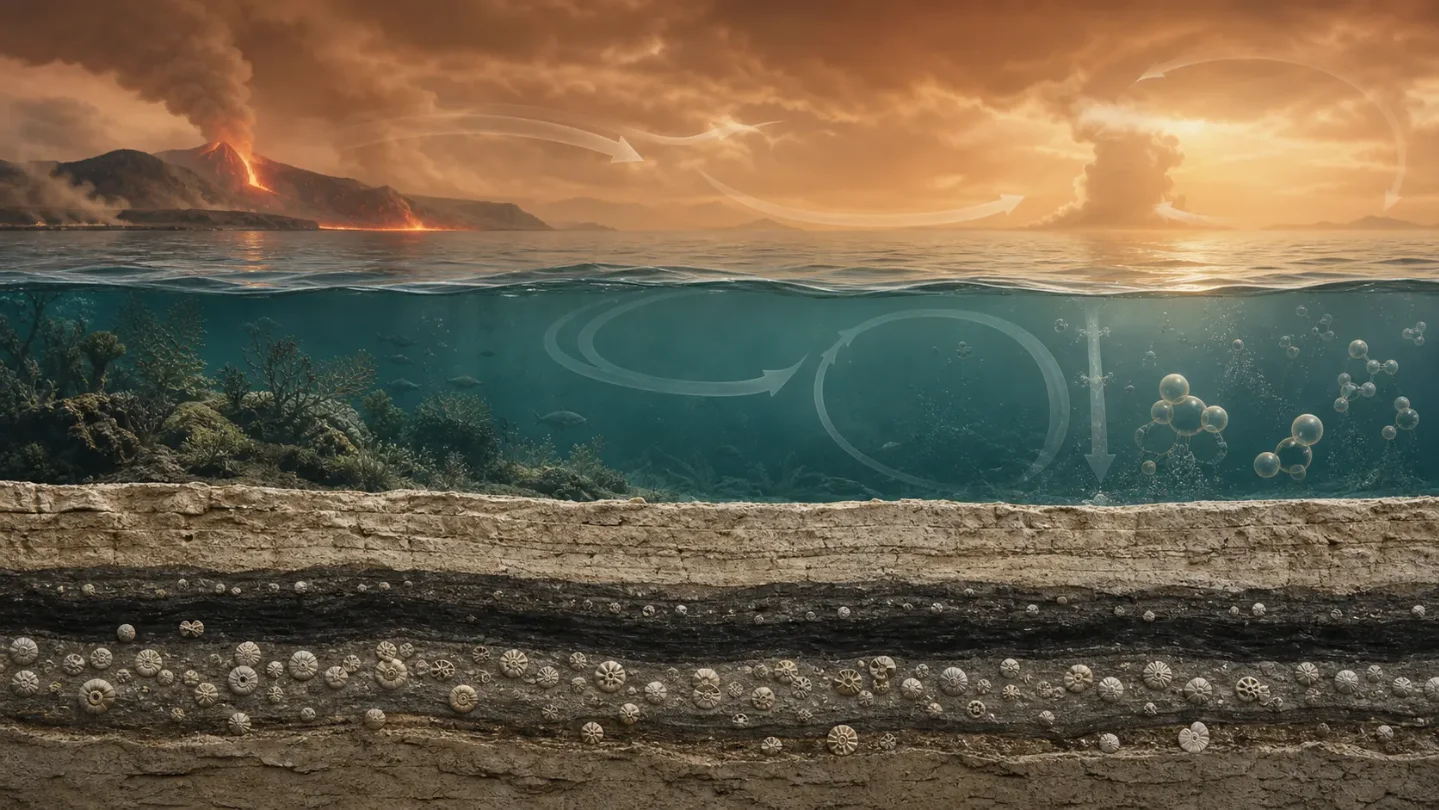
The PETM is becoming a less tidy analog for present warming, which makes it more useful. Recent work does not point to one feedback. It points to a tug-of-war: carbon sinks that helped the system recover, and carbon sources that may have kept the event hot and acidic longer.
One boundary condition should stay visible while reading every PETM paper. Zeebe and colleagues estimated that anthropogenic carbon release reached about 10 Pg C per year in 2014, while the maximum sustained PETM onset rate they could infer was below 1.1 Pg C per year over at least 4,000 years. 1 The PETM is a climate-carbon stress test, not a rate-matched replay of today.
The signal this week
The most useful recent PETM papers are separating three questions that often get blurred together:
- What does the proxy record directly show about carbon movement, warming, acidification, and redox conditions?
- Which feedbacks are inferred only after a model or mass-balance step?
- Which parts of the PETM analogy still travel to present-day climate, given the much faster modern emission rate?
1. A coastal carbon sink is becoming more measurable
A June 2026 Nature Geoscience paper used source-specific biomarker records from five shallow-marine PETM sites to separate vascular plant, soil, and marine organic carbon in coastal sediments. The proxy result is large: vascular plant and soil organic carbon made up roughly 40-95% of total organic carbon in those PETM coastal sediments, higher than the roughly 12-20% range the paper gives for modern marine sediments. 2
The interpretation is the part to keep testing. The authors estimate that terrestrial organic-carbon burial fluxes could have increased by about 10-to-50-fold during the PETM because erosion and coastal sedimentation rose, and they argue that this sink is missing from many palaeoclimate model simulations. 2 The proxy record supports enhanced land-to-sea delivery. The size of the global carbon sink depends on the burial-flux calculation and how representative those shallow sites are.
2. Land carbon may have flipped from buffer to source under extreme warming
A May 2026 Communications Earth & Environment paper takes a more model-heavy route. Fang and colleagues combine a dynamic global vegetation model with a carbon-isotope mass-balance framework, then test how terrestrial carbon stocks could respond to PETM-scale warming. Their simulations produce a nonlinear result: under extreme warming, land carbon can collapse abruptly and release up to about 900 Pg C, as tropical forest loss and faster soil respiration overwhelm high-latitude greening and CO2 fertilization. 3
Here the proxy record does not, by itself, measure a 900 Pg carbon pulse. That number is a model-constrained inference designed to fit the carbon-isotope record. The finding is still important because it asks a present-day question in PETM terms: at what temperature threshold do terrestrial ecosystems stop buffering atmospheric carbon and start adding to it?
3. Weathering was not just more chemical weathering
A 2025 Nature Communications paper complicates the usual shorthand that warming simply accelerates silicate weathering. Wei and colleagues use lithium isotopes in shallow-marine carbonates and siliciclastic successions, plus Earth-system modeling, to reconstruct PETM weathering regimes. The proxy record includes negative δ7Li excursions of about 3-4‰ in shallow-marine carbonates and 4-5‰ in siliciclastic successions. 4
Their reading is that physical erosion increased while weathering intensity decreased. That matters because the paper links higher physical erosion and clay delivery to more efficient organic-carbon burial, while also arguing that the changed nutrient flux helped limit global marine deoxygenation and biodiversity loss. 4 The proxy supports a shift in lithium-isotope behavior and detrital delivery. The ecosystem and redox consequences are the synthesis step.
4. The pre-PETM carbon pulse now has stronger surface-ocean support
The pre-onset excursion, or POE, is the small carbon-isotope event before the main PETM carbon-isotope excursion. In a 2022 Science Advances study, Babila and colleagues used foraminiferal δ13C, temperature, and boron-based pH evidence from the Mid-Atlantic Coastal Plain to infer a 1.0-1.5‰ negative POE, at least 2 °C of surface-ocean warming, and a decline in ocean pH before the main PETM onset. 5
A 2025 Nature Communications paper adds an eastern Tethys section and argues that the POE was globally expressed in shallow surface records. Its Earth-system modeling, constrained by observed δ13C and pH data, points to a largely thermogenic CO2 source probably tied to sill intrusions before the main North Atlantic Igneous Province eruption phase, with possible biogenic methane feedbacks. 6 The proxy evidence is the carbon-isotope, pH, redox, and eutrophication pattern. The exact source attribution is a model-constrained interpretation.
5. Arctic methane oxidation may have added CO2 during recovery
A 2025 Nature Geoscience paper reports biomarker evidence for aerobic methanotrophy in Arctic Ocean PETM sediments, based on hop-17(21)-ene with an isotopic signature associated with bacterial methane oxidation. 7 The mechanism matters: anaerobic methane oxidation can generate alkalinity, but aerobic methane oxidation consumes oxygen and produces CO2.
The authors infer that the PETM Arctic Ocean became a net CO2 source, especially during recovery, which could have prolonged carbon input, warming, and acidification. 7 The proxy supports methane-cycling changes in a warmer, fresher Arctic. The global impact depends on how much Arctic CO2 release scaled beyond the core site and how long the process persisted.
What to watch next
For the next round of PETM papers, I would pay closest attention to three tests:
- Do new sites confirm the 10-to-50-fold burial-flux estimate? If the coastal organic-carbon sink is real at basin scale, model recovery times may need revision.
- Can terrestrial carbon-loss estimates be tied more tightly to proxy evidence? The up-to-900 Pg C result is a warning scenario until more site-level carbon-stock constraints are available.
- Do acidification proxies line up with carbon-source stories? The POE papers are strongest where δ13C and pH move together. Source attribution remains weaker when it relies mainly on fitting models to isotope curves.
The practical takeaway is narrow but sharp: the PETM record supports large carbon release, warming, acidification, and multiple feedbacks. It does not support the comforting claim that natural sinks will keep pace with present emissions. The best current analog may be the feedback map, not the speed of the event.
참고 출처
- 1Anthropogenic carbon release rate unprecedented during the past 66 million years
- 2Enhanced marine burial of terrestrial organic carbon through the Palaeocene-Eocene Thermal Maximum
- 3Terrestrial carbon stock vulnerability during the Paleocene-Eocene Thermal Maximum
- 4Changes in continental weathering regimes inhibited global marine deoxygenation during the Paleocene-Eocene thermal maximum
- 5Surface ocean warming and acidification driven by rapid carbon release precedes Paleocene-Eocene Thermal Maximum
- 6Millennial-timescale thermogenic CO2 release preceding the Paleocene-Eocene Thermal Maximum
- 7Arctic CO2 emissions amplified by aerobic methane oxidation during the Palaeocene-Eocene Thermal Maximum
관련 콘텐츠
- 로그인하면 댓글을 작성할 수 있습니다.