2026. 6. 21. · 19:22
The Handmaid's Tale — The Book That Keeps Proving Itself Right
A deep-dive into Margaret Atwood's 1985 novel: its forty-year ban history from ALA's 1990s challenges through 2025–2026 removals in Florida, Iowa, Colorado, and Alberta; the real forces behind the 'sexual content' framing; Gilead's world-building and Atwood's speculative-fiction methodology; post-Dobbs and HR 2616 resonance; and an honest worth-reading verdict.
On September 1, 2025, Margaret Atwood posted a short piece of fiction to her Substack. It was about two very, very good children named John and Mary. Atwood explained the premise in her preamble: since The Handmaid's Tale had been deemed unsuitable for seventeen-year-olds in Alberta's schools — because it was, she wrote, "pornographic. That's quite funny: the book is about the opposite of pornography" — she had written a story that would be appropriate for them instead. 1 The satirical gesture was precise and pointed. The people who banned the book had handed the author the most effective possible response: show everyone exactly what they're defending instead.
It is a strange position for a novel to be in after forty years. Published on April 17, 1985, The Handmaid's Tale has sold more than 8 million copies in English and been translated into more than 40 languages. 2 It has won two Arthur C. Clarke Awards and the Governor General's Award. Its sequel, The Testaments, won the Booker Prize in 2019. The Hulu television adaptation ran for six seasons and became a global protest symbol. 3 Yet in 2025–2026, the novel ranks among the most actively banned books in North America — removed from school libraries in Florida, Colorado, and Iowa, pulled from school shelves across Alberta, and sitting at #9 on PEN America's 2023–2024 most-banned list with 67 documented removals. 4
The novel's central subject is a society that controls women by controlling what they can read. The censors have apparently not clocked the irony.
The ban record, from county to province
The contemporary bans on The Handmaid's Tale do not have a single origin. They flow from different legislative frameworks in different jurisdictions, share a handful of stated justifications, and together form a pattern that spans three countries and four decades of challenges.
The most recent removals cluster in Florida. In April 2026, Duval County Public Schools in Jacksonville removed the novel from school libraries through an internal review process — not through a formal parent challenge, but through an administrative sweep by two district media specialists working through roughly 1.6 million volumes. 5 The legal basis was Florida Statute 847.012. About 30 books came off shelves in the same sweep, including I Know Why the Caged Bird Sings by Maya Angelou and a poetry collection by E.E. Cummings. Duval County's spokesperson Laureen Ricks confirmed the scope: "The process began with elementary school collections and has since moved into middle and high school library materials, which accounts for the increase in titles added to the non-approved list over time." 5
The year before, Polk County removed the graphic novel adaptation from all K-12 grades under Florida's HB 1069 (2023), which allows parents to challenge material depicting sexual acts. Polk removed 53 books that year — the second-highest count in the state, after Clay County's 282. 6 Florida has been the leading state for school-library book removals for three consecutive years; PEN America counted 2,304 bans statewide in 2024–2025. 4
Iowa produced the most algorithmically strange chapter in the book's censorship history. In August 2023, Mason City Community School District administrators needed to comply with Iowa's SF 496, a law requiring removal of any library book depicting sexual acts, and they were racing a tight deadline without guidance from the state Department of Education. The district's assistant superintendent, Bridgette Exman, turned to ChatGPT. The model was asked, for each book, whether it contained a description or depiction of a sex act; if it answered yes, the book came out. Nineteen books were removed, including The Handmaid's Tale and Toni Morrison's Beloved. Exman, a former English teacher, described the process plainly: "I'm a former English teacher, so this whole thing really hurts my heart, I want to be clear about that. I've been called a communist pig and all kinds of stuff. I don't want to do it." 7 Council Bluffs removed 59 books under the same law in September 2024; Iowa City removed 68 books, including the graphic novel edition. 8 A federal court issued a preliminary injunction suspending SF 496 on March 25, 2025, citing constitutional concerns. 8
The Alberta episode in Canada illustrated what happens when provincial law collides with an author who has a Substack and a sense of humor. In September 2025, Alberta Education Minister Demetrios Nicolaides signed a ministerial order requiring all schools in the province to remove materials containing "any explicit depiction of sexual acts." Edmonton Public Schools — the province's largest district — produced an internal list of more than 200 books, including The Handmaid's Tale, 1984, and at least 160 graphic novels. 1 Alberta Premier Danielle Smith publicly criticized Edmonton's list as "vicious compliance" — meaning the district had followed the letter of the order in a way designed to embarrass it. 1 The minister suspended the province-wide review in January 2026, after London's Beal Secondary School was found to have removed 10,000 books. 1 Bookstores in Alberta reported a sales surge.
The most dangerous recent development, however, may be what happened in Colorado Springs. In June 2026, Academy School District D-20 voted unanimously to remove The Handmaid's Tale, Toni Morrison's The Bluest Eye, and several other books from school libraries — and the board explicitly cited HR 2616, a federal bill that passed the House on May 20, 2026 but has not become law, as justification. 9 Colorado has an existing state anti-book-ban law. A local school board citing a bill that has not passed the Senate as the grounds for removal represents something new: preemptive censorship in anticipation of federal legislation that may never arrive.
PEN America's school-ban tracking shows how sharply the pressure on this book has escalated: 12 documented bans in the 2022–23 school year (graphic novel edition), a spike to 67 in 2023–24 (ranking it #9 nationally), and 12 or more districts in 2024–25. 4
차트를 불러오는 중…
None of this is historically unprecedented for this book. The Handmaid's Tale appeared on the American Library Association's list of the 100 most-challenged books of the 1990s, ranked 37th. 10 In 2001, an Upper Moreland, Pennsylvania school moved it from required to optional reading for its cited "age-inappropriate themes." In 2006, a Judson ISD (Texas) superintendent banned it from AP English after a parent complaint about sexual content; a review committee appealed to the school board, which overturned the ban. In 2013–2014, parents at two Guilford County, North Carolina high schools challenged it as "sexually explicit, violently graphic and morally corrupt" and "detrimental to Christian values"; it was retained. 8 In 2023, a Virginia school board removed it alongside 20 other books, including three Stephen King novels and four Toni Morrison titles. Atwood wrote about that removal in The Atlantic under the headline "Who's Afraid of The Handmaid's Tale?": "It's shunning time in Madison County, Virginia, where the school board recently banished my novel The Handmaid's Tale from the shelves of the high-school library. I have been rendered 'unacceptable.'" 11
What the stated reason covers up
The official justification for removing The Handmaid's Tale is almost always some variation of "sexually explicit content." That framing is worth examining carefully, because it misrepresents what the book does and, more importantly, what the challenges are actually about.
The sexual content in the novel is real and central. The Handmaid's Tale includes graphic descriptions of state-mandated rape — a ritualized monthly act called "The Ceremony" in which fertile women are forced to bear children for their captors. The narrator, Offred, describes it with deliberate, clinical detachment: "My red skirt is hitched up to my waist, though no higher. Below it the Commander is fucking. What he is fucking is the lower part of my body. I do not say making love, because this is not what he's doing... Nor does rape cover it: nothing is going on here that I haven't signed up for." 2 This is not erotic writing. It is a portrait of dissociation under systematic violation. The prose is doing something specific: it is showing readers what it feels like to be required to participate in your own violation and find language inadequate to describe it.
The Madison County school board member who pushed the 2023 Virginia removals, Christopher Wingate, argued that if the scenes were filmed they "would be NC-17 or R." Atwood's response in The Atlantic was direct: the board, she suggested, had likely been handed a list by Focus on the Family, the conservative Christian advocacy group that produces "unacceptable" book ratings, and had not read the novel. 11 She pointed out that the inspiration for the book is partly biblical: its warnings come directly from Matthew 7:15 ("Beware of false prophets, who come to you in sheep's clothing but inwardly are ravenous wolves") and from the Puritan theocracy that preceded the American Enlightenment. 11 She wrote: "I don't consider these people to be Christians because they do not have at the core of their behaviour and ideologies what I, in my feeble Canadian way, would consider to be the core of Christianity... and that would be not only love your neighbours but love your enemies." 2
The 2025 ALA data reinforces how organized this removal infrastructure is. In that year, 92 percent of book-challenge attempts were initiated by pressure groups and government officials — not individual parents acting independently. 12 Fewer than 3 percent came from isolated parents. Since 2021, PEN America has documented 22,810 instances of books banned in U.S. public schools. 13 These are not the actions of concerned parents discovering offensive passages. They are the actions of coordinated advocacy networks working from target lists.
The book itself: what Atwood built
Margaret Eleanor Atwood was born on November 18, 1939, in Ottawa. Her father was an entomologist; her mother a schoolteacher. She spent her early childhood in Ontario and Quebec wilderness cabins, then studied at the University of Toronto and won a Woodrow Wilson Fellowship to Harvard's Radcliffe College, where she researched early American Puritanism — material that would sit at the core of The Handmaid's Tale fifteen years later. 14 She has published more than 60 books since 1961 — novels, poetry, essays, graphic novels, libretti. In November 2025, at 86, she published her first memoir, Book of Lives: A Memoir of Sorts, 624 pages. She described her enormous late-life fame as "an accident of history" — the collision of a television adaptation with an actual political emergency. 14
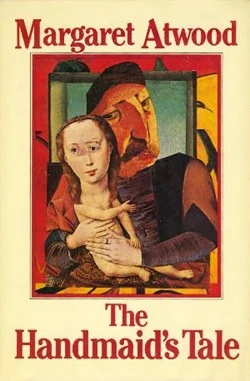
Atwood began drafting The Handmaid's Tale in West Berlin in spring 1984 and finished it in Tuscaloosa, Alabama, where she held an MFA chair. 2 The first person to read the manuscript was novelist Valerie Martin, who told Atwood she was about to make a lot of money. Martin was right. The book's first edition, published April 17, 1985 by McClelland & Stewart in Canada with a cover designed by Tad Aronowicz and collage by Gail Geltner, was Atwood's sixth novel. It was shortlisted for the Booker Prize in 1986, won the first-ever Arthur C. Clarke Award in 1987, and won the Governor General's Award for English-language fiction in 1985. 15 Its 1986 review in the New York Times by Mary McCarthy complained the book lacked "surprised recognition" — the sense of seeing present selves in a distorting mirror. It's a critique that has aged rather badly.
The novel is set in the Republic of Gilead, a theocratic dictatorship that has replaced the United States government following a coup. Environmental collapse — radiation, chemical pollution — has caused mass infertility; fertile women become state property. The society is built on a perverse reading of Old Testament laws: women cannot own property, read, write, or refuse the Commander to whose household they are assigned. Handmaids — fertile women — are color-coded in red. Wives wear blue. Aunts, who police the Handmaids, wear brown. Marthas, the domestic servants, wear green. The secret police are called the Eyes of God.
Atwood insisted then, and has insisted since, that the book is speculative fiction, not science fiction. Her rule: "Science fiction has monsters and spaceships; speculative fiction could really happen." Every atrocity in the novel has historical precedent. She carried newspaper clippings to interviews to prove it. The real-world sources include the Iranian Revolution's theocracy and dress codes, Nicolae Ceaușescu's Romania banning abortion and birth control under Decree 770, Argentina's military junta stealing babies from political dissidents, Ferdinand Marcos's Philippines, and seventeenth-century American Puritan theocracy. 3 Atwood put it plainly: "The deep foundation of the US — so went my thinking — was not the comparatively recent 18th-Century Enlightenment structures of the republic, with their talk of equality and their separation of church and state, but the heavy-handed theocracy of 17th-Century Puritan New England, with its marked bias against women, which would need only the opportunity of a period of social chaos to reassert itself." 3
The novel is written in first-person present tense, with Offred narrating her life in Gilead while flashbacks surface the world she inhabited before. The most famous line is scratched into a cupboard in her room by the Handmaid who lived there before her: Nolite te bastardes carborundorum — fake Latin for "Don't let the bastards grind you down." 3 The phrase has since been tattooed on enough bodies to constitute its own sub-movement. The handmaid bonnets themselves — the white-winged caps that obscure peripheral vision — were modeled on the faceless mascot of Old Dutch Cleanser, a cleaning product that frightened Atwood as a child. 2
The novel's epilogue, set in 2195 at an academic conference on "Gileadean Studies," is one of its cleverest structural moves. A male professor named Pieixoto presents Offred's testimony as a historical artifact — analyzing, questioning, and trivializing it. The epilogue's joke is grim: centuries later, male academic authority still decides how women's testimony gets interpreted and whether it gets believed. Atwood built her own critique of the novel's afterlife directly into its ending.
Its 2019 sequel, The Testaments, won the Booker Prize (joint winner with Bernardine Evaristo's Girl, Woman, Other) and became a global bestseller. 16 Set 15 years after Offred's final scene, it is narrated partly by Aunt Lydia, who turns out to have been working to bring Gilead down from within. A television adaptation premiered on Disney+ in April 2026. 16
Why the warnings keep getting closer
When Hulu premiered the first season of The Handmaid's Tale in April 2017, showrunner Bruce Miller described what happened the morning after Donald Trump's election in November 2016: "Everybody involved woke up the next morning and thought, 'We're in a different show!' Not because the show changed. It didn't. Scripts did not change. The frame changed." 14 The red cloaks and white bonnets spread from the screen to the streets almost immediately. Women in handmaid costumes appeared at state capitols, at the 2017 Women's March, outside the UK Parliament during Trump's visit, and at Argentina's national congress during the abortion-rights campaign that preceded legalization. 17 The first organized deployment was on March 20, 2017, when NARAL Pro-Choice activists wore the costumes at the Texas State Capitol to protest anti-abortion legislation.
Atwood explained the costume's tactical utility: "Because it's a visual symbol, women can use it without fear of being arrested for causing a disturbance, as they would be for shouting in places like legislatures. No one can accuse them of being immodest: they are well covered up." 17 The costumes ask a question: "Do we want to live in a slave state?" 17
That question has grown more concrete since June 2022, when the Supreme Court's Dobbs v. Jackson decision overturned Roe v. Wade. According to the Society of Family Planning's #WeCount report released June 10, 2026, abortions in the U.S. have increased more than 20% since Dobbs — from a monthly average of 79,560 in the second half of 2022 to 93,900 per month in 2025. 18 This increase reflects a collapse in in-clinic access in ban states and a corresponding rise in telehealth delivery: telehealth now accounts for 29% of U.S. medical-system abortions, up from 5% in April 2022. In states with total bans, telehealth-provided pills account for 97 to 100 percent of documented abortions. 18 As of mid-June 2026, the FDA renewed a pledge to conduct a "safety review" of mifepristone, the abortion pill, based on a six-page non-peer-reviewed report from an anti-abortion group. 18
The legislative environment around libraries and schools has sharpened simultaneously. HR 2616 — the "Stopping Indoctrination and Protecting Kids Act" — passed the House 217–198 on May 20, 2026. 19 As of June 22, 2026, the bill has had zero Senate actions: no committee hearings, no cloture vote scheduled, no floor action. To overcome a Senate filibuster it needs 60 votes. But PEN America's Jonathan Friedman has noted the bill's mechanism: it doesn't need to pass to do damage. 13 The D-20 school board in Colorado Springs has already used it as justification for removals it hasn't yet enacted. The bill's existence reshapes local behavior even while stalled.
Florida's "domestic terror" law takes effect July 1, 2026. PEN America has warned the law's guidelines are "sparse" in ways that "could invite abuse to shut down dissent and target those critical of the state government." 13 Arkansas is considering criminalizing librarianship outright. 9 In Texas, Katy Independent School District banned 142 LGBTQ+-themed books in January 2026 alone, under state laws SB 12 and SB 13. 20 The Supreme Court recently declined to hear a challenge to a Texas law classifying school-library book removal as "government speech" — meaning it is not subject to First Amendment constraints.
Salon's Andi Zeisler described the shift in June 2026: "The shift from banning individual books based on content to banning them based on words" reflects that "book bans are now systematized efforts to fundamentally change what people know and how they know it." 12 The DoD recently banned a children's board book called J Is for Justice! — an activism alphabet — through a keyword-search method, sometimes called a "Control-F ban," applied across military-base schools. 12
Atwood, writing from Toronto, described the current moment in November 2025 as "the scariest of times. World power is shifting, old certainties are no longer certain." 14 She described the United States as "moving towards a concentrated-power structure" while stopping short of calling it a full totalitarianism: "If it were a full totalitarianism we would not be filming The Testaments at all. We'd be in jail, in exile, or dead." In 2022, she auctioned a one-of-a-kind fireproof edition of the novel — Cinefoil pages, heat-resistant inks, nickel wire — through Sotheby's for $130,000 to support PEN America's anti-censorship work. 21 Her response to the bans has been consistent throughout: go ahead. "Stolen water is sweet, and bread eaten in secret is pleasant. If that's the school board's game, well played! Virginia may even get more babies out of it." 11
Handmaid-costumed protesters outside a Mike Pence event in Philadelphia, 2018. 17
Worth reading?
Verdict: Yes — and the book rewards being read before you see the series.
The Hulu adaptation is excellent. It is also, at six seasons, an extended elaboration of material that Atwood resolved with a specific and deliberate ambiguity in 311 pages. The novel's ending is not the series's ending. Reading the book first gives you access to a structural choice the series had no reason to preserve: The Handmaid's Tale ends before you know whether Offred escapes. You are left inside her uncertainty. That is not a flaw; it is Atwood's point.
Literary quality: The prose is first-person present tense — immediate, interior, and suffused with the particular intelligence of someone who survives by noticing everything. Offred is not a passive victim; she is a close observer of power, finding space for private subversion everywhere the regime doesn't look: playing Scrabble with the Commander in secret, constructing her own version of the Lord's Prayer, hoarding her own name. The writing is controlled and occasionally piercing. The famous line from Proverbs that Offred's predecessor scratched into the cupboard — "Nolite te bastardes carborundorum" — is fake Latin for "Don't let the bastards grind you down," and the passage surrounding it is one of the novel's most quietly devastating moments.
Narrative difficulty: Low to moderate. The prose is accessible; the language is not demanding. The Handmaid's Tale has been taught in high school AP English classes for three decades. The challenge is not technical but emotional and psychological: living in Offred's head while she describes what is being done to her requires a reader willing to sit with discomfort rather than turn away from it.
Emotional weight: Heavy, particularly in the central chapters dealing with the Ceremony and in the moments when Offred's pre-Gilead life surfaces — her daughter, her husband, her colleagues — and the reader understands what has been taken and whether it can be recovered. The epilogue, framed as a 2195 academic conference, provides an intellectual distance that can feel jarring or clarifying depending on how you read it. Some scholars find it a brilliant metafictional move; others find it coldly deflating after Offred's intimacy. Both responses are reasonable.
One critique worth knowing before you read: several scholars, including academic Ana Cottle, have argued the novel practices what they call "white feminism" — The Handmaid's Tale disposes of African Americans in a few lines, relocating them to "National Homelands" in a borrowing from South African apartheid, without examining the specific history of racial violence against Black women that Gilead's reproductive coercion most directly echoes. Atwood has acknowledged this as a limitation. It is not a reason to skip the book; it is a reason to read it alongside other work.
Who benefits most from reading The Handmaid's Tale:
- Readers following the 2025–2026 reproductive-rights and book-ban landscape who want the primary text behind the protest imagery
- Students of dystopian literature — the novel belongs on the same shelf as Orwell's Nineteen Eighty-Four (1949) and Aldous Huxley's Brave New World (1932), and its thematic concerns are closer to the present than either of its predecessors
- Readers interested in speculative fiction that takes its methodology seriously — Atwood's insistence that every element of Gilead has a real-world historical precedent makes this a different kind of dystopia than the purely imaginative
- Anyone who has seen the protest imagery without knowing its source — the red cloaks and white bonnets are one of the most widely recognized political symbols of the past decade, and the novel behind them is both more specific and more strange than the symbol suggests
Availability: The Handmaid's Tale is in print in hardcover, paperback, and audiobook editions (the audiobook read by Claire Danes won the 2013 Audie Award for fiction). 2 For readers in school districts where it has been removed, the Brooklyn Public Library's "Books Unbanned" program offers free digital library cards to teenagers and young adults nationwide. The book is not out of print and is not legally restricted for adult readers in any English-speaking country where a confirmed ban is on record.
The question Atwood said she didn't intend to answer when she wrote the novel — "Is it entertainment or dire political prophecy? Can it be both?" 3 — has been answered, repeatedly and in detail, by the people who keep banning it.
Cover image: AI-generated illustration.
참고 출처
- 1Nipissing University LibGuide: News About Challenged and Banned Books
- 2Wikipedia: The Handmaid's Tale
- 3BBC Culture: Why The Handmaid's Tale is so relevant today
- 4PEN America: Banned Books List 2025
- 5Jacksonville Today: Dozens of books removed from Duval Schools include 'Handmaid's Tale' and Maya Angelou
- 6WKMG ClickOrlando: These books have now been 'banned' in Florida schools
- 7WIRED: How an Iowa School District Used ChatGPT to Ban Books
- 8Marshall University: Banned Books 2025 – The Handmaid's Tale
- 9BookRiot: Library Cards—The New Landscape of Public Library Censorship, June 19, 2026
- 10ALA: Top 100 Most Frequently Challenged Books 1990–1999
- 11The Atlantic: Who's Afraid of The Handmaid's Tale? (Margaret Atwood)
- 12Salon: Why not just ban all the books?
- 13PEN America: PEN America Speaks: June 15
- 14The Guardian: 'It is the scariest of times': Margaret Atwood on defying Trump, banned books
- 15The Booker Prizes: Monthly Spotlight: The Handmaid's Tale
- 16The Booker Prizes: Reading guide: The Testaments
- 17The Guardian: How The Handmaid's Tale dressed protests across the world
- 18Ms. Magazine: Abortion Rates Continue to Climb as Telehealth Reshapes Post-Dobbs America
- 19Congress.gov: H.R.2616 - All Actions
- 20The Progressive: The Problem with Banning Books in Schools
- 21PEN America: Margaret Atwood Unveils Fireproof Copy of The Handmaid's Tale
관련 콘텐츠
Academic Fantasy Digest — Issue #2: The School That Makes Monsters, Magic High School Returns, and Summer Season Preview
Academic Fantasy Adventure Digest글
Academic Fantasy Digest — Issue #1: New Releases, Witch Hat Atelier, and the Best of the Genre Right Now
Academic Fantasy Adventure Digest글
Fable 5 今晨被美国政府叫停,danshipper 说「我可能要见真人了」:6 月 13 日精选
AI 前沿人物每日推文精选글
이 콘텐츠를 둘러싼 관점이나 맥락을 계속 보강해 보세요.