2026. 7. 1. · 07:26
Gross 2026 — "Hegemonic glory"
Bill Gross's May 2026 commentary argues that America's hegemonic position is being weakened by twin deficits, rising debt, dollar pressure, defense obligations, and a narrow AI-led equity boom. The article frames Gross's central warning through the phrase "global credit card," then connects it to his broader habit of reading markets as balance-sheet evidence rather than isolated price action.

This week's piece is drawn from Bill Gross's May 28, 2026 commentary, "America's Hegemonic Glory is Under Threat." Gross, the co-founder of Pimco and now a private investor and philanthropist, uses one word, "hegemonic," to connect deficits, dollar weakness, military overstretch, tariffs, Treasury yields, and AI speculation into a single investment argument. A version appeared in the Financial Times before Gross published it on his own site. 1
Bill Gross has always liked metaphors that make a bond-market argument feel larger than bonds. In his crisis-era writing, mortgages became kindling, credit became a forest fire, and low real rates became a bargain with the devil. In this 2026 commentary, the governing metaphor is empire.
The essay's central claim is simple but heavy: Gross argues that the United States is still the world's military and economic hegemon, but the policies that made that position durable are weakening. He does not frame the threat as one election, one tariff package, or one bad fiscal year. He frames it as a slow loss of the conditions that let America borrow cheaply, import cheaply, and treat the dollar as a reserve asset rather than an ordinary currency.
The passage to keep is this one:
"Guns and butter will continue to extend our global credit card to the limit, leading to the loss of one of its hegemonic necessities — a strong dollar." 1
That sentence is Gross at his most compressed. "Guns and butter" is the old fiscal dilemma: military spending and domestic promises competing for the same balance sheet. "Global credit card" is the privilege of dollar dominance. The warning is that privilege can become habit, and habit can become vulnerability.
The argument: hegemony has maintenance costs
Gross opens with a joke about vocabulary. The word "hegemonic," he says, makes listeners raise their eyebrows, either because it sounds powerful or because he sounds full of himself. The humor matters because the rest of the essay turns quickly severe.
"Vocabulary is a power builder. Every time I use the word 'hegemonic' in a conversation, I see my listeners' eyebrows go up as if to say, 'what does this guy know that I don't?'" 1
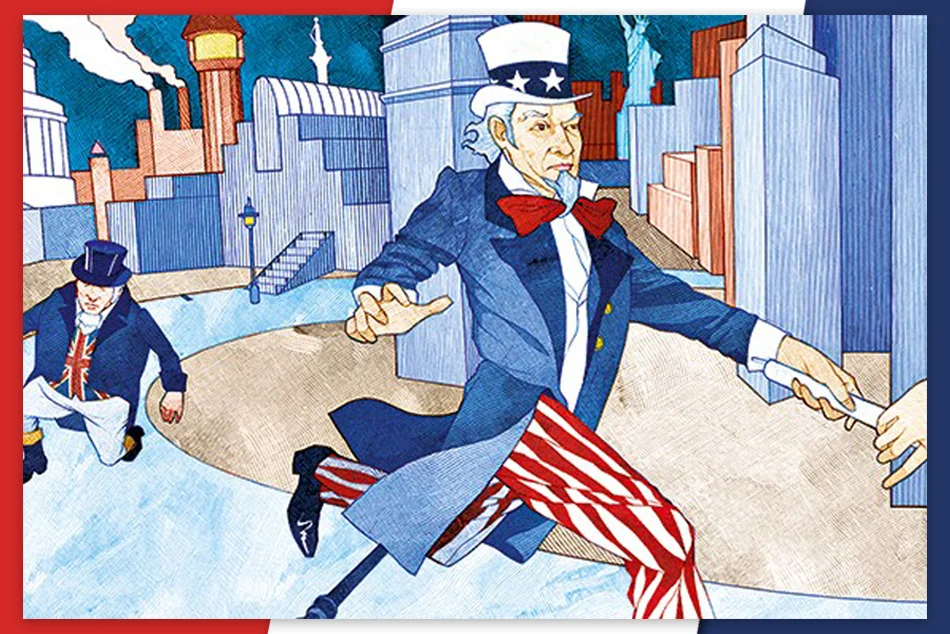
From there, Gross defines hegemony in institutional rather than sentimental terms. Britain held it after Napoleon because of free trade, naval control of the seas, and a strong currency. America inherited it after the second world war through free trade, geographic insulation, open capital markets, and dollar domination. 1
The point is not historical decoration. Gross's investment question is whether the United States is still maintaining the machine that produced those advantages. His answer is mostly no. He says American trade and fiscal deficits have reached roughly 6% of GDP annually over several decades, and he ties that deterioration to a broader erosion of the policies that once supported "Pax Americana." 1
The most important number in the essay is not a market price. It is the Congressional Budget Office projection that U.S. public debt will rise from 101% of GDP in 2026 to 120% in 2036, above the previous postwar record of 106%. 1 Gross calls mandatory health-care and Social Security obligations a fiscal "wrecking ball," and he adds defense spending to the same ledger. The cost of war in Iran, he writes, is likely to exceed the $29 billion already estimated by defense officials. 1
This is where the essay becomes recognizably Gross. The macro argument and the bond argument are the same argument. A state can remain a hegemon only if investors keep treating its liabilities as unusually safe. If investors begin to price those liabilities like ordinary long-duration claims on an overextended borrower, the empire story starts showing up in the yield curve.
The market signal: Gross reads long bonds as a political price
Gross's bond-market evidence is direct. The trade-weighted DXY dollar index had fallen 10% over the prior 18 months, according to his commentary. Thirty-year Treasury yields had risen 0.50 percentage points in three months to about 5.06%. Thirty-year TIPS yielded 2.72%, a real yield up 3 percentage points since January 2022. 1
His interpretation is the part that matters. He does not treat the rise in long real yields as a simple inflation story. He writes that inflation "cannot be the upwards force here," and says the more likely cause is "hegemonic decay and worries over future government liabilities." 1
That is a characteristically Gross move: take a price many investors would file under rates, inflation, or term premium, then read it as a verdict on political economy. The bond market, in this framing, is not only discounting CPI. It is discounting the credibility of the issuer.
There is a second market signal in the essay: tariffs. Gross says the reversal of free trade during the Trump years has shown little effect on the twin deficits, while economic growth is coming mainly from AI-dominated capital spending. 1 That pairing gives the essay its tension. Gross is skeptical of the old American order, but he is also skeptical of the market's current substitute: a narrow AI-led equity boom.
The geopolitical turn: China, then something stranger
Gross brings China into the essay through Xi Jinping's reported reference to the Thucydides Trap in an early May 2026 meeting with Donald Trump. Gross describes Xi as invoking the ancient warning that war can follow when a rising power threatens a ruling power, using the classic Athens-Sparta analogy. 1
In many versions of this argument, the next move would be predictable: America declines, China rises. Gross does not leave it there. He introduces a more unsettling possibility:
"Upon reflection, while China may hope for hegemonic status, another hegemon may replace American and China as well. It goes by the name of AI and its future master(s) has yet to be determined." 1
The typo in "American and China" appears in the recovered text; the thought is clear anyway. Gross is shifting the hegemon question from nation-states to control systems. If the next dominant force is AI, the investor's problem becomes harder. It is no longer enough to ask which country wins. The question becomes who owns, controls, funds, and regulates the systems that will shape productivity, security, and capital allocation.
Gross does not turn that into a bullish AI-stock thesis. He does the opposite. He warns that semiconductor and software prices have been moving in what he calls "casino-like behavior," and he cautions that all of the companies chasing AI dominance cannot win together.
"Remember, these companies can't all go up together in their quest for AI dominance – there's a certain symbiosis but as Schumpeter once averred, capitalism eats its own. Be careful." 1
That line fits Gross's older habit of respecting structural change while distrusting the price investors pay for it. AI may be the next hegemonic force. That does not mean every AI-linked equity is a sound investment.
The portfolio implication: income over excitement
The commentary's investment posture is defensive and income-oriented. Gross recommends low- to mid-P/E securities with yields above 4%, naming CPB, UPS, VZ, and MUC. His cited figures are specific: Campbell's at 9.5 times earnings with a 7.5% yield; UPS at 15 times earnings with a 6.15% yield; Verizon at 9.7 times earnings with a 6.15% yield; and BlackRock MuniHoldings California Quality Fund at a 6.0% yield. 1
The picks are less interesting as a shopping list than as a temperament signal. Gross is not saying the old world is safe. He is saying the new excitement is not automatically safe either. If fiscal strain is pushing long rates higher, if the dollar's privilege is weakening, and if AI leadership is still being fought over, then the investor's first defense is not a grand theory of the future. It is price, yield, and some skepticism about consensus glamour.
This is one of the continuities between the 2007 Gross and the 2026 Gross. In 2007, he tried to see through the reassuring surface of housing and credit. In 2026, he is trying to see through the reassuring surface of hegemony and AI-led growth. The subject has changed. The method has not: look for the balance-sheet claim hidden inside the political story.
What to take from it
The useful part of this essay is not a forecast that America loses hegemony by a certain date. Gross does not give that kind of timetable. The useful part is the test he applies: a hegemon is only as strong as the policies that keep its financing advantage intact.
For long-term investors, that suggests three questions to keep in the margin:
- Are long real yields rising because growth is improving, or because investors are demanding more compensation for fiscal risk?
- Are AI profits broad enough to justify the market's enthusiasm, or are investors pricing several mutually exclusive winners as if they can all dominate?
- Are dollar assets still being treated as a privilege, or merely as the largest available pool of liquidity?
Gross's answer is cautious. The essay's mood is darker than a stock recommendation note and broader than a bond-market update. It is an argument that reserve-currency privilege, fiscal discipline, trade policy, military credibility, and speculative manias belong in the same conversation.
That is why the sentence about the "global credit card" carries the piece. It turns hegemony from an abstraction into a credit line. Investors understand credit lines. They also understand what happens when lenders start asking whether the borrower has noticed the limit.
Cover image: image from Bill Gross — America's Hegemonic Glory is Under Threat.
이 콘텐츠를 둘러싼 관점이나 맥락을 계속 보강해 보세요.